Richard Shank
Columnist
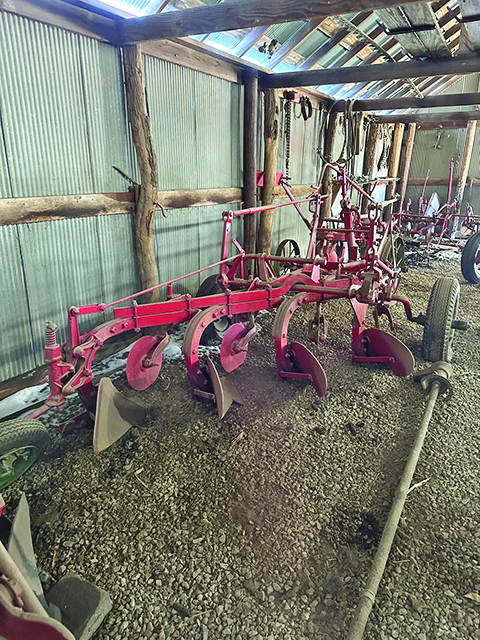
1950, the dawn of the second half of the 20th century, all seemed well on the Shank farm near New Cambria, Kansas, where Ray Shank (my father) was planning to update his farm equipment, including the purchase of an Oliver four-bottom plow with radydex shares and crank levers.
Times were good on the farm during those years following World War II and, perhaps, no one could visualize what was on the horizon in 1951, that being the worst recorded flood in Kansas history, a record that remains to this day.
My dad who entered adulthood in 1929, the start of a time in American history which has come to be known as the “Great Depression” was not one to waste or discard anything, including purchase orders for farm equipment. Recently, Kent Shank, a nephew, was pursuing some of dad’s farm records and came across the purchase order for the plow.
The plow was purchased February 27, 1950, for the hefty sum of $253. Included in the file was a loan document stating dad agreed to pay the full amount plus $7.78 in interest on or before July 15, 1950 or shortly after that year’s wheat harvest. Dad must have kept his end of the bargain as the plow is still in family hands, three quarters of a century later.
In those days, the Shanks lived on a farmstead within 1,000 feet of the Solomon River. On Friday the 13th of July 1951, the worst recorded flood in history, crossed the farmstead and the current was so strong that it took everything not tied down with it. My brother, Ed, a 10-year-old then, remembers the plow which was sitting outside and being washed 150 feet south of the buildings before stopping. When the water receded, Dad retrieved the plow and it was soon back in action.
In those pre-hydraulic days, dad called his new piece of equipment a “trip plow.” In other words, we tied a rope to the back of the frame of the tractor which was then attached to a piece of iron sticking up from the front of the plow.
If all went as planned, the tractor driver would pull the rope and the moldboards of the plow would fall into the ground. To get the plow out of the ground, we just pulled the rope with the tractor going forward and it jumped up in the air. To establish depth, we gave the levers a few turns to the left and then we were ready to plow. From what I remember, it was a lot easier than cranking a tractor to get it started.
Sometimes following harvest, particularly when it did not rain, the soil was hardened making it difficult to get the plow in the ground, no matter how much you cranked the levers. Old-timers, like my dad, could improvise practically any situation and this time he placed a piece of iron weighing approximately 100 pounds atop the plow to help get the plow in the ground. That worked too.
Sometimes the plow became plugged due to intake of heavy straw, which could be a daily occurrence considering the heavy stubble produced by those fertile fields in Ottawa and Saline County. My dad said backing the plow was not an option. His preference for unplugging the plow was to pull the rope and get it out of the ground, and then pull the straw out, one clump at a time. That process ranks as my least favorable memory of plowing the fields of north central Kansas.
Five months after purchasing the plow, Dad splurged and purchased an Oliver 99 tractor, which could take the plow sailing across a field. The 99, still on the farm and running, came with an electric starter, lights and 18 mile per hour road gear and is ranked as one of the greatest tractors from that era.
I fondly remember days while growing up and plowing early in the morning until evening going round and round the fields driving the Oliver 99 and turning over the sod leaving behind what looked like a perfectly manicured field. At the end of the day, this tractor driver went home with the impression that something big time had been accomplished. For this teenage farm boy, life was as good as it gets, considering my mother showed up in the middle of the afternoon with a Pepsi and one of her homemade peanut butter cookies.
Longevity ruled the day for the plow, and with all of Dad’s equipment purchases. His goal was to always “get his money’s worth out of all purchases.”
The plow would go on to turn over wheat stubbles for the next 25 years, until 1976, when it was replaced by a four-bottom, semi mounted plow. Not much monetary value remained on the four-bottom, but dad decided it should remain on the farm and in the family, and it was pulled into a machinery lot where it remained for the next 27 years.
Upon Dad’s death in 2003, I had the opportunity to purchase the homeplace and most of the machinery remaining on the farmstead, including the four-bottom plow. Other than a few trees that had grown up between the moldboards, the old plow still looked pretty darn good. A good clean up and paint job followed and the plow looked like it was ready for an encore performance. Next, we stored it in a machine shed where it remains today.
Recently, on a cold winter day following a blizzard, I opened the doors of a 93-year-old machine shed and peered at a sea of antique implements, a majority of which were Oliver. There is nothing young these days at the Shank farm, including the owner.
The old plow, now 75 years of age, parked inside the shed looked as if it was in repose. A quick check determined the crank levers still turned. The plow is in good company in the old machine shed, which includes an Oliver hay rake with steel wheels, and a spring-tooth harrow purchased near the same time as the plow. Twenty years ago, I was able to purchase a 1930s two-bottom plow that was previously owned by Louie Royal, a neighbor three miles to the south of the Shank farm, and it is parked in the shed too.
All the above-mentioned implements looked as though they could do a day’s work today if called to action. All implements are proof that in Oliver’s heyday, this company manufactured the finest in farm machinery.