
- The New World Screwworm, a flesh-eating parasite, is spreading northward through Mexico, posing a threat to U.S. livestock.
- The USDA has suspended live cattle, horse, and bison imports from Mexico to prevent the screwworm’s entry.
- Kansas lawmakers are supporting legislation to increase funding for a sterile fly program in Mexico to combat the screwworm.
- A screwworm outbreak in the U.S. could devastate the livestock industry, particularly in Kansas, a leading beef producer.
The return of a flesh-eating parasite to Mexico poses a threat to livestock production in the United States, and the Kansas congressional delegation is speaking up and taking action.
The New World Screwworm is rapidly spreading northward through Mexico despite interdiction efforts, according to the U.S. Department of Agriculture. If it reaches the U.S., the results could be devastating for ranchers and the broader economy.
“Due to the threat of New World Screwworm I am announcing the suspension of live cattle, horse, & bison imports through U.S. southern border ports of entry effective immediately,” U.S. agriculture secretary Brooke Rollins said in a May 11 post on X. “The last time this devastating pest invaded America, it took 30 years for our cattle industry to recover. This cannot happen again.”
U.S. Rep. Tracey Mann, R-Kansas, said he was glad to see the response by President Donald Trump’s administration.
“We’ve got to make sure and take every step we can to make sure that it never reaches the United States,” Mann told The Capital Journal on May 15. “Kansas would be dramatically impacted if it ever does, and so I appreciate President Trump and secretary Rollins being proactive in sealing the border to incoming beef while they are working with the Mexican government and others are working to make sure that the outbreak and the scope and size of the outbreak is reduced.”
What is the New World Screwworm?
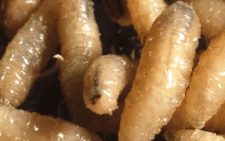
The New World Screwworm is actually a fly but gets its name from its maggot larvae. The female fly lays eggs on a wound or opening, which hatch into maggots that burrow into living flesh of livestock.
“The name screwworm refers to the maggots’ feeding behavior as they burrow (screw) into the wound, feeding as they go like a screw being driven into wood,” according to the USDA’s Animal and Plant Health Inspection Service. “Maggots cause extensive damage by tearing at the hosts’ tissue with sharp mouth hooks. The wound can become larger and deepen as more maggots hatch and feed on living tissue. As a result, NWS can cause serious, often deadly damage to the animal.”
Sterile insect technique eradicated screwworm in US
Known as NWS, the pest was eradicated from the United States in 1966, according to APHIS. USDA scientists in the 1930s and 1940s worked to develop the sterile insect technique, which started being implemented in the 1950s.
Scientists used radiation to sterilize male flies, which were mass produced and released into the wild. When the sterilized male flies mate with a wild female, the result is unfertilized eggs. Over time, the population declines until it is ultimately eradicated.
The insects aren’t modified through genetic engineering.
While the screwworm eradication programs established a barrier at the U.S.-Mexico border, there were recurrent outbreaks in the U.S. The two countries then worked together to eradicate the screwworm in Mexico, pushing the barrier to that country’s southern border by 1986.
For decades, the U.S. has worked in Central America, particularly in Panama, to maintain a biological barrier containing the pest to South America. But NWS detections in Panama started rising in 2023 and the pest has since been re-introduced farther north.
What Kansas congressmen and USDA are doing about screwworm in Mexico
The USDA said effective eradication requires a three-pronged approach of active field surveillance, limiting animal movement and dispersal of sterile insects.
Mann said the U.S. needs to be proactive about the screwworm threat.
“One of the ways they fight against New World Screwworm is by introducing sterile flies into some of these infected areas by the tens of millions,” he said. “That process is underway in southern Mexico and other parts of Mexico. Our government is supporting that, as we should, but let’s make sure that never enters our country.”
Mann said legislation has been introduced in Congress to increase funding specifically for a sterile fly program targeting the screwworm in Mexico.
“We are doing many, many good things,” he said. “We want to make sure that we have the funds available to continue to do those things if and as they’re needed in the future.”
One bill in the U.S. House is co-sponsored by U.S. Rep. Derek Schmidt, R-Kansas, and U.S. Rep. Sharice Davids, D-Kansas. That bill has a companion version in the U.S. Senate. In posts on X, U.S. Sens. Jerry Moran and Roger Marshall have indicated they are monitoring the situation.
The legislative effort, which is being led by Texas congressmen, would provide $300 million to build a new sterile fly production facility in the U.S.
Kansas is a top producer of livestock
Mann said the Big First district is “the No. 1 beef producing district in the country.”
USDA statistics from the 2022 census of agriculture show Kansas’ 1st Congressional District is the country’s top producer of cattle and calves, with about $11 billion in sales. That contributed to the Big First being the top producer in the entire livestock and poultry category, with a market value of nearly $13 billion.
Statewide statistics put the cattle and calf industry in Kansas at nearly $14 billion in sales in 2022, which was second in the country behind Texas. The state’s nearly $16 billion total for livestock and poultry was fourth in the U.S.
“We got to make sure that the New World Screwworm — and other diseases — don’t enter our country,” Mann said. “Because it would devastate our herds, devastate our feed yards. Very large negative impact to our state if we ever saw a large outbreak.”
A screwworm outbreak could be devastating
The USDA estimated as of 1996 that eradication of the screwworm provided an annual economic benefit of $796 million to producers and $2.8 billion to the broader economy.
The USDA in January performed an economic analysis of a 1976 screwworm outbreak in Texas. About 1.5 million cattle were infested in that outbreak, in addition to other livestock.
The USDA said “an NWS outbreak roughly the scale of the 1976 outbreak could cost Texas producers $732 million per year and the Texas economy a loss of $1.8 billion.”
While a new outbreak in the U.S. could be devastating, the federal government was able to quickly respond to an outbreak nearly a decade ago. That re-emergence in the Florida Keys in October 2016 was controlled using a release of sterile flies, which had the screwworm successfully eradicated by March 2017.
That was the first local infestation in the U.S. in more than 30 years.
As reported in the Topeka Capital Journal
Share



Read more

