Richard Shank
Columnist
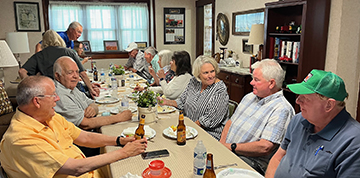
A reunion at the Shank farm near New Cambria with 11 contemporaries from days spent as a Southwestern Bell Telephone/AT&T Managers was both nostalgic and fun, which prompted preliminary plans to meet again in Topeka in December.
The combined service of this group exceeds 250 years during turbulent times in the telecommunications industry. Needless to say, there were plenty of stories to swap providing reaffirmation this group was a true team, dedicated to working together to support the fortunes of an appreciative employer.
My first day on the job, January 2, 1980, at the Southwestern Bell offices in Topeka, today seems like a time in the dark ages, although we all thought everything was high tech during that period of time.
In February 1980, Senator Ted Kennedy flew to Topeka for a speech to a group of supporters. After touching down in the capital city, Kennedy realized he had left his speech behind in Washington, D.C. A frantic aide called Ross Markwardt, my boss at the time, and asked for help. As it turns out, Southwestern Bell was one of a few that had a fax machine in those days. Ross went to the office and watched as Kennedy’s speech was transmitted over the phone line one page at a time and the story had a happy ending.
In the 1980s, there were 34 mobile phone customers in Hutchinson. Today, there are, perhaps, 15,000 cellular phone customers, so times have changed.
The origin of the telephone is a story in itself. Quite by accident, Bell invented the phone in 1876 while attempting to develop a mechanism for the deaf to better communicate. Few, at the time, thought the telephone would become a part of American life. An editorial published at the end of 1876 reported the two most significant events from that year were Custer’s last stand and the centennial of the Declaration of Independence.
The perception soon changed and Bell, who lived until 1922, never allowed the installation in his office, as he considered it a nuisance to getting work done.
Everyone at the reunion looked happy and healthy, with talk of grandchildren, foreign vacations, and golfing being the most common topics of the day.
My intro to Southwestern Bell was in a position called “Science Demonstrator,” which entailed traveling Missouri and Kansas delivering a presentation of how technology would change in coming years. During my first four- and one-half years, I spoke to civic clubs and anyone else that cared to listen. Employees jokingly called the job “the dog and pony show.”
It was a gratifying job in that I heard all the positives of the company and, on occasion, the negatives. Pulling into the Sonic Restaurant drive-in in Iola for a late lunch one afternoon, the old company Ford I was driving experienced some mechanical issues and the brakes ceased to function. Soon I was coasting up to the side of the eating establishment stopping within inches of hitting a brick wall. The manager, walked out and commented, “your brakes work about as good as our phone system.”
I was in no position to disagree and then the Sonics Manager who then laughed and offered to assist with my predicament.
In 1983, the AT&T phone system was one big happy monopoly and few were complaining. Then, Federal Judge Harold H. Greene issued an order requiring AT&T system be divided up into what was called AT&T and seven “baby bells,”
with Southwestern Bell being one of them. The term used to define this break up was “divestiture,” a word spoken daily for years to follow.
January 1, 1984, the telecommunications world was turned upside down although Southwestern Bell would be a stand-alone company.
I was off the road and sitting behind a desk on what was called “state staff.”
Early in my career, a few old-timers in the business provided some savvy advice, all of which proved accurate. One told me that in the phone business, you will be a PFC prior to being a colonel which I presume meant prepare to work your way up the ladder. Another said be nice to everybody as you never know who your next boss might be.
During my days traveling as the Science Demonstrator, I visited Joplin, Missouri, for a week of speeches to local groups. The Joplin Manager was a young man named Shawn McKenzie who looked all of 16 years old. Driving around town with Shawn, I almost wanted to ask, “when will you graduate from high school?” but did not. Actually, we really hit it off and glad we did.
Five years later, sitting at home one evening, the phone rang and the caller was Shawn. He recalled our meeting in 1984 and then said, “I will be your new boss.”
Naturally, I said great and during the 12 years to follow, would work twice for Shawn, and admire him greatly. He is one person I would like to see again, and hope to make that happen soon.
One of my favorite responsibilities while on state staff was scheduling the company’s president for his travels across Kansas. One of the presidents was a man named Ed Whitacre, a Texas born towering figure standing a six foot five inches with a deep voice. When he spoke, everyone listened.
One day Mr. Whitacre asked me to schedule a trip to Colby in the state’s northwest corner. The Colby Southwestern Bell manager decided to shake things up a little and borrowed an old Cadillac convertible to drive Mr. Whitacre around town. Mr. Whitacre, an engineer by profession with a serious demeanor probably would have preferred a pickup truck or anything but a convertible.
The following morning, by coincidence I was in the elevator with Mr. Whitacre, and he gazed at me with a stern look before saying, “you did me no favors when you sent me to Colby” and then walked around the corner to his office.
Fortunately, for all parties concerned, not a word was spoken again about the incident. Mr. Whitacre went on to serve and President and CEO of AT&T and, following retirement, revived the fortunes of General Motors as head man for that company.
In 1988, a move to Hutchinson for a position called Community Relations Manager, a name later changed to External Affairs Director, provided the opportunity for me to know and work with those attending the recent reunion.
We all traveled the highways and byways of Kansas working with the communities served by Southwestern Bell. During the winter months, we all descended on Topeka to push the company’s legislative agenda.
Some called us Governmental Affairs Representatives but most referred to us as lobbyists. A 1994 editorial in the Wichita Eagle called this contingent “an army of lobbyists” and even printed an unflattering cartoon of the group.
Then, we made trips to Washington, D.C. where we became acquainted with a new Congressman named, Jerry Moran, now the state’s Senior Senator.
A former president of Southwestern Bell/Kansas called these jobs the best in the company and that they were, which is why in part I look forward to our next gathering.