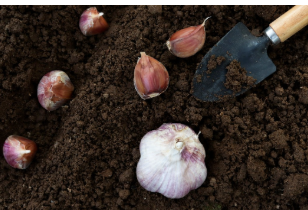
Fall is the ideal time to plant garlic. If you want large, flavorful bulbs next summer, planting in early October gives garlic time to establish roots before the ground freezes. Later fall plantings are possible, but yields tend to drop off. Planting in spring almost always results in much smaller bulbs and reduced yields.
Choosing the Right Variety
Garlic comes in two main types:
- Hardneck varieties are best suited for Kansas. They produce sturdier stalks, often large cloves, vivid paper skins on the cloves, and a wide range of flavors from mild to sharp. Many hardnecks also send up flowering stalks (“scapes”) in spring, which are tasty and useful in the kitchen.
- Softneck varieties (such as Silverskin or Artichoke types) include the kinds you often find at the grocery store. They are less suited to our climate in Kansas and typically don’t form a scape.
Some hardnecks adapt especially well to cold winters and cool springs; others are more tolerant of milder winters. Your location and winter severity will affect which variety works best for you.
Planting in the Fall
Garlic thrives in well-drained, fertile soil, ideally a sandy loam with a pH between 6.3 and 6.8. Before planting, loosen the soil and mix in compost; add phosphorus if a soil test shows deficiency. Break bulbs into individual cloves just before planting, leaving the papery skins intact, and set them about two inches deep with the pointed end up. Space cloves roughly six inches apart, with 12 inches between rows—or closer in raised beds. Water thoroughly after planting and apply mulch such as straw or leaves in late fall to protect the cloves through winter.
Caring for Garlic Through Harvest
In spring, remove mulch once frost has passed so the soil can warm, then feed with compost or a balanced fertilizer. Keep the bed weed-free and evenly moist, as garlic has shallow roots and struggles in competition or drought. Hardneck varieties will send up scapes in late spring—clip them off to encourage larger bulbs.
Garlic is ready for harvest from late June to mid-July, when about half the leaves have yellowed. Stop watering once three or four leaves have died back. Loosen the bulbs gently with a fork, cure them in a shaded, airy spot for two to three weeks, then trim the roots and cut stems back to about an inch. Store in a cool, dry place with good air circulation; mesh or paper bags work well. Properly cured garlic can keep for months, with refrigerated storage extending usability into winter.
Check out K-State Extension Sedgwick County’s publication on Growing Garlic (https://www.sedgwick.k-state.