There are mint patties, hamburger patties, and cow patties — all appropriate in their own time and place. But in this time and place, we think mostly of St. Patty’s.
St. Patrick’s Day comes every year on March 17. Immediately images of shamrocks and a green-robed red-haired man come to my mind, plus possibly some corned beef and a few suspect leprechauns. It’s my sister-in-law’s favorite holiday, so I know we’ll be rifling through the kids’ drawers to find them some green clothes. Family Sunday lunch before The Tuesday will be themed green, I have zero doubt.
I like all these things. While green beer, dying the Chicago river green, and the idea of kissing people because they’re Irish might turn me a little green, moderate and intentional participation in holidays, especially ones recognized by the liturgical calendar, can be a valuable practice.
And valuable not just because I’m planning on making a minty shamrock shake on the 17th — St. Patrick loved those, right? Valuable because grounding ourselves in history reminds us this present moment is not all there is, because honoring the legacy of people from the past can keep those ethics in sight for the future.
Yet while I clearly love eating my greens, it’s apparently a little ironic that we put up the greenery for St. Patrick.
First, it’s easy to forget that Patrick was not Irish. At least not by origin; he was in fact British, introduced to Ireland by the unfortunate and unpleasant means of being sold as a slave after being kidnapped by Irish pirates. Just a teenager at his abduction, Patrick spent six years as a shepherd for a Druid chieftain, during which time his parents’ faith in Christ became his own, obvious to such an extent that he was nicknamed “Holy Boy” by his fellow slaves.
One night he had a dream that the ship to return him to Britain was waiting for him, so he escaped and walked the two hundred miles to the coast, where indeed a ship and crew accepted him aboard. Eventually Patrick made it back to his family, I assume with no plans of ever leaving again.
But after several years, and studying to be a priest, he had another dream: this time of a man delivering a letter with “the voice of the Irish,” begging the “holy boy” to come back and walk with them again. Nobody thought it was a good idea for him to leave, especially considering his previous experience in the Emerald Isle and the torture typically imposed on Druids’ escaped slaves; the reception wasn’t exactly lucky charms upon his willing and selfless return to Irish soil, either.
Though Patrick was often opposed in his travels across Ireland, from poisoning to imprisonment to enslavement, he continued to bravely teach people how to read and write, and about the light of the world. He shared Christ for about thirty years before his death on March 17, 461, during which time he established many monasteries, churches, and schools.
Though never officially canonized as a saint by the Catholic church since he died before that process was established, St. Patrick is recognized as the primary patron saint of Ireland (and Nigeria, and engineers!). Though we don’t know if he actually used the shamrock as a way to teach the Trinity, or if he drove all the snakes out of Ireland, St. Patrick didn’t need to be Irish to bring light to Ireland.
And, even if he had been, he wouldn’t have been all about the green. Blue was more a traditional Irish color than green until the last century, and there is no official country color; and in fact, there is a certain sky blue known as St. Patrick’s blue.
All that said…we’ll still be pulling out the green over here.
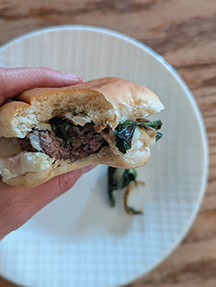
St. Patty’s Melts
Yes, I had to. Ireland is known for good dairy, so a good hamburger with a thick slice of cheese — topped with some green of course — seemed fitting, even beyond the name pun. The bread for a “real” patty melt is typically toasted rye or sourdough, but I know my family, and regular hamburger buns are preferred. Irish cooking doesn’t use so many spices, so these are simple, yet solid. I’m lazy about getting the grill out, and these are a quick and easy way to get burgers on the table, good too for this capricious winter/spring/wind weather we are in.
Prep tips: pull in the Irish blue with the addition of crumbled blue cheese in the spinach bit.
good butter
1 large onion, sliced
several handfuls fresh spinach
1 pound ground beef, formed into 4 thick patties
4 thick slices sharp white cheddar, preferably Irish of course
4 hamburger buns (or 8 slices toasted bread)
Heat the butter in a cast iron skillet, and add the onions with a pinch of salt, cooking until browned. Stir in the spinach until fully wilted, then remove from skillet. Add another knob of butter over medium-high heat, then arrange the patties in the skillet, pressing them down until about ½” thick. Season liberally with salt and pepper, and flip over once the bottom is nicely browned. Season the new top sides, top each with a slice of cheese, and cook to desired doneness (i.e. not very, if you’re Brian). Serve in the buns with plenty of the sauteed spinach.