Amanda Miller
Columnist
Lettuce Eat Local
Instantly I think of that incomparable sound of a mouse chirp, as it skitters along inside the wall or darts across the driveway — a rodent squeak that often elicits a human squeak in response. A similarly disconcerting squeak might be coming from an unidentified source in the vicinity of the car engine or pipes under the sink. A bicycle chain or a screen door might squeak in its plea for a good oiling, as might a rusty wagon wheel. My daughter has a pretty good squeak-squawk in response to her brother pestering her.
Some squeaks, however, are just right. While they’re hard to categorize, lots of the squeaky sounds my kids make when they see kittens, cousins, or Daddy are the kind you want to bottle up and save forever. While the squeak I’m segueing to is technically of a less endearing nature, it is hard to hear it and not feel a tremor of happiness.
It’s the cheese squeak! If you’ve never had squeaky cheese, you’re missing out. It literally squeaks in your mouth as you chew, which can be quite unnerving if you aren’t expecting it but equally somehow very endearing. Cheese with this audible personality is not a specific type, but rather has certain age and pH characteristics: lower in age and acidity.
Most people probably associate squeakiness with cheese curds, which is an ambiguous category in itself, since almost all cheeses start off as curds. What’s marketed as “cheese curds” typically refers to small, nubby pieces of any type of unaged/baby cheddar — so renowned for their distinctive sound that they are also known colloquially simply as squeaky cheese.
The sound is actually a working scientific collaboration between your teeth and the molecular structure of the cheese. According to Wisconsin Cheese, “cheese curds are made up of proteins that are bound together with calcium. When you bite into a cheese curd, this protein and calcium structure rubs against the enamel on your teeth, making a squeaking sound.” After a few days, cheese loses the ability to squeak as the protein-calcium bonds break; it tastes the same, just doesn’t sound the same.
Other cheeses that have a similar protein structure might also provide a squeak-symphony. Fresh mozzarella, bread cheese (juustoleipӓ), panela, and halloumi are a few options from around the globe. Fortunately, “squeak” seems to be pretty relatable in any language, and we don’t even have to traverse the globe to experience it ourselves. I was catering a Mediterranean islands themed workshop recently, and may have squeaked in preemptive excitement at the excuse to make some halloumi, a Cypriot culinary all-star and “marvel of the cheese world.” One of its most distinctive qualities is its ability to withstand high heat without melting, and in fact grilling or pan-frying halloumi are some of the most common ways to enjoy it — its caramelized, crispy exterior and warm, squeaky center is wonderful.
Halloumi has a long history, mentioned in literature from the 1500s but likely with centuries of usage before then. Authentic halloumi was traditionally made exclusively with sheep and goat milk (since those animals could traverse the island’s mountains better than bovines), and now has Protected Designation of Origin, meaning it has to be made in a certain part of Cyprus. So what I made in my kitchen in Kansas with all cow milk wasn’t “real,” but it was very tasty, and very squeaky.
Now if I could just get Kiah to see a chicken and her grandma at the same time as she chews on some halloumi, we might have squeaky perfection.
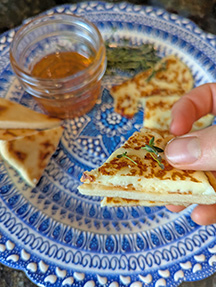
Halloumi Grilled Cheese-adilla
A cheese squeak has no language, so I can mix Spanish and Greek, right? Although quesadilla means “little cheese,” so I guess it is inappropriate since the cheese is not little here. Normal grilled cheeses with the cheese in between bread is good and all, but I figured if you can grill halloumi it might as well be the one to sandwich the bread! The texture of the halloumi when raw could be considered rubbery, but at least to me in a positive way; when warm and pan-fried, it might still be a bit rubber-esque, yet now with that beguiling squeak. Thyme honey is a common pairing with all sorts of cheeses in Cyprus, deliciously blending the line between savory and sweet.
Prep tips: I can’t include the recipe for halloumi here since it is too involved, but you should be able to find either halloumi or similar “bread cheese” at a larger grocery store or Aldi.
halloumi, sliced about ¼” thick
coarse salt
soft pita
local honey
fresh thyme
Heat a skillet over medium heat, then lay in a couple pieces of halloumi with enough space so they don’t touch. Sprinkle them with salt, and sear until they start caramelizing in spots; flip and sear the other side. Warm the pita, drizzle with honey, and sprinkle with thyme. Cut in pieces to match the halloumi if you can, then sandwich it between the pieces of fried, squeaky cheese. Eat right away.