Richard Shank
Columnist
Readers have asked what happens on a farm between completion of the wheat harvest and cutting the fall crops of corn, milo, and soybeans. The answer is that one is never caught up on the farm and there remains plenty to do at all times.
On July 23, I traveled back to the farm near New Cambria in Saline County to check things out.
Unlike most hot days in North Central Kansas during July, the ground was damp and wet following 1.7 inches of rain from the preceding three days.
The ears of corn on an 80-acre field south of the homeplace were bulging in the stocks, which must mean we will have a corn crop fall, but it is too early to predict the yield. A crop of lush-looking soybeans surrounds the homeplace as we and our neighbors hope for a couple more rains to seal the deal on the crop.
At the entrance to the Shank farm, the road switches from sand to dirt, which makes one wonder why anyone would drive the path after a heavy dew let alone a substantial rain. No one seems to agree with me on this one. I had no more than parked my pickup when a vehicle drove north of the entrance, creating a track deep enough to bury a cat.
A check of our small garden showed the pumpkin patch is starting to produce bright orange produce suitable for conversion to pumpkin pie, which was a major dessert item during my growing up years. Thanks to modern refrigeration, the pumpkins can be frozen and thawed out for Thanksgiving dinner.
Lunch with an old friend in nearby Bennington seemed like a great noon time break. Census figures list Bennington’s population at 641, and driving down the one block Mainstreet, it looked like a couple dozen pickups were parked by those eating a noon time meal at Westside Ventures, a restaurant/grocery store combination.
Inside a sea of area farmers seemed cheerful for the recent rains, in spite of low grain prices.
Westside Ventures can leave customers with a full stomach, and for those wanting to catch up on the local news, the Minneapolis Messenger is sold here for a meager $2.
Back at the farm, a deputy from the Saline County Sheriff’s office on patrol of our neighborhood, stopped to visit. Those who reside in rural Saline County appreciate Sheriff Roger Soldan’s commitment to areas outside Salina.
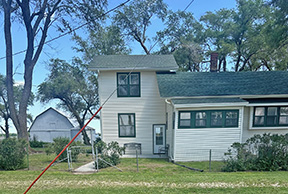
Walking past the house where I spent a part of my formative years, was a little nostalgic. To put the house in perspective, the east two-thirds of the house is observing a 125th birthday this year. According to the Saline County Assessor’s office, the original house was built in 1900. Nineteen years later, Dr. Isaac Culp, a retired doctor who owned the place at the time, added an addition, which we call the “West Wing,” being a master bedroom and upper-level room.
Then, in 1920, Dr. Culp added a barn, which remains to this day. The barn sits on the north side of the farmstead and one cannot imagine how much north wind it has endured for more than a century.
When non-tornadic winds struck the farm in 2022, the old barn endured the wrath of a bad storm. On the other hand, three structures less than 20 years old, within feet of the barn, lost roofs.
Driving the highway and byways of Kansas, I often see dilapidated old barns leaning waiting for the next gust of wind to take it down. Occasionally, you can pass a totally restored barn that, perhaps, looks better than it was when new.
Gary Johnson, a neighbor to the west of the Shank farm did a perfect job restoring his barn, which adds beauty to the old neighborhood.
Bill Came, Jr. who farms the Shank spread, was busy mowing the road ditches on the land he farms, a perk appreciated by all landowners.
With more than 60 trees on the farmstead, I have yet to visit the homeplace when there weren’t limbs on the ground, and this day was no exception.
Fifteen years ago, we parked three antique implements on the farmstead. I guess we could call this yard art, but each was a part of early 20th century agriculture. When I saw a Krause one way plow at an estate sale, the asking price of $40 was hard to resist. After all, on the front was emblazoned, “Made
In Hutchinson, Kansas.”
Then, we have an old disk with no wheels underneath it, meaning it was manufactured before 1960.
When Lloyd Craig, Publisher of the Winfield Courier, offered to give his dad’s sulky rake to the farm, my brother-in-law and I drove to Cowley County to pick it up, making a long-term display at the farm.
The next trip to the farm will be allocated to mowing approximately three acres, which make up the farmstead. Whoever invented the zero-turn lawnmower made this job easier and is deserving of kudos.