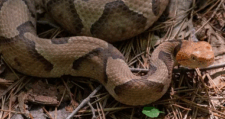
What types of venomous snakes slither around in the Sunflower State?
The copperhead and massasauga rattler are among four native venomous snakes present in Kansas, with the others being the prairie rattlesnake and timber rattlesnake, said the website of the Kansas Department of Wildlife and Parks.
“Western diamond-backed rattlesnakes were introduced, but are not widespread and have been recorded in only a few central-Kansas locations,” that site said.
It said another type of venomous viper, the northern cottonmouth, is “rare” in the Sunflower State, as only two specimens having been recorded — both in the Spring River drainage area in the state’s southeast corner.
Venomous snakes in Kansas all share this distinctive feature
The KDWP website said all venomous snakes found in Kansas are pit vipers, meaning they have heat-sensitive pits in front of each eye to help locate prey.
- Kansas is home to four native venomous snakes: the copperhead, massasauga rattlesnake, prairie rattlesnake and timber rattlesnake.
- All venomous snakes in Kansas are pit vipers, possessing heat-sensitive pits to locate prey.
- If bitten, keep the bite below heart level and seek immediate medical attention; do not apply a tourniquet or attempt to remove venom.
- Snakes are an important part of the ecosystem and are generally shy unless provoked.
The pain was excruciating when a venomous snake bit Grady Kornelson in 2018 in south-central Kansas.
“On a scale of one to 10, it was a nine,” he told the Hutchinson News.
Kornelson received five doses of antivenom and spent a weekend in a hospital after being bitten on a forearm as he was getting out of the water just after dark on a Friday in a cove at Cheney Reservoir.
Hospital staff told Kornelson he’d been bitten by a copperhead, though a Kansas Department of Wildlife and Parks official suggested it may have instead been a massasauga rattlesnake.
What types of venomous snakes slither around in the Sunflower State?
The copperhead and massasauga rattler are among four native venomous snakes present in Kansas, with the others being the prairie rattlesnake and timber rattlesnake, said the website of the Kansas Department of Wildlife and Parks.
“Western diamond-backed rattlesnakes were introduced, but are not widespread and have been recorded in only a few central-Kansas locations,” that site said.
It said another type of venomous viper, the northern cottonmouth, is “rare” in the Sunflower State, as only two specimens having been recorded — both in the Spring River drainage area in the state’s southeast corner.
Venomous snakes in Kansas all share this distinctive feature
“Venomous snakes are generally shy and aren’t looking for a fight, but they will bite in self-defense if you step too close, step on or provoke them,” the KDWP website said.
It said venomous snakes tend to be well-camouflaged, “So watch where you walk, and don’t go barefoot or wear flip-flops or sandals, even on established trails or around campgrounds.”
Many people each year are bitten by harmless snakes “and experience nothing but small scratches that readily heal,” said “A Pocket Guide to Kansas Snakes.”
The guide — written by Joseph T. Collins, Suzanne L. Collins and Travis W. Taggart — is on its sixth edition after initially being published in 2011.
What should you do if a venomous snake bites you?
Deaths from snake bites in the Sunflower State are rare, the pocket guide said.
“There is only one documented fatality in Kansas since 1950,” it said.
The KDWP website encourages anyone who thinks he or she has been bitten by a venomous snake to “keep the site of the bite quiet and below the level of your heart.”
The pocket guide encourages those in that situation to stay calm., treat for shock and go by vehicle to the nearest hospital or other medical facility.
It said such victims must NOT do the following things:
- Use a tourniquet. If the tourniquet is tied too tight, that may cause the loss of a limb.
- Make cuts through or near the site of the bite.
- Try to suck venom from the site of the bite, as “You might have a tooth cavity or gum sore and this would place venom into that wound.”
- Allow antivenom to be administered to them unless they first get tested to determine if they’re allergic to it.
- Try to kill or capture the snake, as that would only give it another chance to bite.
Killing or capturing the snake is also unnecessary, the KDWP site said, “because a single type of antivenom is used to treat all pit viper bites in the U.S.”
When and where do snakes hang out?
Kansas is home to 42 different native species of snakes, which are active during the warmer months between late March and November — the same time period when people are most active outdoors, the KDWP website said.
“Most snakes are found in rural or semi-rural areas where there is suitable habitat and prey,” it said. “They may be found in woodlands and shrubby areas; brush, log or rock piles; around water; in tall grass; around rocky outcrops or ledges; or even under ornamental shrubbery and gardens.”
Snakes are a vital part of the food chain, the pocket guide said.
“They are small, shy animals that are frightened by people,” it said. “Understanding their role in nature and their unassuming presence are vital to dispel the myths and fears people have of snakes.”
Snakes can’t regulate their body temperature internally, so they’ll be more active at night during times of hot weather, retreating to shady areas or under rocks and logs during the day, the KDWP website said.
“When it’s cooler, they tend to be more active during the day,” it said.
What’s the largest rattlesnake in Kansas?
The venomous timber rattlesnake is found in the eastern fourth of the state, the KDWP website said.
The timber rattler is the largest rattlesnake in Kansas, capable of growing up to 5 feet, 3 inches in length, the pocket guide said.
That species feeds on small mammals and smaller snakes, it said.
Prairie rattler feeds on lizards, mice, rats, pocket gophers
The prairie rattlesnake is found in the western half of the state, the KDWP website said.
It is capable of growing up to 4 feet, 9 and a half inches long, the pocket guide said.
It said the prairie rattler feeds on lizards, mice, rats and pocket gophers.
Massasauga rattler is the state’s smallest rattlesnake
The massasauga rattlesnake is found in the eastern two-thirds of the state, the KDWP website said.
It is capable of growing up to 2 feet, 9 and a half inches long, the pocket guide said.
It said the massasauga rattler feeds on frogs, lizards, rodents and other snakes.
Copperhead is particularly fond of rodents
The copperhead is found in the eastern third of Kansas, the KDWP website said.
It is capable of growing up to 3 feet, 4 inches long, the pocket guide said.
It said copperheads are particularly fond of rodents but also feed on insects, frogs, toads, lizards, small birds and other snakes.
As reported in the Topeka Capital Journal