The death of a 6-year-old Kansas boy highlights deadly hazard allowed on county roads.
TURON, Kan. — A dangerous road hazard banned from U.S. highways more than 30 years ago remains legal on rural roads across the country, where it continues to cause deadly crashes.
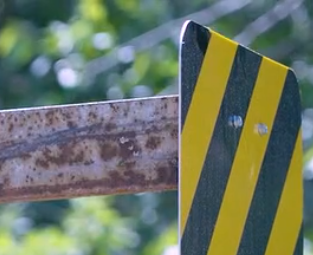
Blunt-end rails — single fixed pieces of steel with nothing on the ends to cushion vehicles — can spear cars at speeds as slow as 10 miles per hour, according to safety experts. The Federal Highway Administration ordered them removed from all U.S. highways in 1994, but the agency lacks authority to mandate changes on state and county roads.
Six-year-old Cameron Paul Epp died in rural Kansas after being impaled by one of these rails while riding in a truck with his mother and sister. The family was driving home from the store, just half a mile from their house, when the crash occurred.
“I looked back, one hand on the wheel, and I said, ‘Hold on, bud, we’re almost home’ and then I hit the bridge,” Cayla Epp, Cameron’s mother, said. “I remember seeing the tip of the guardrail come through, and I saw the airbags go off. It speared the front seat through the window and took him with it.”
Built as barriers for horses and buggies
Ronald Faller, a research professor at the Midwest Roadside Safety Facility at the University of Nebraska, said fatal crashes into non-crash worthy fixed objects like blunt-end rails occur nationally every day or every week.
“It’s really not designed as a crash-worthy barrier system at all,” Faller said.
He said the rails were originally built as barriers for horses and buggies, and even as cars became more common, the rail designs did not change.
Faller said these rails are not uncommon on lower volume rural roads throughout the United States. Counties often lack money to install safer, more expensive infrastructure.
“Maybe five or 10 miles an hour might be something that you would take a chance on. I’m not sure I’d want to do 10 on the side either,” Faller said when asked about safe speeds for crashes into the rails.
The speed limit on the road where Cayla Epp crashed was 45 miles per hour.
Solution requires funding and education
Faller said most rural counties do not know how dangerous these devices are, but solutions exist.
“Really what can be done is try to raise funds, for one, for state DOTs and counties to be able to afford safety improvements. And then two, it’s educating and training for the engineers around the United States, city level, county level,” he said.
Faller said they have had success in Nebraska, where state funds helped replace dangerous old rural road infrastructure. Without help from states, he said these dangerous devices will remain.
The Epps said a day after Cameron’s death, the bridge rail was replaced with another blunt-end rail.
“To put the same exact one up, it’s kind of a slap in the face and it’s very disrespectful to my son,” said Brian Epp, Cameron’s father.
The Epp family drives by the rail every day, a constant reminder of their loss. They hope Cameron’s death can prompt changes to rural road safety.
“Make a purpose out of this. It’s the ultimate cost — his life. Let it be known that this is a deal, this is an issue,” Brian Epp said.
Multiple calls over months to the Reno County, Kansas Public Works Department, which oversees the stretch of road, were not returned.
Faller said most counties are allowed to do “replace in kind” repairs, meaning if a railing is damaged, they can replace it with whatever was there, even if it’s dangerous.
He said the bridge where Cameron died would be better off without a barrier.