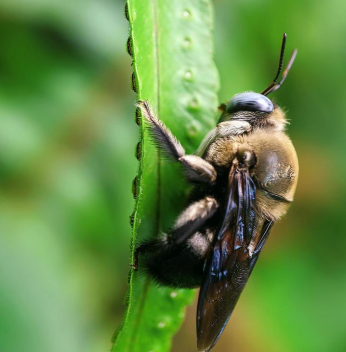
Carpenter Bees
Description: Carpenter bees resemble honey bees however; the abdomen of the honey bee is covered in hairs while the carpenter bee abdomen is smooth and shiny. Female carpenter bees have a black face and a stinger, though they tend not to sting unless provoked. Males have a white face and no stinger.
Life Cycle: The life of a carpenter bee lasts one year. Adults overwinter in tunnels they bore into wooden structures. In late spring adults emerge to mate and lay eggs. Female carpenter bees make “bee bread” by combining pollen with nectar. The bee bread is inserted in one of the tunnels and females lay an egg on top of it. That section of the tunnel is sealed and the process is repeated six to ten more times. Larvae hatch from the eggs and reach maturity in five to six weeks. During late summer/early fall the mature bees emerge from the tunnels to eat for a short time before overwintering.
Damage: Carpenter bees are reliable pollinators but can be very destructive. Their tunnels are about ½-inch in diameter and five to six inches long through wooden decks, awnings and siding. The secondary damage can be even more destructive as woodpeckers peck gaping holes in the wood in search of the larvae.
Control: Carpenter bees tend to prefer soft, unpainted or weathered wood at least a couple of inches thick. Insecticides can be used to treat openings. Sevin can be applied inside the tunnels as a spray or dust. Apply on a cool night when the bees are more likely to be inside their tunnels. Treatment will need to be reapplied after one to two weeks. Carpenter bee traps can be effective for smaller populations, but to control larger populations many traps will be required for any control.
Japanese Beetles
Description: Similar in appearance to other June bugs, the adult Japanese beetle is 1/4 to 3/8-inch long with a shiny, metallic-green head. The body has bronze wing covers and five clumps of hair that border the sides of the abdomen. The larvae are cream-colored grubs with a light brown head about 1 ¼-inch long at maturity.
Life Cycle: Adult female Japanese beetles lay eggs in July beneath wet lawns. Upon hatching, larvae feed on the sod roots and overwinter until the following summer. In June, the larvae pupate and adult beetles emerge to feed above-ground.
Damage: An extremely destructive pest, Japanese beetles feed on every part of the plant. The beetles skeletonize leaves and consume flowers and fruit entirely. Hundreds of varieties of plants can play host to this non-selective pest.
Control: Controlling Japanese beetles is a challenge this time of year as new adult beetles emerge from underground daily over several weeks. In small quantities, beetles can be manually removed from plants and dropped into a bucket of soapy water. Check plants daily to look for symptoms. Mornings are the best time to observe as beetles are slower and easier to catch.
There are many traps available that lure Japanese beetles into a container where the pests can be gathered and disposed of. However, some sources caution against using traps as the pheromones used to attract the beetles can draw in even more beetles than would naturally appear. Not all of these beetles may end up in the traps and the result could be greater damage to the plants.
Contact your local Extension agent for recommendations on chemical control options.
Blister Beetles
Description: There are several varieties of blister beetles. Colors vary including solid black, black with a gray or cream-colored band, and grayish-brown with yellow stripes. The relatively soft body can be up to one-inch long. They have a broad head with a narrow neck-like structure attaching it to the rest of the body. The wings are soft and the mature adult has long legs. The antennae are about 1/3 the length of the body.
Life Cycle: Adult blister beetles lay masses of eggs in the soil during late summer. When the larvae hatch, they search for nests of grasshopper eggs and begin feeding on them. Throughout several molts the larvae develop more prominent legs. The late-stage larvae are the most active and leave the grasshopper nest to pupate underground the following summer. The adult emerges 10 to 20 days later. There is one generation per year.
Damage: Blister beetles feed primarily on flowers but will consume leaves as well. Though damage can defoliate a plant entirely, blister beetles can also be great natural predators against grasshoppers. The name blister beetle is derived from the oily substance the insect emits, cantharidin, that is toxic and can leave blisters on human skin if it comes in contact.
Control: If removing manually, wear rubber gloves to protect the skin from blistering. Chemical control may be necessary for large populations. Contact your local Extension agent for support.
Budworms on Garden Plants
Description: Budworms can be brown, purple, red or green depending on the host plant it’s consuming. It has white stripes on the abdomen that run the length of the 1 ¾-inch body. There are hairs on the body as well. Adult moths are greenish-brown with a
wingspan of about 1 ¼-inches.
Life Cycle: There are two generations of budworms each year with the second generation typically being the more destructive. The pupae overwinter several inches beneath the soil surface during mild winters outdoors or in container plants that are brought indoors as well as in the soil of protected patios.
Damage: Budworms are common on petunias, geraniums, nicotiana, roses and other
ornamentals. The larvae bore a hole through the flower buds and feed on the petals. Buds may drop prematurely or, if not, the resulting bloom will show damage from the feeding. Larvae also drop black feces on the buds.
Control: Manual removal can be effective if plants are monitored regularly. Winters with
temperatures that drop below 20 degrees F can kill overwintering pupae if they are not in protected environments.
Contact your local Extension agency for recommendations on chemical controls.