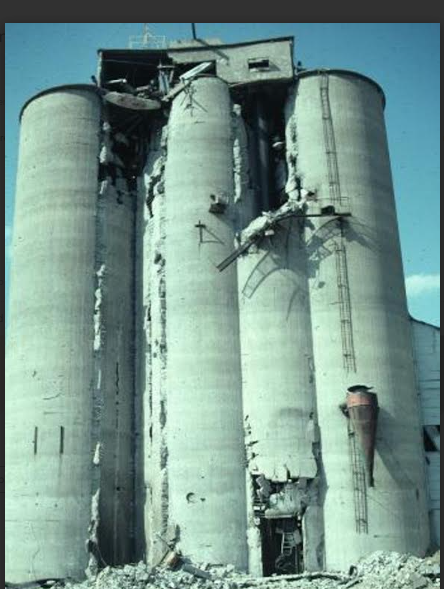
Even on a global scale, the impact of the DeBruce grain elevator explosion
(considered the largest such facility at the time) in Haysville back on June 8,
1998, was felt — and certainly hit close to home in Derby and the
surrounding area.
Local residents Larry Simmons and Malissa Paxton, father and daughter,
were among those first responders on scene at the explosion— quickly
jumping into action.
“I didn’t really notice it. I notice every explosion around me now —
earthquakes and everything — but [my partner] said, ‘What happened?’ He
had that walkie in his ear and immediately he was like, ‘Wow, something
big’s going on,’” said Paxton, who was working for Sedgwick County EMS at
the time. “You don’t forget that. And before that, it was just a building I
didn’t know anything about.”
“We knew that it was something big and we figured [out] what it was before
dispatch even gave any information; we knew,” said Simmons. Now retired,
Simmons was working for Sedgwick County Fire Department at Station 38 in
Bel Aire at the time.
Currently, Derby area resident Robin Turnmire — who lost a brother in the
DeBruce explosion — is working on a documentary film, “11 Days,” that tells
the story primarily from the first responders’ perspective.
Noting that she never actually set out to make a movie, Turnmire became an
“accidental filmmaker,” as she was looking to shed light on the instigating
factors of the explosion as more of a preventative measure.
“What I set out to do was get to the truth about what really happened out at
DeBruce, and then go figure out how to do the causal analysis and really dig
in,” Turnmire said.
Identifying the first responders as the most accurate witnesses, Turnmire set
out to talk with them about their experiences “rolling up to a war zone,” as
many of them put it. Turnmire talked to over 25 of the 200 first responders
who were on scene in the immediate aftermath of the explosion, which is
considered one of the deadliest in American history and claimed the lives of
seven workers.
Once she began interviewing the first responders, she realized their stories
had to be captured on film. Among those she talked to were the firefighters who rescued her brother, Lanny Owen, from being trapped near the top of
the grain elevator. Their efforts gave him 11 more days to live, which is
where the film gets its title.
Recalling the scene
Simmons was also among those first responders Turnmire talked to for the
film. He was a captain with Sedgwick County Fire at the time and in charge
of the technical rescue team.
As Simmons recalled, “the whole tops of the elevators were gone and people
were hanging in the headhouse [the top two to five stories].” That left
Simmons with quite the situation to sort out, first calling in a rescue
helicopter to help the trapped workers. However, the vibrations from the
blades were dislodging rubble and creating more issues, so cranes were
called in instead to get the technical rescue team up to the trapped workers
to help free them.
Looking back, Simmons noted his team had done all sorts of rescues over
the years, but responding to the DeBruce explosion combined all of those
elements into one call and he said the imprint of the body of one of the
victims 100 feet up on one of the silos has stayed with him, speaking to the
force of the blast.
“When I saw that body up there, that just blew me away,” Simmons said.
On top of that, Simmons and his team had to worry about the additional
risks of secondary explosions while on site. He stayed on in response until
the morning after the explosion, while his daughter was out there for the
day providing medical support to the firefighters while also helping search
the scene for critical body parts — with recovery and cleanup efforts
continuing for weeks after.
Now a physician’s assistant at Tanglewood Family Medical Center, Paxton
said she and her father were aware they were at the same scene the day of
the explosion. While their paths didn’t cross, given how shaken the
firefighters she treated were, she was certainly concerned.
“I knew that he was in command of that scene, and I was worried,” Paxton
said. “It was a threatening scene and I knew he had a lot of stress on him,
and those firemen were his family. He had to make decisions on who was
going in; he was in a tough spot.”
Avoiding future risk
Rob Dusenbery, a fellow retired firefighter who now teaches fire science at
Wichita South High School, noted there are only a handful of calls the
magnitude of the DeBruce explosion firefighters will make in their careers.
Part of the purpose of the film is to help raise funds for Dusenbery’s program
and other local firefighter charities.
While Dusenbery was relatively new to the department compared to
Simmons and was on the fringes of the response team, the lessons on
incident management — between all parties — from the grain elevator
explosion are something he is trying to pass on to the next generation within
the consistency he preaches to his students.
“We start out with a good game plan and then we make a mistake and don’t
correct it and pretty soon we’ve normalized that behavior. Pretty soon we
normalize other mistakes and other sloppiness, and when you end up on an
accident scene like that somebody has to have their stuff together and
somebody else has to know what their place is and how they react,”
Dusenbery said. “I see something like DeBruce as the ultimate example of
that kind of coordination, and I see something like this film as a way to get
people to think about it.”
Speaking to the many moving parts of such a response, Simmons noted he
was just one pawn out on the scene doing his job and there are plenty of
others who deserve the spotlight — which the film is shedding some light on.
“It was overwhelming. It’s something I’ll never forget in my life,” Simmons
said. “I learned a lot from it, and I’m sure other people learned a lot from it
that were there.”
There were signs of an eventual issue like the explosion. Simmons saw it
when he worked at the grain elevator as a teenager, and Turnmire said her
brother made comments noticing issues coming to a head as well.
Part of the drive behind the film is to explore the technical challenges,
hazards, lessons, etc., from the DeBruce explosion and other similar
accidents to help prevent them in the future.
“I can’t bring my brother back. I can’t bring those men back. None of them
are going to come back. We’re not going to have any of those experiences
with them, and I am so sorry that they’re gone,” Turnmire said. “But on the
flip side, I’m so thankful that I’ve had this experience with the [surviving
responders].
“This is about risk management. I’m hopeful that by having these
conversations, we educate [people] that it’s all of our jobs,” she continued.
“What can we do as a community to make sure it never happens again?”
Currently, “11 Days” is in post-production and editing, with a private premier
screening being planned for the contributing first responders. Turnmire is
also seeking to enter the film on the festival circuit in the coming months.
For more updates and to view the film’s trailer, check
https://sannnordstudios.com/11-days-the-film/.
Derby’s Larry Simmons (right) and Malissa Paxton, father and daughter, were among the
emergency personnel who responded to the DeBruce explosion, helping share some of their
insight for the documentary.
Documentary,
BY KELLY BRECKUNITCH
[email protected]