Potentially deadly Kansas creatures range in size from as big as a bison to as tiny as a tick.
The WorldAtlas website spotlights a dozen such animals in an entry titled, “The 12 Deadliest Animals in Kansas.”
The site focuses on 12 animals, at least two of which it doesn’t document as having caused any human deaths.
American bison
The American bison appears tame at first glance but can be “unpredictably dangerous,” said the WorldAtlas site.
The bison since 1955 has been the state animal of Kansas. It is the largest mammal in North America, yet is capable of running as fast as 35 mph, the WorldAtlas site said.
A bison gored its owner to death in August 2022 in central Kansas.
That animal subsequently threw an Ellsworth County sheriff’s deputy 10 to 12 feet into the air, and appeared to be charging at him when it was fatally shot by another deputy. The downed deputy survived.
Snakes on the plains
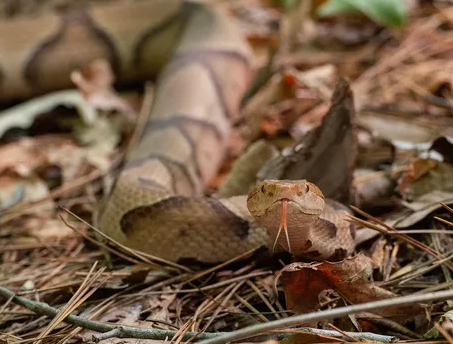
Four venomous snakes indigenous to Kansas are among the 12 types of creatures highlighted on the WorldAtlas site.
Those are the prairie rattlesnake, the timber rattlesnake, the massasauga rattlesnake and the copperhead snake.
All venomous snakes found in Kansas are pit vipers, meaning they have heat-sensitive pits in front of each eye to help locate prey, according to the website of the Kansas Department of Wildlife and Parks.
It said the timber rattler can be found in the eastern fourth of Kansas, the prairie rattler in the western half of the state, the massasauga rattler in the eastern two-thirds of the state;and the copperhead in the state’s eastern third.
Deaths from snake bites in Kansas are rare, according to a “A Pocket Guide to Kansas Snakes” — written by Joseph T. Collins, Suzanne L. Collins and Travis W. Taggart — which is on its sixth edition after initially being published in 2011.
“There is only one documented fatality in Kansas since 1950,” it said.
Kansas has two types of poisonous spiders
The poisonous black widow and brown recluse spiders are two others among the 12 potentially deadly Kansas creatures listed on the WorldAtlas site.
“A black widow spider bite is rarely fatal but may harbor a neurotoxic venom that causes severe muscle cramping, nausea, localized pain, vomiting, headaches, sweating, and trembling,” it said. “In rare cases, these bites may induce tremors, convulsions, breathing difficulties, or suffocation.”
The WorldAtlas site added, “Though a majority of reported bites from a brown recluse often cause little to no symptoms, a human reaction to a bite from a brown recluse spider can vary depending on the amount of venom injected in the victim and the victim’s sensitivity to the spider’s venom.”
Bites from the brown recluse almost never cause death in humans, said the website healthline.com.
List includes two types of ticks found in Kansas
The lone star tick and black-legged, or deer, tick are two others among the 12 potentially deadly Kansas creatures listed on the WorldAtlas site.
Ticks are slow-crawling, wingless parasites that attach themselves to hosts and feed on their blood.
Exposure to ticks puts humans and animals at risk of becoming infected by various diseases.
A tick-borne disease in May 2022 killed a Topeka family’s cat.
Black-legged or deer ticks are said to be the primary species that transmit Lyme disease in Kansas, the WorldAtlas website said.
Lone star ticks, which get their name from the single white dot often seen on the back of the female, can also transmit that disease, it said.
Lyme disease can be fatal but rarely kills humans, according to the Medical News Today website. Between 1985 and 2019, 11 people worldwide died due to the related heart condition Lyme carditis, it said.
‘Kissing bug’ can cause a potentially fatal disease
Triatominae, also known as the “kissing bug,” got that name because it was initially thought that it often bites the face of its victims, though it can actually can target any part of a victim’s body, said the WorldAtlas site.
Kissing bugs may carry a parasite that that causes Chagas disease, a potentially deadly inflammatory and infectious disease that can cause heart or digestive issues if left untreated.
“It is estimated that about 50% of kissing bugs carry the disease, though the number of infected insects varies by location,” the WorldAtlas site said.
Common snapping turtle
The snapping turtle, a semi-aquatic and omnivorous freshwater turtle species, tends to be short-tempered and stand its ground when provoked, the World Atlas site said.
Snapping turtles, when disturbed, may also emit a foul-smelling musk, the site said.
“They can be vicious if removed from the water,” it said. “As the name suggests, snapping turtles may inflict painful bites, albeit uncommonly.”
The WorldAtlas site didn’t document any human deaths caused by snapping turtles.
‘Velvet ant’ is actually a wasp
The “velvet ant,” a furry-bodied insect that is actually part of the wasp family, is another Kansas creature mentioned on WorldAtlas.
Velvet ants are not aggressive but females will sting if they are being held or stepped on, that site said.
“The sting of a velvet ant is excruciatingly more painful than a bee sting,” it said. “Its sting is so painful that the wasp is referred to as the ‘cow killer!’ While the venom is not very toxic, individuals ought to avoid handling velvet ants to prevent getting a jab of their painful sting.”
The WorldAtlas site didn’t document any human deaths caused by velvet ants.
As reported in the Topeka Capital Journal