Wednesday, January 21, 2026
Home Blog Page 144

USDA to Provide $1 Billion to Livestock Producers Impacted by Drought or Wildfire in 2023 and 2024

0

Assistance for Flood-Impacted Producers Coming Summer 2025

(Washington, D.C., May 29, 2025) – U.S. Secretary of Agriculture Brooke L. Rollins today announced the release of Congressionally mandated Emergency Livestock Relief Program (ELRP) payments to cover grazing losses due to eligible drought or wildfire events in 2023 and/or 2024. Secretary Rollins committed on May 7 to release these emergency payments by May 30, and today she is delivering on that commitment ahead of schedule.

The U.S. Department of Agriculture’s (USDA) Farm Service Agency (FSA) is leveraging existing Livestock Forage Disaster Program (LFP) data to streamline payment calculations and expedite relief. Emergency relief payments are automatically issued for producers who have an approved LFP application on file for 2023 and/or 2024, and do not have to contact USDA to receive payments.

“The Department of Agriculture is stepping up to support livestock producers by expediting disaster payments when drought and wildfires strike. Under President Trump’s leadership, USDA has the backs of ranchers, and that’s why we are delivering much-needed emergency relief ahead of schedule,” said Secretary Rollins.

The American Relief Act, 2025, provided funds for emergency relief payments. This program is the first of two programs authorized to assist with eligible losses suffered by livestock producers. FSA will announce additional ELRP assistance for other losses authorized by the Act, including flooding, later this summer. FSA expects demand for this first program to be great so the ELRP payments will be factored at 35%. If additional funds remain, FSA may issue a second payment.

Supplemental Disaster Assistance Timeline

USDA is fully committed to expediting remaining disaster assistance provided by the American Relief Act, 2025. On May 7, we launched our 2023/2024 Supplemental Disaster Assistance public landing page where the status of USDA disaster assistance and block grant rollout timeline can be tracked. The page is updated regularly and accessible through fsa.usda.gov.

The Act also authorized $10 billion in economic loss assistance to producers of covered commodities based on 2024 planted and prevented planted acres. To date, USDA has delivered more than $7.7 billion to producers through the Emergency Commodity Assistance Program (ECAP). The ECAP deadline is Aug. 15, 2025. Contact your local FSA county office for information.

KDA Photo Contest Begins June 1

0

MANHATTAN, Kansas — Kansas agriculture has a beauty like no other, and we love to appreciate that beauty whenever we talk about Kansas ag. While that beauty can’t be fully captured with a camera, we encourage photographers to try, and then to share it with us in the Kansas Department of Agriculture’s annual photo contest. KDA will begin accepting photos on June 1, and will continue accepting entries through August 1.

This year’s KDA Photo Contest categories were selected to promote different aspects of Kansas agriculture: Picture Perfect PrairieFarm AnimalsAgriculture at Work, and Farm Fresh These categories allow you to showcase Kansas agriculture in many ways — the natural resources that make our state flourish; the farm pets and livestock which are our friends and partners at work; the various crops and produce that help feed Kansans; and the everyday activities in agriculture such as working cattle, fixing fence, and planting crops. As always, there is a separate Youth division, for young photographers age 18 and under. And a video category will welcome drone footage, harvest videos, or other short clips of under 30 seconds that showcase Kansas agriculture. Prizes will be awarded to the top two winners in each of the six categories.

KDA serves to advocate for agriculture, the state’s largest industry and economic driver. Photos which best capture the categories will be used throughout the year as we tell the story of Kansas agriculture. After submission, KDA is granted permission to use any photograph for publications, social media, websites, displays, etc. without payment or other consideration from the photographer.

Photo entries should be sent in .jpg format to [email protected]. Videos should be sent in .mp4 or .mov format. Entries must include a title and brief description, where and when the photo/video was taken, the photographer’s full name and age, entry category, hometown, and email address.

Guidelines for the KDA Photo Contest, including deadlines, categories and prizes, can be found at agriculture.ks.gov/PhotoContest. Voting to select finalists will begin on KDA’s social media sites in mid-August. For more information, contact Heather Lansdowne, KDA director of communications, at [email protected] or 785-564-6706.

Groundbreaking marks new era for Kansas Law Enforcement Training Center

0

YODER — University of Kansas and state legislative leadership broke ground on major renovations at the Kansas Law Enforcement Training Center near Hutchinson on May 23, part of a bold campus master plan to support its competency-based curriculum and to expand programs to meet the training needs of partners in public safety.

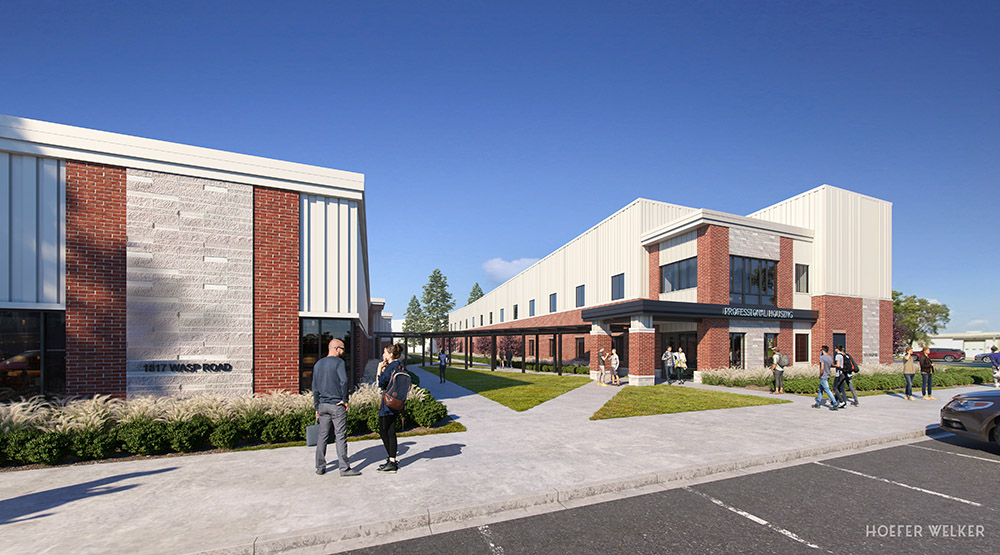
Rendering of future KLETC space, including a dormitory for students attending longer training programs at the campus near Hutchinson.

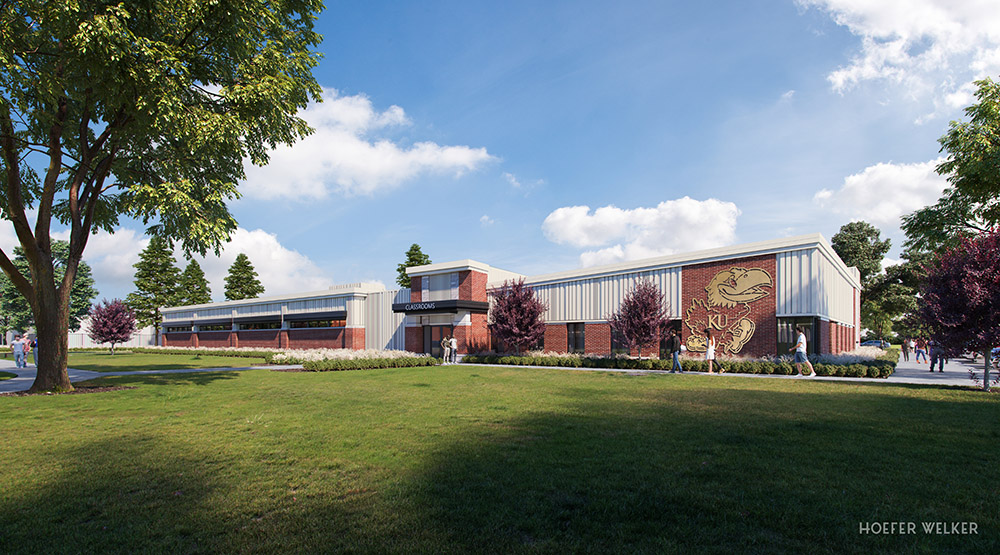
The first phase of the project includes two major additions to the KLETC campus. One is a new administration building that will provide office space and classrooms. The other is a dormitory with 46 suites for students attending longer training programs. A standout feature of the administration building will be a 12-foot by 13-foot Jayhawk mounted on the south side of the building, visible from across the quad, displaying the campus relationship to KU.

A rendering of a new building at the KLETC campus will include a 12-foot by 13-foot Jayhawk.

Due to anticipated inclement weather, organizers brought the groundbreaking inside Integrity Auditorium, and the ceremony moved forward without missing a beat.

Darin Beck, vice provost of KLETC and director of police training for the state of Kansas, said how meaningful the day was to everyone involved.

“It’s exciting because everything we’re talking about started here,” Beck said. “It started as an idea. It started as a combination of ideas with shared visions from everyone in this room — shared visions from our students, our staff and the state.”

Chancellor Douglas A. Girod also spoke at the event.

“It really is a great day for the Law Enforcement Training Center, for the state and for KU. We’re so excited to be part of what the Law Enforcement Training Center does and the support it provides for our state,” he said.

Barbara Bichelmeyer, KU provost and executive vice chancellor, praised the creative thinking behind the project.

“It’s been such a joy to see the innovation they’ve brought to the Law Enforcement Training Center,” she said. “They’ve thought boldly about what it could be, what it should be, what the state needs, and honestly, what the nation needs. And they’ve shared that vision far and wide.”

This first phase of construction is being funded with $20 million from the state of Kansas. The money comes from the American Rescue Plan Act of 2021.

Speaker of the Kansas House Dan Hawkins said the ceremony marked the beginning of something bigger.

“This is the start of a long journey that Darin probably won’t even get to see completed,” Hawkins said. “But I can tell you we’re going to continue working really hard to make sure KLETC has the resources it needs to serve the students who come through here.”

https://news.ku.edu/news/article/groundbreaking-marks-new-era-for-kansas-law-enforcement-training-center

Just a Bit of Bark & Banter: The Aussie Olympics

0

Jenny Long
Columnist

Every four years, the world watches elite athletes compete in feats of strength, speed, and skill. But at our house? The Aussie Olympics happen every day, and the competition is fierce.
Welcome to our backyard stadium, where four toy Australian Shepherds turn the ordinary into the extraordinary with their events: Herding, Fetching, Speed Sprinting, and Emotional Manipulation (yes, that’s a category here).
Let’s meet the contestants:
Brutus – The Anxious Athlete
Don’t let the worried eyes fool you—Brutus is all heart. He’s the silent professional of the group, with lightning-fast pivots and laser focus. In the Herding Challenge, Brutus dominates. Whether it’s gathering the other dogs or nudging a misplaced shoe into its proper spot, he does it with loyalty and precision. Sure, he is startled if the wind changes direction, but give him a task and he’s on it faster than you can say “good boy.”
Lucy – The Diva With a Mission
Lucy may have a bad knee and the speed of a nap, but she brings drama and determination to the games. With her dazzling blue eyes and head-high trot, she wins gold in Emotional Manipulation without breaking a sweat. Herding? She does it in her own time. You’d never guess she’s got a limp when there’s something that needs organizing—or when Brutus needs backup. Grace, style, and a touch of sass—she’s the Simone Biles of side-eyes.
Scout – The Stealth Sprinter
Quiet and mysterious, Scout avoids the spotlight but stuns the crowd in Speed Sprinting. He doesn’t fetch, doesn’t mingle—but if a squirrel so much as breathes in the next yard, Scout is gone before the rest even notice. He’s like the track star who doesn’t show up to opening ceremonies, then smashes a record and vanishes again. We still don’t know where he goes during the awards ceremonies.

Luna – The Social Butterfly
Luna is… enthusiastic. She listens selectively, thrives in chaos, and has never met a person she didn’t love instantly. She brings home the gold in Fetching (With Flare) and wins the unofficial Wiggle Butt Triathlon. Ask her to sit? For Sure. Ask her to fetch? Absolutely yes, ten times in a row, with a victory lap after each return. She’s the people’s champion, even if the judges occasionally raise an eyebrow.

Final Medal Count:
Brutus: Gold in Herding
Lucy: Gold in Emotional Manipulation
Scout: Gold in Speed Sprinting
Luna: Gold in Fetch & Social Engagement
Me? I won silver… in Keeping Up.
In the end, there’s no podium tall enough for the joy these four bring every day. The Aussie Olympics might not air on primetime TV, but they sure keep our hearts racing—and our backyard very, very busy.

Brutus:
“Always watching, always ready—Brutus takes Herding gold with heart and hustle.”
Lucy:
“With her piercing blue eyes and royal strut, Lucy proves that divas herd, too.”
Scout:
“Gone in a flash! Scout claims Speed Sprinting gold—and probably a squirrel.”
Luna:
“Fetch queen, social butterfly, and chaos enthusiast—Luna lives for gold and belly rubs.”
All Four Together:
“The Aussie Dream Team—no medals needed, just treats, toys, and a yard to run.”

Healthy body, healthy mind: The food you eat can affect your mood

0

Most Americans understand that the food we eat is important for physical health, but perhaps a little less well known is that food also affects our mental health.

“If we think about our brain cells, our nerves, our gut and other parts of our body, the food we eat is going to be part of those cells,” said Priscilla Brenes, a nutrition and wellness specialist with K-State Research and Extension. “So, what we eat will in turn affect the mood we have (and) the way we sleep. All of it affects our mental health.”

Brenes cites research indicating that a diet high in fruits and vegetables, whole grains, and healthy fats are associated with fewer depressive symptoms, less anxiety and overall well-being.

“Diets that are high in saturated fat, sugar and processed foods tend to be associated with an increase in depression and anxiety symptoms,” she said.

The U.S. Department of Agriculture’s Center for Nutrition Policy and Information publishes guidelines to help Americans eat a variety of foods in proper proportions. The campaign is called MyPlate.

“The idea is that if half of your plate is fruits and vegetables, then you will get a lot of the essential nutrients that our body needs to promote brain health, such as magnesium and folate (a B-vitamin),” Brenes said. “These are the types of foods that help ease our nerves, help our gut, help us maintain our brain function and keep our neurons healthy so that we can process our daily lives better.”

Brenes said additional guidelines for eating that promotes brain function comes from a pair of popular eating plans known as The Mediterranean diet and the MIND diet. Free, online publications about these diets are available from the K-State Research and Extension bookstore.

“There is a bi-directional connection between our brain and our gut,” Brenes said. “All of the nerves from our brain that go to our body also go to our gastrointestinal tract. The food we eat has the potential to influence those nerves…and send messages to the brain.”

She adds: “So if we eat diets like the Mediterranean diet and the MIND diet that promote good gut health, the good gut bacteria sends messages to the brain that can help with the neurotransmitters that help our mood.”

Some foods that contribute to good brain and gut health include fatty fish like salmon, tuna and white fish (which contain important Omega 3 fatty acids), nuts and seeds, dark leafy greens, berries, whole grains and fruits and vegetables.

“Western diets tend to be very reliant on processed foods, and processed foods generally do not contain the polyphenols and the combination of nutrients that, for example, fruits and vegetables will have,” Brenes said. “Processed foods try to add these nutrients, but they don’t work the same way as if we eat the real food.”

More information and assistance on eating healthfully is available at local extension offices in Kansas. A longer conversation with Brenes about the mental benefits associated with healthy eating is available on the May 23 segment of Sound Living, a weekly podcast from K-State Research and Extension.