Monday, January 26, 2026
Home Blog Page 194

He, She Or It

0
lee pitts
I’ve always had a problem with sex. No, not in the sense you’re thinking about. Get your mind out of the gutter. I’m talking about identifying animals and babies as “he” or “she” and then being wrong about it. Birds are easy to identify because the male is always the better looking and some would argue that’s true with humans too. We used to raise mallard ducks and they are a dead giveaway because the female is always a drab and dreary muddy brown while the drake is very colorful with a bright blue or green ring around his neck. The female ducks seem to quack a lot more too.
I’ve never had a problem identifying the sex of chickens, hogs or horses and I’ve been around so many cattle in my life I can tell their sex just by looking at their heads, I don’t even have to see their toolbox. I’ve also raised lot of sheep and can usually tell what sex they are immediately but if the males have been castrated it makes it a little more difficult. With older sheep I can usually guess right about 100% of the time. But I’m not so lucky with cats and rabbits who are impossible to tell.  Goldfish and fluffy itty-bitty dogs aren’t exactly a piece of cake either.
Just the other day I saw a beautiful collie and complimented the woman who owned her by saying, “My, you must take great pleasure in owning such a fine looking dog.”
“It’s not a dog, she’s a bitch,” said the person I thought was a woman but turned out to be a man.
Of course I was just referring to the colloquial term for canines but people have become real sticklers these days when it comes to vocabulary. I think it has something to do with political correctness. Take people for instance. It used to be a human was either a male or a female but these days there are some 52 official ways to identify the sex of a person. I liked it better when there were only two. Babies used to be especially easy for me because the parents would either dress their child in pink for girls or blue for boys. Now that they’re dressing them in peach, turquoise and mauve I have much more trouble. There are other ways to go with the odds in identifying the sex of babies. For example, some professor with way too much time on his or her hands has figured out that returning soldiers, male abalone divers, fighter pilots and anesthetists tend to have more girls than boys so I always try to find out the parent’s occupation before I try to guess the sex of any baby I comment on.
People are getting as hard to tell as oysters and clown fish who can change their sex almost on a moments notice. I guess now you can say the same thing about people with “gender reassignment surgeries”. Just the other day I saw a couple of women visiting my bachelor neighbor and I made a snarky comment to him about the two ladies who came calling. “They weren’t both women,” he said. “That was Jason and his mother. You know Jason. You gave him your old computer.”
“That was Jason,” I exclaimed. “The one with the long blonde hair, earrings, and capri pants?”
Things have gotten so confusing now I usually wait until I see which restroom a human uses before I’ll commit to calling them a “he” or a “she” but with the advent of unisex bathrooms I’m back to being left in the dark.
For awhile I classified all babies as “its” but one especially sensitive parent got real pushed out of shape about me referring to her baby as an “it” so I’ve had to change my tactics. Now I just go with the odds and since 50.8% of babies are born male and 49.2% are born female I’ll usually just say, “That’s a beautiful baby boy you have there.”
Invariably the parent will say, “She’s a girl, I’ll have you know.”
“I’m sorry,” I’ll say. “I didn’t know you were her father.”
“I’m not, I’m her mother.”
Sometimes you just can’t win.

Just a bit of Bark and Banter

0

Jenny Long
Staff writer

If you’re looking for peace and quiet, 8th Street isn’t the place to find it—at least not at my house. I live with four Toy Australian Shepherds, and let me tell you, there’s never a dull (or silent) moment.
Let’s start with the leader of the pack—Brutus. He’s a red merle and the man of the house, in every sense of the word. Brutus is fiercely loyal; I truly believe he wouldn’t trade me for the juiciest steak. He takes his job seriously: guarding the house, keeping the others in line, and making sure everything is running smoothly.
Then there’s Lucy, a striking blue-eyed Merle and without a doubt the Alpha. She carries herself like royalty and has perfected the art of the judgmental stare. If you dare to interrupt her lounging, she’ll make sure you know it. She prefers men, but over time, she’s warmed up to the women of the house—realizing, of course, that we aren’t going anywhere. Soft blankets, belly rubs, and being left alone are her love languages.
Luna—short for Luna-tic—is our tri-colored firecracker. From day one, she’s kept us on our toes. She has the biggest personality in the house and absolutely lives for attention and kisses. If someone comes over, prepare for chaos—Luna is on it. And she always has something in her mouth: food, toys, sticks, or her personal favorite… acorns. (Spoiler alert: those acorns have cost us more than a few vet bills, but that’s a story for another time.)
And finally, Scout. True to his name, he’s the outdoorsman of the crew. Since he was a puppy, dirt has been his happy place. He loves chasing bunnies under the shed, barking at squirrels in the trees, and tracking birds like he’s on a mission. Scout is shy and skittish, but when he smiles—yes, he smiles—you can’t help but melt. He’s a couch snuggler by night, an explorer by day, always scouting around the backyard like it’s his job.
Life with four Aussies is full of chaos, comedy, and the occasional chewed-up stick. But I wouldn’t trade it for the world.
Stick around—there are plenty of stories to come from this wild, wonderful crew on 8th Street.

Lettuce Eat Local: U Might Still Need A Glass Of Milk

0

Amanda Miller
Columnist
Lettuce Eat Local

Those little fingers flit over the counter again, sneaking another pinch of dough. “I thought you said only one more taste?” I ask Benson, giving him a look of mixed exasperation, amusement, and perplexity. 

He does this with any dough, from cookie to bread to pie crust. While I enjoy tasting things at almost any step in the cooking process, I’m usually done after a single sample of most raw doughs, unless I’m still tweaking them. They’re fine, but they’ll be so much better baked, so I might as well wait. 

My son, however, clearly didn’t inherit only his daddy’s good looks and love of farming, but also his affinity for unbaked flour-based products.

Now, before we get any farther, I know there are health concerns for consuming raw eggs, and actually raw flour is even potentially more dangerous. We use our hens’ eggs, so they are very fresh and have more of the natural protective coating of the shell, so I’m not worried about a little bit here and there. We also only use wheat from our field or from local Hudson Cream, which doesn’t take away all risks, but somehow makes me feel better. So hear me out that I know there is danger of bacterial infections, and I’m not being flippant with my family’s health; but at some point, anything is dangerous and we can’t/shouldn’t recoil from everything. Simply living on a farm like we do puts us in potential peril every day. 

On that cheerful note, back to the dough. It really doesn’t much matter what it is, but Benson likes it. He’s usually helping me mix it, so he’s all up in the tactile experience already. There is something peculiarly attractive about stretchy, glutinous bread dough, especially when it’s our favorite brown-sugar oatmeal; and of course a little smackerel of prebaked scone or heavily-flavored biscuit dough works. But plain biscuits or pastry crust are too meh for me, and cookie dough is the opposite too much for me. 

Almost hypocrisy, I know, but I just don’t do raw cookie dough. Too sweet, too rich, it cloys in my mouth and turns my stomach a little; in fact, cookie dough is even one of the very few ice cream flavors I truly do not like. Brian, on the other hand, has to hide how large of a scoop of dough he pilfers if he happens across us in the process, or his son will never be satisfied with the paltry amounts his stingy mother allows.

This appreciation for the unbaked also extends to the underbaked, at least for Brian — a little “claggy” is a good thing. (If it has sugar in it, Benson will eat it no matter the bake.) I like to know the different internal temperatures to bring baked goods to, realizing there is science behind the numbers, but if I’m just baking for us, research proves my husband will enjoy it more if I slightly undercut the temp. If there’s a question, always err on the side of underbaked. 

That is, if I have enough dough left to even bake at all. 


Unbaked Cookie Dough

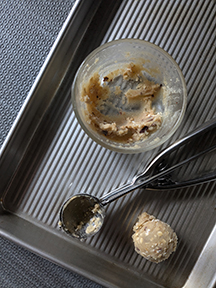
Yes, we know regular cookie dough is unbaked, but this one is actually meant to stay that way. This version doesn’t require a mixer, just a bowl and a spoon, plus it has some redeeming healthful qualities. Did Brian think it was as good as actual cookie dough? To be honest, no, but he liked this one better than the one I tried with cannellini beans, so there’s that. I, however, liked it much better, and I’m the one who actually eats snacks. 

Prep tips: this is good right away (yay for instant “cookies”!), but I prefer it fully chilled. You can dollop it out in cookie-scoop portions, or just leave it in a bowl and snatch a little every time you open the fridge…I’ve heard that works pretty well.

2 cups almond flour

½ cup quick oats

2-4 tablespoons local honey, to taste

2 tablespoons melted coconut oil or butter

1 tablespoon of milk, or as needed

½ teaspoon salt

a good splash vanilla

2 oz chopped dark chocolate

Melt oil or butter in a glass bowl, then stir in remaining ingredients. Eat. 

More measles cases reported in Kansas

0

MORTON COUNTY —Three new cases of measles have been confirmed in Morton County, linked to a previous case identified in Stevens County last week, according to a statement from the Morton County Health Department.

Early symptoms of measles are a fever of more than 101 degrees Fahrenheit, runny nose, cough, and red, watery eyes. Usually, one to four days after these early symptoms, a red rash appears on the face and spreads to the rest of the body. Measles symptoms typically develop 10-14 days after exposure. Symptoms can develop as soon as seven days and as long as 21 days after exposure, according to the Kansas Department of Health.

Measles is a respiratory disease caused by a virus. Measles is spread through the air by breathing, coughing or sneezing. Measles can be spread from an infected person to others from four days before, to four days after the rash appears.

Because measles is a highly infectious disease, it is very important for anyone exposed and experiencing symptoms to isolate from others with the exception of visiting a health care provider.

The best way to prevent measles is to get the Measles, Mumps and Rubella (MMR) vaccine. The Centers for Disease Control and Prevention (CDC) recommends children get their first dose at 12 to 15 months of age, and a second dose at age 4 to 6 years. Infants ages 6 through 11 months old should get the MMR vaccination if traveling outside the United States. Adults are protected from measles if they have had at least one dose of the MMR vaccine, were born before 1957, or have evidence of immunity from a blood test.

If an individual has known exposure to someone with measles and they are not immune through vaccination or prior infection, they are recommended to:

Consult with a health care provider to determine if post-exposure prophylaxis is recommended.

Exclude themselves from public settings for 21 days from the last time they were exposed unless symptoms develop.

If symptoms develop, individuals should notify their local health department and stay away from public areas until four days after the rash appeared.

Individuals seeking health care are advised to call ahead to their health care provider and let them know their symptoms and exposure concerns. This will help limit exposure within the healthcare setting.

Per K.A.R. 28-1-2, measles is a four-hour reportable disease. If a health care provider, laboratory or hospital suspects, tests, or diagnoses an individual with measles, KDHE should be notified immediately. KDHE will work with the health care provider on testing recommendations. Teachers and school administrators are also required by law to report suspected cases to KDHE.

Measles cases rarely occur in Kansas and are usually associated with international travel.

For questions, call the Stevens County Health Department at 620-544-7177 or KDHE Epidemiology Hotline at 877-427-7317 (option 5).