Tuesday, January 13, 2026
Home Blog Page 37

Daughter Loretta Shares About Her Family’s Recent Trip to Alabama

0

Lovina’s Amish Kitchen
Lovina Eitcher,
Old Order Amish
Cook, Wife &
Mother of Eight

Dear readers,

This is Loretta, I’m Lovina’s daughter. I haven’t written Mom’s column for a while. I thought that since I have some free time to write, this would be the time. Right now my husband is out with the children choring. They love being outdoors. Denzel is 3, Byron is 2, and Kylie is 10 months old. Denzel and Byron are my helpers throughout the day when Dustin goes to work. Denzel is potty trained; I’m still working on potty training Byron. He’s a different cookie. Every time he needs to go, he says, “it’s coming” hahaha. Byron will tell me when he needs to go but it’s too late. Dustin has his own business doing excavating work and lots of different construction work, so he’s staying busy doing that. Throughout the winter, it slows down a bit.

Seeing sister Verena practice with her bow with a screen brought back memories of when I used to go deer hunting. That was before I was married and before our children were born. My husband Dustin had taught me how to use a bow, which didn’t have a screen like Verena’s, which would have been a lot nicer. My first shot was a small buck (button buck). Next, I shot a nice size spike, and you could see his antlers. Dustin told me if I shot my first bigger buck, he would mount it for me, so he did. It wasn’t a big buck but to me it felt nice to have meat in the freezer. It was also something in the future I could show my kids that I did. Nothing is impossible, which is what I love to tell myself. I also shot two does after that. I missed once, but that’s because I got pretty excited. I never really had a chance at getting a bigger buck, but maybe I can go again after the children grow older. Right now, Dustin and I do not really have a good hunting spot. If you don’t have your own hunting land, it’s hard to find someone else’s to hunt on.  

Recently we spent two weeks in Alabama. A cousin of ours had asked if Dustin would want to come out and help with the construction of a big office building that he needed help with. It was nice to also be able to go see where my Uncle Pete and Aunt Carol live and their children. It was very beautiful scenery. After the 2 weeks were up, we left that Friday afternoon and headed towards the Smoky Mountains. We drove up some mountains and saw a black bear! Very awesome!! Son Byron said, “Oh, there is a moo moo cow!!!” Hahaha, we had a good laugh at that. We also went to Gatlinburg, Tennessee and looked around. There is so much to see so we didn’t get to see everything but just that one day we got was worth it. If you go to Gatlinburg, Tennessee, you’ll have to go more than one day to see everything.

We headed home Sunday morning, home sweet home. How you miss home when you leave that long. While at the motel Dustin would leave for work at 6:30 in the morning and I stayed with the children. We stayed in a handicap accessible motel for two weeks. It was a challenge to keep the children happy in a motel room. It wasn’t as bad as I thought it would be. I felt worse for the children than I did for myself. But they did very well. It was at least a trip we could do that we could afford. Other than that, we wouldn’t have been able to go down there if it wasn’t for that job. I had never been to Gatlinburg, Tennessee in my life, so it was a nice experience.

I’m going to share the recipe for this coffee cake my sister Susan and Ervin brought to our house recently when they came for supper. We really liked it and it’s easy to make. Susan’s mother-in-law gave her the recipe.


I’m going to sign off now. You all have a Happy Thanksgiving and Merry Christmas. 

God’s blessings from our family to yours. 

COFFEE CAKE 

4 eggs 

1 cup water

1 cup vegetable oil

1 yellow cake mix

1 box instant butterscotch pudding mix

1 box instant vanilla pudding mix

TOPPING

1 cup sugar 

1 tablespoon cinnamon

Mix eggs, oil, and water together. Add both dry pudding mixes and cake mix and beat well. Pour into a greased 10×15 cookie sheet and then sprinkle on the topping and bake at 325 degrees for about thirty minutes. Optional- Two vanilla puddings can be used instead of butterscotch.  


Lovina’s Amish Kitchen is written by Lovina Eicher, Old Order Amish writer, cook, wife, and mother of eight. Her three cookbooks, The Cherished Table, The Essential Amish Cookbook, and Amish Family Recipes, are available wherever books are sold. Readers can write to Eicher at Lovina’s Amish Kitchen, PO Box 234, Sturgis, MI 49091 (please include a self-addressed stamped envelope for a reply); or email [email protected] and your message will be passed on to her to read. She does not personally respond to emails.

Holiday blooms need to be planted soon

0
Popular amaryllis known to produce 3-4 blooms during the season.

‘Tis the season to start thinking about decking the halls with holiday décor, which may include some of the season’s most colorful flowers.

“Now is the time to start amaryllis if you wish to have them in bloom for Christmas,” said Kansas State University horticulture expert Cynthia Domenghini.

Amaryllis, genus name Hippeastrum, are ready to bloom when purchased. Hippeastrum means “horse star” which is an appropriate name since this plant can produce blooms as large as 8-10 inches across.

“Amaryllis bulbs can be huge – approaching the size of a grapefruit,” Domenghini said “The larger the bulb, the larger the flowers and the more expensive the bulb.”

Despite its size, this plant prefers tight quarters, according to Domenghini: “Select a container about one-inch larger in diameter and twice as tall as the bulb with drainage holes in the bottom.”

Domenghini explained how to properly pot the amaryllis:

  • Hold the bulb so the roots hang down into the pot and add potting mix.
  • Firm the mix around the roots carefully so that they are not snapped off.
  • Water thoroughly and place the plant in a warm, sunny location.

A day temperature in the 70s and night temperature in 60s is optimal for the amaryllis to bloom, according to Domenghini.

“Once the flower buds begin to show, move the plant to a cooler location and out of direct sunlight so the flowers last longer. Amaryllis can remain in bloom for about a month,” she said. “In order to keep the plant from expending energy to form seeds, flowers should be cut off after blooming.

Domenghini added: “Place the plant back in a sunny location until it is warm enough to be placed outside. Sink the pot in the soil in an area that has dappled shade.”

Before the first frost, bring the plant inside and place it in a dark location, withholding all water so the leaves can completely dry. Leaves can be cut off close to the top of the bulb. The amaryllis can usually be left in the same pot for several years, but eventually will need repotting.

Amaryllis can produce 3-4 blooms on a 1-2 foot stem, according to Domenghini, meaning there will be plenty of blooms to admire this holiday season if planted now.

Domenghini and her colleagues in K-State’s Department of Horticulture and Natural Resources produce a weekly Horticulture Newsletter with tips for maintaining home landscapes and gardens.

Interested persons can subscribe to the newsletter, as well as send their garden and yard-related questions to [email protected], or contact your local K-State Research and Extension office.

New World screwworm’s risk for the wildlife population

0

Although it has mostly been discussed as a concern for the cattle industry, the threat of New World screwworm is also causing unease within the wildlife and big game industry. Wildlife officials in Texas are particularly concerned because of the state’s proximity to the Southern Border and Mexico where NWS has been detected.

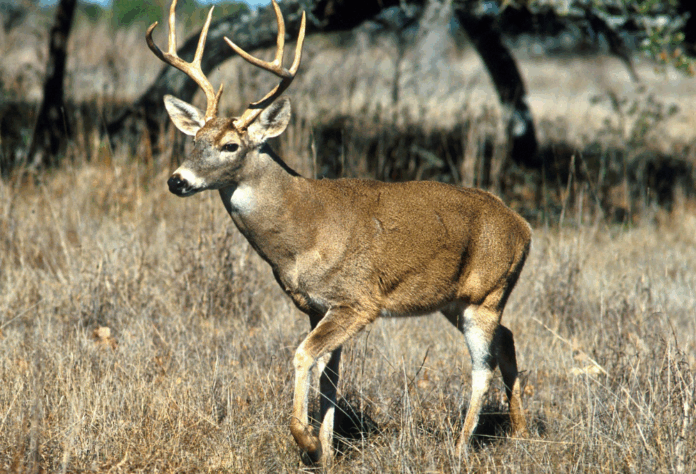
Kory Gann, big game program director with the Texas Parks & Wildlife Department, said white-tail deer hunting is a $9.6 billion industry in Texas and last year 753,000 hunters harvested 837,000 whitetails in the state.

“Hunting in Texas is extremely important economically, and we’ve got the rural economies that depend on it,” Gann said.

Deer are like cattle in that they are prime hosts for NWS. However, there is also potential for many more species of wildlife to become infested, die, and spread this parasite that eats living flesh.

“When we think about New World screwworm on the wildlife side, deer are definitely going to be a host,” Gann said. “But we’re also looking at every warm-blooded animal—rabbits, raccoons, opossums, potentially even turkeys.”

The last time NWS was confirmed in an animal within the United States border, it was in the Florida Keys’ Key Deer population in 2016. The outbreak was contained in about six months, but more than 130 deer died, which amounted to about 14 to 20% of the Key Deer population, according to the University of Florida, The Wildlife Society and Eagle Hill Institute.

Modes of infestation

Gann said two major modes of NWS infestation are common in deer. Bucks are prone to sustaining small wounds during the rut when they spar with other deer, and NWS are attracted to those open injuries and will lay their eggs in them. Gann said the majority of the infestations in Florida’s Key Deer population were in bucks that had been through the rut.

“The only caveat would be that when we look at the Florida Keys, that’s a very tropical environment, and so they didn’t have that lull in screwworm activity that you might see here,” Gann said. “A lot of times that rut period is going to happen during colder weather, so maybe we won’t see the same impacts as they did in Florida.”

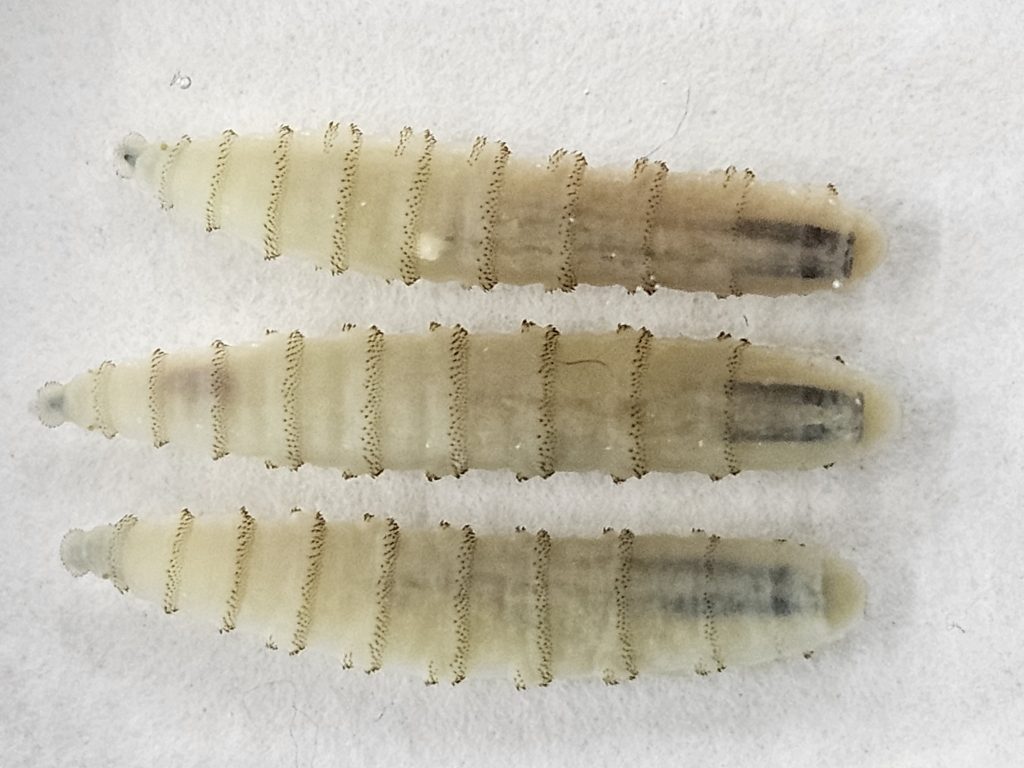
New World screwworm larvae. (Photo courtesy USDA APHIS.)

According to Sonja Swiger, Extension entomologist at Texas A&M University, NWS prefer temperatures between 64 to 91 degrees Fahrenheit, with peak activity occurring around 86 degrees. When temperatures fall below 59 degrees Fahrenheit, they have little to no activity. Many are optimistic about a pause in NWS progression because fall is underway, and winter is just around the corner, but not every part of Texas enjoys those cool temperatures. Some areas will still be under threat even in their coldest months.

“We have portions in south Texas, up the coast, where we would expect activity to probably lessen, but not completely go away,” Gann explained. “It’s almost November right now, and my truck still says 93 degrees.”

The other mode of infestation is in newborn fawns, specifically through the umbilical stump area that is an exposed wound for a period after birth. Fawns and calves are highly susceptible to becoming infested with NWS and have an extremely high mortality rate.

“When fawns are born, it’s typically right in the peak time period of when we would expect New World screwworm to be the most active in the United States,” Gann explained. “When we’re looking at Texas, that’s going to be May, June, July, so it’s definitely a problem. While we don’t have great data on previous infestations in the 60s and 70s on the wildlife side, some of the anecdotal information is that we might lose 80% of our fawns due to New World screwworm infestation.”

“We’ve obviously got a lot more wildlife hosts than we had 50 years ago. The white-tailed deer population then was about a million in the state of Texas, and it’s about 5 million today.”

When it comes to the spread, the big concern is about live animal movement. However, Gann was less concerned with the wild deer spreading the pest than humans moving captive deer or cattle that have been infested.

“White-tailed deer do not move extremely long distances,” Gann said. “If we look at even a yearling in the late spring, they may only move 10 to 20 miles at most, so we’re not looking at a big migration. We’re going to obviously see a lot more movement with the transport of animals, which we’re trying to get a handle on.

Fighting NWS from all sides

The U.S. Department of Agriculture, Texas Department of Agriculture, Texas Health Commission, and TPW are all working together to prevent the spread of NWS into the U.S., but Gann said hunters can also be a piece of the puzzle.

“We’ve got a million white-tailed deer hunters going out into the field in Texas, running trail cameras and sitting in blinds and observing wildlife, and that’s going to be extremely important on the surveillance side to help us detect that initial case, if it should get here, or give ourselves some reassurances that we don’t have it,” he said. “Our general message to hunters is if they see maggots in live animals, they should contact their county TPW wildlife biologist.”

Gann said unknowingly transporting maggots from one location is a major concern when hunters are harvesting deer. Since NWS need living flesh to feed on, soon after that animal dies its body temperature will start to drop, and the maggots will begin to come out of the carcass and look for a new host. He recommends every hunter inspect their kill for open wounds or maggots prior to moving it.

Military Get Free Admission to Top Kansas City Attractions in November (Visuals Included)

0
Crystal Hess

Making a splash and building big thanks for our local community heroes, SEA LIFE Kansas City and LEGOLAND Discovery Center Kansas City are offering free admission during their Military Appreciation Month now through November 30th. Visuals and offer details are below.

Not only can military personnel enjoy free admission now through November 30th, they also receive 30% off for up to six friends and family members so they can enjoy a memorable day together. Families of the community heroes can enjoy a day at the ultimate indoor LEGO playground where creativity never ends and then become ocean explorers by discovering thousands of sea creatures, come face to fin to sharks and rescued sea turtles, and touch real sea creatures.

Offer Details and Timing:

Free admission for military personnel is only available at SEA LIFE Kansas City and LEGOLAND Discovery Center Kansas City during the month of November, and tickets will be available a few days prior to November for military personnel at these websites: SEA LIFE Kansas City and LEGOLAND Discovery Center Kansas City.  Military personnel must provide military ID or pay stub at admissions. Military personnel must purchase a ticket to receive one free admission ticket.

Visuals:

LEGOLAND Discovery CenterVideo & Photo
SEA LIFE: Video & Photos

Understanding Macular Degeneration: The Importance of Early Detection and Specialized Care

0

Age-related macular degeneration (AMD) is one of the leading causes of vision loss among adults over 65. This condition affects the back of the eye where light is processed by macula. The macula is the part of the retina providing sharp, detailed vision needed for reading, driving, and recognizing faces. Two categories of macular degeneration are “dry” and “wet”. This article will focus on dry macular degeneration and therapy options to help slow vision loss from it.

Macular degeneration begins silently. Early symptoms may include mild blurring, difficulty seeing in low light, or the appearance of wavy or distorted lines. Later on, a dark or empty spot near the center of the vision can develop. In advanced stages, central vision may be lost entirely. Regular eye exams are crucial because early AMD can be detected during a dilated retinal examination or with specialized imaging.

A few major risk factors include age, family history, current smoking, and genetics. Individuals with a family history of AMD should be especially vigilant about screening.

Routine eye exams with an optometrist or general ophthalmologist are the first line of defense in identifying AMD. However, once AMD is suspected or diagnosed, referral to a retina specialist is essential. Retina specialists undergo additional years of fellowship training specifically in identifying and treating diseases of the retina and macula. This specialized expertise allows for detailed diagnostic imaging, tailored treatment plans, and access to the latest clinical advances in emerging therapies for AMD.

For patients with intermediate dry AMD, one of the most promising new therapies involves photobiomodulation (PBM) using the Valeda Light Delivery System, an FDA-authorized device. PBM works by exposing the retina to specific wavelengths of light that stimulate the mitochondria—the “powerhouses” of our cells. By energizing these tiny structures, PBM helps improve cellular metabolism and reduce oxidative stress thought to have a role in slowing AMD. Clinical trials, including the LIGHTSITE III and LIGHTSITE IIIB, have shown that PBM can lead to improved visual function and contrast sensitivity in patients with intermediate AMD. These studies support PBM as a safe, non-invasive treatment option for eligible patients. In addition, there are FDA-approved injections for geographic atrophy, a more advanced stage of dry AMD. These treatments aim to slow progression and preserve remaining vision, marking a major milestone for patients who previously had limited options.

For AMD that has advanced beyond the ability to benefit from the therapies mentioned there are still options. Many vision aids and tools are available today that can help optimize remaining vision. Getting a referral to a Low Vision specialist is another step available to help individuals affected by advanced AMD. Early identification and intervention is key. Just like controlling blood pressure or diabetes early to prevent complications later on, addressing macular degeneration before it becomes advanced can make a significant difference in the long run. Current therapy slows down AMD to keep vision better for longer, but does not completely stop or reverse dry AMD. Regular follow-ups and referral to a retina specialist can ensure timely diagnosis, access to cutting-edge treatments, and personalized care to preserve sight for as long as possible.

Dr. Jed Assam is a board-certified, fellowship-trained retina specialist dedicated to the diagnosis and treatment of AMD along with other macular and retinal disorders. He is the founder of VRA Vision in Sioux Falls, a Center for Excellence in Macular Degeneration, and is passionate about patient education and early intervention to prevent vision loss. Follow The Prairie Doc® at www.prairiedoc.org Facebook, Instagram, YouTube and TikTok includes On Call with the Prairie Doc®, a medical Q&A show (most Thursdays at 7pm YouTube and streaming on Facebook), 2 podcasts, and a Radio program (on SDPB, Sundays at 6am and 1pm).