4 Legged Puzzles
Between The SO and LD
I feel sorry for sale managers when they stop a sale and make a long speech telling the crowd the animal in the ring is the best bargain since the Dutch bought Manhattan from the Indians for some beads and $24 in cash. Then after the momentum of the sale has come to a complete stop he’ll hand it back to the auctioneer who, despite the speech, can’t find another bid anywhere.
That’s why it’s important to have an auctioneer and a ring crew who know intuitively when a person is done bidding. If you watch a bull sale closely you’ll see a ring man point to the out gate or shake his head meaning his bidder is done bidding. I used to use my flat hand in an underhand movement like I was pushing the animal out of the ring.
This is especially important in a video sale where the TV time can cost over three grand an hour and you want to sell as many lots as you can while still getting every dollar for the consignor. Now days where we often see bull sales with 500 bulls and a couple hundred females and you don’t want to be wasting any time.
Years ago we were selling a high dollar bull and the auctioneer thought we’d gathered up all the money we were going to get and he said “SOLD” and slammed his gavel down right before a ring man turned in another bid. It was obvious to everyone the bull had sold but the auctioneer made the mistake of saying, “You got me right between the SO and the LD” and he restarted selling the bull. The man who’d obviously already bought the bull once became very irritated and ended up buying the bull for $30,000 more than he’d paid the first time. He told the owner he’d never buy another animal at his sale as long as he employed the same auctioneer.
Guess who got fired?
I was the announcer for a big video company for 20 years and we had six World Champion auctioneers and I was on the block 95% of the time. In all that time I can’t remember two times that we had a similar incident because we had such good auctioneers and excellent ring men. We never wanted to sell a bidder out too soon but we didn’t want to beg and plead all day either. A good ring man knows instinctively when a bidder is done bidding and conveys this information to an auctioneer who usually trusts his judgement.
I read one time that people who’ve had abusive childhoods make excellent ring men because they’d had to read the mind of the abusive parent to know when to steer clear. I think there’s something to this theory because I learned to read my mean alcoholic father like a book to avoid a scolding, a swat or worse.
I enjoyed my 50 years as a ring man and made a study of it. I read a book a long time ago that said only one third of communication takes place through the spoken word and the book explained how to read a person’s tells and non-verbal behavior. If you watch car auctions on the Internet you’ll see practically on every lot a bidder will tell the ring man he’s through bidding but then goes on to bid several more times. To know when he or she really means it a ring man studies the bidder’s posture, gestures, and movements. If the bidder tells you they’re done while covering their mouth, scratching their nose, covering their ears or their eyes, or blinks a lot he or she will probably bid again. But if they offer you an open palm in the direction of the person they’re bidding against he or she is DONE and you can convey this information to the auctioneer with confidence. The same with a man turning to his wife and saying, “I’m through.”
He dang well better be.
Surprisingly when a bidder gets up and says, “I’M DONE!” while walking away that doesn’t necessarily mean he is. I’ve seen countless times where the bidder will stop, turn around and bid again.
Working ring is a lot like playing poker in the wild, wild west only the ring man doesn’t lose any money and no one gets shot. At least so far anyway.
Rooted in health: making plant-based eating work for you
Are you curious about the benefits of plant-based eating? A plant-based lifestyle can improve health and boost energy. Plant-based does not always mean giving up all animal products. The US Dietary Guidelines for Americans (DGA) recommend healthy eating patterns that emphasize fruits, vegetables, whole grains, and plant-based proteins as part of a balanced diet. Also, the DGA and organizations, like the American Heart Association and American Cancer Society, highlight that plant-based eating patterns can do the following:
- Reduce the risk of heart disease, type 2 diabetes, and certain cancers.
- Support healthy weight management.
- Provide more fiber, vitamins, and minerals than the average American diet.
Types of Plant-Based Diets
There are several plant-based diets that fit different approaches. Two DGA-recognized options include the Mediterranean and Vegetarian Pattern diets. The Mediterranean diet emphasizes fruits, vegetables, whole grains, beans, seafood, and olive oil. The Vegetarian Pattern diet includes dairy and eggs, while emphasizing legumes, soy, nuts, seeds, and whole grains. Other plant-based approaches that can align with these guidelines when carefully planned include the following:
- Pescatarian. Includes fish and seafood as primary animal proteins.
- Flexitarian. Mostly plants with occasional meat or poultry.
- Vegan. Excludes all animal products. Nutrients such as vitamin B12, vitamin D, calcium, and iron may require additional attention.
Getting Started
Shifting to a plant-based diet does not have to be overwhelming. Try the following options to get started:
- Fill half your plate with vegetables and fruits.
- Cook a meatless meal once a week.
- Swap beans or lentils for ground beef in tacos or chili.
- Choose healthy fats like avocados, nuts, and olive oil.
- Explore whole grains such as oats, brown rice, or quinoa.
Simple Meal Ideas
- Black-bean tacos with salsa and avocado.
- Quinoa salad with chickpeas and roasted vegetables.
- Whole-grain pasta with marinara and roasted vegetables.
- Overnight oats with fruit and chia seeds.
Key Nutrients to Consider
- Iron. Helps carry oxygen in the blood. Found in beans, lentils, nuts, and fortified cereals. Pair with vitamin C-rich foods (citrus or peppers) to boost absorption.
- Zinc. Supports the immune system and wound healing. Found in beans, lentils, nuts, and fortified cereals.
- Vitamin B12. Supports healthy nerves and red blood cells. Found naturally in animal foods, such as dairy, eggs, fish, poultry, and meat. For those limiting animal products, look for fortified plant-based milks, cereals, or nutritional yeast or consider a supplement.
- Vitamin D and calcium. Keep bones and teeth strong. Found in dairy or fortified alternatives.
- Protein. Builds and repairs muscle and tissues. Good options are beans, tofu, eggs, Greek yogurt, nuts, and seeds.
More Information
Plant-based eating is flexible, affordable, and accessible. By following the DGA, even small changes—such as adding more vegetables to your lunch or choosing a meatless dinner—can make a big impact on your health. For more information, visit the helpful resources below:
Dehydrated foods gaining in popularity
K-State food scientist outlines steps to preparing and storing dried foods.
Dehydrated foods are gaining in popularity as the costs of home equipment become more affordable, said Kansas State University food scientist Karen Blakeslee.
“There are many options in tabletop food dehydrators,” said Blakeslee, who also is coordinator of the university’s Rapid Response Center for Food Science. “The cost of the equipment needed to dry foods depends on the features of each appliance, and its size.”
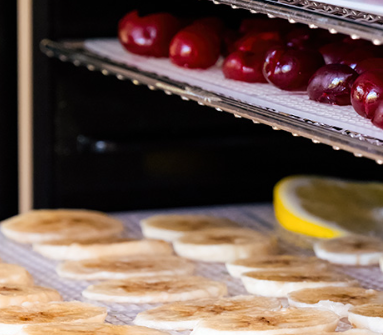
Blakeslee said a food dehydrator uses heat and circulating air to reduce the food’s moisture content to about 20 percent.
“This allows the food to be stored at room temperature,” she said.
Dehydrated foods stored in airtight containers and in a cool, dry, dark place can be stored for up to a year at 60 degrees Fahrenheit, or six months at 80 F. Dried vegetable have about half the shelf-life of fruit, according to Blakeslee.
“Fruit leathers should keep for up to one month at room temperature,” she adds. “To store any dried product longer, place it in the freezer.”
Foods should be rinsed and prepared properly before drying.
“Most vegetables will need to be blanched first for best results,” Blakeslee said. “This is done by steam or water blanching, depending on the vegetable. Blanching stops the enzyme action, which could cause a loss of color and flavor during drying and storage. It also shortens the drying and rehydration time by relaxing the tissue walls so that moisture can escape, and later re-enter more rapidly.”
She adds that many fruits need a pre-treatment to prevent browning.
“If not pre-treated, fruit will continue to darken after it has dried,” Blakeslee said.
Examples of pre-treatments include using ascorbic acid, fruit juice (such as lemon juice), honey or sugary syrup, and steam blanching. The type of pre-treatment varies by fruit.
Meat jerky must be heated to 160 F to kill any possible E. coli bacteria that may be present. Instructions for safely drying meat is available online from the K-State Research and Extension bookstore.
The choice to dry foods or can them “is a personal preference, and it may depend on your storage options,” Blakeslee said. “Dehydrating foods typically takes less space, but it does take more time to dehydrate foods, though there is not as much equipment requirements.”
Blakeslee said freeze drying is another option for preserving and storing food. Compared to dehydrated food, freeze-dried food maintains more of its nutrients throughout the process, and once rehydrated, is similar in nutritional value to its fresh counterpart.
However, she cautions that freeze drying does not kill bacteria that may be present: “So, if contamination is present before the food is freeze dried, it will remain. But freeze-dried foods are very dry, as 90-95% of the moisture is removed and the food can be stored for as long as 20-30 years.”
More food safety tips are available online from K-State’s Rapid Response Center for Food Science. Blakeslee publishes a monthly newsletter, called You Asked It!, with timely tips for safe food in and out of the home.
More information is also available at local extension offices in Kansas.
See the three most popular dog names in Kansas and across the U.S
The word “Bella” means “beautiful” in Italian and Spanish.
Bella is now the most popular dog name in Kansas, said a study conducted this year by U.S. News & World Report, which had also done a study in 2023 identifying the most popular dog names nationwide and in each state.
According to USA Today, Bella became one of the nation’s most popular dog names after a character with that name was the heroine in the “Twilight” book and movie series. Those first came out in 2005 and 2008, respectively.
Which dog names are most popular nationally?
Nationwide, the most popular dog name is Luna, followed in order by Bella, Charlie, Max and Daisy, said the U.S. News & World Report website.
The same names had been on the 2023 list, but in a different order.
The order that year, from first to fifth, had been Bella, Luna, Max, Daisy and Charlie.
Which dog names are most popular in Kansas?
Tied for second place after Bella as the most popular dog names in Kansas are Luna and Milo, U.S. News & World Report said.
Coming in right behind those names is a tie between Millie and Rocky, it said.
For states adjoining Kansas, the survey said the most popular dog names are as follows:
- Bella in Missouri, followed by a tie between Buddy and Milo and a tie between Daisy, Lucy and Luna.
- Max in Nebraska, followed by Bella”and then a tie between Lucy and Izzy.
- Luna in Colorado, followed by Bella and then a tie between Bailey, Daisy and Lucy.
- Lucy in Oklahoma, followed by Atlas and then a tie between Bella and Luna.
How was the study conducted?
A survey conducted this year by the American Pet Products Association concluded 68 million U.S. households have a dog.
U.S. News & World Report said it compiled its list of the most popular dog names using about “80,000 data points from a third-party pet insurance industry partner in March 2025, containing dog names registered from January 2020 to February 2025.”
The U.S. News & World Report article didn’t identify the insurance industry partner.
“The data points analyzed included dog names and state residences, which were filtered by state and ranked to show the most popular dog names in each state,” U.S. News & World Report said.
“This study did not consider names within the data set with various, similar spellings,” it added. “All spelling variations for the same name (e.g., Abby and Abbie) were counted and ranked as separate names.”