Wednesday, January 21, 2026
Home Blog Page 136

Hillbilly Hunter Hacks

0

One of the buzzwords of the 2000’s is “hack.” Now hack can mean something very bad, like your computer getting “hacked,” meaning someone has digitally broken into your information and now everyone in the township somehow knows the secret recipe for Aunt Agnes’s famous potato salad and Uncle Oscar’s deer jerky marinade, (even though they were both written on the inside of the kitchen cabinet door.) “Hack” can also mean a DIY shortcut of some sort, like how to use a roman candle to light the neighbor’s wheat stubble on fire without even leaving your yard. But I digress, so now on to some hunter hacks I found, and some hunter hacks of my own.

More has probably been written about different ways to start a campfire than about any other outdoor subject. First off, no one in the crowd I hang with is gonna’ have need of a campfire except for rare camping trips with the family, then we’ll start our fires with those neat gizmos called matches and lighters. We all have Little Buddy propane heaters in our deer blinds, and none of us have the ambition to climb Mount Everest or do anything where emergency campfires might be needed. Never-the-less, I found hacks about using corn chips and crayons as fire starters. Sure, they work fine, but what self respecting hunter is going to waste good corn chips to start a fire. Eat the chips and light the empty bag, it works just as well. And as far as lighting crayons to start a campfire, once again it works great and they burn for a long time, but no hunter worth their jerky would dream of wasting a perfectly good crayon just to start a fire. They should be kept for things of greater importance like scribbling messages and phone numbers on the wall of your deer blind or for labeling packages of meat in the freezer so you can tell this year’s venison back strap from the muskrat meat kept for next year’s coyote bait. Another interesting campfire starting hack I found involves dryer lint; it seems dryer lint burns very well and starts very easily. It can be stuffed into empty toilet paper tubes or merely carried in a Ziploc bag and used right from there. Now we’re talkin’, something we all can relate to. I mean who doesn’t save all their dryer lint and empty toilet paper tubes? Instead of emptying them into the recycle container and trash every couple years, make fire starters from them! But in all my trolling of the almighty internet I did not find one reference to the most trustworthy tried-and-true method of starting a campfire ever, even used by our Native American forefathers. From anywhere in Kansas, you would have to travel forever to deer hunt where there are no cattle nearby, SO LIGHT A DRY COW TURD.

The next most talked about topic in the outdoors, especially relating to survival, is how to build a shelter. Let me offer a hillbilly hack for building a shelter. All hillbilly outdoorsmen worth their pork rinds will have a serious collection of tarps, and what a better use for a tarp than an emergency shelter. Harbor Freight has them in all sizes and you can occasionally get a small one “free with any purchase,” so there’s absolutely no excuse for not having one to carry with you on all outdoor excursions. A word of caution here; it’s not in your best interest to remove the tarp covering the hole in your trailer house roof. Anyway, there are a variety of ways to deploy your tarp/shelter. If you’re fishing, I’m sure you’ll have dynamite with you, so merely drop a stick into a small hole you dig in the ground, light her up and you’ll soon have a nice cave that you can crawl into and cover with your tarp.

No friend of mine would be caught dead on a hunting or fishing trip without a menagerie of plastic five-gallon buckets, and the uses for them as hillbilly hunter hacks are endless. You can buy kits to turn one

into a “luggable loo,” and even cut a notch lengthways in a pool noodle and snap it around the top for a soft seat while you heed nature’s call. Spray paint a few more green, drill a small hole at the bottom and put them at the base of each “illegal pharmaceutical” plant you “just happened to find growing” along the river as a way to water those beauties. Five-gallon buckets make great hillbilly mouse traps too, for the deer blind or even the living room. On each side of the bucket near the top, drill a hole big enough for a broom handle to slide through and fit loosely enough to spin. Fill the bucket with water or used motor oil (which I’m sure you will have by the barrel-full,) put a glob of peanut butter in the middle of the broom handle and viola; when a mouse walks the broom handle to get the peanut butter, it will spin and dump the little blighter into the slurry below. If you keep the TV volume low enough you can hear the splash each time and reward the cat with a live mouse.

I’m certain the list of hillbilly hacks, whether for hunting or not is endless, and I’ve probably just scratched the surface here. Maybe another book is in order, “Hillbilly Hunter Hacks for the Deer Blind, Boat and Living Room.” For all my loyal readers who want one, let me know and I’ll reserve you a signed copy. Continue to Explore Kansas Outdoors!

Steve can be contacted by email at [email protected].
Name Dropping

0
Thayne Cozart
Milo Yield

Recently I wuz browsing the internet when I came across a discussion group which had a theme, “The Most Famous Person You’ve Ever Met.” Folks in the group name dropped a wide range of people they personally considered “famous.”
That got me to thinking. During my 82 years — after living in many places, after traveling to many places, and after many career experiences as a columnist and ag journalist — I’ve met quite a few folks that probably carried the “famous” or semi-famous label.

So, for this column, I’m gonna become a member of the Name Dropper Club. Some readers might consider it bragging, but it ain’t. It just happened. Here are some of the so-called “famous” persons that I’ve personally interacted with, not just seen from a distance.

Country Music & Humorists

• Willie Nelson — interviewed him prior to a Farm Aid Concert in Ames, Iowa. Very humble and down-to-Earth guy.

• Roy Clark — hunted with him in a celebrity quail hunt. Very friendly guy and a good shot. But he didn’t help clean the birds. His side-kick Vernon Sandusky hunted, too.

• Jerry Clower — aggie humorist, sat next to him at the head table at convention in Wichita. Could hardly get him to engage in conversation. Aloof. I think a phony nice guy.

• Baxter Black — close friend with Bax. Visited him at his ranch in Benson, Ariz., and posed with him for a picture in a brand new red two-holer privy he’d build. Genuine, all-around nice guy.

• D. B. Shepherd — country music singer, played rummy with him and “The Afternoon Bozo” in Shepherd’s tour bus at the Bates County Fair in Butler, Mo.

• Dale Summers — “The Afternoon Bozo” radio personality at 61 Country Radio in Kansas City in the 1970s-80s. We carried an ongoing, irregular give and take on his show.

•Shelly West — C/W female singer, visited with her during the National Farmers Organization convention in Oklahoma City.

• Janie Fricke — C/W female singer, hired her for farm show exhibitors’ party in Pittsburg, Kan. She choked on a moth while singing from the back of flatbed truck.

• Kenny Price — C/W singer and Hee Haw TV show regular, played game of 8-ball pool with him at Silver Saddle Supper Club in Parsons, Kan.

• Barbara Fairchild — C/W female singer, talked with her at the Silver Saddle Supper Club prior to her singing.

• Tracy Bird — visited him after he finished entertaining for candidate George W. Bush during a Republican presidential straw poll event in Ames, Iowa. Met him again after he entertained years later at the Granada Theater in Emporia, Kansas.

Journalists & Educators

• Norman Borlaug — Nobel Peace Prize winning agronomist, interviewed him about his extraordinary wheat breeding program in Pullman, Wash.

• A. D. “Dad” Weber — renowned head of the Kansas State University Animal Sciences Department, portrait hangs in Saddle And Sirloin Club in Chicago, sat next to him and visited on an airplane trip from Chicago to Kansas City.

• Pat Buchanan — national syndicated columnist, presidential speech writer, and brief Republican candidate for president, visited with him about his campaign in a booth at a diner in Boone, Iowa.

• Rod Turnbull — acclaimed Kansas City Star Farm Editor, met with him many times at farm events. Extremely nice and true professional.

• Ward Sinclair — Washington Post Farm Editor, visited with him at a table in the National Press Club in Washington, D.C. We were attending the annual convention of the National Farm Editors’ Association.

Politicos, Administrators, Bureaucrats

• Kansas U.S. Senator Bob Dole — when he invited himself to the Four State Farm Show in Parsons, Kan.

• North Carolina U.S. Senator Sam Irwin — head of the Nixon Watergate investigation, visited with him in the western art exhibit at the Kansas Livestock Association convention in Wichita. Pleasant and down-to-Earth guy. Speaker at the event.

• U.S. Rep. Kiki de LaGarza — Democrat Texan, tried to visit with him at the National Press Club in Washington, D.C., but he was too inebriated to carry on a conversation.

• James A. McCain — president of Kansas State University.

• Robert Kamm — president of Oklahoma State University.

• Pete Williams — National Leader of 4-H Clubs, worked with him in Oklahoma before he went to Washington.

• Secretaries of Agriculture — at various meetings: John Block, Orville Freeman, Ann Veneman, Dan Glickman, Tom Vilsack, Bob Bergland, Earl Butz.

Ag Leaders

• Wayne Cryts, — farmer from Puxico, Mo., and a national leader of the American Agriculture Movement during the farm protests in the 1980s. Interviewed him several times.

• Devon Woodland, Steve Halloran, and Paul Olson — three presidents of the National Farmers Organization, worked with all three.

• Walter Merrick — Quarter Horse Hall of Fame member, QH breeder, owner and trainer, from Sayre, Okla., bred the first AQHA Futurity winner, wrote cover story and picture of him for the Oklahoma Farmer-Stockman.

• Frank LeRoux — former Commodity Credit Corporation administrator for the USDA during the Lyndon Johnson administration, prominent Walla Walla, Wash. farmer, business man and author, met him at his home to plan to achieve parity farm prices for farmers through the National Organization for Raw Materials.

Business Notables

• H. L. Hunt — wealthy oil man, father of Lamar Hunt, met him at the National 4-H Club Congress in Chicago. Told me he still took brown bag lunch to work office.

• Ms. Walgreen — one of the founders of Walgreen Drugs, also at the National 4-H Congress in Chicago. We talked briefly in the lobby.

• Warren Staley — former CEO of Cargill, sat next to him and talked during a college football game.

Others

• Debbie Barnes — former Miss America from Moran, Kansas, preceded her in school five years, father was a John Deere dealer, met her as Miss America in Chicago at National 4-H Club Congress. She was commencement speaker for a daughter’s high school graduation. My mother-in-law was her elementary school teacher.

• Jim “Catfish” Hunter, baseball Hall of Fame member and Farm Crisis of the 1980s advocate, shared the speakers platform and luncheon with him during a “Farm Save Rally,” at Elizabeth City State University, in North Carolina. Pleasant and engaging fellow.

***

Enuf name dropping. Words of wisdom for the week: “Experience is a hard teacher because she gives the test first and the lesson afterwards.” — Vernon Sanders Law.

Have a good ‘un.

Even in Kansas cattle country, locals are opposing a mega feedlot

0
credit -NDSU Ag
The cattle feedlots on the western side of Kansas produce a significant amount of the beef in your grocery store. But a small town in the region is now opposing a feedlot because of health and environmental concerns.

PAWNEE COUNTY, Kansas — The western side of Kansas is a great place to produce beef.

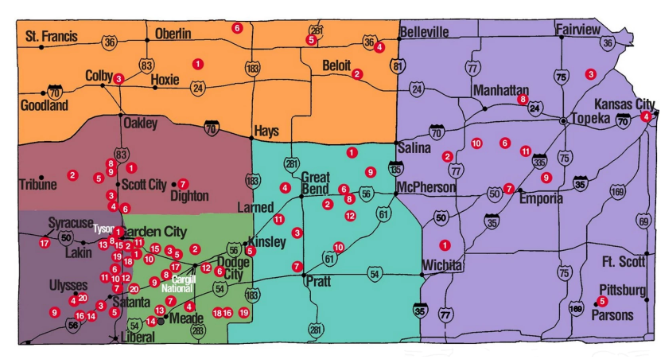
It has wide open spaces that seem to go on forever and low humidity. The region has embraced its beef culture and is now home to 75% of the state’s feedlots. These facilities are where cattle are sent to be fed a high-energy diet to gain weight before being sent to a beef packing plant.

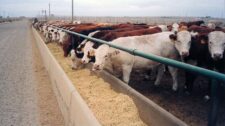
Outside of small towns these feedlots look like miles of fences with cattle standing end to end. But some people have started to be wary of these expansive developments.

“It’s good to live in beef country, as long as it ain’t too close. They’re able to stir up enough dust and stink,” Merrill Cauble said.

Cauble is a farmer who lives near the town of Larned in Pawnee County. He has been skeptical of the increase of feedlots near where he lives.

Pushing back against the norm

The company Innovative Livestock Solutions has feedlots across central Kansas and Nebraska. There are three in Pawnee County with a combined capacity of 72,000 cattle.

They are looking to expand and proposed a new facility that can hold 88,000 cattle. That’s a lot of livestock for a county with only about 6,000 people. It would be one of the biggest feedlots in Kansas.

This map shows where the feedlots in Kansas are condensed, with most of them in the southwest.

All those animals are estimated to produce over 5 million pounds of manure every day. Beef cattle eat high protein diets, which can produce nitrogen heavy manure. That poses a risk if it gets into waterways or seeps into the aquifer underground where people get their drinking water.

“It’s not going to do the community any good whatsoever, and that’s why we decided to push back,” Cauble said.

After the Kansas Department of Health and Environment reviewed the feedlot’s plans, the agency held a public hearing in Larned to see what the town had to say about it.

Cauble teamed up with the Kansas Sierra Club, an environmental advocacy group. The duo along with those critical of another huge feedlot were vocal about their concerns to KDHE.

“These feed yards have been polluting our waters for years, and their recommendations haven’t improved the problem to the extent to where we have safe nitrate levels,” Cauble said.

They gained quite the following of locals questioning the safety of another large feedlot near the community.

Something in the water

Pawnee County and other central Kansas counties already have an established history of high nitrate levels in their groundwater.

The soil in this region is very sandy, so things can easily leak through. The community also sits above the Ogallala aquifer. Towns like Larned rely almost exclusively on the aquifer for drinking water.

Late last year, student researchers from three Kansas colleges found that nitrate levels in private wells in south-central Kansas are as much as five times higher than Environmental Protection Agency limits for healthy drinking water, which is 10 milligrams per liter.

High nitrate levels in water can cause “blue baby syndrome” where children under six months have their blood deprived of oxygen. There are also some studies that link high nitrate levels with increased risk of some colon and kidney cancers.

The researchers say the pollution is likely due to fertilizer leaking into the groundwater. But some Larned residents believe that fresh feedlot manure is contributing to that as well, but it’s not clear if that has been proven.

According to the EPA, Kansas ranks second in the nation in estimated area with higher levels of nitrates in drinking water than permissible.

The EPA estimates that 5% of Kansans have private, unregulated water wells.

Kansas State University student Chase Glasscock said most of those Kansans are farmers who keep the economy going, and neglecting their needs could hurt the state.

“If we’re not taking care of them, then we’re not taking care of ourselves,” Glasscock said when presenting his data to the public in November.

Response from the health department and company

KDHE said in an email that the reason the ILS feedlot was approved was because it met all the statutory and regulatory requirements. But the agency did acknowledge the elevated risk the region has due to its soil composition.

To try and address the community’s concerns, KDHE provided stricter guidelines than the minimum to control pollution. That includes seepage requirements for the manure lagoon and protections for groundwater much greater than required by state law.

“We are committed to our role in protecting the environment but also acknowledge that owners of feeding facilities have rights that have been set in law. We are only able to enforce requirements that we have jurisdiction over,” KDHE spokesperson Mitchell Osterlund said.

ILS also expressed an interest to go above and beyond and adhere to more stringent standards tailored to this unique situation.

ILS sent Jon Skelton, their chief financial officer, to the meeting to calm the waters.

Skelton told the attendees that a significant number of ILS shareholders live locally within or near the county.

ILS didn’t respond to a request for comment.

There have been proponents of the feedlot who have been surprised by the negative backlash. A few spoke at the public hearing and have been trying to make the case that this feedlot will create economic opportunities.

It’s estimated that the feedlot will create 70 jobs for the town, but also could provide a strong market for nearby farmers and agribusinesses.

Pawnee County has been steadily losing its population for decades. Some here are eager for new business and development.

In a press release, ILS estimated it will contribute approximately $50 million in added valuation to Pawnee County’s tax base.

With the permit approved, construction is planned to start later this year, with the facility operating by 2027

Where to go from here

Felix Revello is a chapter delegate for the Kansas Sierra Club near Larned. He has been leading the charge in opposition to the feedlot.

“We want the permit to operate the proposed feedlot withheld until after any water and air pollution from existing feedlots is researched and remediated,” Revello said.

Revello and Cauble spent their time at a local festival handing out a petition to appeal KDHE’s approval of the feedlot’s permit. With over 50 signatures and a lot of firsthand stories about health and environmental concerns with a feedlot of this magnitude, Revello delivered the information to Gov. Laura Kelly’s office.

“Urban areas would not tolerate this level of health risk and pollution,” Revello said. “Why do we constantly ask our rural residents to?”

Calen Moore covers western Kansas for High Plains Public Radio and the Kansas News Service. You can email him at [email protected].

The Kansas News Service is a collaboration of KCUR, Kansas Public Radio, KMUW and High Plains Public Radio focused on health, the social determinants of health and their connection to public policy.

Adopt wild horse at Svaty Ranch wild horse pasture in Ellsworth

0

ELLSWORTH – The Bureau of Land Management will offer the public an opportunity to adopt a wild horse at an adoption event held at the Svaty Ranch Public Off-Range Pasture on Saturday, June 21.

The event will run from 9 a.m. to 1 p.m. and will feature 12 yearling and 2-year-old wild horses available for adoption. Pictures and more information about the wild horses available for adoption can be found on Facebook. The Svaty Ranch Public Off-Range Pasture is located at 1016 Avenue J, Ellsworth.

BLM staff will be onsite to assist with and approve applications. To qualify to adopt, applicants must be at least 18 years old, with no record of animal abuse. Qualified homes must have a minimum of four hundred square feet of corral space per animal, with access to food, water, and shelter. A six-foot corral fence is required for adult horses; five-feet for yearlings; and four-and-a-half feet for burros. All animals must be loaded in covered, stock-type trailers with swing gates and sturdy walls and floors.

Find more information about the BLM’s Adoption and Sales programs.

Bureau of Land Management

0

I recently listened to a brief video by a father who helps tuck his two young daughters in bed each night.  He talked about how, when he tucks them in bed, he likes to ask them, “What was the best part of your day?” He wants to remind them to be thankful for the good things in their lives.  


The dad told the story of a Sunday when their family had attended church in the morning.  Afterwards the mom prepared a delicious lunch which included dessert.  During the afternoon, the family watched a movie and played video games together.  The dad described it as an overall enjoyable day.  


So, that evening, when he was telling his daughters goodnight, he asked one of girls about “the best part of the day,” and she immediately replied, “lunch!”


When he asked her, “why,” she replied that it was because they had “all talked together.”


Then he asked his other daughter the same question.  “What was the best part of your day,” and she also replied, “lunch!”  When he asked her “why?” she replied, “because we all sat around the table and laughed and told stories!”  


Perhaps the dad expected the daughters to mention the delicious dessert their mom had made or the movie they had watched.  But instead, the highlight of the day was sitting around the table after lunch, talking, laughing, and telling stories!


That father’s story reminded me of my own childhood memories of eating and talking around a big table in years past where I grew up in Tennessee.  There were 10 of us—my parents, seven kids, and my grandmother.


We had hot homemade biscuits in the morning and cornbread at noon and for supper.  And we also laughed and had many conversations around our old table.  


Our daddy was a preacher and took the scripture about not too much “foolish talking and jesting” seriously, so we seldom let our “foolishness” get out of hand.  But we still had fun talking and telling stories—special time which made special memories.  


After I grew up and married, I bought a sturdy old table with six leaves.  We could seat 18 people comfortably around it and “squeeze” in a few more.  On many occasions, our family, extended family, and friends filled that table plus another table in the kitchen!  Those fun times and conversations are now priceless memories.  


One of Tom and my favorite “table” memories was when Devin, one of Tom’s grandsons, was ten years old.  We all sat around my big table after a Thanksgiving meal and told stories and laughed.  Devin listened attentively, soaking up the stories!  After a bit, Devin piped up with, “We need to have more family times like this!”


My daughter Misty told me another “table” memory.  It happened when she, her husband Bryan, and their family were moving from one house to another.  They worked all day moving their belongings and had moved the beds into the new house so they could sleep there that night.  By then, it was almost midnight, so they decided to finish moving the next day.  


At that time, their oldest child Samuel was about four years old.  Sam went to his parents very distressed and was ready to cry.  He pleadingly asked his parents, “But how can we eat without a table?”  So, his dad made another trip and brought the table and chairs to their new home so they could eat together the next morning.


Sometimes we do not know how valuable taking time to talk and share stories may be for younger family members.  Or we may not realize that our presence and time spent around a table (or even without a table) may be a gift to others!  


So, dads, moms, and others in the lives of the younger one, those little ones are watching you.  Your example is important!  So, don’t underestimate the importance of the love and time you invest in the next generation.


Talking, laughing, and storytelling around a table can leave lasting impressions and memories.  But like Sam said, “How can we eat (and talk) without a table?”


Wishing a late happy Mother’s Day and Father’s Day to those reading this!


[email protected]