Monday, January 26, 2026
Home Blog Page 205

Kansas county features stunning tour of redbud trees and barn quilt creations

0
By Sheridan Wimmer

Kansas Living Magazine

Many of us have memories of our grandmas or moms who enjoyed quilting. Their hands were never still – always with a needle in their hand or a sewing machine pedal at their foot. Like reading physical newspapers, quilting is an art form that may be dwindling over generations, but it isn’t gone – especially in places where it’s treasured.
In Sedan, the county seat of Chautauqua County, quilting, pottery and small-town charm make up a patchwork of Americana worth saving. Cousins Jolynn Reed and Kathy Ebersole work to save the spirit of their town and the legacy of quilting through the annual Redbud and Barn Quilt Tour every third weekend in April.
“The first tour was in 1961, and I remember how much fun I’d have at it over the years,” Reed says. “I was a military kid, so I moved around a lot, but I’d come back and stay at our family farm, especially for the annual Redbud Tour.”
Reed and Ebersole are the organizers of the tour and are both artistic. Reed is a photographer and Ebersole teaches pottery and has barn quilt painting classes, which are held at the Kurtis Art Center in Sedan. Although they’re cousins,  they act more like sisters, often finishing each other’s sentences and creating patterns of conversation similar to the process of completing a quilt.
“She’s the perfectionist and I’m, well, not,” Reed laughs. “We play off of each other really well.”
The history of barn quilts
The idea of barn quilts originated nearly 300 years ago with the arrival of immigrants from Europe. Starting in Pennsylvania, barn quilting (painting) moved its way across the United States and became a landmark in sharing directions or finding a particular family.
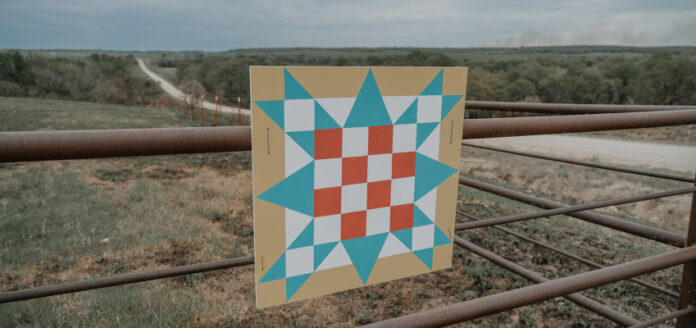
Barn quilts preserve a time in our history when barns and quilts showcased a community’s heritage. While barn quilts can represent something family-specific, they can also resemble a traditional quilt pattern like Jacob’s ladder or Compass Star.
The year-round barn quilt tour
The Redbud and Barn Quilt Tour occurs every third weekend of April, although the barn quilts can be toured year-round.
“We have more than 60 barn quilts that people can tour anytime,” Ebersole says. “The landowners have always been incredibly gracious to allow us to hang the barn quilts on gates that can be viewed from the road.”
Ebersole owns a unique shop in downtown Sedan, Katz Custom Jewelry, where she sells jewelry she creates. Maps of the route are available at her store and many others on Main Street in Sedan during store hours. The tour kit includes different route options in addition to the barn quilt tour, like a “Wild, Wild West” tour that takes you on country roads to the Oklahoma border town of Elgin, with its rugged slogan, “A town too tough to die.” The route also showcases an old arch bridge and Stoney Point Lookout, one of the highest points in Chautauqua County.
The self-guided tour through the countryside of Chautauqua County is breathtaking – with views of greening trees, cattle and cropland – the barn quilts, which are created by volunteers in Chautauqua County, offer a bonus to the route where you rarely see other vehicles.
Catching the redbud trees in bloom depends on Mother Nature’s timeline – some years the third weekend in April is perfect while in other years, like 2024, the blooms happened early. The packet of routes you can pick up in Sedan includes 28 stops to see redbud trees – whether they’re blooming or not.
The third weekend of April events
What does occur on the specific dates each third weekend of April is a photography, art and pottery display, plus a barn quilt painting display, offered by Ebersole at the Kurtis Art Center on Saturday. At a main street store, The Red Buffalo, you can stop for a free redbud tree sapling, a route kit and a barn quilt bingo map on Saturday and Sunday.
The Sedan Kansas Chamber of Commerce and Sedan Area Economic Development Committee are supporters of the event and offer an opportunity for businesses to place a sticker on a bingo card – an effort to stimulate the downtown economy at 16 locations.
Once a participant gets a bingo, they turn it back in at the Kurtis Arts Center for a chance to win prizes.
Growing for the future
Reed and Ebersole are passionate about Sedan and the memories they’ve made there. Reed thinks about the impact of the Redbud and Barn Quilt Tour and gets emotional when she thinks of her grandmother and what she’d think of the event now.
“I just know she’d be so proud of the growth of Sedan,” she says. “This event is a legacy, and we hope to grow it for future generations to continue to enjoy.”
Just as our grandmas and moms weave together threads of art in quilts, Reed and Ebersole are uniquely connecting the growth of Sedan to the simpler way of life through the barn quilt tour, stitching together community pride, rural heritage and artistic expression.
Stay updated on the next Redbud and Barn Quilt Tour on the Facebook group.
Where to eat:
Be sure to visit Gunnar’s Bourbon for lunch – bourbon not required, but a tasting is responsibly encouraged. Buck’s BBQ is a great location for dinner or Granny Wolfe’s Green Door Café for home cooking specials.
Where to stay:
Grandma’s Houses offers two locations where you can stay comfortably within Sedan. For other locations, visit www.cityofsedan.com.

https://kansaslivingmagazine.com/articles/2025/02/03/kansas-county-features-stunning-tour-of-redbud-trees-and-barn-quilt-creations

“Businesses for Babies”

0

When businesses support working parents, they’re not just boosting their bottom line – they’re helping prevent child abuse and neglect. In South Dakota, 72.5% of all children under age six have all available parents in the workforce, making family-friendly workplace policies crucial for our state’s families.

Research shows that workplace policies like flexible scheduling, paid family leave, and childcare assistance significantly reduce major risk factors for child maltreatment by decreasing parental stress and providing essential economic stability. When parents have the flexibility to attend school events, care for sick children, or work from home when appropriate, it strengthens family bonds and creates more nurturing environments. Access to quality childcare and living wages helps ensure families can meet basic needs without the overwhelming stress that can lead to crisis.

Prevention is far better – and far less costly – than intervention after abuse occurs. Studies show that every dollar invested in prevention can save up to seven dollars in future costs related to child welfare services, healthcare, and criminal justice. By creating supportive work environments, businesses play a crucial role in building the safe, stable, nurturing relationships children need to thrive. These investments in families today help develop healthier communities and a stronger workforce for tomorrow.

The Center for the Prevention of Child Maltreatment’s “Businesses for Babies” campaign highlights South Dakota companies that have adopted family-friendly policies. By showcasing businesses that prioritize family well-being through flexible schedules, parental leave, and childcare support, the campaign aims to inspire more companies to implement similar policies. Together, we can create a business culture that strengthens families and protects our most vulnerable citizens – our children.

Christina Young has been an influential figure in the child welfare field for over a decade, dedicating her career to the well-being of children and families. She directed an in-home family services program covering 30 western counties in Iowa, demonstrating her commitment to community-based support. Christina has a bachelor’s degree in psychology and a master’s in human services administration. Follow The Prairie Doc® at www.prairiedoc.org, Facebook, Instagram, Youtube and Threads. Prairie Doc Programming includes On Call with the Prairie Doc®, a medical Q&A show (streaming Thursday’s on Facebook), 2 podcasts, and a Radio program (on SDPB), providing health information based on science, built on trust.

Net-Zero Cows

0
lee pitts

The liberals who’ve been trying to legislate the weather lately now say that we are facing a “national climate emergency” and to hear them rant and rave it’s all the cow’s fault. Universities and greenie groups are insisting that we need net-zero cows so we won’t face “the sixth mass extinction”. These net-zero cows will be “more climate friendly” because they’ll contribute zero methane, but one wonders, what would a net-zero cow look like?

Believe it or not there are efforts afoot to come up with an EPD that ranchers can use to breed less gaseous cows. It’s been predicted that such an EPD might be five years away but it could be accelerated if a corporation like McDonalds suddenly wants beef from climate friendly cattle. Then the Big Four packers will supposedly pay a premium to ranchers who produce net-zero cattle. So instead of breeding for cattle that taste good, grow fast and efficiently, and calve easily we will all be breeding for cattle that burp less.

These new net-zero cows will probably weight 600 pounds because smaller cattle produce less methane. According to scientists net-zero cows will wear an on-board digester gas mask on their face. But if the gas mask covers the cow’s entire face how will they eat? Without any feed the cows will die making them net-zero because dead cows don’t burp all that much. This would really please the greenies who dream of ridding the world of cows.

Although this is counterintuitive, we’re told that cattle on grass actually produce 20% more methane than cattle in a feedlot. Grasses supposedly produce more methane than corn. So we can’t just spray the feed in a feedlot bunk with bicarbonate of soda because we have not addressed what we’re going to do about the grazing of cows. I checked on-line and Gas Ex Maximum is $17.99 per bottle and Beano Ultra 800 is $20.79 so we’d need one endless line of tanker trucks full of products like Pepto Bismol, Extra Strength Mylanta or Imodium to spray all the grasslands in America. I suppose you could distribute it in a block form but it’s hard enough to get cows to lick their mineral block so I don’t think they’ll be lining up to dine on the Kaopectate Extra Strength Gas Relief block.

Speaking of things cows wont eat, seaweed isn’t exactly the cow’s version of filet mignon and yet it has also been put forth as another answer to gaseous cows. Because I live by the ocean I gathered up a bunch of prime fresh seaweed and dumped in front of 100 nearly starving cows. Not only would they not eat the wet seaweed they peed and pooped on it to show their disdain. They wouldn’t touch the dried seaweed either. And not many cows are raised right on the ocean so there’ would be the additional cost of transporting the stuff. I guess you could make the seaweed in bolus or pill form but who wants to gather their cows everyday to come up with a solution in search of a problem?

Another way a rancher might produce net-zero cows is by leasing out his or her land for solar arrays and windmills and acquiring carbon credits in that manner. Their remaining cows will produce just as much methane as always but the rancher will be able to make his cattle net-zero with the greenie’s stamp of approval.

Of course wealthy ranchers will do what big corporations do when faced with the questionable climate change crises: they’ll just buy carbon credits on carbon trading platforms to make Wall Street con artists and former Vice President Al Gore even richer.

Personally, I think the idea that our cows can cause the climate to change half way around the world is the biggest con game since The Sting. If you don’t think so consider this: I looked at several sources and their guess as to how much the methane produced by cows contributed to global warming. The answers varied from three percent to thirty percent! So it’s not exactly settled science and breeding for net-zero cows with the use of an EPD for methane production is the dumbest idea I’ve heard of since the motorized ice cream cone.

It’s like treating a cold with chemo.

The Color Of Tractors

0
lee pitts

I looked around the cafe, saw that the rancher’s table was filled and then noticed there was a seat at the farmer’s table, so I considered joining them. I mean how bad could it be? So I went over to the dark side and asked the clodhoppers if they’d mind if I joined them?

“Sure, pull up a seat,” said farmer #1. “We have no prejudices here. Your ball cap may advertise a bull while mine advertises a CAT. You go to Denver to see all the newest squeeze chutes, while we go to Tulare’s Farm Equipment Show to see what’s new in heavy metal.”

“Some cattlemen have Red Angus,” said farmer #2, “and we have red tractors.”

“Yeah,” chimed in farmer #3, “We have a lot in common with you cow pokes. You have trouble finding good cowboys while we have trouble finding good tractor jockeys. And we’re both in a bad mood when we pour out the rain gauge and four inches of dust falls out.”

“And we’ve been invaded with imports,” said farmer #4. “You have Charolais from France, Simmental from Switzerland and Kobe from Japan while we have Kubota’s from Japan, Argo made in Europe and even some John Deere tractors made in China. America is dominated by John Deere Green while Registered Black Angus wear the pants in your family.”

I countered, “But many of our black Angus are bred to cattle of another breed.”

“Are you kidding, farmers invented crossbreeding,” said farmer #4. “Have you ever heard of a tangelo, a limequat or an orangelo?”

“Yeah, chimed in farmer #1, “and it’s a common sight in farm country to see a green John Deere pulling a blue New Holland baler. If that’s not crossbreeding I don’t know what is.”

“I’ll tell you what it is,” said the grumpy Oliver guy. “It’s heresy. That’s what it is!”

“That’s just because you’re so red that you own 35 antique Oliver tractors,” said the county extension agent who’d joined us. “There’s another difference between farmers and ranchers. You don’t see ranchers preserving taxidermy bulls or entering them in the Fourth of July parade. Generally, ranchers don’t have huge shops with bridge cranes, milling machines, expensive tool chests filled with Snap-On tools and piles of used tires everywhere. And you won’t find any horses on farms much any more, except in Amish country.”

“Now that I think of it,” I said, “ranchers and farmers do have some equipment in common. “We’re both starting to use drones, there’s usually a Bobcat or a mini-excavator on most big ranches and we both use ATV’s. And all of us are just like firefighters in that we’re always putting out fires. My bull might be shooting blanks while you’re tractor may not start. A rancher might have to get up in the middle of the night to check the bred heifers while a vegetable farmer checks on pumps and generators around the clock.”

“Yeah, I suppose we do have a lot in common,” said farmer #2. “We both read the farm papers to check on prices and read the classified ads, and all of us have to worry about being sued into insolvency for salmonella and e coli. And the product of our toil is hauled to market by Peterbilt’s and KW’s. We both drive pickups to check on water and many of us have equipment we use only once a year, farmers their harvesters and ranchers their scales. All of us pay attention to hay prices and many ranchers stoop so low as to grow their own. We both like auctions where farmers buy big tractors and ranchers buy young bulls and old cows. Both farmers and ranchers take out big bank loans to pay for everything and we both have no idea how we’ll ever pay it back. And farmers and ranchers get paid just once a year. If we’re lucky.”

By the end of breakfast with the crazy cultivators I had gained a new appreciation for them and we slowly formed an uneasy truce. And I found myself eating breakfast with them more and more often because my old rancher buddies had banned me from their table for associating with the sod busters. They said I’d need to get all the requisite vaccinations if I ever wanted to rejoin their table.

Spring is about to Spring

0

Well, you know what they say, “Spring Waits for No Man;” wait, maybe it’s just me that says that. Anyway, it’s true, and while we certainly have some winter left, I think we can figure there’s more of winter now in our rearview mirror than there is in front of us. So, as we wait to see if she comes in like a lion or a lamb, spring will continue to claw its way across the calendar and arrive at just the right time that God has planned. In the meantime, here are a few things in the Kansas outdoors still going on, or on the horizon.

Light geese, more commonly known as snow geese, can still be hunted under a special “conservation order” until April 30. In order to thin down the enormous population of these birds, besides allowing for a lengthy season, the special conservation order removes all harvest limits and allows for unplugged shotguns to be used. That lets hunters use the complete shell capacity of their shotgun, rather than only 3 shells in the gun at a time that is legal for normal waterfowl hunting. Permission to hunt these guys is usually easy to get too, as most farmers want them gone.

Both beavers and otters can be trapped in KS until March 31. I have never trapped otters, but I know that spring beaver trapping can be really productive as the males become very active in spring. They can be enticed to check out man-made castor mound sets that they make naturally in the wild to attract females. A pile of mud and leaves pulled up onto the edge of the bank and sweetened with a dab of beaver castor-based lure will usually do the job.

Wild turkeys will soon be leaving the large flocks where they accumulate, sometimes by the hundreds, for safety and security during the winter. The toms will start putting together their smaller harems of hens, and heading to where they will breed, nest and raise their broods. The 2025 spring turkey season for youth and disabled hunters starts April 1, archery season begins April 7 and regular firearms season starts April 16.

We all watch to see the first robins, wrens and other songbirds arrive back in KS each spring, but another less popular and often maligned, or at least ignored species will begin arriving back in our state in the month of March. Turkey Vultures that have wintered in South America will begin gracing our skies again in mid to late March. Vultures are God’s clean-up crew and have a face only a

mother could love, but watching them soar effortlessly on huge outstretched wings for hours at a time is mesmerizing to me. One spring years ago, Joyce and I were told of an old tumbled-down building not far away that had been a vulture nesting site for years, and that year we were privileged to watch a pair of Turkey Vulture chicks grow-up and fledge from that nest. Talk about humble beginnings; that so called “nest” was nothing more than a flat spot on the floor, amidst filth and excrement, in a concealed corner of that old ramshackle building. But from there grew two more amazing birds to float on the Kansas winds and to help clean-up dead critters from along out highways. Yet another example of how God can use the meekest among us for His service…Continue to Explore Kansas Outdoors.

Steve can be contacted by email at [email protected].