Monday, January 26, 2026
Home Blog Page 213

Overcome poor soil, lack of space with straw bale gardening

0

Straw bale gardens are becoming popular with growers plagued with poor soil or limited garden space, said University of Missouri Extension horticulturist David Trinklein. Straw bale gardening combines container gardening and raised-bed gardening into one green-thumb package.

You can grow many vegetables, fruits and flowers in a straw bale garden, Trinklein said. Cool-season varieties can be planted as early as mid-March if you cover plants with protective materials such as clear plastic or floating row cover.

Use bales of straw, not hay, for gardening, he said. Hay contains weed seeds and usually is too dense for best results. Choose bales held together tightly with twine. Farmers and local farm supply stores are good sources for straw. Avoid bales made from wheat or oats treated with an herbicide during production.

To assemble a straw bale garden, first choose a location that gets at least six to eight hours of direct sun. Once bales are watered, they become heavy and hard to move. If you place bales on the ground, Trinklein suggests putting them on a base of thick layers of newspaper to control weeds. Set bales so that twine is on the outside and cut ends are face up. Place bales in single rows to allow best access, air circulation and sun exposure.

Successful straw bale gardening begins with conditioning the bales. This involves adding water and nitrogen to help bales partially decompose. Conditioning helps prevent nutrient tie-up once plants are added, Trinklein said.

Nitrogen deficiency is common in straw bale gardening. This happens when the soil microbes take nitrogen away from garden plants as they break down the organic matter in straw. If leaves turn yellow, you need to add more nitrogen.

To condition bales, soak them with water daily for 12 days. On days 1, 3 and 5, add ½ cup of a high-nitrogen fertilizer such as urea, ammonium nitrate or a lawn fertilizer to each bale. If using lawn fertilizer, make sure it is not the “weed and feed” type, which contains herbicides that would harm garden plants.

Continue to water to activate the microbes and break down the straw. On days 7 and 9, add only ¼ cup high-nitrogen fertilizer. On the 11th day, add 1 cup of a general-purpose fertilizer such as a 12-12-12 mix to each bale.

After the 12th day, touch the bale to check for heat. If it is cool to touch, you can plant.

To plant, dig small pockets or holes into the straw and set plants into the holes. Fill the holes with soilless medium and cover the plant’s roots. Water the base of the plant to settle the medium around the root system.

If planting seeds, put a layer of sterile potting media on top of the bale and tamp it down into the bale. Plant seeds according to package instructions.

Straw contains few nutrients, so feed the plants regularly with a water-soluble liquid fertilizer solution. However, do not overfertilize plants growing in straw bales, Trinklein said. Otherwise, you end up with plants lush with abundant vegetative growth and little fruit. Too much nitrogen causes pollen abortion, and flowers fall off.

Be especially careful not to overfertilize vining crops such as cucumbers and melons. For sweeter-tasting melons, cut back on water when the fruits begin to size.

Keep bales adequately watered during the growing season. Drip lines or soaker hoses may be helpful and eliminate hand watering.

Straw bales provide conditions for good root growth, especially for tomatoes. You will see few weeds, but mushrooms may appear, Trinklein said. Discard them. Earthworms like the nutrient-enriched bales and help plants thrive. You should see fewer pests than in conventional gardening.

Salad greens are a perfect choice for straw bale gardening, Trinklein said. You can enjoy greens up to frost, and even after frost with protection. Tomatoes, peppers and eggplant also grow well in straw.

Although space in a straw bale garden is limited, avoid the temptation to crowd plants. Space them as you would if growing in soil. MU Extension’s “Vegetable Planting Calendar” (G6201) lists typical spacing for garden vegetables. It is available for download at https://extension.missouri.edu/p/g6201.

Unfortunately, straw bales last only one growing season. However, used bales make excellent compost.

Get out and play: K-State expert says outdoor time is learning time for kids

0
Time spent outside benefits physical and mental development.

Turns out, time spent outside is good not only for children’s ability to be physically active. Kansas State University child development specialist Bradford Wiles says it’s pretty valuable for their minds, as well.

“There are so many benefits for adults and children to be together,” Wiles said. “Not only do we respond better mentally and physically to fresh air, but being outside typically involves some movement. It’s a great opportunity for parents and their children to learn with and from each other.”

“Mentally,” he adds, “there are just so many cool things happening. Trees are growing, plants are no longer dormant, there are insects everywhere and other parts of the natural environment are starting to emerge. Getting outside is a really good opportunity to spend time with your family just having a good time.”

Weather is rarely predictable, but spring should provide warmer weather that is conducive to outdoor activities, Wiles said, noting that parents don’t need to plan structured activities.

“I think some of the best advice I can give to anyone is that there’s nothing wrong with saying, ‘hey, let go outside and let whatever happens, happen,’” Wiles said.

Unplanned activity “gives your children an opportunity to do some self determination,” he said. “They are continually being told what to do and how to do it, so going outside opens up the possibilities for them to engage in self-directed play. Let them choose what they’re going to do. That’s really empowering for them.”

Wiles describes play as “the work of early childhood.”

“For children, they’re completely learning about their world through play. They are learning cause and effect – they are beginning to understand what happens if I do ‘this.’ That’s part of growing up and so the opportunity to engage in self determination builds their self esteem.”

Wiles said children develop self-efficacy – an individual’s belief in their ability to making things happen – by exploring their world. He notes it can be simple things, such as throwing rocks or drawing in the mud.

“All of those things feed into a mental health component of child development,” Wiles said. “There’s always value in getting some energy out; that’s a shorter term effect. But the longer term is very much about increasing self efficacy and making sense of what they can and can’t do.”

“That’s an important part of growing up. What we know is that children who get experiences in managing frustration from an early age, and learn the skills that go with that, end up being much healthier mentally going forward.”

The same skills can be learned during indoor play, but getting outside as the temperatures get warmer provides a larger world to explore.

“One of the things I love about being outside is that it’s almost it’s own reward,” Wiles said. “We all generally feel a little bit better. Yes, the sun will take your energy out of you…but at the end of the day, it’s just great. Being outside and playing with your kids or letting them play on their own or with peers…What’s not to love?”

More information on child development is available online from K-State Research and Extension.

Avocado Addiction

0

Trent Loos
Columnist

What an interesting history of avocado production and consumption in the USA.
Because I have a limited amount of knowledge about avocado growing and marketing, despite having a relative in the business of selling this tree fruit, I thought I would do a little  research into the implications of tariffs on Mexican imports as it affects avocado consumers. OH MY! I had no idea the history of these little gems and how getting them here isn’t much different than importing drugs from the cartels in Mexico. You can literally find pictures of armed guards around avocado trees in Michoacan, Mexico that are reportedly the cartels protecting their crop. This avocado thing is a very big deal with a ton of interesting history.
First off, let’s look at some consumption facts. Americans are “addicted” to avocados. Apparently, the region in Southern California best suited to growing avocado trees has never been able to grow enough to even satisfy the domestic market. USDA indicates that Americans eat the equivalent of 7 lbs of avocados annually. Thanks to a man named Mr. Rudolph Hass and his tree grafting skills, the production of avocados got much easier. Clearly genetics always have and always will matter.
Now for the history lesson. On February 27, 1914, B.T. Galloway, then Acting U.S. Secretary of Agriculture, signed a Notice of Quarantine Number 12, which stated: “I… do hereby declare that it is necessary, in order to prevent the introduction into the United States of the avocado seed weevil, to forbid the importation … from Mexico and Central America, the seeds of the avocado.” The authority for this action rested with section 7 of the Plant Quarantine Act, approved by Congress on August 20, 1912.
Right off there is nothing new about this trade dispute although the California avocado industry rightfully made that well known because of the risk to trees growing in Florida and California. That is basically how imports were banned until February 8, 1973, when the original avocado seed quarantine was terminated and 7 CFR Part 319 was amended concurrently, adding the avocado seed to the list of items prohibited from Mexico and all countries in Central and South America because of the avocado weevil on the justification that better protection was afforded by this regulation. That only lasted a short 20 years and the fight commenced again.
Mexico truly hit a gravy train and wanted to expand the approved area that avocados could come from into the U.S. On February 5, 1997, the USDA issued a Final Rule authorizing the importation of Mexican avocados into the U.S. subject to certain conditions. This was the first time USDA used the so-called “systems approach” to manage risks posed by multiple quarantine pests known to occur in the area where fruit was originating. The Final Rule allowed for shipment of Mexican avocados to 19 northeastern states during four months of the year—November through February.
This systems approach is still a big deal today. For example, we are importing pork from Poland even though wild hogs in Poland possess African Swine Fever. The wild hogs are from a “region” different than the location of the Smithfield Pork plant that sources our imports. In no way, shape or form do I believe that pork coming into the United States from Poland should be equivalent to avocados coming in from Mexico, but I am sure the avocado growers of California do not agree with me.
Fast forward to 2015 when the USDA lifted a ban, which had been in place since 1914, on all imported avocados from Mexico. The ban was initially put in place due to concerns about the Mexican fruit fly, a pest that can cause significant damage to avocado crops. However, with the implementation of new safety protocols and inspection procedures, the USDA deemed it safe to allow Mexican avocados into the US market. Since then, per capita avocado consumption in the U.S has ballooned from 2 pounds in 2001 to calendar year 2024 where it is in excess of 7 lb. per person annually.
The moral of the story is that there are a few things we can not produce here in the United States as easily as other countries can, but we still cannot put our domestic production at risk. The best thing I can ask for is that the next time you order guacamole or buy an avocado, you at least consider the all-out battle it has been to keep it on the menu as a choice for consumers in the domestic market.

It Was Us We Were Looking For: Kansas, UFOs, and the Unknown

0

Christopher Auner
Humanities Kansas

February 18th is Pluto Day, the 95th anniversary of Kansan Clyde Tombaugh’s discovery of Pluto. In commemoration, HK is sharing this essay, originally published in the Written in the Stars celestial poetry chapbook.
Humans have always looked to the stars for answers—not just about the universe, but about ourselves: Who are we? Where are we? What does the future hold? Through constellations, we tell stories about our world. Through astrology, we tell stories about who we want to be.
But sometimes, when we look to the stars, we’re searching for something beyond ourselves—friends, companions, co-conspirators in this vast, cold universe.
In 1964, Elmer D. Janzen—chiropractor, ventriloquist, UFO enthusiast—opened his Geneseo, Kansas, home as a museum. This was at the height of UFO fever in the United States, when flying saucers regularly made headlines. Still open today in the self-proclaimed UFO capital of Kansas (aliens welcome!), the museum features drawings of humanoid aliens, spaceship diagrams, and newspaper clippings about a dog from Venus. (Her name was Queenie.)
The museum showcases Janzen’s passion for the weird and the town’s fond remembrance of the man, but it also tells of a time of discovery, imagination, excitement for the future—and more than a little trepidation about what we might find out there beyond the clouds.
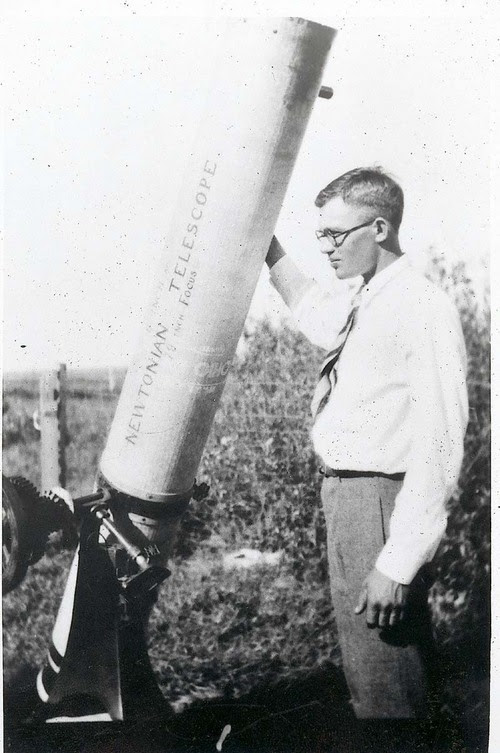
Lest we discount Janzen as an eccentric, it bears mentioning that even Clyde Tombaugh, Kansas’s astronomical sweetheart, reported several UFO sightings during his scientific career. Tombaugh built his first telescope on his family’s farm near Burdett, Kansas, and was a self-taught astronomer with a high school diploma when, in 1930, he discovered the long sought-after “Planet X”—soon dubbed Pluto, after the Greek and Roman god of the underworld. (Pluto was reclassified as a dwarf planet and hailed as the first known object in the Kuiper Belt in 2006.) Tombaugh earned his bachelor’s and master’s degrees from the University of Kansas while continuing to work summers at Lowell Observatory in Arizona, where he first caught sight of the smudge of light that was Pluto.
In addition to discovering Pluto, 15 asteroids, and hundreds of stars, Tombaugh also observed several UFOs. Although he tended toward a scientific explanation rather than an extraterrestrial one, he was nevertheless open to the idea of intelligent life on other worlds. And perhaps it was this openness that drew him back to the sky night after night, straining to see just a little bit further into the unknown.
Sometimes we look to the sky in search of faraway worlds, but we find ourselves instead. What if those stories about aliens and UFOs are really stories about us? Stories to make the darkness a little less lonely, the strange a little more familiar. They speak of our thirst to make meaning, to seek connection, to ask questions and discover answers.
But sometimes when we look up at the night sky, we aren’t looking for answers. We look to the stars to set our imaginations alight.
Christopher Auner is a writer from Lawrence, Kansas, who has a background in teaching, publishing, freelance writing, and higher education. He earned an MFA in fiction from the University of Kansas and an MA in literature from Missouri State University.