Wednesday, January 28, 2026
Home Blog Page 241

Kansas Volunteers Launch First Women on the Wing Chapter of Pheasants Forever and Quail Forever

0

 Pheasants Forever (PF) and Quail Forever (QF) are proud to introduce the first Women on the Wing Chapter in Kansas. The Kansas Prairie Women on the Wing Chapter will provide women with a dedicated space to bond, collaborate, share experiences and influence upland conservation efforts together.

Unique among national conservation organizations, chapters of Pheasants Forever and Quail Forever retain 100 percent decision-making control over fundraising dollars, allowing volunteers to support impactful wildlife habitat projects, public access initiatives and conservation education programs throughout the upland bird range. PF & QF’s east central Kansas regional representative, Mika Rezac, will work closely with the new chapter to support the organization’s vision to sustain abundant populations of wild pheasants, quail and other wildlife.

“A Women on the Wing chapter in Kansas is not just important—it’s long overdue,” Rezac said. “This network allows women to exchange knowledge, inspire one another, and build a strong, like-minded community dedicated to preserving Kansas’s upland heritage while carrying out Pheasants Forever and Quail Forever’s mission.”

The chapter volunteers will work to promote sustainable land management practices, enhance upland wildlife habitats, engage women in the upland community and build a strong family of women dedicated to preserving Kansas’s natural resources. They will emphasize education and outreach through hands-on learning, workshops and networking to inspire and support women in making impactful conservation decisions.

“Our state’s rich agricultural and wildlife heritage benefits from diverse perspectives, and women play a critical role in land management decisions,” Rezac said, “By building a community of passionate, conservation-minded women, the chapter helps safeguard Kansas’s natural resources and upland traditions for future generations.”

To learn more about the Kansas Prairie Women on the Wing Chapter of Pheasants Forever and Quail Forever, contact chapter president Kari O’Riley at [email protected]. The chapter’s next event will be a virtual meeting on January 23 at 6:30 pm CT, using this link. For more information about Quail Forever and Pheasants Forever in Kansas, contact Mika Rezac at [email protected].

About Pheasants Forever and Quail Forever

Pheasants Forever and Quail Forever make up the nation’s largest nonprofit organization dedicated to upland habitat conservation. This community of more than 477,000 members, supporters and partners is dedicated to the protection of our uplands through habitat improvement, public access, education and advocacy. A network of 754 local chapters spread across North America determine how 100 percent of their locally raised funds are spent — the only national conservation organization that operates through this grassroots structure. Since its creation in 1982, the organization has dedicated more than $1 billion to 580,000 habitat projects benefiting 28.8 million acres.
 

K-State researcher touts benefits of winter wheat in crop rotation

0

Lollato says crop’s value extends beyond grain

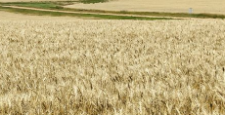
Kansas State University wheat specialist Romulo Lollato says farmers should consider what they might be missing when choosing to leave winter wheat out of their usual crop rotations.

Lollato notes that wheat acres in Kansas have been decreasing at a rate of approximately 2% every year since 2005. Nationally, that decline remains at about 1.5%. Often, he said, management decisions are based solely on the crop’s profitability.

However, sidelining this crop may result in growers passing over the benefits of winter wheat in multiple areas of agricultural production, such as planting, fertilizing and grazing.

According to Lollato, producers can obtain more flexibility in cropping systems when planting winter wheat. Specifically, winter wheat has a broader planting window when compared to summer crops.

“In regions where the winter is a little warmer, there is more time to plant the wheat crop and still reach your maximum yield potential for that area,” he said. “Some of our research (at K-State) shows that you have as much as 50–60 days to reach that yield potential in south-central Kansas.”

Beyond planting, growers have more freedom when fertilizing fields. Plants use most of the nitrogen available for growth in the spring, so Lollato said producers have an approximate six-month window after planting in September to put out fertilizer without losing efficacy.

“Timing is important,” he said. “The closer you administer nitrogen to the stem elongation phase is typically better regarding the nitrogen’s effectiveness.”

He added: “A large fertilizer window allows producers to match up applications with optimum weather and it ensures the nitrogen has time to get incorporated into the root zone and reduce losses.”

Additionally, diversified producers raising livestock benefit from planting winter wheat for grazing.

“Growing this dual-purpose crop provides quite a bit of high-quality forage during a time of the year when others are less available – like late fall, winter and early spring,” Lollato said.

While the price of the actual grain can be less than ideal some years, incorporating winter wheat into crop rotations allows for double-cropping or growing two or more crops in the same field simultaneously, which opens up other economic possibilities.

“In many operations, if we’re dealing with summer crops, we can grow just one crop each year,” Lollato said. “If we introduce a winter wheat crop in that system, we can grow three crops in two years, depending on where we are.”

“The possibility of intensifying the system like that and being able to produce – on average – more than one cash crop annually plays a huge role in profitability.”

Other advantages of having winter wheat in crop rotations:

  • Weed suppression.
  • Moisture conservation.
  • Carbon sequestration.

To help communicate the positives of winter wheat, Lollato and the vice president of research and operations at Kansas Wheat, Aaron Harries, have launched an information campaign called “Wheat: Beyond the Value of the Grain.” More information about this movement is available online.

Skating? Try living on thin ice

0

At a glance: Kansas State University fisheries and aquatics specialist Joe Gerken shares how some warm-blooded wildlife sustain themselves during cold temperatures.

More information: Joe Gerken, 785-532-1418, [email protected]

By Jacob Klaudt, K-State Research and Extension news service

MANHATTAN, Kan. – When most elements in nature get colder and freeze, they usually get denser in composition. However, as water approaches its freezing point of 32 degrees Fahrenheit, it transitions from liquid water to solid ice and becomes less dense.

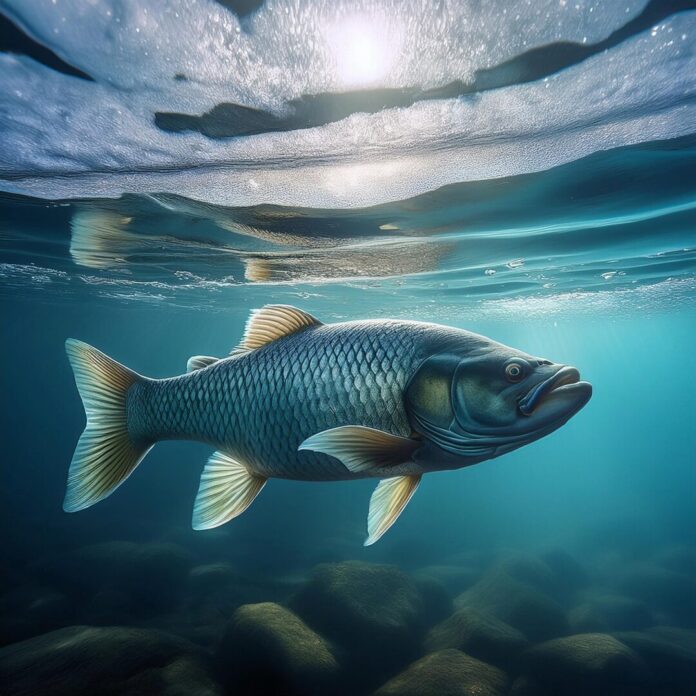
This feature allows ice to float up and warmer water to plunge deeper – a key feature permitting aquatic life to live beneath water in its frozen state.

Freezing conditions and ice have impacts beyond habitat, though, said Kansas State University fisheries and aquatics extension specialist Joe Gerken, noting that many species have uniquely adapted to survive frigid weather.

“In the winter, the densest water is going to be warmer and sit below the ice, so we’re going to start seeing fish that want to be at greater depths,” he said. “Salamanders and turtles are going to tend to go down to the benthos, or the bottom of a pond or stream, and thrive in those deeper habitats.”

Yet, if whole bodies of water freeze, so will fish, according to Gerken. In Kansas, fish have no choice but to seek warmer refuge in deeper habitats, but in places like Antarctica, some aquatic species have evolved to meet the challenges their harsh environment provides.

“There’s a group of fish called the notothenioids that live in saltwater, which can get subfreezing,” Gerken said. “These fish have antifreeze proteins in their blood, which keeps their bodies from turning to ice.”

Besides fish, reptiles and amphibians also have tactics for fighting against the freeze. Specifically, these animals enter a state called brumation – one similar to the process of hibernation observed in mammals.

“We see the amount of oxygen that these animals use decrease to almost nothing,” Gerken said. “Ice can start to form over surfaces of their bodies, and species like to hide underneath mud and bury themselves; they just hang out there and do nothing – not even eat.”

While breathing slows in turtles, it doesn’t completely stop, Gerken said.

“They practice cloacal breathing,” he said. “They put their tails up in the air where their cloaca is, and they breathe. Normally, that’s where waste comes out.”

Cloacal breathing and brumation end when warmer temperatures return with spring days and more daylight.

“Those things trigger these animals to wake up and come out of this situation,” Gerken said. “The animals then start feeding because they’ve used up a lot of their fat reserves. Then they’re going to jump right into breeding season.”

Warmer days in January and February can trick species into exiting brumation earlier than desired.

“You might see them climb up out of a log and try to warm up a little bit,” Gerken said. “Then as soon as those temperatures start to drop again, they say, ‘Hey, I don’t want to be around this and go back to their little hiding spot’ and reenter that dormancy stage.”

He added: “It’s not like it’s they are either entirely in it or out of it; they can peek in and out from time to time.”

According to Gerken, this back and forth can cause confusion about animal activity during brumation.

“They’re still fully alive,” he said. “They’re still moving; they get up and occasionally move from one side of their den to another.”

More information about animals and their winter habits is available online through K-State Extension Wildlife Management.

Related: Fins, Furs, and Feathers podcast | KSRE Wildlife YouTube | Gone Fishin’: Colder months signal new opportunity for anglers in Kansas

Venison or Bologna?

0
Photo by Steve Adams

As I left our deer blind this morning ahead of the approaching winter storm, the windows of my pickup were already icing over, and my driveway was so slick already, I nearly feel on my butt when I stepped out of the truck at home. That should have answered the nagging question “Did I stay long enough in the blind?” Yet here I sit, a little guy on my shoulder whispering in my ear “What a looser; you should have stayed loooonger!”

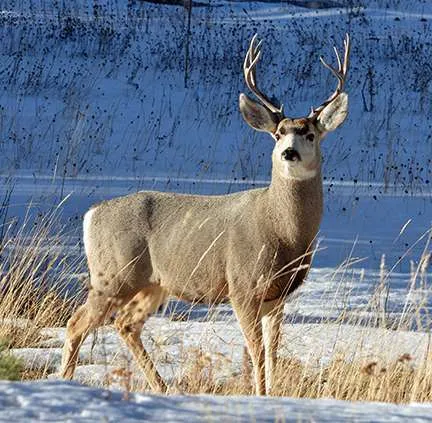
This has been a different and exasperating deer season for many hunters in my area. Several local hunters have come away without harvesting deer, as the deer just don’t appear to be here. The moon was full or bright for much of the regular firearm’s season, raising the excuse that the deer were simply moving at night. That coupled with the unseasonably mild weather, makes that theory more than plausible. But an avid deer hunter nearby told me he has seen fewer pictures on his cameras this year than any year he can remember. The 3 years of drought that has plagued our state might also be a factor, as drought affects fawn survival and forces deer to drink from stagnant water holes which foster diseases like Blue Tongue.

Around here, it always seems the nearer the river, the more deer there are. With that in mind, I was given the chance to hunt from a friends raised blind close to the river. He had gotten a buck there opening morning, but for the next several days, I saw a total of two small bucks. The owner even sat with me one morning this week during antlerless season as a second set of eyes, and we saw nothing. The farmer just across the fence had counted 17 in the field well after dark one night as he worked in the field, again, lending credence to the theory that the deer were moving at night. But this morning ahead of the storm, a 13-year-old girl got her first deer from that blind, which happened to be the only deer they saw.

Volumes have been written instructing deer hunters how to have a successful deer season, but try as I might, I can’t find anything consoling those of us who failed to harvest a deer this year, or instructing us how to cope for the next twelve months. So besides giving you the names of the local psychiatrists and advising you to just go out and buy half a hog, I’ll try to offer some advice as coming from a deer hunter who’s been down that “empty freezer” road more than once.

First and foremost, you know how I feel about the term “unsuccessful” as it relates to any hunting trip or outdoor adventure. I live by the cliché that a bad day in the woods is still better than a good day at work or most other places for that matter. I have to remind myself that watching the owl silently land in the tree in front of our blind, or hearing the wailing howls of coyotes help make the morning anything but “unsuccessful.” Failure to harvest a deer doesn’t necessarily mean you did something wrong. If you missed an easy shot or spooked the deer by being seen, smelled or heard, yes, that was your mistake. But things beyond our control affect deer harvests also.

So, here’s my advice to all deer hunters who didn’t connect this year. First, figure out how to correct mistakes that might have cost you your venison, this can include spending time at the range if you missed an easy shot. Secondly, get permission to hunt more property. One cannot have too many places to hunt deer; it’s like having too much

money! The more ground you can hunt, the better the odds of finding deer under any circumstance. Last, and certainly not least, spend time in the field or woods with your binoculars. I grew up hunting Ohio whitetails with a group of guys that included a couple seasoned deer hunters. When deer season ended, it became a tradition to ask each other “Well, are you eating venison or bologna?” Pre-season scouting can often mean the difference between venison and bologna for the next twelve months.

Now that I’ve finished this week’s contribution, please excuse me while I get to work on recipes for my new cookbook, 101 Ways to Cook Bologna…Continue to Explore Kansas Outdoors.

Steve can be contacted by email at [email protected].

Long-ago New Year’s Eve

0
Thayne Cozart
Milo Yield

New Year’s Eve, 2025, has come and gone and I hope you survived the celebration. When I started contemplating New Year’s Eve happenings from the past, I recalled a story I heard not long ago about a good ol’ rural fellow who had a part-time job as the night manager of a commercial bus station in a Kansas county seat town.

The story as told to me is this: This fellow, ol’ Tip D. Flask, liked to hit the bottle. On a New Year’s Eve back in the 1970s, Tip and a younger co-worker, Aiden A. Bett, ended their shift at the bus station after midnight with the task of cleaning the station and closing up for the night.

As told, ol’ Tip began hitting the bottle well before midnight and when the new year rang in, he wuz soused. When they locked the door to the station, Aiden saw clearly that Tip had no bizness driving to his home 15 miles away.

So, Aiden insisted that he drive Tip home. He helped the woozy, wobbly-legged Tip into Aiden’s car and off they went. Apparently, Tip wuz a happy drunk and he sang songs and slurred stories all the way home.

When they arrived at Tip’s home around 2 a.m., Aiden saw a clear problem. Tip’s wife wuz standing on the front porch with her arms crossed. Her stance gave every evidence that she wuz not a happy camper.

Not wanting to get in the middle of a family feud, Aiden unloaded Tip from the car, headed him in the right direction, and then sped away. Once he did that, his conscience kicked in and he told himself, “that’s no way to leave a good friend.”

So, Aiden turned around and went back to Tip’s home with the goal of helping his inebriated friend into the house. When he pulled up next to the Tip’s front yard, he saw Tip on his hands and knees on the lawn with his angry wife standing over him giving him the riot act.

Aiden apologized to Tip’s wife and offered to help get Tip into his bed. The wife agreed that would be helpful.

But, when Aiden tried to lift Tip to a standing position, Tip looked up at him, grinned big, and yelled out, “Don’t stand me up. I’ve got a good grip on the grass so I won’t fall off the lawn.”

At that clever impromptu quip, everyone started laughing — including Tip’s wife. Eventually, they got Tip to bed and everyone survived. But, the story persists.

***

When it came to New Year’s Eve celebrations in my youth, I wuz not a choir boy. One true story, illustrates my lack of common sense and responsibility.

On the New Year’s Eve of my senior year in high school, my pappy, Czar E. Yield, took Mom and headed to her sister’s home in Springfield, Mo. He entrusted me with all the farm choirs, including milking our dozen or so milk cows.

Rather than rein-in my new year’s celebration, I went at it whole hog, I connived an older friend to poach me a bottle of the hard stuff before I went to a dance.

I’ll shorten this story to this. New Year morning I wuz so hung-over that I could not properly milk or feed the cows. That evening, I finally got all the chores caught up, but I think ol’ Czar knew the truth behind the shortage of milk in the milk cans.

But, he never accused me of anything. Perhaps, from his callow-youth, he had a few “best forgotten” new year’s story or two in his past.

***

OK, let’s get serious for part of this column. Economists seem to agree that massive tariffs on many imported goods and services into the U.S. — as promised by soon-to-be-president Donald Trump –will wreak havoc on the national economy. The reason — they say the tariffs will negatively skew global trade and ultimately raise prices for American consumers.

As has been historically true in the U.S., the collected tariff monies will flow into the federal treasury for use as the government sees fit.

I can’t see how the tariffs will restore balanced trade or enhance reciprocal trade. I think they will invite retaliation by affected nations and companies.

Perhaps the goal of U.S. trade policy should be “balance of trade,” not free trade. Balance of trade would work thusly: Rather than having the collected tariff monies go directly into the U.S. treasury, the collected tariffs are automatically deposited at a U.S. bank into a “trade escrow account” in the foreign trade entity’s name.

The deposited tariff money would collect interest payments until the foreign entity redeems its escrow funds by purchasing a like dollar amount of any goods or services from the U.S.

The foreign trade entity would forfeit its escrow funds to the U.S. federal government only if it fails to make a reciprocal trade within one-year of the escrow establishment.

The way I see this “balance of trade” system, the trade books end up balanced and U.S. labor rates, manufacturing standards, and living standards are safe-guarded.

In the long run, maybe it would help lift global standards of living. However, I’m not holding my breath for it to happen. I seriously doubt that Elon Musk reads my column.

***

Going into the new year and a new administration, here are words of wisdom uttered by Founding Father Benjamin Franklin.

They are: ” They who can give up essential liberty to obtain a little temporary safety, deserve neither liberty nor safety.”

Have a good ‘un.