Friday, February 6, 2026
Home Blog Page 377

Kansas wildlife commissioners met in Hays last week, making several changes.

0

Commissioners with the Kansas Department of Wildlife and Parks ( KDWP ) gathered in Hays on Thursday, June 20 to discuss the latest issues regarding the state’s outdoor spaces. They voted in favor of approving changes to the following regulations following a presentation by KDWP Fisheries Division Director Bryan Sowards:

KAR 115-25-14

  • Blue catfish
    • Change to 10 per day creel and only one 30 inches or longer for Clinton, Glen Elder, John Redmond, Melvern, El Dorado and Elk City reservoirs.
    • Change to 10 per day creel with a 28 to 40-inch slot, only one of which can be 40 inches or longer.
  • Channel catfish
    • Change to two per day creel and 15-inch MLL for Eisenhower Park Pond in Marquette.
    • Change to five per day creel for Trexler Lake in Graham County.
    • Remove two per day creel for Smoky Gardens in Sherman County.
    •  Walleye
      • Change to two per day creel and 18-inch MLL for Trexler Lake.
    • Saugeye
      • Requirement for 21-inch MLL for Veteran’s Lake in Great Bend.
    • Largemouth bass
      • Remove catch and release only on largemouth bass for Smoky Gardens.
    • Paddlefish
      • Remove Neosho Falls Dam, Erie Dam, Oswego Dam, Coffeyville Dam and Ottawa Dam from list of paddlefish snagging locations.
    • Paddlefish
      • Remove Neosho Falls Dam, Erie Dam, Oswego Dam, Coffeyville Dam and Ottawa Dam from list of paddlefish snagging locations.

        KAR 115-17-3

        This change requires commercial fish bait permit applicants to successfully complete the Aquatic Invasive Species (AIS) certification course. You can learn more about this certification by clicking here .

        KAR 115-7-3, 115-7-9 and 115-7-10

        Replaces the word “nuisance” with “invasive” in these regulations. This involves four spots in the KDWP’s regulations and is being made for clarification purposes.

        115-7-3: Fish; taking and use of baitfish or minnows.

      • 115-7-10: Weigh-in black bass fishing tournaments.
      • 115-7-10: Fishing; special provisions.
      • KAR 115-7-10

        Adds Willow Lake and Riley County portion of the Kansas River to the list of Kansas Aquatic Invasive Species Designated Waters.

        The next meeting for KDWP commissioners will be on Thursday, Aug. 29 at the Independence Gun Club Heritage Center in Independence. To watch the full meeting back online, click here .

Kansas insect expert warns people to watch out for black widow, brown recluse infestations

0

A Kansas entomologist says summer heat is bringing two notorious spider species into greater contact with people.

Kansas State University’s Jeff Whitworth commented on brown recluses and black widows in a recent publication from the college on June 20. He said the spiders are laying eggs this month, leading to potential problems for homeowners who may not be experienced with the arachnids which can deliver painful bites, according to the CDC.

Black Widows

Black widows are recognizable for their black coloration and red markings which sometimes appear as an hourglass shape. The spiders are have a reputation for being dangerous due to their ability to deliver painful and sometimes even fatal bites.

“Right now, the black widow can be found around out-buildings, garages, old sheds and those areas,” Whitworth said. “And right now, of the one’s I’ve seen, they are producing egg cases.”

Whitworth said the spiders are actually quite timid and more likely to run away than try to fight back if disturbed, according to K-State. However, the spiders will stick around if their egg cases are nearby.

“If you hang around…they’ll act a little more aggressive,” Whitworth said. “They’ll rear up on their back legs. If you brush up against them or stand there for a minute, they may come out and actually bite you.”

Black widow spider bites can leave you with pain which lasts several hours and lead to symptoms such as fever, increased blood pressure, sweating and nausea. People bitten by these spiders should seek medical attention.

Whitworth highlights the main concern people should consider which is the black widow’s ability to reproduce quickly. A lone black widow female may create up to four egg cases in a given year.

“And inside of each case may be 100 to 200 eggs, and when those hatch, you’ll have a whole bunch of little black widow spiders,” Whitworth said. “So, if you’re wanting to eradicate the black widow spider around your house or yard, now’s the time to go around and find them.”

Spiders hatching from these egg sacs typically appear within 20 or days after the eggs were laid. These young spiders are also dangerous as they contain a toxic substance which can harm pets or children if swallowed.

Strategies you can use to avoid encountering these spiders is to make sure to reduce clutter in and around your properties to reduce hiding places for them. You can get rid of egg cases using alcohol or fire. If a black widow lands on you, try to flick it away as crushing it may push its fangs into your skin.

“If you suspect you have been bitten by a black widow, contact your healthcare provider and show them the suspect if you can capture it safely,” Whitworth said.

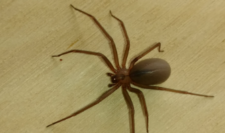
Brown Recluses

Similar to black widow spiders, brown recluses are also becoming more active and laying eggs. They can also deliver a painful, though often not fatal, bite.

“They’re laying eggs right now,” Whitworth said. “They might make a little bit of a webbing, but for the most part, the brown recluse goes out searching for food from under or behind other objects, and from which there is often a small, loosely constructed web.”

These spiders can often be found hiding in cardboard boxes and insulation inside structures. They tend to become more active as the weather becomes warmer.

“We’ve actually sampled and trapped hundreds of brown recluses in a building where we were doing research,” Whitworth said.

Brown recluse bites can lead to pain, bleeding and an ulcerous wound, according to K-State. Often, the bite area will lead to a slow-to-heal wound with significant scarring. In rare cases, a bite can lead to a potentially life-threatening systemic illness.


Parts of Kansas once tried to secede and form ‘West Kansas.’ It helps explain our politics today

0
More than 30 years ago, a group of southwest Kansas counties tried to secede and form their own state called West Kansas. It’s largely forgotten now, but the political divisions that caused it remain.

Secession movements in places like eastern Oregon continue to make headlines today, but back in the 1990s, parts of western Kansas made an effort to secede that previewed the political divisions that still cause people in the U.S. to consider cutting ties from their governments.

In Kansas, the effort involving nine southwest Kansas counties all started with a disagreement over school funding policies.

After people in western Kansas felt a new school funding law adversely affected rural schools, some residents of the nine counties were so upset that they petitioned to leave the state. They proposed a new state called West Kansas.

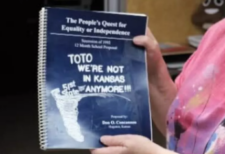
In the heart of one of those counties, tucked behind endless rows of corn and milo, Sharon Concannon takes a trip down memory lane, thumbing through a book of newspaper clippings and documents from the time.

The navy blue book’s cover exclaims, “Toto, we’re not in Kansas anymore” in large white letters.

The laminated book documents the reactions to a secession movement that grew out of the region 30 years ago.

Concannon remembers how it unfolded.

“They went about getting petitions signed to make our own state,” Concannon said.

As she flips through the pages, she chuckles at some of the headlines. They remind her of her late husband, Don, who started this movement.

“He was an attorney, and he felt that … we’re just kind of no man’s land,” Concannon said. “We don’t feel like we’re ever heard.”

Don has since passed away, like many of the others originally involved in the movement to form West Kansas.

The push for ‘West Kansas’ 

Supporters of the idea were so serious that they gathered in 1992 in Ulysses, Kansas, and drew up state borders. They decided what should be the West Kansas state bird, the pheasant, and the state flower, the yucca.

Pete McCormick grew up 30 minutes from Ulysses in Lakin, just outside of Garden City. He was studying cultural geography at the University of Kansas and wrote his thesis on this topic in 1995. He said there was a clear reason these Kansans were upset

“The state redid its school finance laws, and basically it was trying to equalize things across the board,” McCormick said.

But it didn’t seem like equalization to many in the western part of the state.

Southwest Kansas was enjoying economic stability because of the growth of natural gas and irrigated grain, without a significant tax burden. Schools in this rural region were spending north of $5,000 per student, but this new law would cap that at just $3,600.

With the 1992 school finance formula, eastern Kansas received significant tax relief, and southwest Kansas saw an increase in tax rates.

This further stressed the already existing divide between the more populous eastern parts of Kansas and more rural western Kansas.

“I remember there was a sign on the motel in Lakin, and it said ‘To hell with Topeka, let’s secede,’” McCormick said.

Cultural divisions 

Through the lens of cultural geography, McCormick can see the distinctions between the two halves of Kansas.

The different landscapes have influenced the cultures, and the different cultures have simultaneously impacted the landscapes.

Looking at western Kansas, patterns of circles and squares show the impact of farming, and how the rural towns have built lives in an area with plentiful farmland and mineral resources, but not a whole lot else. Seemingly every other car has a license plate proclaiming “eat beef” as a reminder of how agribusiness and beef processing are the centers of this region’s economy.

Eastern Kansas is less flat, receives more rain and has urban centers that are more industrialized, similar to other midwestern states.

“Those cultural distinctions are there, and so when you had something as shocking as this tax reform, immediately everybody was like, ‘alright, that’s it,’” McCormick said.

Counties that voted to secede and create “West Kansas” in 1992
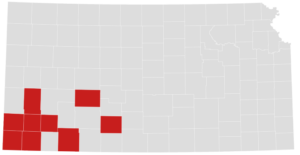
Stanton, Morton, Kearny, Grant, Stevens, Haskell, Hodgeman, Meade and Kiowa.

Results from a public poll showed in seven of the eventual nine southwest Kansas counties, a whopping 85% of the residents who answered the polls were interested in secession.

Joe Thompson, Stevens County commissioner, said the movement now is largely forgotten.

“There may be some folks hanging on to that, but it’s been years since I’ve seen or heard anything about it,” Thompson said.

But a major aspect of the secession movement was natural resources and education, issues that linger today. Since the movement, resources have continued to dwindle. Oil in Kansas has gone down ever since, and so has groundwater for irrigated grain.

Looking at the parallels today

Donald Haider-Markel, political scientist at the University of Kansas, said these kinds of secession attempts have become more common in rural areas over the years.

“This is what happens when a rural region of a state feels neglected and creates an ‘us versus them’ mentality,” Haider-Markel said.

And those feelings can still linger today. The West Kansas movement took place when Kansas had its first Democratic woman for governor, who was widely disliked by the larger conservative western constituents.

As rural schools continue to consolidate, the way taxes flow through the region remains a big contention.

Many of the counties involved in the movement saw their populations peak before the year 2000.

And just as they once feared, this region of Kansas has the hardest time retaining teachers today.

Haider-Markel also pointed out that the movement may have been a precursor to our identity politics in the country today, as factions fear loss of control. The West Kansas group was able to garner overwhelming support by leveraging dissatisfaction with state leaders and dissociation from the rest of the state. That’s still seen today in far-right groups that resist the federal government.

“You could find some roots of what you see today in the Republican Party in Kansas, really going back to the 1990s. Where there’s sort of a super far-right portion of the party,” Haider-Markel said.

In the end, the movement was thoroughly squashed after the state attorney general said it was unconstitutional and called it an exercise in futility. A couple years later, multiple rural school districts filed lawsuits against the school funding law, but the law was upheld by the Kansas Supreme Court.

Back in her office in Hugoton, Sharon Concannon said her husband Don, an attorney, knew this movement was doomed, but did it more as a stunt to grab lawmakers’ attention. Ultimately, it worked.

“I don’t think anybody ever really believed it could happen, but everyone was absolutely amazed at the support we got,” Concannon said. “He was just finding a way to get them to listen to us out here.”

Calen Moore covers western Kansas for High Plains Public Radio and the Kansas News Service. You can email him at [email protected].

The Kansas News Service is a collaboration of KCUR, Kansas Public Radio, KMUW and High Plains Public Radio focused on health, the social determinants of health and their connection to public policy. ksnewsservice.org.

With this app, Kansas families can go to more than 200 attractions for free this summer

0

Families with children in Kansas who don’t want to travel far for vacation have the perfect opportunity this year and they won’t have to pay an admission fee at several attractions to do so.

Back again is the 2024 edition of Sunflower Summer, a program happening from May 25 to Aug. 11, that offers a way for Kansas families with school-aged children to explore their state, providing complimentary access to tourism attractions across the Sunflower State.

Kansas Tourism announced more than 220 attractions will be part of the program, nearly doubling the amount from 2023.

“The Sunflower Summer program plays a pivotal role in making in-state travel affordable for Kansas families,” Lieutenant Governor and Secretary of Commerce David Toland said. “It offers amazing opportunities for parents to nurture their children’s love for travel and appreciation for our incredible state and everything it has to offer.”

Participating attractions this year are located in all regions of the state and includes places like museums, discovery centers, historic sites, arboretums, water parks, amusement parks, zoos, guided trolley tours, live theater events and professional sports events.

How does the Sunflower Summer program work?

To use the program, families with school-aged children need to download the Sunflower Summer app in either the App Store or Google Play Store beginning May 1. From there, they can create an account and claim tickets to participating attraction venues, which will be redeemed upon arrival at the venue.

Free tickets are available to all Kansas students from pre-K through 12th grade and up to two adults accompanying them. The Sunflower Summer App allows one free admission ticket per student for each attraction. Once a ticket is used, the app will “stamp” the ticket and it will no longer be valid to be re-used for that attraction.

A list and map of participation attractions, as well as links to download the app, can be found on the Sunflower Summer website, sunflowersummer.org.

What kind of impact does the Sunflower Summer program have for Kansas attractions?

Attractions and cities that have taken part in the Sunflower Summer program speak highly of it, saying that it offers a great way for Kansans to have fun, learn and experience their state in a cost-effective way.

“I’ve heard from a lot of families that say this is how they travel in the summer,” said Julie Roller Weeks, director of the Abilene Convention and Visitors Bureau.

Previously, Abilene only had the Eisenhower Presidential Library and Museum as part of the program, but this year, the Abilene and Smoky Valley Railroad and Dickinson County Heritage Center are also taking part.

“Now packaging (all) three attractions, we’re a great vacation now,” Weeks said. “All of them are in the same block and very walkable.”

While the tickets are free for those participating, each attraction gets reimbursed for each ticket used, which Weeks said is a win-win for everybody.

“The family gets to go for free, but the attraction… isn’t out anything,” Weeks said. “So this is a way for (the attraction) to increase revenue and increase visitation…thanks to the State of Kansas.”

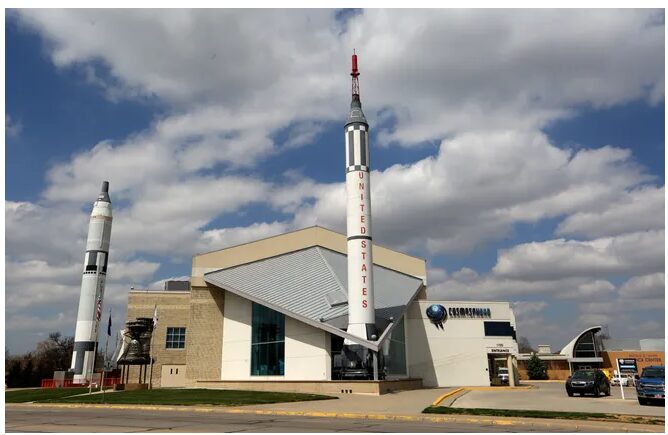
One attraction that is able to expand what families can do for free this year is the Cosmosphere in Hutchinson. Chuck McClary, Digital Specialist and Public Relations Coordinator for the international science education center and space museum, said last year, the Sunflower Summer Program only included access into the Hall of Space Museum.

“Reno County residents already get into the…museum for free, so they weren’t getting the full benefit of the Sunflower Summer program,” McClary said.

This year, the program includes a free All-Access Mission Pass, which includes access to Hall of Space Museum and CosmoKids, one Carey Digital Dome Theater documentary, one show in the Justice Planetarium, one show in Dr. Goddard’s Lab and one ride on the naviGATOR Flight Simulator.

“It’s a pass to pretty much everything in the building,” McClary said.

There are currently renovations happening in the Hall of Space Museum, but McClary said people who come are still able to see things like the Apollo 13 command module and the Liberty Bell 7 spacecraft on display.

Plan a vacation or weekend around the Sunflower Summer program

With cities and towns like Abilene or Salina that have multiple attractions participating, there is an opportunity for Kansans to plan a whole trip in one place.

“We’re drawing in a lot of people from outside the area,” said Linda Henderson, director of development and marketing for Rolling Hills Zoo.

Henderson said Salina is trying to create a destination for people to travel to, and with this program, that allows families multiple things to do when they come here, with not only the zoon, but The Garage, the Smoky Hill Museum, Kenwood Cove Aquatic Center and the Art Center and more participating in Sunflower Summer.

“(We want people to) come and spend the weekend in Salina, and check out all of the great venues we have,” Henderson said.

For more information about the Sunflower Summer program, visit sunflowersummer.org.