Monday, February 9, 2026
Home Blog Page 413

Cabbage Worms

0

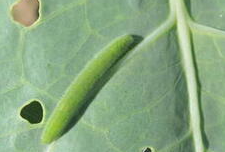
Description: Velvet-green larvae are 1-1/4 inches long at maturity. The chrysalis is light green, tan or yellowish and about one inch long. The adult is a white butterfly with black spots on the wings. Spherical eggs are yellow to cream in color.

Life Cycle: Adult butterflies emerge in spring and begin laying eggs on the underside of leaves of host plants. The resulting caterpillars reach maturity within 10-14 days and feed on hosts of broccoli and cabbage typically. Chrysalises attach to the food source with silken threads. There can be multiple generations of cabbage worms each year.

Damage: No damage is caused by the adults but the larvae feed on their host plant and can defoliate entire plants sometimes preventing the formation of heads. Boring into the heads can also cause them to be inedible due to their presence along with the fecal pellets.

Control: Monitor plants for signs of cabbage worms regularly. White butterflies near cole crops are an indicator of cabbage worms. Larvae are camouflaged against plant leaves so look for irregular-shaped holes and dark green fecal pellets on the plant or ground nearby.

Prevent cabbage worms by removing debris after the growing season to reduce overwintering habitats. Use row covers to prevent butterflies from laying eggs. Choose cultivars that mature faster to shorten the season. Remove larvae by hand. Bt (Bacillus thuringiensis) is effective on young caterpillars as are Spinosad, neem and pyrethrum. Always follow label instructions and practice safe application. A spreader sticker will increase efficacy due to the slick leaves of the host plants.

0

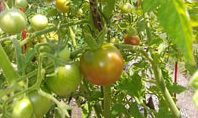
Tomatoes need support to remain upright. If left to grow on the ground there is less air flow and greater risk of disease. Support keeps the fruit off the ground which helps reduce contamination from contact with soil. Is there a right or wrong way to support your tomato plants? Maybe…

Traditional, store-bought cages can be effective especially for small, container varieties of tomatoes. Though these cages sometimes come in fun colors, they tend to be more expensive than building your own. The support they provide is minimal and often insufficient for most tomato varieties.

You can build your own tomato cage using concrete reinforcing mesh. With a roll 150 feet long and 5 feet tall you can create multiple tomato cages and trellises to support climbing plants. The openings between the wires are large enough to fit your hand through for harvesting and allow even large slicing tomatoes to slide through. Cut the wire at the desired length and create a cylinder that will wrap around the tomato plant. If you cut the wire at a length of six feet, the diameter of the cage will be almost two feet. Wrap the cut wires around the other end of the panel to secure the cylindrical shape. To keep the cage in place you will need at least one or two wooden stakes. Hammer them into the soil several inches and attach the cage to them using wire or garden tape.

Another support method is called the “basketweave” or “stake and weave” which is a trellising system. Plants should be grown in a row with a t-post in the ground between every few plants. Install a t-post at the start and end of the row as well. When plants are about one-foot-tall tie a strand of twine to the t-post at one end of the row. Walk the length of the row holding the twine and wrapping it around each t-post as you pass. At the opposite end of the row, wrap the twine around the t-post and then return to the start while again wrapping the twine around each post. As you come upon plants, they should be carefully placed between the strings for support. When you reach the starting point, cut the twine and secure it to the t-post. As the plants grow add twine higher up on the posts in this same pattern. Twine should be added every 8-12 inches or at least before the plants begin to droop.

K-State food scientist shares tips for buying, cleaning fruits and vegetables

0

Blakeslee touts the benefits of storing fresh produce.

In most locales, the changing of seasons from spring to summer translates into an abundance of fruits and vegetables.

That’s good news for health, but if the wealth of fresh foods is allowed to spoil before they’re eaten, it could cause a pinch in the pocketbook.

“Fruits and vegetables are so important for health and they provide lots of good nutrition,” said Karen Blakeslee, a food scientist at Kansas State University. “But there are some general guidelines when it comes to purchasing those foods, and the first is to look it over – whether you’re purchasing at the grocery store or at a farmer’s market – to make sure you buy good quality produce.”

Blakeslee said most fruits and vegetables should be cleaned before eating, as well as before they’re put into storage. Lettuce, leafy greens and fresh herbs, for example, may contain a small amount of dirt or even a stray bug crawling on the leaves.

“If you leave dirt and other visible contamination on the produce, that can reduce quality, so clean them up before you store them,” Blakeslee said. “If it needs to be rinsed before you put it into the refrigerator, do so. With some foods, it’s better to wait until you’re ready to use them before rinsing them with water.”

Rinsing, she said, should be “with plain water. There is no need to use produce washes or other cleaning products. Use a vegetable brush with water on produce that grows on or in the ground to remove visible dirt.”

“When you’re getting ready to prepare those foods, keep the fresh produce that is ready to eat away from raw meats,” Blakeslee said. “You don’t want raw meat juices to cross-contaminate those foods. Be mindful to wash your hands, use clean equipment and keep foods cold, if necessary.”

If food spoils, throw it out, or compost it, Blakeslee says. Clean storage bins, dishes or counters that may have been in contact with the spoiled product.

“There are some categories of foods that should be stored in the refrigerator, such as fresh berries, cherries, grapes, fresh herbs, lettuce and fresh vegetables, such as carrots,” Blakeslee said. “Once you start cutting produce, you have to store them in the refrigerator because they are going to deteriorate quickly.

Some foods – peaches and pears, for example – can be left on a counter to ripen. Then they should be used or refrigerated. Potatoes, onions, tomatoes and bananas can be left at room temperature until ready to use. Keep potatoes and onions separated because onions can cause potatoes to grow sprouts.

Blakeslee said K-State Research and Extension has a publication titled, Storing Fresh Produce, to help consumers care for many fruits and vegetables. The publication is available to purchase or view online from the K-State Research and Extension bookstore.

“There’s a lot of food waste that ends up in the landfill, and it creates environmental problems,” Blakeslee said. “A better choice is to re-purpose foods that may be spoiled, such as a compost pile or maybe you’ve got animals that can eat those foods.”

Food preparation scraps, such as produce peels, can also be composted or fed to animals.

Blakeslee said decreasing the amount of spoiled foods often begins at the time of purchase.

“Be a smart shopper,” she said. “Plan your meals and make a shopping list so you buy the right amount of food for the week. Plan around how much you can store to help avoid food waste.”

More information on food safety, including food preservation and canning, is available at local extension offices in Kansas.

USDA Beef Quality Grades: What do they mean?

0

A large portion of beef sold at retail in the United States is accompanied by a USDA quality grade label, such as USDA Choice. However, the label can be confusing to consumers. This article will discuss how quality grades are determined, what they mean, and how they are used.

Factors That Impact Quality Grade

Beef quality grades are determined by evaluating the maturity and the marbling of beef carcasses. As beef animals mature, their meat generally becomes tougher. This is because collagen, the most-abundant protein in the body, continues to develop throughout an animal’s life through a process called cross-linking. Collagen is a connective tissue that lies within muscle and provides structural support. As cross-linking occurs, bonds between adjacent collagen fibrils are formed, making the muscle stronger. In the case of meat animals, the more collagen cross-linking that has occurred, the tougher the meat will be. Carcass maturity can be assessed using one of three methods:

  • Dentition or determining age through the presence of permanent teeth.
  • Documentation of age through USDA approved programs.
  • Evaluation of the ossification of bone and cartilage of the vertebrae and the color of the lean meat.

Dentition and documentation of age are evaluated by USDA Food Safety Inspection Service inspectors during the harvest process. USDA Agricultural Marketing Service graders evaluate carcass ossification and lean color during the grading process. Maturity categories are A, B, C, D, and E. Carcasses assigned to A or B maturities are generally referred to as “young,” and carcasses assigned to C, D, and E maturities are generally considered “old.”

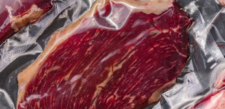
When a beef carcass is presented to a USDA grader, the carcass is cut, or “ribbed,” between the 12th and 13th ribs of the carcass. This cut allows the grader to view the ribeye muscle, which is the only muscle in the carcass that is evaluated when assigning a quality grade according to the U.S. system. The grader will evaluate ossification and lean color to determine if the carcass should be classified as old or young beef. Then, the grader will determine the amount of marbling, or flecks of fat, within the ribeye muscle. A greater amount of marbling correlates to a higher quality grade.

What are the USDA quality grades?

The U.S. grading system has two sets of quality grades that apply to steers, heifers, and cows: one for young carcasses and one for old. Old carcasses are generally graded as USDA Commercial, Utility, Cutter, or Canner. Young carcasses can be graded as USDA Prime, Choice, Select, or Standard. Bulls do not qualify for USDA quality grades. Prime and Commercial are associated with the greatest amount of marbling; Standard and Canner are associated with the lowest. The majority of meat sold at retail is Prime, Choice, or Select.

Why do quality grades matter?

Research has shown that consumer acceptance and willingness to pay increases with higher quality grades. One report that evaluated data from multiple studies suggests that probability of a positive eating experience when eating a strip loin steak that was graded USDA Prime was 97% (Tatum, 2015). That probability decreased to 93% for steaks graded Premium Choice (Average or High Choice), 82% for steaks graded Low Choice, and 66% for steaks graded Select (Tatum, 2015).

Because of the strong relationship between higher quality grades and more positive eating experiences, increased quality grades generally result in increased prices. According to the USDA, the increased value of Choice carcasses compared to Select was approximately $6 to $24 per 100 pounds of carcass weight in 2023. For an 800-pound carcass, that would be an increase of $48 to $192 for the cattle producer. From a retail perspective, traditional steaks, such as the New York Strip or Top Sirloin, labeled USDA Choice can cost $2 to $4 per pound or more over USDA Select. However, there are some cuts that lend themselves to lower prices for Choice versus Select, such as the London Broil, where consumers are seeking leaner cuts of meat.

Overall, quality grade is simply a prediction of palatability. Many other factors influence the final eating experience, including seasonings, cooking method, and degree of doneness. However, choosing the appropriate cut and quality of your meat ingredients will set the tone for the remainder of the meal. Understanding the impact of quality grades will help guide you in that decision.

Proud Of His Pride

0
lee pitts

“What is the difference between a cowboy and a buckaroo?” you ask.

A Great Basin buckaroo drives a beat-up old pickup with a fully tooled $5,000 saddle resting comfortably in the bed. He wears silver spurs made in Elko in the vaquero tradition, meaning silver is hanging all over them. His horse is decked out with a hackamore, Santa Ynez style reins, bosal and headstall made by Luis Ortega, hanging on to a spade bit made by Mark Dahl.

A cowboy, on the other hand, drives a brand new pickup with a $125 beat-up old saddle thrown in the back and his Chihuahua spurs have no maker’s mark. They do have wide heel bands and look like they were horseshoer’s rasps in a previous life. There’s no silver adornment because it wouldn’t last two minutes in the brush of south Texas. A cowboy’s gear is built for functionality, not for beauty.

It’s been said that the cowboy can gather two pastures while the buckaroo is still decorating his horse. But to be fair, the buckaroo with all his or her horsehair, latigo and rawhide contraptions, might just be, as a class, unrivaled in the making of a cow pony.

I’ve been collecting old bits and spurs for half a century and have learned how to craft all the old tools of the cowboy trade by fixing up old spurs, saddles and anything else made of leather.

A restauranteur who inherited a valuable pair of old G.S. Garcia spurs came by my place several years ago and wanted to know how much I’d charge for a pair of spur leathers with silver conchas and buckles that would match the engraving on the spurs. If I recall correctly, I quoted a price of $350 and the guy blew a gasket. You’d have thought I killed his dog or had a sordid affair with his wife. I thought he was gonna stroke-out on me!

I tried to explain that to make each concha I’d use a silver dollar, then worth $25 apiece. I’d also use a silver dollar to make each fancy buckle that would also be heavily engraved. So you can see that before I’d even begun to pound or engrave I’d already be out a hundred bucks. To make the actual spur leathers I’d use only the best Herman Oak leather which would add another fifty dollars. I’d use a four step process to get the new leather looking old which requires an assortment of expensive finishes. I also had to tool and sew them, burnish the edges and solder backs to the conchas to mount on the spur leathers.

Long story short the guy took his business elsewhere.

Years went by and the restauranteur was back in my garage/shop with the same old spurs hanging on to what I presume were spur leathers. By committing what I think should be a felony someone had assaulted the spurs with a wire wheel to remove all the beautiful old patina which devalued the spurs by about 90%. It seems the restauranteur had taken his business to a guy who sharpened knives for a living and had heard from someone how a new lucrative career awaited him in the uncrowded restoration field. The leathers were made with inferior leather probably tanned in urine in Mexico, the stitches were frayed and nothing was tooled. But the restauranteur said the knife sharpener had stressed that the conchas had been made out of the finest German silver.

Now in addition to a set of spur leathers, conchas and silver buckles the restauranteur asked if I could restore the shiny spurs to their former glory. I told the guy it would now be $750 for everything, hoping it would scare him off. When he once again objected to my price I mentioned the higher price of silver. He interrupted and asked if I couldn’t just reuse the German silver that the knife sharpener had insisted was the very best.

I took great pleasure in asking him, “You do know that there is actually no real silver in German silver don’t you?”

The restauranteur looked like I’d just barfed in his Bouillabaisse. After he finished choking and was able to breathe again he said, “Sure. Who doesn’t know that?”