Tuesday, February 17, 2026
Home Blog Page 513

Anti-Horse Slaughter Bill Reaches Milestone With Lawmakers Sponsoring It

0

Federal anti-horse slaughter legislation, known as the SAFE Act, H.R. 3475, reached a critical political threshold with a majority of the U.S. House publicly on record in supporting it,

H.R. 3475 would, among other things, halt inhumane trafficking of healthy horses to Mexico and Canada to be butchered for reexport to Asia.

The SAFE Act, would ban the slaughter of U.S. horses for human consumption, including live exports to Mexico and Canada. The companion bill, S. 2037, also has strong bipartisan support.

“The United States halted any slaughter of American horses and other equines in 2007,” said Wayne Pacelle, president of Animal Wellness Action and the Center for a Humane Economy.

“Now it is time to complete the job of protecting American horses by halting live exports of them for butchering in Mexico and Canada.”

“The House Agriculture Committee should take note of the overwhelming Congressional support for the legislation on both sides of the aisle,” Pacelle added.

“I doubt any serious-minded lawmaker would stand up in the well of the House and defend this ruthless trade of horses who had lives as companions, racing animals, work horses, or other accepted roles in American society.”

Pressure for passage of the SAFE Act is mounting just as recently released USDA export data shows that kill buyers shipped 17,997 horses from Arizona, New Mexico, and Texas to slaughter plants in Mexico in 2023.

It is the most significant annual percentage increase of live exports since 2012. Final numbers are not yet available for live exports to Canada.

A year ago, an investigation by the Center for a Humane Economy, revealed immense suffering of horses and other equids during transportation, holding, and slaughter, with results showing a lack of care, deficient delivery of food or water, and transport in cramped, dangerous, and unsanitary conditions.

“We are sounding the alarm to Congress that healthy American horses are being butchered in a secretive, inhumane trade to Mexico,” Pacelle said.

“Not one more year of this trafficking of these iconic animals should be tolerated. The animal welfare community and the Thoroughbred racing industry are united in demanding an end to this archaic, miserable, sickening trade.”

Among hundreds of supporters of the SAFE Act are the National Thoroughbred Racing Association, The Jockey Club, The New York Racing Association, the New York Thoroughbreds Horsemen’s Association, and the New York Thoroughbred Breeders, Inc.

Animal Wellness Action is a Washington, D.C.-based 501(c)(4) whose mission is to help animals by promoting laws and regulations at federal, state, and local levels that forbid cruelty to all animals. The group also works to enforce existing anti-cruelty and wildlife protection laws.

The Center for a Humane Economy is a Washington, D.C.-based 501(c)(3) whose mission is to help animals by helping forge a more humane economic order.

The center encourages businesses to honor their social responsibilities in a culture where consumers, investors, and other key stakeholders abhor cruelty and the degradation of the environment.

+++30+++

Modern Machinery Still Better

0

“The days of tossing four small square hay bales out the south hay mow door to the bunk are gone.”

Morning feeding chores would be finished by pitching two more bales down the chute to the barn manger.

Sometimes a harnessed draft team was hitched to a wagon for distributing hay to other nearby pasture critters.

Those days when a family was raised on a quarter section farm have become hindsight. Now it takes big trucks and tractors to get the livestock chores done hopefully before noon.

Instead of a couple dozen head of livestock fed in the barnyard, it’s several hundred if not a thousand. They’re spread out over a section of ranchland or sometimes several miles away.

It was sorrowful for some farmers in the past century when they replaced horsepower with tractors. Several families have talked about tears shed when a farmer replaced his team with a tractor. The horses had become almost family as they were handled and used every day.

Small tractors became essential for field work and handling livestock with pickups filling in for feeding and hauling.

Like all agriculture, technology changed rapidly, and bigger, more powerful equipment was deemed essential for growing enterprises.

An established routine makes choring relatively easy for the operator with livestock soon becoming accustomed to feeding time.

Problems are part of farm living and equipment breakdowns are quite frequent always increasing when the weather becomes inclement.

Most farmers used to be such mechanically inclined that machinery repair could be done personally.

That has changed with computerization, so most equipment requires a special technician to calculate the problem.

Despite fewer agricultural operations, there are not enough facilities with adequate technology and operators to keep up with machinery breakdowns.

Repairmen used to be called to the field getting farmers back working within a few hours. That is impossible today due to the necessity of having equipment in the shop for repairs.

Machinery dealers have long lists of equipment needing work with technicians working overtime. It might require several days before a machine can be overhauled.

Some people have indicated the world would be better off going back to horse and mule teams.

Reminded of Ecclesiastes 7:10: “Do not say, ‘Why were the old days better than these?’ For it is not wise to ask such questions.”

+++ALLELUIA+++

XVIII–6–2-5-2024

I’ve Been Such A Fool

0
lee pitts

I try to be loyal, I really do. I got so tired of buying stuff made in China that I recently went through all my tools and sold or gave away any tool that was made in China. I know Craftsman is now having communists make their tools so I quit them and switched to Milwaukee® for all my rechargeable tools naturally thinking that they were made in Wisconsin. Imagine my surprise when I learned that Milwaukee® is owned by a Hong Kong company called Techtronic Industries and the majority of their tools are made in China, Mexico, Europe and get this, Vietnam. Call me old fashioned but I refuse to knowingly buy tools made in a country where 58,220 American GI’s died in the not-so-distant past.

I guess I’ve been a big sucker because I haven’t been inside a Harbor Freight store in years because everything in them seemed to be made by the red Chinese. You walk in the store and it smells like everything just came off the boat. Then I discovered that Harbor Freight is a privately held American company with its headquarters in Calabasses, California.

It’s getting real hard to find a truly American company whose products are made by American hands. Who would have ever guessed that Ben and Jerry would sell out to a foreign conglomerate? Selling out doesn’t sound like anything the two aging hippies would do, but they did. And I always thought that Trader Joes was uniquely American selling uniquely American merchandise until I learned that a giant supermarket chain in Germany owns it.

One of the brands my grandpa proudly sold in his furniture store was Hoover vacuums. He’d roll over in his grave if he knew Hoover was now owned by the same Techtronic Industries in China that also owns and makes Dirt Devils®. When my wife and I last went to Sears I told the salesman I wanted to buy a washer and dryer that was made in America and he laughed in my face. He said whether I bought a Frigidaire®, Kenmore® or any other appliance they were all owned by one or two foreign companies. I said, “What about a GE®?” Nope. GE’s appliance division was sold in 2016 to foreigners.

Monopoly® is made by Hasbro® in plants in China and India, Purina® is owned by Japanese, and every one of the 58 million Barbie® dolls sold every year is made by a Japanese company. In fact, there never has been a Barbie doll made in America! Fisher Price® is making the toys your kids play with in 11 factories in China. Gillette® makes its razors and blades in Poland, Brazil, Mexico and China, and I cancelled my subscription to Forbes Magazine® when I learned that it was sold to a Chinese outfit ten years ago. If you haven’t quit drinking Budweiser® yet maybe you will switch to an America craft beer when you learn that the famous Clydesdales have been owned by a Belgian company for years. We even sold an American oil outfit (Citgo) to Hugo Chavez and his Venezualan cronies.

For gosh sakes, have we no pride?

Little did I know that when I took an Alka-Selzer I was enriching a German company. Motorola® was bought by Google® in 2014 and just like their phones, it was then flipped by Google® and sold to a Chinese outfit, losing ten BILLION dollars on the deal! What says America any better than IBM®? It’s PC division was sold to the same Chinese company where Motorola® ended up.

The list of once proud American companies now owned by foreigners goes on forever: Gerber, Smithfield, Burger King, Holiday Inn, Firestone Tires and Hilton are either majority owned or completely owned by foreigners. Even the famous all-American Waldorf Astoria in New York City is owned by the Chinese.

I gave up buying my flannel shirts at COSTCO® that I really liked because they were made in Vietnam and I quit wearing Levis® that were made in Italy, Japan and China. I figured that surely Hush Puppie® shoes are still made here?

Nope. China, Vietnam and Brazil. If it wasn’t for my cowboy boots I’d already be barefoot because Nike and Converse have plants scattered all over Vietnam.

Due to my boycott of stuff NOT made in America I may be naked soon.

Livestock tank maintenance doesn’t get an off season

0

Even though it’s sometimes frightful outside during the winter months, warm up by thinking ahead to maintaining those livestock watering setups when the cattle finally get turned out this spring.

But clean water isn’t something that happens during a certain season. Livestock of any species need a clean, fresh, reliable source of water year-round. During warmer months, staying ahead of algae growth and dirty conditions can prove to be challenging, especially during the peak busy season for many farmers and ranchers.

Iowa State University Extension material suggests algae growth can come from excess organic matter in tanks. Dirt, manure, feed, saliva or urine help encourage growth. One fact sheet suggested eliminating the opportunity for livestock to crawl into tanks, placing feed sources away from water tanks to keep stray hay stems or grain out of water, and discouraging animals from congregating near the water source in order to manage cleanliness.

Beth Reynolds and Erika Lundy-Woolfolk of ISU said the most effective way to maintain a healthy water source is to regularly clean it. The pair suggests draining the tank manually or turning off the water source and watching for livestock to drain the tank. Long-handled brushes with stiff bristles work best to scrub the sides and bottom. Rinse to reduce buildup and remove dead algae. Then, consider options to suppress algae growth.

There are chemical water treatment options available in retail locations that are safe for livestock. Copper sulfate or bleach can be effective when used appropriately. Many can kill or suppress algae bloom.

ISU said care should be taken to closely follow label directions when utilizing copper sulfate. Due to its corrosive properties, the longevity of metal tanks, pipelines, and floats may be shortened, and it can cause skin irritation. If using copper sulfate, allow at least five minutes following treatment before allowing cattle access to get effective results. Copper sulfate can be utilized every two to four weeks, if needed.

Another chemical option includes unscented household bleach. ISU said by adding 2 to 3 ounces per 50 gallons of water, algae growth can be hindered without impacting water palatability. Keep cattle away from the tank for an hour, allowing the chlorine to dissipate prior to water consumption. If deemed necessary, bleach can be utilized weekly.

Pastures, too

Water sources in pastures need to be cared for as well. Jerry D. Volesky, associate director of the Center for Grassland Studies and professor, range and forage specialist with the University of Nebraska-Lincoln said pastures with large water tanks can be troublesome too.

“Yes, that can be a challenge in keeping water in large livestock tanks clean,” Volesky said.

One design—a bottomless tank—is fairly common in the Nebraska Sandhills and were often filled by a windmill pump.

“These windmills ran all the time (when there was wind) when cattle were in the pasture and they had an overflow setup,” he said. “So water ran out of the tank as new was pumped in.”

A more natural method used to control algae growth in tanks is goldfish. Data from the University of Missouri recommends adding 4 to 6 goldfish per 100 gallons of water. To survive, water temperatures need to be above 60 degrees Fahrenheit. The tank will still need to be cleaned periodically in order to remove fish excretions. Volesky’s not as convinced.

“I am not sure how well the fish would work,” he said. “Might have to stock some every year.”

Other research from the University of Minnesota found no difference in algae presence when goldfish were utilized compared to tanks without.

Frozen water

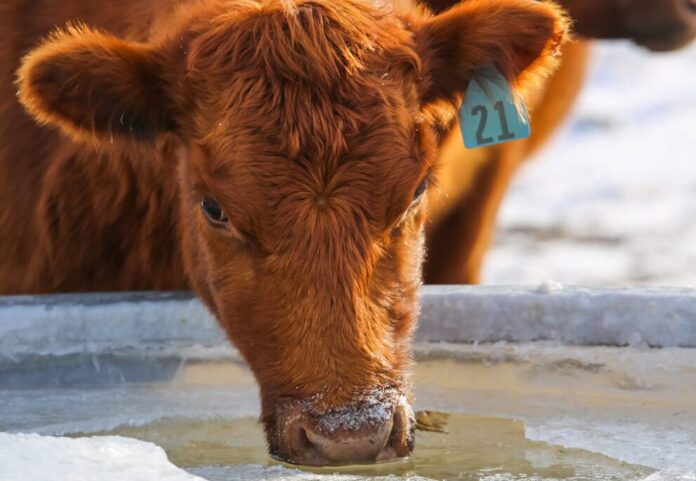
When temps begin to drop, Kansas State University experts said producers need to be sure their watering setups allow full-time access to clean, fresh water. Most typically, cattle will drink about a gallon of water for every 100 pounds of body weight. Those lactating cows will drink even more.

Veterinarian Bob Larson said in a K-State release that water is the most important nutrient for overall cattle health and production. It is important for cattle to have access to clean water at all times, even in freezing temperatures.

Investment in a freeze-proof waterer can be expensive, but not having the labor of breaking ice may be well worth the investment in the long run. With this type of waterer, the animal’s consumption will keep the water free flowing at all times. Routine maintenance with this equipment needs to be performed periodically.

Experts from K-State agree, those animals who are consuming water from a well, the water should be tested periodically to make sure it’s safe.

February Pre-gardening Checklist

0

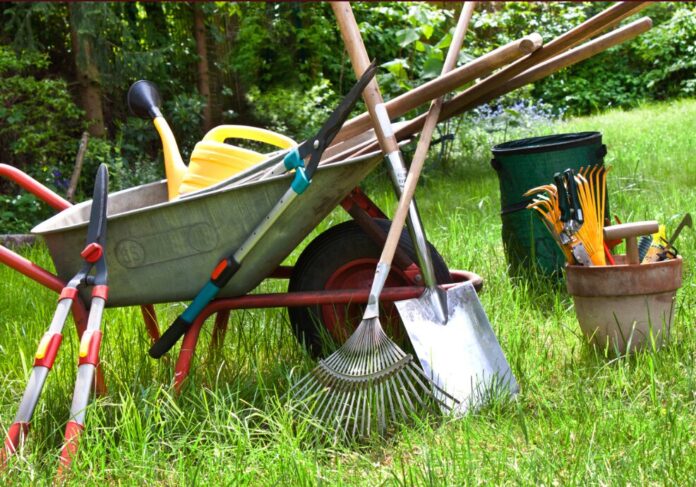
Much can be done now to get a jump start on the growing season. The below tips, with links from the Utah State University Extension Gardeners Almanac, can help get you going.

  • Consider adding a smaller structure, such as a low tunnel or a larger high tunnel, to extend your growing season.
  • Try your hand at starting vegetables or annual plants indoors from seed to get a jump start on growing.
  • Consider growing herbs and/or microgreens indoors to add fresh greens to your diet.
  • If you are storing bulbs, check their condition to make sure they are still firm. Remove any that are soft or rotten.
  • Prune grapes and fruit trees in late February to early March.
  • Fertilize fruit trees at least 6 weeks before they bloom.
  • Monitor for deer and rodent damage in the landscape.
  • Avoid fungus gnat infestation in house plants by allowing the soil to dry between watering.
  • Specific gardening information can be found at garden.usu.edu. Here you will find fruit, vegetable and herb growing guides, as well as information on soil, lawn, yard, tree, shrub, and flower care. In addition are monthly tips, the basics of gardening, information on events, classes, and more.