
Thursday, February 19, 2026
Home Blog Page 533

Gov. Laura Kelly said she has ‘political capital’ to spend on water issues this year

0

Gov. Laura Kelly said she is planning to spend a significant amount of political capital on water during the upcoming legislative session.

The aquifers under several western Kansas towns are depleted beyond the minimum threshold for aquifer density, meaning what remains couldn’t support things like center-pivot irrigation. Other areas are luckier, with an estimated 25 to 100 years of water use.

Still, those areas need to change water use to be able to support agriculture long term. Kelly said since the water shortages reached crisis levels, there hasn’t been a politician in the unique position she’s in as a second-term governor who isn’t planning to run for higher office again.

“I decided that, should I be reelected, that I would elevate water to be one of my highest priorities because it’s sort of an interesting moment in time and one that we’ve never experienced, where you have a governor in their second term, who never plans to do anything else, never be on the ballot again,” Kelly told The Capital-Journal. “So, I’ve got political capital and I can afford to spend it because it’ll be a very political sensitive issue.”

Kelly said the issue became a top priority while campaigning in western Kansas. It didn’t take long for residents to bring up water.

“It didn’t matter if it was northwestern or southwestern. Even though I thought they were going to be talking about schools and roads and health care, it always went to water almost immediately everywhere,” Kelly said.

In November, Kelly created a subcabinet on water that will attempt to formalize systems of cross-agency coordination and planning on the sometimes byzantine approach to water management. Kelly hopes agency and an influx of federal cash could move the needle on water in the coming year.

“We’ve got money — which is another thing that we really have not had in the amount that you need to even begin to approach this — but because of all of the funding that came in, during the pandemic, and some of the funding that’s coming in now, through the various infrastructure, programs that have been passed in Congress, we have we have some resources that we can spend,” Kelly said.

Money can only go so far, though, and some change will be needed by agricultural producers to conserve water to the point of sustainability. In December, Kelly’s special adviser on water touted Local Enhanced Management Areas, which is a voluntary association between landowners to meet specific conservation goals.

Some LEMAs saved 30% of their water without losing production.

“I think there is more recognition on the part of water users with particularly our producers,” Kelly said. “All the stars are aligning at this point. If ever we can come up with a plan and implement, it’s now.”

As reported in the Topeka Capital Journal
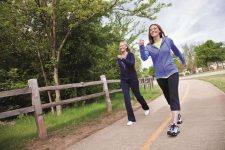
Looking to get more exercise? Here’s how much you need to be walking each day.

0
Photo courtesy of Getty Images

Have you been feeling guilt-tripped by your activity tracker? You’ve been on the move all day, but it still wants more. You may be wondering – ”Sheesh. How much should I walk in a day?” Since the boom of activity trackers like the Fitbit or Apple Watch, many people would be inclined to say around 10,000 steps. This goal may be right for you, and the more steps you take, the better – but it really depends on your current activity level and what your goals are. Recent research has found that walking just 4,000 steps per day decreases the risk of dying from any cause. Many experts contend that any activity is better than no activity, so slowly building up an exercise tolerance may be an excellent place to start. We aim to answer some questions you may have about walking.

What are some of the benefits of walking?

Walking, and physical activity in general, can help prevent many different health issues. According to the Mayo Clinic, regular activity can help stave off:

  • Heart disease
  • Obesity
  • Diabetes
  • High blood pressure
  • Depression

  • Walking is also a stepping stone to more vigorous exercise. Jeremy Golden, the former Director of Athletic Training at Santa Clara University, the former Strength and Conditioning Coach for The University of Virginia Women’s Basketball Team, and the current Director of Fitness at Tehama Golf Club in Carmel, California says, “You crawl before you begin to walk, you walk before you run. You don’t want to go all out right away because then you put yourself at risk for injury.”

    What is the recommended distance to walk each day?

    The CDC recommends 150 minutes of exercise per week, which can include walking. These minutes can be broken up into smaller increments, which is helpful for those who may be crunched for time. Sometimes, it can be as simple as taking the stairs or parking farther away from your destination. Activity adds up.

  • How far is 10,000 steps in miles?

    10,000 steps is significant – it adds up to about 5 miles. Walking 10,000 steps does have its benefits – after 4,000 steps, for every 1,000 steps taken, the overall risk of mortality drops by about 15%.

  • How much should I walk a day for my weight?

    This depends on what your goals are. If you are trying to lose weight, you must be in a calorie deficit. If you are eating more, you may need to walk more, and if you are eating less, you might not need to walk as much. Everyone can benefit from walking, whether or not you want to lose weight.

KU News: Author makes case for data-driven language learning

0

From the Office of Public Affairs | http://www.news.ku.edu

Headlines

Contact: Rick Hellman, KU News Service, 785-864-8852, [email protected], @RickHellman

Author makes case for data-driven language learning

LAWRENCE – You could consider Nina Vyatkina an evangelist for data-driven learning and open educational resources as they apply to helping students learn a second language.

The case for the synergistic benefits of those two approaches and the results of a new study demonstrating their effectiveness form the content of Vyatkina’s new book, “Corpus Applications in Language Teaching and Research: The Case of Data-Driven Learning of German” (Routledge, 2024).

The University of Kansas professor of German and applied linguistics is a believer in students directly using collections of word usage – corpora – to help them understand and gain fluency in their target language.

“Simply put, a corpus is a curated assembly of naturally occurring texts chosen to represent a specific state or variant of a language,” Vyatkina said. “That’s still a mouthful, but the notion of corpora goes way, way back in literary scholarship.

“A great example of a corpus is the compilation of the Oxford English Dictionary. They wanted to have not only a list of words and their definitions, but usage examples. So in 1880, James Murray, the first editor-in-chief, put out the call to submit sentences with the words collected from books and over the years had collected millions of slips of paper, which he stored in something the size of a garden shed. And that was a prototype of our contemporary corpus.

“Of course, with modern electronics, this all became much, much easier,” Vyatkina said.

A popular corpus that Vyatkina cites as groundbreaking for its time (it debuted in 2008) and still useful today is COCA, the Corpus of Contemporary American English – which ranks and cross-references billions of words taken from newspapers, books, TV, webpages, etc., between 1990 and 2019. COCA has a user interface much like a Google search. For instance, learners of English can search to see which adjective — “big” or “large” — pairs most commonly – and thus best – with the noun “problem,” which will help them use English more idiomatically.

But not all corpora are so well-organized as COCA, Vyatkina said. Nor are there as many useful corpora for languages other than English (LOTE), even if one accounts for the smaller number of LOTE speakers. Nor were there many useful teaching guides to using these LOTE corpora, Vyatkina wrote.

So her book is an attempt to bridge all those divides.

“One part is a survey of what has been done in teaching German with this method and research on the effectiveness of teaching with this method,” the author said. “I have a new empirical study. I actually did use this method with KU students of German … and it turned out to be very effective, and students liked the method.

“Then the final part is the introduction of the open educational resource,” Vyatkina said.

In cooperation with the KU Open Language Resource Center, Vyatkina and co-author Schirin Kourehpaz, a multiterm lecturer in German language, published in 2020 a free online course titled Incorporating Corpora with links to active German corpora, making their use seamless to the teacher and student.

“You have exercises, lesson plans, explanations to teachers how to use it, and then you can click on links and you will be taken directly to the corpus, and that is what is needed for teachers and learners to use it,” Vyatkina said.

The proof this method’s success, she said, is in faster, better language acquisition.

“This is why we call it data-driven learning,” Vyatkina said, “because this teaching method is a little different from what we think of as traditional teaching, where the teacher presents a rule, and then the learners practice using the language. Here, it is the opposite procedure. They look at the examples first, and then, under the teacher’s guidance, they infer a rule or a pattern.”

Vyatkina also believes that the proven success of data-driven learning in acquiring German can be repeated with other languages and perhaps other fields.

“Absolutely,” Vyatkina said. “I review a lot of research that has been done on other languages, and I try to make this connection in every chapter of my book.”

-30-

————————————————————————

KU News Service

1450 Jayhawk Blvd.

Lawrence KS 66045

Phone: 785-864-3256

Fax: 785-864-3339

[email protected]

http://www.news.ku.edu


Erinn Barcomb-Peterson, director of news and media relations, [email protected]


Today’s News is a free service from the Office of Public Affairs


How do we control them, pesky indoor pests

0

You can have pests on your indoor plants even if you are taking the best of care for them. How do we control them. There are chemical methods and nonchemical methods to use.

Many insect problems on indoor plants can be managed using nonchemical methods, particularly if the infestation is minor.

Washing

Wipe leaves with a damp paper towel, changing towels often to prevent spread.
Spray small plants in a sink.
Spray large plants in a shower.
Physically remove pests

Handpick large pests such as earwigs, caterpillars, slugs and millipedes.
Small numbers of scale insects can be removed using a fingernail file or something similar.
Mealybugs can be removed using tweezers or a cotton swab dipped in alcohol.
Some pests can be removed using a forceful spray of water.
Repot with new potting soil to eliminate soil-borne pests. Use clean pots and wash soil off plant roots.
Pruning

Prune if a pest issue is isolated to a few leaves, stems or branches.
When infestations are more widespread, prune the most severely infested plant parts. This makes it easier to manage pests on the remaining plant.
In the case of severe infestations and depending on the type of plant, cutting it back may help eliminate pests.
Watch new growth for signs of infestation.
Throw away or compost plant

Necessary and economical if the plant is heavily infested and badly damaged.
Avoids exposing other plants to the same pest problem.

Seizures

0

A seizure can be one of the most frightening things for a family member, friend, or anyone to witness. However, for some people with epilepsy, seizures may be fairly common and not unexpected. Roughly 1 in 10 people may have a seizure at some point in their lifetime.

A seizure occurs when there is a burst of uncontrolled electrical activity in the brain. This may cause a sudden change in awareness or full loss of consciousness, unusual sensations or thoughts, or temporary problems in muscle tone or movements, such as stiffness, twitching, or limpness.

The two main types of seizures are focal and generalized. A focal onset seizure starts in one area of the brain and spreads, causing mild or severe symptoms. A generalized seizure occurs when both sides of the brain are affected. Generalized seizures may include:

· Absence – which causes a staring spell, the “petit mal” seizure

· Atonic – which causes someone to go limp suddenly

· Myoclonic – which causes sudden body jolts or increased tone briefly

· Tonic – which causes muscle stiffness

· Clonic – which causes muscles to spasm and jerk

· Tonic-clonic – a combination of jerking and muscle stiffness, the “grand mal” seizure

If you witness someone having a seizure, stay with them until the seizure ends and they are fully awake. Stay calm, it should end in a few minutes. Ease them to the floor and turn the person gently to one side which can help them breathe. Clear the area of anything hard or sharp to help keep them safe. Consider putting something soft and flat like a folded jacket under their head. Consider removing their glasses or sunglasses. Loosen ties or anything around the neck.

Not all people who have a seizure need to go to the hospital. Time the seizure and consider calling 911 if the seizure lasts longer than 5 minutes. Other reasons to call 911 include if they have never had a seizure before, if they have difficulty breathing or waking after the seizure, if they have another seizure soon after the first, if they get hurt from the seizure, if it happened in water, or if they have a known health condition like diabetes, heart disease, or are pregnant.

Do not hold the person down or try to stop their movements. Never put anything in their mouth or forcefully open a tightly clenched jaw, since that could harm them. It is a myth that someone having a seizure is in danger of swallowing their tongue.

After the seizure, the person is likely to be unconscious or sleepy for a few minutes more. This is the post-ictal phase, when the brain is still very active and trying to contain the electrical impulses. Once someone is alert, they are likely to be sore, confused, or frightened themselves. Tell them what happened in a calm and simple manner.

Seizures can be quite frightening to witness, but with some knowledge, you may be better prepared to help.

Andrew Ellsworth, M.D. is part of The Prairie Doc® team of physicians and currently practices family medicine in Brookings, South Dakota. Follow The Prairie Doc® at www.prairiedoc.org and on Facebook and instagram featuring On Call with the Prairie Doc® a medical Q&A show celebrating its 22nd season

of health information based on science, built on trust, streaming live on Facebook most Thursdays at 7 p.m. central.