Monday, February 23, 2026
Home Blog Page 593

University feedlot works to find answers for the beef industry

0

As reported in High Plains Journal for generations, improvements in cattle handling equipment were based on guesswork. Livestock producers observed cattle behavior, and equipment manufacturers made adjustments, sometimes only to change them back.

At the Klosterman Feedlot Innovation Center, a state-of-the-art, commercial-scale feedlot research center under construction at the Eastern Nebraska Research, Extension and Education Center, researchers have the opportunity to attach data to those observations.

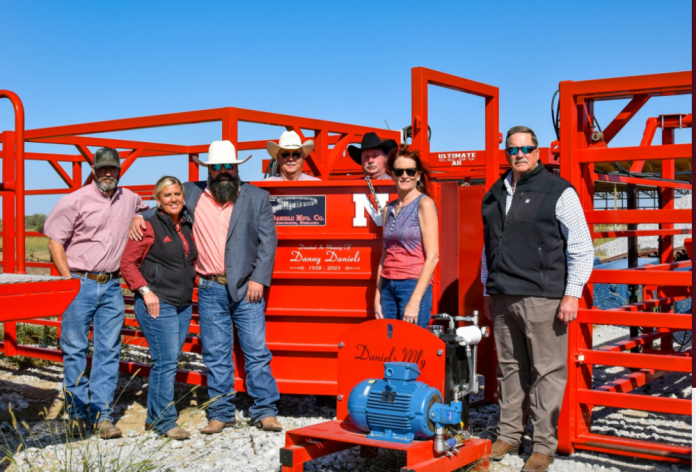
A Husker-red cattle handling system manufactured and donated by Daniels Manufacturing Co. in Ainsworth, Nebraska, the latest addition to the facility, is a “dream come true for many,” said Ruth Woiwode, assistant professor of animal behavior and well-being at UNL. Woiwode is part of the team that planned the facility and is charged with dreaming up the future of the research to be conducted there.

Those dreams are big.

The processing barn that will house the Daniels Manufacturing Co. cattle handling system will also feature a separate cattle handling system, donated by ArrowQuip, that will allow side-by-side studies of cattle handling facilities and methods. An elevated classroom with one-way glass will let students and industry stakeholders observe cattle handling without interfering with the process, and a wall of screens in the classroom connected to cameras throughout the facility will enhance those observations.

The processing barn reflects the facilities in feedlots where cattle are given vaccines and other health treatments.

In operations that work thousands of cattle every year, small changes in facility design or handling practices can mean big results in stress reduction, safety or efficiency for animals or humans.

The Daniels system includes a double alleyway and a Bud Box. The Bud Box is named after Bud Williams, a pioneer in low-stress animal handling who developed the system. The Bud Box is a rectangular pen that is positioned at a right angle to the entry point of the double alley leading to the squeeze chute where cattle are held for treatment.

“Both handling systems are designed to capitalize on an animal’s natural tendency to return to where they came from,” Woiwode said. “Some of those details come down to the actual layout and understanding, from a handler perspective, where they need to stand and move in relation to the cattle.”

The work UNL is planning at the Klosterman Feedlot Innovation Center will provide data that can be used to further streamline facility design.

“We can test concepts related to the number of animals and alley width, number of handlers, handler skill level, just to mention a few,” Woiwode said.  With two systems side-by-side, Woiwode says UNL can generate an enormous dataset that can be used to inform the design of working facilities, and best practices for cattle handling in the respective facilities.

When Woiwode and her team started planning this project, they thought it made sense to include Daniels Manufacturing Co., a Nebraska company with a 65-year history in the cattle industry. Dude Daniels started Daniels Manufacturing Co. in 1958, building autogates, gates and panels. “When Dude had an idea he would dive in head first and devote his time to building something the best way possible for the cattle and the user,” said Kade Blake, sales manager and design consultant for Daniels Manufacturing Co. “He started building the double alleyway back in the early ’90s, and the very first one is still in use today down in Oklahoma.”

Dude’s son and daughter-in-law, Danny and Teri, took over the company when Dude passed away. In 2001 they went to a Bud Williams cattle handling seminar and came home determined to figure out how those ideas could be used to improve their equipment. “Danny was the first person to manufacture and sell the Bud Box,” Blake said. “He worked with Bud and the Production Animal Consultation team to come up with the right size, and from there it took off.”

Woiwode had worked with Daniels Manufacturing previously and knew they were committed to finding the best solutions for cattle and handlers, and the future of the cattle industry.

“When Ruth approached us about this project and explained how they were going to focus on stockmanship and study the voluntary flow of cattle, Danny was very excited about that,” Blake said. “Our goal here at Daniels has always been building quality, long-lasting equipment that improves the life of cattle and the cattle handler. We focus on noise elimination, reducing sharp corners and edges, keeping our sides open so cattle can see the handler to use body placement to move the cattle, keeping our sides straight so cattle have a natural footing, and using the highest quality of steel to have equipment that gets used for generations.”

Danny Daniels passed away in April of this year, but before then, he and Blake drove to Lincoln to meet with Woiwode about her plans.
“On our way home, he told me that ‘these kids are going to need our equipment’ and he was so glad to be able to help them out,” Blake said.

Daniels and his contribution to the industry won’t be forgotten. There’s an inscription on the Husker-red alleyway, right below the Husker N and the sticker that says “Daniels Mfg. Co. Ainsworth, Nebraska.” It reads, “Donated in Memory of Danny Daniels 1958-2023.”
As drought continues to plague pastures, consider a couple things

0
KSU

As reported in High Plains journal “The best thing is what might be the hardest to do.”

Jaymelynn Farney, associate professor of animal science at Kansas State University and beef systems specialist at the Southeast Area Research and Extension Center near Parsons, Kansas, said as forages are in short supply and other feed ingredients are expensive, some tough choices might have to be made by beef producers.

“The best thing for perennial grasses is to have a sufficient amount of biomass above ground to have an adequate amount of root growth below,” Farney said. “If we deplete the root supply of nutrients, then the plant won’t regrow when we have optimal weather conditions.”

She said producers need to examine appropriate stocking rates and test pasture soils before Mother Nature turns off the spigot and drought conditions start.

“Plan appropriate stocking rates—assuming the worst scenario,” she said. “If it goes to raining, then you can utilize stocker cattle to increase grazing pressure to most effectively utilize your land resource.”

When testing pastures, especially those that have had fertilizer applied, be aware of what the grasses need.

“During drought, appropriate soil pH is the best thing to help maximize utilization of any fertility options, and luckily lime is still reasonably priced as compared to the other main fertilizers,” she said.

Farney was asked if the “grass can be saved” and with current conditions she said the best practice is reduce stocking rates.

“Make sure you adhere to the ‘take half-leave half’ rule so that you do not apply undo stress on the plant reserves,” Farney said. “This is especially true of the warm season grasses. For the cool-season grasses come up with some flexible grazing strategies and be willing to de-stock if needed.”

Farney said some producers may not be able to keep their herd together if they rely on surface water.

“It is often easier to be able to purchase and bring in feeds than it is to provide and haul water, especially long distances,” she said.

Don’t forget about infrastructure changes that would have to happen in order to feed different ingredients when trying to stretch forage supplies.

When drought forces culling, Farney said those animals need to be prepared beforehand. Dry, pregnant cows are cheaper to feed than lactating ones.

“So if you haven’t weaned, that would be the first thing to do,” she said. “Depending on where you are located and the resources you have, daily cost of dry lotting cows may be more than what you have paid for grass grazing.”

If the cost is too high, continue to cull strategically and make sure investment is made in those animals who have the greatest potential to pay you back.

“Preg check before sending cows to the feedlot; old ‘shelly’ cows might need to be removed from your production system; cows that are higher strung (wilder) also might not be as fun to work with in the dry lot system, especially if you are building and utilizing pens that aren’t designed to hold large animals with lots of pressure,” she said.

There is added pressure to return to what producers consider normal once the drought breaks and Farney is encouraged by several studies showing native pastures after extreme droughts have managed to recuperate, especially if producers practiced smart grazing decisions during the dry periods.

“But even some of the pastures that were extremely overgrazed often ‘came out’ of the extreme drought,” she said. “Historically, the most extremely dry years have been followed by extremely wet years. During that first year post extreme drought there may be less desirable plant species—weeds grow fastest‚ but if you work on control and stock based on grass production, then those pastures can overcome quite a bit of adversity.”

Wacky Warnings

0

Somewhere on my lengthy list of unanswered questions is the query that asks “Just how far will we go to protect ourselves from ourselves?” Don’t get me wrong, there are some very necessary warnings out there, like huge letters on a tank of gasoline that read “FLAMMABLE,” or flags that tell us “Road Work Ahead.” But for every good and reasonable warning are a dozen other absolutely wacky warnings that leave us shaking our head.
The thing to remember about wacky warnings is that they got there because someone, somewhere actually did what the warnings tell you not to do. So, someone somewhere tried eating that deodorant stick before the warning “Do Not Ingest” was put there, and so on and so forth. I’m convinced the need for most wacky warnings come about as dares, and are preceded by those 4 infamous little words, “Here, Hold My Beer.”
The outdoor industry is not immune to wacky warnings and offers plenty of products that bear them. The owner’s manual for a new gun I bought says “Appropriate use for this firearm means using your firearm for legal purposes.” So evidently criminals using guns to commit crimes haven’t read the owner’s manual first? “Always keep fingers and other body parts away from the muzzle” is another firearm warning. I already know there’s a hole in the end of the barrel where that thing comes out, oh now what’s it called…oh ya, the bullet, so I shouldn’t have to feel around there with my finger to find it, and I can’t imagine what other body parts the warning means. The manual for my crossbow tells me “Always THINK before you shoot.” Now why’d they have to go and open that can-a-worms?
And speaking of worms, I found “Not for human consumption” on all fish bait, whether artificially made from who-knows-what, or catfish stink bait made from blood, liver and other organic stuff. Now I may have had this fishin’ thing wrong all along. I’ve always thought the goal was to use the bait to catch fish to take home and eat, not to sit in the boat and eat the bait. Part of the fun of fishing for me has always been takin’ along a nice picnic lunch or at least snacks. I really can’ t picture myself taking a loaf of bread and making sandwiches by spreading slices of bread with stinky catfish bait. On one brand of catfish stink bait, I found the warning “Beware, dogs love this stuff.” Not sure I’d have put that on the jar if my goal was to sell that bait to fishermen to actually catch fish. And I’m not sure why I should “Beware” that my dog might love it. Should I “Beware” because all my expensive bait might disappear, and show up later that night as chunks all over the couch that now smell worse than the bait, or because the dog could grow fins and swim away down the river? One particular artificial bait made by the Berkley Company looks like crayfish packed in a pouch of liquid of some sort. It’s called “Gulp Alive” and the warning reads “Looks alive, Feels alive, Tastes alive; not for human consumption.” Now, to a good-ole’-boy out for a relaxing day on the water, that’s like dealing him all 4 aces and asking him not to play them!
On canisters of black powder used for muzzle loading guns I found this odd warning “Caution, do not eat, drink or smoke around this product.” Now, a warning against smoking anywhere near gun powder is one of those things that should never have to be said, but why not eat or drink around black powder? I have to remind myself again that these warnings usually come about because of some actual event. Maybe someone somewhere was once enjoying a sandwich while loading their muzzleloader, unknowingly ingested some black powder from the air along with the sandwich, and the next morning while completing their morning constitutional, blew the outhouse into the next county.
Perhaps the product I was most surprised to find warnings on were the little hand, foot and toe warmers that you stick inside your gloves or boots. The warning read “Caution, for external use only. Do not allow contents to contact eyes or mouth.” OK, not quite sure what to say about the “external use only” part of the warning, but I must say how disappointed I am that I can’t eat hand warmers! Yes, there have been a few times while sitting in a deer blind when I’ve neglected to pack a snack and wished I had just a little something to nibble on, but I can honestly say I’ve never considered chomping on my hand or foot warmers. As for the rest of the warning, I can’t remember the last time my mouth or eyes got cold and I considered putting a hand or foot warmer on them.
Warnings; you gotta’ love em.’ My warning to you readers is that reading this column will either make you pee your pants with laughter or put you to sleep, hopefully not both at the same time. Continue to Explore Kansas Outdoors.
Steve can be contacted by email at [email protected].

Winners Named At Ranch Rodeos Sponsored By Morris County Youth Rodeo Association

0

Lonesome Pine Ranch, Cedar Point, won the Fall Ranch Rodeo sponsored by the Morris County Youth Rodeo Association at Council Grove.

Team members are Travis Duncan, Bud Higgs, Troy Higgs, and Bo Krueger, according to Amy Allen, rodeo secretary.

Enroute to championship buckles and a check, Lonesome Pine placed first in team penning, and steer branding as well as second in team roping and fourth in double mugging.

Second place team was Rezac Land & Livestock from Pottawatomie County, while Lilley Performance Horses, Council Grove, placed third.

Slash N won the junior ranch rodeo with team members Hudson Lange and Riley Williams, both of Council Grove, and Avery Hastings, Wilsey. The team placed first in ribbon roping and third in team penning.

Wilson Ranch and T4 Ranch tied for second place junior team honors.

+++30+++


CUTLINES


Lonesome Pine Ranch, Cedar Point, with Bo Krueger, Travis Duncan, Bud Higgs, and Troy Higgs won the Fall Ranch Rodeo Association sponsored by the Morris County Youth Rodeo at Council Grove. (Amy Allen photo)


Slash N won the junior ranch rodeo at Council Grove with team members Avery Hastings, Wilsey; Hudson Lange and Riley Williams, both of Council Grove. (Amy Allen photo)


Investigation Fails To Find Reason For Churchill Downs Horse Deaths

Churchill Downs, home to the Kentucky Derby, has reopened to racing after shutting down for the summer to investigate a number of horse deaths.

The Horseracing Integrity and Safety Authority (HISA) announced that it could not “identify any singular explanation” for a cluster of horse deaths at Churchill Downs,

Racing was suspended for its spring-summer meet following 12 horse deaths, including seven in the run-up to the Kentucky Derby.

The investigation by HISA, a watchdog group created by a federal act in 2020 and fully implemented in May after overcoming lawsuits from industry opponents, examined whether conditions at Churchill Downs contributed to the cluster of horse deaths.

Racetrack surface expert Dennis Moore, hired by HISA to provide an independent review of the track, found the condition of the surface was unchanged from previous years.

He concluded that the metrics did not indicate a correlation between the track surface and the equine catastrophic injuries sustained during the race meets.

Alina Vale, official veterinarian for the California Horse Racing Board who was brought in by HISA, examined the necropsies performed on the 12 dead horses and found “no identifiable pattern that pointed towards a single causal factor of the fatalities.”

Vale also found that none of the 12 horses tested positive for prohibited substances. But another veterinary expert, Susan Stover of UC Davis, found the 12 horses had run more races in their career than the average racehorse.

“Analysis of training histories did indicate an increased risk profile for some of the horses due to the frequency and cadence of their exercise and racing schedules,” the report said.

HISA also said it found no rules violations by Churchill Downs officials, trainers or workers that contributed to the horse deaths. However, HISA released a number of proposed reforms after the horse deaths at Churchill Downs, Laurel Park in Maryland, and Saratoga Race Course in New York.

They include creation of a track surface advisory group; the creation of a committee that will look into data surrounding the use of synthetic surfaces, which “may be safer for horses than dirt or turf surfaces”; collaboration with horse racing stakeholders on better data collection and analysis; more strident and consistent veterinary protocols; and better doping controls.

“The inevitable recognition that horse fatalities are almost always multifactorial means that the response must similarly be multi-responsive,” HISA said. “No one entity or issue can on its own guarantee a meaningful reduction in equine injuries.

“Horse racing has reached an ‘all-hands-on-deck’ moment requiring more than ever a truly unified effort for the horses. All stakeholder groups must participate in bringing the appropriate recommendations to fruition and being part of the solution.”

The goal is to get the number of horse racing deaths down to zero.

“I believe that if the industry works together and we get behind these initiatives genuinely, that we absolutely can achieve it,” HISA CEO Lisa Lazarus said. “Our goal will always be to get to zero.”

In announcing the return of racing, Churchill Downs said it had implemented a number of changes after undertaking “a comprehensive evaluation of existing safety protocols and a thorough assessment of industry best practices.”

These include new surface maintenance equipment and increased testing of the track’s surfaces, increased veterinary oversight, continued work with HISA to predict at-risk horses, and the establishment of a safety committee comprising horsemen, track employees, and veterinarians.

Churchill Downs also changed its rules regarding which horses are allowed to race. If a horse has been beaten by 12 lengths or more in five consecutive starts, it will not be allowed to run unless the track’s equine medical director provides approval. Plus, horses will be limited to four starts over an eight-week period.

The fall meet is October 29 through November 26.

+++30+++


CUTLINE

Probe fails to pinpoint the reason for horse deaths at Churchill Downs.

Better Days Without Computers

0

A young man asked his grandfather, “Grandpa, how did you live in the past without technology . . .
Without computers, without internet connection, without television, without air conditioners, without cars, and without cell phones?”
Grandpa answered:
“As your generation lives today . . .
There are no prayers, there is no compassion, there is no respect, there is no real education, there is no personality, there is no shame at all, there is no modesty, and there is no honesty.
“We, the people born between the years 1940-1980, were the blessed ones. Our lives are a living proof…
While playing about everywhere and riding our bikes we never wore a helmet. Before school we played and then again after school until dusk we played and hardly ever watched television. We played with real friends, not virtual friends.
If we were thirsty, we drank tap water, or water from the hose, not mineral water in a plastic bottle. We never worried even when we shared the same cup of juice with four friends. We never gained weight by eating plates of pasta every day.
Nothing happened to our feet despite roaming barefoot. We never used food supplements to stay healthy. We used to make our own toys and play with them. Our parents were not rich, but they gave love, not stuff.
We never had a cell phone, game console, Xbox, video games, personal computer, or internet, but we had true friends.
Our friends were our neighbors and we visited them and their parents without being invited and shared and enjoyed the food with them.
We had black and white photos, but we can find colorful memories in these photos.
We are a unique and the most understanding generation because we are the last generation that listened to their parents. And to my extreme sadness, we are also the first ones who were forced to listen to their children.
We are a limited edition. Take advantage of us. Learn from us. We are a treasure destined to disappear soon.”
Reminded of Matthew 12:45 “That is what this generation is like. You may think you have cleaned out the junk from your lives and gotten ready for God. But you were not hospitable to His kingdom’s message, and now all the devils are moving back in.”
+++ALLELUIA+++
XVII–41–10-8-2023