
Saturday, February 28, 2026
Home Blog Page 653

Ballou wins King of the Ring, Champion’s Choice

0

As reported in High Plains Journal, Bailey Ballou, from Elgin, Oklahoma, was comfortable from the start and his calm demeanor paid off big.

Ballou won the recent 2023 King of the Ring contest at Winter Livestock. Besides winning $15,000 for the King of Ring he was also voted the Col. Roger Emigh Champions Choice, which netted him $1,500.

Ballou, the 2012 World Livestock Auctioneer champion, sold cattle for many years at Oklahoma National Stockyards in Oklahoma City, but is now with Superior Livestock, Fort Worth, Texas. He has sold cattle on several occasions at Winter Livestock but this was the first time he had competed in the King of the Ring.

He literally was a last-minute entrant. Longtime friend Robert Fisher Jr., Oklahoma City, Oklahoma, who was being inducted into the Cattle Marketing Hall of Fame, had asked Ballou if he could attend the ceremony. Ballou thought the contest might be something he should try as an added experience.

“Even though I’ve never been to the King of the Ring contest it was something I always wanted to do” he said. “It’s a lot of fun.”

His key to success was his relaxed style and with a plan to treat it like a regular sale. During the first round he was told that some of the sound was not as clear as a result of a loose wire and organizers asked him to hold the microphone a little closer. Ballou was told he sounded good on the internet broadcast and that eased any fears that he might be behind the other seven competitors.

In the past a problem like that might have bothered him, but Ballou’s thought was that he was there to honor Fisher first.

“It felt very much like a regular sale and I was very comfortable,” as he noted the quality of cattle and how the event was organized. “The Winter family made it easy for me to do the job.”

Like his fellow competitors his task was to focus bringing top dollar for the cattle and to serve customers. It was a busy day as the eight auctioneers sold 6,000 head of cattle.

Ballou said the icing on the cake was winning the Col. Roger Emigh Champions Choice—meaning he got the rare “double-double.”

“Roger was a friend of mine and I always admired how he wanted to have a contest to bring the best auctioneers to the Winter sale ring. Roger always believed in giving back,” Ballou said. “When it was announced it really got to me and I choked up as I thought about Roger.”

Besides his $16,500 in winnings Balou also received two belt buckles.

Ballou said it capped a memorable weekend. When he told his mom that he was coming to Dodge City to honor Fisher and that he was thinking about entering the King of the Ring contest, she wanted to give him more incentive.

“My mom wanted to research it and see what prize money was available and then she was going to tell me,” he said, then quipped. “I told her not to. She never told me. If she had told me that might have made me nervous.”

Reserve champion was Sixto Paiz, Portales, New Mexico. Paiz earned $5,000 and received a belt buckle. The second runner-up was Kenneth Wilcox, West Fork, Arkansas, who pocketed $4,000 for his work. Other competitors were Neil Bouray, Webber, Kansas; Dakota Davis, Waukomis, Oklahoma; Philip Gilstrap, Pendleton, South Carolina, Jay Romine, Mt. Washington, Kentucky; and Barrett Simon, El Dorado, Kansas.

Judges for the contest were Mike Cantrell, Greg Foote, Joe Frazier, Clay Myers, Russele Sleep and Corbitt Wall. Master of ceremonies was Dustin Focht, a 2013 LMA world champion auctioneer.

In addition to Fisher, those inducted into the Cattle Marketing Hall of Fame this past weekend were Jack Hunter, Jackie Moore, Gerald “Beef” Palmer, and “Cowboy Jack” Steinmetz.

Ukraine grain, ag damages detailed

0

As reported in High Plains Journal, despite severe damage to its agricultural infrastructure and Russian missile attacks on its export ports and grain warehouses, Ukraine is managing to keep up ag exports and has shifted cargoes to ports on the Danube River.

Antonina Broyaka, Extension associate of agricultural economics at Kansas State University—who formerly taught and did research at the Vinnytsia National Agrarian University in Ukraine—gave a detailed update to attendees of recent webinar hosted by Kansas State University. Broyaka spoke and gave figures on the situation in Ukraine after Russia’s pulling out of the Black Sea Grain Initiative and targeting Ukrainian grain infrastructure in the ports of Odesa, Pivdennyi and Chornomorsk, causing ripples in world grain markets, especially for wheat.

The Black Sea Grain Initiative was negotiated among Russia, Turkiye, the United Nations and Ukraine and took effect in August 2021. Its purpose was to keep both Ukrainian and Russian grain flowing to food-challenged parts of the world. Some of the grain was bought by aid organizations and destined for Yemen, Afghanistan, Sudan and other countries reliant on food aid, although most went to the European Union.

In recent months Russia has been complaining that its provisions in the deal—such as being able to sell its fertilizer freely—have not been honored, and has raised a list of demands, including renewed access to the SWIFT financial payment system by its agricultural bank and access for an ammonia pipeline.

Agreement without Russia?

Broyaka said there has been some international discussion of the possibility of resuming the agreement without Russia’s participation. The advantages would include no slow-walked Russian grain inspections; a reduction in logistics costs; and an increase in world food security. There have been calls for NATO or the United Nations to offer protection for vessels carrying grain out of the Black Sea.

However, she admitted that possibility is remote, since insurance premiums would be unaffordable. Russia has newly mined the area around Ukraine’s Black Sea ports and said it would regard all foreign vessels as potentially military, a clear threat.

Damages to ag infrastructure 

Broyaka said Russia’s missile attacks on grain warehouses destroyed about 600,000 tons of grain. The damage would take at least a year to restore, she said. During the past year, Ukraine has been building up its ports along the Danube River to compensate. The port of Izmail has handled about twice the amount cargo as its prewar volume. The port of Ust-Dunaysk, at the Danube’s mouth, has also seen increased traffic.

“Solidarity” rail lines carry Ukrainian grain to the EU, although countries directly bordering Ukraine were allowed to forbid its sale within them, after their own farmers complained that cheaper Ukraine grain was undercutting their livelihoods.

Broyaka said war damage to the residential areas of Ukraine totals about $147.7 billion so far, with $40 billion direct damage to agriculture and $9 billion indirect damage. About 20% of all Ukrainian agricultural land is occupied and will have to be de-mined after the war.

These figures don’t include damage to the Kakhovka Dam and the resultant flooding in June, which also took out some agricultural land. Broyaka estimated those damages at $2.079 billion. Up to 30,000 residences were affected by the flooding, including some in Kherson. About $25 million in direct agricultural damage resulted from the floods, part of a total of $1.5 billion damage. Before the dam’s destruction, the Kakhovka Reservoir irrigated 584,000 hectares of agricultural land.

Total crop losses from the dam’s destruction totaled about $182 million. Restoring a new hydro-electric plant would require about $1 billion. The reservoir was completely drained, and the area lost 334.8 megawatts of electric capacity.

African charm offensive

After fierce international criticism that Russia’s actions were a direct attack on the world’s poor and hungry, Russian president Vladimir Putin recently invited leaders of African countries to St. Petersburg, where he promised them free grain and they promised to help him work for a “multi-polar” world. But the grain Russian missiles have destroyed in Ukraine is much greater than the 25 million tons Putin is promising to send to Africa.

Exports hanging on

Ukraine managed to export 33 million tons of corn and 17 million tons of wheat. Seaports totaled exports of 53,846,580 tons of agricultural goods, while rail handled 13,800,814 tons and vehicles handled 264,424 tons. In the past agricultural year, a total of 32,856,036 million tons of grain and foodstuffs have left Ukrainian ports, including 725 million tons food aid. China’s imports of Ukrainian grain are about half of prewar imports.

Average yields of corn, wheat and soybeans have been lower, she said, due in part to difficulties getting fertilizer.

Although the Russian actions caused wheat and corn prices to jump, Broyaka presented graphs showing that the prices of both commodities have been steadily falling. Even after the spikes, wheat prices, for example, remained below the highs of August 2021.

In the question period, Broyaka said Russia had stolen grain from the occupied parts of Ukraine and offered it to poor countries. “Normal countries don’t accept stolen grain, but some do,” she said. Russia has taken over some Ukrainian wheat exports to China and Egypt.

The video and supporting graphs and slides are available at bit.ly/3OBUDph.

Lettuce Eat Local: Maybe It Is A Big Dill

0

Amanda Miller
Columnist
Lettuce Eat Local


They were one of Grandma specialties: round and bright green, crunchy, deeply sweet with a hint of sour. 

It’s both a little disconcerting and pleasantly humorous that I realize I could be describing either a certain kind of candy…or pickles. And I’m definitely talking about pickles. 

This Grandma’s specialty candies are the pink Canada mints, Good ‘N’ Plenty licorices, and M&M “vitamins” from the bookshelf dispenser. Just reminiscing about her sweets makes me miss her incredibly sweet self, far away in southern Alabama. 

But as much as I love her and as much as I love her pickles, I will never make them. I was just asking my mom where to find the recipe, and she wondered if I was going to make some: “Absolutely not!” I replied. I will always remember the distinct crispness of those radiantly dyed-green slices, the way that addictively sweet and sour combination forces you to fork a couple more out of the jar when you thought you were done. They are the best featured in a little “sandwich” my family used to eat alongside soup: a club cracker, a slice of cheese, a sweet pickle. I grew up assuming everyone ate pickles like that. 

But like I said, while they are perfect for what they are, deliciously full of nostalgia right alongside flavor and texture, I will never be able to bring myself to make them. First of all, looking at the recipe for Crystallized Pickles, I’m not even sure where to get household/pickling lime (okay, I’ve also never looked). Second, there’s not nearly enough difference in the poundage of cucumbers versus sugar — the line between candy and pickles is far too blurry. And third, it takes three days. I am not one to shrink from major kitchen tasks by any means, and clearly it’s not three days of active labor, but this growing baby is sapping all my motivation and I’d just rather not. 

So there’s that. And honestly, except for Mini Wheat’s first trimester, I have never been a pickle person. Brian needs them at very specific yet infrequent intervals in his life, so he rarely ever pulls them out of the fridge; and while Benson does like a pickle here and there, I’m not interested in making a batch for him when all I’d have to do is ask if he’d like a frozen banana instead and he’d forget about pickles immediately. 

However, here I am writing about pickles, so clearly I’m not against them. But after too many batches of canned pickles that are not crisp (because I didn’t follow directions) and that sit down on the shelf in the fruit room for too many years (because it’s never the right moment to eat them), I’ve discovered that refrigerator pickles are my style. They stay delightfully crisp and are full of vinegary tang, and the jar or two I make will be almost enough to last us until I make more next year — and while I hate to admit it, I could even buy a jar of pickles for Brian if I needed to. This year my volunteer dill was so energetic it turned into a forest, and I traded a bag of it to a neighbor in exchange for a jar of the pickles it was going into: the best of all worlds as far as I can tell. 

So while my grandchildren will never have the opportunity to think fondly of my pickles, if I’m half as sweet as my grandma and her pickles, we’ll be in good shape.


Not a Big Dill Refrigerator Pickles

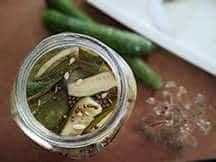
These pickles don’t take a long time nor do they make too much — just two quarts. They do take up refrigerator space, but just a few minutes of prep and a few days of waiting result in crispy, crunchy, tangy slices or spears. If you don’t have fresh dill available, a couple tablespoons of dried dill seed and/or weed will suffice. If you also need a little sweet in your pickle, add up to a cup of sugar to the vinegar before pouring it in the jars for a nice in-between sweet and sour. 

Prep tips: It has been hot, which can make cucumbers bitter, so just taste the cukes before you use them; peel off any yellow skin as necessary. I use a mandoline to get nice even slices, and I always use a cut-resistant glove to protect my fingers. 

8 cups sliced or “speared” cucumbers

optional: 1 small onion, sliced

2 tablespoons salt

6ish heads of dill seed

2 tablespoons pickling spice mix

1+ cup white vinegar

In a large bowl, cover cucumbers, onion, and salt with water; let set an hour.

Meanwhile, add dill and pickling spice to glass jar(s). 

Once veg are ready, scoop them out and press into the jars. Add vinegar, and then some of the saltwater/more vinegar until cucumbers are covered. Lid tightly and refrigerate for at least five days and up to five months. 

Day 16, Final Kansas Wheat Harvest Report

0
Kansas Wheat

Contact: Marsha Boswell, [email protected]

For audio file, please visit kswheat.com.

This is day 16, the final day of the Kansas Wheat Harvest Reports, brought to you by the Kansas Wheat Commission, Kansas Association of Wheat Growers, Kansas Grain and Feed Association and the Kansas Cooperative Council.

The Kansas wheat harvest is finally drawing to a close with 95 percent of wheat harvest complete, according to the official statistics provided by the USDA’s National Agricultural Statistics Service in its crop progress report for the week ending July 30, 2023. That is still well behind last year’s 100 percent completion at this time and the five-year average of nearly 99 percent.

Ahead of the weekend, the last remaining farmers in the harvest field were cutting down toward the Oklahoma border, primarily so they could report numbers to crop insurance, according to Lawson Hemberger, MKC senior location manager of rail terminals who is based out of the Sumner County Terminal in Milan. Hemberger oversees both of MKC’s current terminal elevators as well as the one under construction near Sterling. The terminal in Milan covers Sumner County, southwest of Wichita, and into neighboring Harper and Cowley counties.

The terminal took in its first loads of wheat around June 8. While that makes the length of harvest very long in total, Hemberger noted the majority of acres were harvested by the Fourth of July. The area caught five to six inches of rain that week, forcing farmers out of the field and starting a cycle of every-other-day rain delays, increasing weed pressure and falling test weights.

“This is definitely the first year I’ve seen a wheat harvest go darn near two months long,” he said.

Hemberger noted the area was pretty decent on moisture compared to other areas of Kansas as the wheat came out of dormancy. The wheat was up and looking pretty average, but then the area went all the way to early May before finally catching rain.

Hemberger estimated abandonment ranged from 10 to 15 percent. Some of those planted acres were abandoned before harvest so farmers could plant a second crop, others were zeroed out during harvest when some producers could send the combine down and back once in the field and not even fill up a coffee can.

He noted he was holding his breath when the rains arrived — calling it the do-or-die moment — but the wheat was at the exact right stage to fill the kernels that it put on. Test weights were excellent during the first few weeks of harvest, right at 60 to 60.5 pounds per bushel.

Yields were widespread from five bushels per acre — primarily where crop insurance would not release acres ahead of harvest — up to 48 bushels per acre. For the early part of harvest ahead of the holiday, Hemberger estimated most farmers averaged about 20 bushels per acre.

Protein was exceptional — even higher than last year’s drought-stressed crop — with Hemberger estimating 80 percent of wheat coming in was at 13 percent protein or higher. He noted for wheat report readers that the protein levels are mostly locked in once the wheat matures, meaning the protein values do not drop significantly like test weight.

The Sumner County Terminal has four different pits, allowing MKC to set up a really good segregation plan. Hemberger explained that most of the time they have four to five protein breaks — so trying to separate every percentage point (10 percent, 11 percent, etc.). This year, the crop came in so much higher with protein content that they had to adjust that segregation plan every other day to continue separating the highest protein wheat. He noted they are putting higher protein wheat — 14 and higher — into long-term storage, stashing it away for another time when good protein wheat may not be as readily available as this year’s crop.

Hemberger reported the most consistently reported top wheat variety this year was AgriPro’s Bob Dole, which was developed by K-State. He noted producers also highlighted Larry, also developed at K-State, and Paradise from Polansky Seed, as varieties that performed well in the area this year.

After the big rains around July 4, however, the rain kept coming. As a result, damage has substantially increased on those tail-end acres and test weights dropped off and at the end of harvest were down to 56 to 57 pounds per bushel. Weeds were a whole other debacle as producers struggled to control late-season emergence options in order to harvest. Crop insurance ended up zeroing out some fields due to crabgrass that came in after pigweed was sprayed.

Even with the frustrating end of harvest, Hemberger reported this year’s harvest was better than expected.

“We figured we got about 60 to 65 percent compared to a normal year,” Hemberger said. “Looking back at where we were going into May, we didn’t think we would have a crop at all.”

Despite the challenges the rain caused for the wheat, the ample moisture means the fall crops are looking really good, even with the long period of triple-digit weather that is threatening the crop at a critical growth period. Hemberger noted a rain at the end of last week of 1.5 to 3 inches could not have come at a better time.

Now the challenge is to turn house quickly at the terminal to make space for those fall crops. Most of the wheat will be sent to local mills. The MKC terminal does have two train loaders, but with such a short crop, there is not a strong export market out of Kansas this year. Still, he noted they will load a few trains that were contracted back this spring.

Overall, this wheat harvest will be one for the record books, although not in the way that producers would prefer, according to Justin Gilpin, Kansas Wheat CEO. As of its last estimate, USDA predicted Kansas wheat production will total 208 million bushels on 6.5 million acres, the smallest crop since 1966.

Breaking down that overall number, however, average yields for 2023 are currently estimated at 32 bushels per acre compared to 19.5 bushels per acre in 1966. That gain is directly attributable to the improvement in available wheat genetics, recommended farming practices and decades of on-farm knowledge.

“What shouldn’t be lost in everything that’s going on is the gains that have been made through genetics to try and keep a disaster from being more of a disaster,” Gilpin said. “The 2023 wheat crop had more than its share of twists and turns, but overall, we’ve come a long way. Every year is a little bit different, but 2023 is probably going to be one of those years that does stand out for a long time on charts, and not just due to the overall challenges this crop faced. Combined with the market volatility and unprecedented geopolitical events — everything that is occurring simultaneously within the wheat market right now is pretty incredible.”

Learn more about Gilpin’s perspectives on this year’s harvest, supply-and-demand factors across wheat classes, end-use quality, international market influences and more in the latest episode of the “Wheat’s On Your Mind” podcast at wheatsonyourmind.com.

The 2023 Harvest Reports were brought to you by the Kansas Wheat Commission, Kansas Association of Wheat Growers, Kansas Grain and Feed Association and the Kansas Cooperative Council.

###

Written by Julia Debes for Kansas Wheat

Meals from Thoughtful Church Families Help the Eichers in a Busy Time

0

We have entered the month of August. We are having cool mornings after having hot and humid weather last week. We also had a few storms that took down trees and branches in the area. Son Benjamin mowed the grass last night and also cleared up a lot of branches from our yard. We have lots of trees. The grass looks nice and green, and the rain perks up the gardens.

Today my plans are to can sweet dill pickles. I use Palace King cucumbers and grow my own dill so it’s easy to make them. Last week we canned 14 quarts for daughter Elizabeth while helping her. We also use the Palace King cucumber for fresh eating. It has a rougher skin, but I just scrape it and then slice them. Or sometimes I peel them for cucumber salad. They stay very crisp when canning them. I usually serve this kind when we host church services.

Today, daughters Lovina and Verena are assisting Elizabeth with last-minute jobs that need to be done before they host church services on Sunday. Lovina left last night and spent the night at Verena’s house. Daughter Loretta and her son Denzel are here. Denzel is starting to walk. When he wants to go somewhere fast, he crawls because he still thinks it’s faster than walking. Right now he’s sitting beside me looking at a book. He is taking an interest in books now. Of course, we only give him the cardboard types because he loves to tear up paper. When he gets ahold of a newspaper, there isn’t much left of it when he gets done with it.

Last night’s supper was brought in for us, and also for Dustin and Loretta. This is the third meal brought to us from church families. Our bishop’s wife passed out slips of paper to our church families or whoever wanted to help with a date on it to bring some in to Dustin and us. She told me that every Monday, Wednesday, and Friday for several months the meals will be brought in. This is just so thoughtful! We really appreciate it. We cannot be thankful enough for our church families that show support and are willing to help out each other. The meals have been really delicious as well. It will give me some more time in the weeks ahead to help out Loretta.

Monday, I took son Kevin to get his stitches removed. It seems to be healing well. The doctor did a good job to put the stitches close to the eyebrows to help hide the scar. 

I can smell freshly cut hay from the field beside us. Dustin also has hay cut that needs to be put in most likely today or tomorrow. We have put our hayfield into pasture for our horses and were buying hay. Benjamin has two horses, Joseph has two horses, and Joe and I have one horse and a colt and our pony, Stormy. Joe wants to get some beef calves to raise for our own use. 

I need to get started with the pickles. My work won’t get done with me sitting here! 

I will share the pickle recipe I will use today. May God bless you all!


Sweet Dill Pickles

Pickling cucumbers, sliced (enough to fill 3 quarts)

2 cups vinegar (I use white vinegar)

2 cups water

3 cups white sugar

2 tablespoons salt (I use a canning and pickling salt)

4 cloves garlic (per quart)

2 dill weed heads, or 1 teaspoon dill weed seeds (per quart)

Pinch alum (per quart)


This recipe will make about 3 quarts. Place sliced cucumbers, dill, garlic, and alum into quart jars. Heat vinegar and water until hot, then add sugar and salt and stir to dissolve. Pour liquid over cucumbers, leaving 1/2 inch of headspace above the top level of the brine. Cover jars with lids and bands and process in a boiling water canner for 5 minutes.

Note: Canning times are subject to change according to USDA regulations. Check your county extension office.

Lovina’s Amish Kitchen is written by Lovina Eicher, Old Order Amish writer, cook, wife, and mother of eight. Her newest cookbook, Amish Family Recipes, is available wherever books are sold. Readers can write to Eicher at Lovina’s Amish Kitchen, PO Box 234, Sturgis, MI 49091 (please include a self-addressed stamped envelope for a reply); or email [email protected] and your message will be passed on to her to read. She does not personally respond to emails.