Wednesday, January 28, 2026
Home Blog Page 200

TMI

0
lee pitts

We are told that consumers want to know everything about the food they eat, from the time its was planted or impregnated until the time it reaches their plate. I think we have to be very careful in how we meet the consumer’s wishes or it could backfire on us.

Follow along with me now as we join the Wilson family as they are gathered around the dinner table to enjoy a scrumptious prime rib. Instead of saying grace before dinner Mrs. Wilson scanned a bar code on the beef package so they could put a face to the food they were about to enjoy.

A computer screen came to life and as music faded away there appeared on the screen a black-faced calf that said, “Hi, I’m Blizzard and I was born in North Dakota in the middle of a blizzard. I survived but my mother didn’t.”

The youngest Wilson girl dabbed her eyes with a napkin and said, “Oh, the poor thing. He’s so cute.”

Blizzard continued, “I never knew my father and my mother didn’t either because she got raped repeatedly by several brutish thugs at the time of my conception. I’d have given anything to have known my father, to have him explain the birds and the bees, or show me where to hide when the cowboys came to gather us all up. But like many modern American males these days, he skipped town wanted nothing to do with his offspring.”

Suddenly what was a joyous Wilson family dinner now turned into a soap opera. As they were about to dig into the prime rib one by one the family members put their forks down and sat in rapt attention as Blizzard continued with his autobiography. “Here I am in the bathtub of the family that owned the ranch I was born on. They are pouring hot water on me to warm me up. For the first weeks of my life I lived in close proximity with this kind family of five who bottle fed me at all hours of the night. There I am curled up in front of their fireplace. I lived in the barn until I was turned out with the herd. The rest of the calves called me names like”dogie” and I felt lonely a lot. Occasionally I’d try to sneak a drink off the other cows when they weren’t looking but I grew tired of being kicked in the head. Then the rest of the calves were weaned off their mothers and it was their turn to cry. But I had no mother to cry for and I had long ago lost the urge to suckle.”

Mr. Wilson looked at his prime rib and wondered if this wasn’t a case of TMI… too much information.

“For the most part,” continued Blizzard, “I was treated well except when they gave me shots, branded and castrated me. There’s a photo of me sprawled on the ground as some cowboy took away my manhood. It didn’t hurt as much as you’d think but I did lose all interest in heifers from then on.”

“Here I am being loaded on a truck with the other calves, bound for a feedlot in Nebraska. Life at the feedlot was like living in a commune with a cafeteria that was open 24 hours a day and we could eat all we wanted. Being the runt of the litter I had few friends in my pen, except for the cowboy who rode through the pen on frequent checks to make sure we were all okay. There was lots of gossip about where we were going next, some cattle concentration camp it was rumored, but I didn’t believe them. If you are eating me now I guess the rumors were true.”

As Blizzard’s story came to a close the Wilson’s turned their attention back to the prime rib but they’d lost their appetite for beef so someone in the family called and ordered a take-out pizza. A vegetarian pizza! And the next day someone removed all the packages of Blizzard’s beef from the freezer figuring the poor calf had enough cold weather for one lifetime. From then on whenever Mrs. Wilson bought beef, if she bought it at all, she made sure it was from Uruguay or Australia that she knew absolutely nothing about.


St. Patrick’s Day: Time to rock your shamrock knowledge

0

If a leprechaun leaps from the faerie den this St. Patrick’s Day to ask if you know a shamrock from a clover, what will you answer?

“If you said the shamrock is a clover, you’re in luck,” says University of Missouri Extension field horticulturist Kathi Mecham.

In short, all shamrocks are clovers, but not all clovers are shamrocks.

The word shamrock comes from the Gaelic word semróg, which translates to “little clover.” Shamrocks are the most common and recognizable symbols of Ireland.

While a shamrock is a clover with three leaflets, some clovers have four leaves and are thought to bring luck to anyone who finds one. “There is about a 1 in 10,000 chance of finding a four-leaf clover,” says Mecham. As an Irish proverb says, “A good friend is like a four-leaf clover: hard to find and lucky to have.” Even rarer is the five-leaf clover.

By most accounts, the original shamrock is thought to be either yellow clover (Trifolium dubium) or white clover (Trifolium repens). Both plants have three oval green leaflets with tiny, ball-shaped floral clusters.

Clover draws bees, butterflies and other pollinators to the nectar of its lightly scented flowers.

“The shamrock has long been a part of Irish history and culture,” says Mecham. Legend has it that the Emerald Isle’s patron saint, Patrick, used the three-leaf clover to teach about the Holy Trinity of Christianity: Father, Son and Holy Ghost.

Around St. Patrick’s Day, grocery stores or floral shops will sell an attractive “shamrock plant.” This imposter is a plant from the genus Oxalis, a member of the wood sorrel family. It hails from mountainous regions of South and Central America, not Ireland.

Oxalis triangularis looks like clover with its three triangular leaflets. This eye-catching plant produces small white to pink flowers. Its leaves may be green, variegated or deep maroon.

While true shamrock has a fibrous root system, many oxalis species produce tubers, or bulb-like structures, says David Trinklein, MU Extension state horticulturist. “In fact, the plump, juicy tubers of Oxalis tuberosa have long been cultivated as a food source in Colombia and other South American countries. Referred to as oca by people indigenous to the area, it is second only to potato in acreage planted in the Central Andean region.”

Shamrocks prefer a porous medium that is barely moist. Fertilize only when growing. Place in indirect bright light to keep plants from becoming leggy. However, too much sun scorches the tender leaves.

Oxalis’ leaves begin to decline after a few months. Don’t despair, says Mecham. Your plant just needs a rest. When leaves start to die back, stop watering and allow leaves to dry. Remove the dead leaves and put the plant in a cool, dark spot for 2-3 months. Purple-leaf plants only need about a month’s dormancy. After the rest period, move the plant back to a window and begin watering again.

The leaves of oxalis and other shamrock plants fold up at night and reopen in the morning light, giving a wee “top o’ the morning” tip of the hat to its owner.

“With the right care, this attractive houseplant can be enjoyed for years,” says Mecham.

For more history of the oxalis, see “Oxalis: Shamrock’s Imposter” at https://ipm.missouri.edu/meg/2019/3/oxalis/.

Learn more about another favorite Irish plant, Bells of Ireland, at https://extension.missouri.edu/news/bells-of-ireland-a-st-patricks-day-favorite.

Durham Is A Place

0

Richard Shank
Columnist

The pundit who said rural America is lacking in good family restaurants and cafes has not been to Durham, Kansas to dine at the Mainstreet Café and Bakery.
Durham, located in Marion County 30 miles south of  Abilene on Highway 15, is not untypical to many small rural towns and has experienced a loss in population during the past 30 years. The internet reports the town’s 2023 population at 96, but one of the locals jokingly told me that could be a stretch. Still, this tiny berg remains incorporated and continues to have a mayor and governing body of five city council members. From what I observed the café is a common meeting place for those who reside in the area.
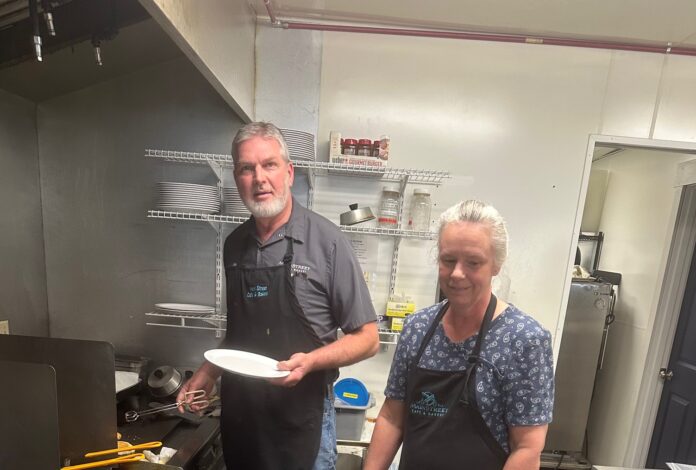
Arriving in Durham at 11 a.m. March 6, I found this town’s downtown area filling up with cars and pickups and all were entering the Mainstreet Café and Bakery for a hearty noon meal. Mark and Kris Wiebe, owners of the Mainstreet Café and Bakery, were hard at work in the kitchen cooking and serving a near full house of customers, many of which came to order a Chicken Fried Steak, which was the cafe’s Thursday special.
A quick look around the restaurant by this first-time diner was proof they serve more than the traditional steak and hamburgers. A counter display of freshly baked pies was positioned to the south of the salad bar, strategically placed to tempt all who came for a noon meal, including yours truly. And, as the waitress pointed out, a dip of ice cream goes with the pie, an offer no eater should pass on. For this new customer, the cherry pie nudged out apple and the preferred choice. And, as a customer pointed out, the cafe’s baked bread is known far beyond the boundaries of Marion County.
Mark, in a short break from his chef duties, smiled as he said his greatest reward is meeting so many nice people every day. Observing the size of the crowd, the eaters all like his cooking as many were repeat or daily customers. “Occasionally, we accept a catering job and soon we will prepare a wedding dinner for 250,” Mark said. “At Thanksgiving time, we offer holiday meals to go.”
Kris said that although no specific date exists as to when the café first opened its doors for business, it is assumed it may have been more than 100 years ago, in the same location. The Wiebe’s have been owners for about five years. Mark grew up on a farm near Durham and Kris, growing up in Montezuma in the state’s southwest corner, took up residency after marrying Mark.
During the past several years, the café was expanded to the north where a meat shop and the town’s library were formerly located. Daily specials are written on a chalk board. Wall décor includes metal pictures of antique tractors and an antique display case exhibiting memorabilia from Durham High School, including a letter jacket. And, on this day, Kris pointed out the cafe’s original refrigerator which is still used.
Kris noted they frequently serve new customers, including this day. “Many customers drive from as far as Kansas City, Wichita and Salina to eat here,” Kris said.
And, Kris echoed Mark’s comments that she, too, enjoys the daily interaction with people.
Hours are Tuesday-Saturday 7 a.m. to 2 p.m.; Friday evenings 5 p.m. to 7:30 p.m. and on the first Saturday of the month, diners can feast on a breakfast buffet from 7 a.m. to 10:30 a.m.
Durham was founded in 1887 and was named after Durham cattle.
For Durham, 1963 holds a special memory for the town as the high school basketball team swept to a state championship in what was then called Class “Double B.” Galen Frick, a star on the championship team, went on to play for Dodge City Community Junior College, earning a spot in the school’s Sports Hall of Fame. Next, Kansas State Coach Tex Winter recruited him to play his junior and senior for the Wildcats where he was an above-average player in what was then the Big Eight Conference.
As a freshman on Solomon High School’s team in 1963, I vividly remember two losses we suffered to the opposing team from Marion County. We thought Durham could have competed with much larger schools in the metropolitan areas of Kansas. They were as good as it gets in that distant time.
For many years, signs on each end of town on Highway 15 proclaimed Durham as home of the 1963 State Championship Basketball Team; but, note the signage is now gone, which I found a little surprising.
Durham High School closed its doors many years ago and the community is now served by a Mennonite school located outside the city limits. I noted the high school located on the north edge of town looks abandoned but shiny new farm implements are parked in front of what was once the school.
Also, on a street to the south of the café, G&R Implement Company still markets some Oliver tractor parts, even though the last Oliver tractor rolled off the assembly line in 1976. On a drive by the business, I noted an Oliver sticker on a window, something very uncommon a half century after the company ceased business.
For this traveler who has, for several decades, driven the highway and byways of Kansas, there is nothing better at noon time than to pull up in front of a well-run cafe with good home cooked meals. Durham’s Mainstreet Café and Bakery meets that criterion in every aspect.
And Mark and Kris Wiebe are not only great cooks, but equally good hosts.
It is one of those places where customers say “we need to go back there again when we are in the area.”

Lettuce Eat Local: V for Vegan Victory

0

Amanda Miller
Columnist
Lettuce Eat Local


I often comment that if I hadn’t married a dairy farmer, I could potentially be a vegetarian.

Before you leave my column for good, know that I have nothing against meat necessarily, with a few caveats: for the animals’ sake, I value well-raised; for the eaters’ sake, I value minimally processed; and for the planet’s sake, I value conscious consumption. But I personally get kind of tired of eating it, if it’s by itself, and I don’t love touching it raw, so I could easily just slide into a mostly meatless lifestyle. 

My dad has always worked for non-profits (he still does), so in my childhood our food budget was never excessive. No one went hungry by any means, and my mom did a masterful job keeping my brothers and I satisfied and well-fed with healthy and varied meals, but meat was too expensive to be featured prominently. We would often have ground beef or shredded chicken in things, like stews, curries, casseroles, but not as the thing itself. It didn’t help that neither of my parents enjoy meat that much either, particularly not on the bone nor with any speck of schpeck (is that a Dutch word? I mean gristle or fat). I don’t actually remember an instance of my mom cooking a straight-up piece of meat, except for on a holiday or something maybe, and while I could be wrong, I don’t think I ever had a steak before Brian and I were dating.

That brings us to the present situation, where I’ve married into the farm family, and beef is one of the “cheaper” things around; it’s always in the freezer. The cows would have to literally be living in my house to get any more locally raised, and as I look out my window to see our Holsteins grazing in the adjacent field or listen to my husband talk about cow comfort, I don’t have many qualms about their good lives. (Waste chocolate is part of their daily nutritionist-formulated ration, for goodness sake; could they be happier?)

Even so, I have to admit my personal style still gravitates away from meat, and towards things like vegetables, beans, and cheese. Lots of cheese…hence why I could be a vegetarian by happenstance, but never a vegan. Because dairy. 

I don’t make choices for other people though, of course, and I’m well aware there are realistic moral or health arguments for following a plant-based diet. I had the opportunity to expand my vegan cooking capabilities last weekend when I catered a retreat for a group with multiple dietary needs, and I really enjoyed (some of) the challenges. I hollered when I took my first taste of the tofu-based mayo, grabbing the jar of Duke’s out of the fridge for a side-by-side taste test — it’s not an exact replica but it is so stinking close. I made a couple gallons of my archetypal yogurt, delivering some plain and whisking up a jar of brown-sugar vanilla; but also tried my hand at using homemade coconut milk to make into coconut yogurt, and was pleasantly surprised at my success. 

And honestly I was a little offended at how well the vegan baking went. I take joy in using my hens’ eggs, any number of homemade dairy products, and local honey in my baked goods, and even the science of baking changes when techniques turn plant-based. But with the help of some solid ingredient stand-ins and some respectable recipes, my cakes, scones, and cookies all turned out beautifully. 

I will, however, tactfully decline from comment on the soymilk ricotta and melty cheese. Our dairy cows have good job security there.

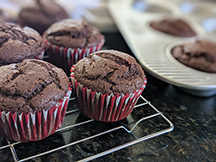
Vegan Chocolate Fudge Cupcakes

I borrowed most of this recipe from the Great British Bake Off — like I said, a credible resource. It’s similar to one-bowl “wacky cake” if you’re familiar with that, but with a spot more panache. Rich and moist, these cupcakes were so easy because they didn’t require creaming the butter (since there was none); just a whisk can get the job done. I did finish them with a butter-free “buttercream” frosting, but they were so good, I’m not even sure they needed it. 

Prep tips: I had a little extra batter after filling a dozen cupcakes, so I made a few mini ones as well. Use cute paper liners and you have the perfect little springtime snack. 

1 cup soy milk

1 teaspoon apple cider vinegar

¾ cup white sugar

⅓ cup brown sugar

½ cup veg oil

vanilla

1 ½ cup flour

¾ cup cocoa

1 tablespoon baking powder

½ teaspoon baking soda

1 teaspoon salt

1 teaspoon espresso powder

¾ cup pumpkin puree

Mix milk and vinegar; set for 5 minutes. Whisk in sugars, oil, and vanilla. In a mixing bowl, sift flour, cocoa, baking powder and soda, salt, and espresso. Whisk in wet ingredients, adding pumpkin. Transfer to paper-lined cupcake pans, and bake at 400° for about 20 minutes. Let cool half an hour in pan before cooling on racks.