

Lettuce Eat Local: The X Factor
Amanda Miller
Columnist
Lettuce Eat Local
Formulating a concise definition of magic almost feels like we first need to invoke some type of magic to boil it all down. To assess and categorize the panoply of lore, thoughts, theology, and gradations of the subject, and then to arrive at any sort of clear and socially agreed upon articulation therein, would require a certain level of supernatural input.
Is magic of Merlin, Harry Potter, Aslan, or Gandalf? There are many different levels of “magic” that others may subscribe to, but I won’t/can’t even go there, since I do not study or believe in them. All that to give the disclaimer that I believe in the supernatural power of Christ, and references to magic otherwise are literary, card-trick-style, or facetious.
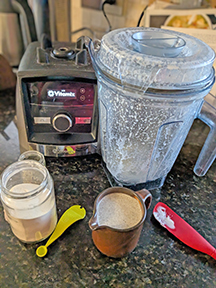
The kitchen is often my magical milieu. The symbolic tool of magic for me there is not a pointy hat, the One Ring, or a broomstick. Since it does everything from mixing quick breads to meatballs to softened butter, I often introduce my fancy-looking spiraled dough whisk as my magic wand — but anyone who’s stepped foot in my kitchen knows my Vitamix blender is my real magic worker. I have been under its spell ever since I bought it at the State Fair a decade ago, and I have no intentions of ever trying to escape.
My blender is the catalyst for sorts of entrancing culinary transformations, although it doesn’t hold a total monopoly on the magic. The Bosch mixer turns gloppy egg whites into pillowy billowy meringue or flour and milk into stretchy, supple dough; the coffeepot takes only beans and water to create an elixir of life; even the oven, whose power is often overlooked, quietly transmutes all sorts and forms of substances in enchanting ways if we only choose to take notice.
And the dishwasher, now there is a truly magical appliance. Brian and I didn’t have one for the first seven years of our marriage, and rarely do I press the start button without a moment of awe in recognition of the metamorphosis about to occur. Abracadabra indeed.
Sometimes it’s hard to identify the source of the magic, to distinguish whether it’s the tool, the ingredient, or the process, but it is more important to notice and appreciate these small moments of culinary enchantment than to delineate. You can literally hear the moment cream converts into butter, see the milk transmogrify into ricotta before your very eyes, feel the difference when sticky dough slowly changes into kneaded dough, smell the rich nuttiness when butter suddenly turns into browned butter. And then you get to taste all of it! Our senses tell us this kitchen magic is both mysterious and yet completely tangible, more material than otherworldly.
There are no spells, no incantations, no magic wands (except for that dough whisk, of course). At times certain equipment and niche ingredients come into play, but other times the simplest ingredients and set-up yield magical results — just ask Benson what happened when we experimented with baking soda and vinegar last week.
What we need more is simply the ability to notice and take joy in the little moments of everyday magic, the things that make getting food on the table a little more fun and fantastic.
Oh, and a dishwasher.
Xanthan Gum Italian Dressing
This recipe is full of magic, plus bonus X factor points for using my VitamiX. The dressing tastes just like Olive Garden’s, which is miraculous since I’m allergic to garlic and can never have theirs anymore; vinegar is essentially a magic potion since it does so many things, and I’ve long considered mayonnaise a magic sauce. The xanthan gum is the only component you might have to seek out, but it’s a fun ingredient to have around: often used in gluten-free and non-dairy baking, just a tiny bit of xanthan also works as an emulsifier or instant thickener (I use it in homemade soft-serve which is a whole other level of magic). Adding xanthan to this recipe keeps the dressing from separating, as well as providing a nice mouthfeel without much oil.
Prep tips: for the garlicky version, add ¼-½ teaspoon garlic powder.
½ cup water
¼ cup extra-virgin olive oil
¼ cup white vinegar
1 oz parmesan or romano
1 tablespoon mayonnaise
1 teaspoon sugar
1 teaspoon Italian herbs
½ teaspoon salt
1/16 -⅛ teaspoon xanthan gum
Process all ingredients in a blender.
The Harvey County Home and Garden Show

The Harvey County Home and Garden Show is next month at the Dyck Arboretum in Hesston! Mark March 22 and 23 on your calendar for this awesome local garden show!
There will be lawn and garden educational presentations, home and garden vendors, door prizes and this year kids get to build a birdhouse! Admission is just $1 and ages 12 and under are free.
We are accepting registrations for vendors now. We already have many signed up!
The presentations are given by state and local experts. The speaker topics include: mushrooms, nuisance insect control, bird scaping, birding, lawn care, indoor blooming plants, weather, Humming birds, and flower gardening.
If you wish to become a vendor contact the Harvey County Extension Office at 313-284-6930 or email at [email protected] or [email protected] for a registration form.
The show hours are March 22 8:30 – 5:00 pm and March 23 Noon – 5:00 pm. Don’t miss this great local garden event to learn, shop, and enjoy the spring season!
Wheat Scoop: Kansas Wheat Farmers Cautiously Waiting to see Impact from January’s Chilling Temperatures.

For the audio version, visit kswheat.com.
Winter is a “watch and see” season for Kansas wheat producers as their fall-planted stands wait in dormancy. Thanks to a combination of good stand establishment and moisture events, the coffee shop chatter remains optimistic thus far that this harvest will be better than the last, even as recent freezing temperatures threatened the crop with winterkill damage.
Richard Cott, who farms in north central Kansas, shared during the recent Kansas Wheat board meetings, that there is lots of hope, thanks to good stands established in the fall and more than a foot of snow that lay evenly on fields.
Still, it’s no secret to anyone who wandered outside, it got cold in Kansas from January 18 through January 21, with temperatures dropping as low as -15 degrees Fahrenheit. According to an eUpdate from K-State Agronomy issued on January 23, air temperatures were low enough to cause leaf burn but soil temperatures at two inches down never dropped below 20 degrees Fahrenheit.
The crop was further protected from snow cover following winter storms on January 6. According to the eUpdate, just two to three inches of snow should be sufficient to insulate the wheat crop from the coldest temperatures.
John Hildebrand, near Stafford, reported receiving nearly a foot of snow that stuck around for days and had rain come on top. Stands look good in his area in central Kansas.
But even the crops left without a blanket of snow still had good stand establishment from moisture this fall, especially for fields planted early. In fact, some of these early-planted fields were considered “too big” going into dormancy. Armed with a large number of tillers and good root development, the crop was and is set up to withstand a Kansas winter.
Jason Ochs from Syracuse and Mike McClellan from Rooks County both shared that their early planted wheat, planted as early as September 15, might fall into that “too big” for winter category, but the stands are up across the board and look loads better than the past couple of years.
According to the eUpdate, “A well-developed crop with three to five tillers can handle air temperatures in the single digits fairly well. Over 60 percent of the Kansas wheat crop emerged by mid-October and likely falls in this category. However, soil temperatures in the single digits can cause significant damage and winterkill, especially to less developed crops, such as the fields that emerged after November (about 25 percent of the Kansas crop), which will be more sensitive to winterkill with higher temperature thresholds for damage.”
Late-planted fields without snow cover are the most susceptible to winterkill damage, and there are parts of the state that will need more moisture than anything else as the crop emerges from dormancy. Kyler Millershaski, who farms near Lakin in southwest Kansas, reported he had to redrill some wheat, but it doesn’t look “too terribly bad.” While the top layer of soil is still dry and rain totals are still counted in hundredths, the crop still looks better than the past couple of years.
In the monthly winter crop progress and condition report, USDA’s National Agricultural Statistics Service reported winter wheat conditions with slight improvements from the month prior at 50 percent good to excellent, 36 percent fair and 14 percent poor to very poor, as of the week ending February 2.
The true impact of the combined winter weather will not be seen until the crop comes out of dormancy, which K-State estimates will be in another 50 to 60 days. Until then, producers will continue to monitor fields and count the drops or flakes that fall into the rain gauge.
Learn more about the potential for winterkill to the Kansas wheat crop and track the crop as it emerges at https://eupdate.agronomy.ksu.edu/.
###
Written by Julia Debes for Kansas Wheat
KU News: Researcher co-edits special issue highlighting how just energy transition can happen globally

From the Office of Public Affairs | http://www.news.ku.edu
Headlines
Researcher co-edits special issue highlighting how just energy transition can happen globally
LAWRENCE — As the world transitions from fossil fuels to renewable energy, entire communities are being left behind or overlooked. A University of Kansas associate professor of public affairs & administration has co-edited a new special issue of the journal Planning Theory & Practice examining how public planners can help ensure a just energy transition around the globe. “While people may think of these energy problems being in Madrid, Nairobi or other major cities in other countries, they are also right here,” Ward Lyles said. “There are already winners and losers in places like Kansas that are getting funding to address these questions and issues of air quality, justice and place-based solutions, to deal with energy transition as it lands in communities.”
KU to welcome School of Pharmacy dean candidates to Lawrence campus
LAWRENCE — Four candidates will hold public presentations in consideration of becoming the next dean of the School of Pharmacy at the University of Kansas. The name of each candidate will be announced approximately two business days before their respective campus visit, and visits are scheduled Feb. 10, 13, 17 and 20. Presentations will take place in Room 1020 of the School of Pharmacy building and will be livestreamed.
Artist’s guide to digital weaving blends old, new technology
LAWRENCE — The new 72-page book “RATIO: Digital Weaving to Change the World” is Poppy DeltaDawn’s first take on a more cross-disciplinary approach to the possibilities and implications of the digital hand-loom. The University of Kansas assistant professor of visual art spends much of “RATIO” explaining and illustrating her methods — practically and step by step — but also recounts the development of weaving technology in China and Europe, integrating a philosophy that, in the words of her publisher, “considers the broader implications of creating cloth and why it matters to our agency, autonomy and freedom.”
KU graduate is first Jayhawk named finalist for Fellowship for New Americans
LAWRENCE — University of Kansas alumna Isabel Keleti is the first KU graduate to be named a finalist for a highly competitive national fellowship that provides merit-based funding for new Americans, immigrants and children of immigrants who are poised to make significant contributions to U.S. culture. Selected from a pool of more than 2,600 applicants, Keleti is one of 77 finalists to interview for the Paul & Daisy Soros Fellowships for New Americans. A dedicated pianist and educator, Keleti is a Leawood native and Blue Valley North High School graduate. She earned a bachelor’s degree in piano performance from KU in 2017.
Full stories below.
————————————————————————
Contact: Mike Krings, KU News Service, 785-864-8860, [email protected], @MikeKrings
Researcher co-edits special issue highlighting how just energy transition can happen globally
LAWRENCE — As the world transitions from fossil fuels to renewable energy, entire communities are being left behind or overlooked. A University of Kansas researcher has co-edited a new special issue of a journal examining how public planners can help ensure a just energy transition around the globe.
“From a planetary standpoint, we have to get off of coal, but there are people employed at coal plants. And there are communities that are very dependent on fossil fuels,” said Ward Lyles, associate professor of public affairs & administration at KU. “As you look around the world there are people who are making choices about their energy future and finding it’s not always a just future for everyone.”
Lyles, along with Fayola Jacobs and Elise Harrington of the University of Minnesota, edited the special issue of the journal Planning Theory & Practice. The issue invited scholars from around the world to explore topics in a just energy transition and how planners can play a part in equity and justice, policy and governance, community engagement, and other factors.
“This issue’s pieces offer planning a call to action, an encouragement to redouble our efforts to address justice in both traditional planning areas and increasingly important arenas, such as energy. We are reminded that a transition away from carbon-intensive fossil fuels and shift in energy production technologies does not inherently result in processes and practices that reshape social and economic systems for good, from documenting the prevalence of unjust financial practices in the solar industry to re-centering non-human beings in the energy transition,” the editors write in their introduction.
The journal includes submissions from authors representing five continents exploring topics in just energy transition in both the Global North and South. Paired teams offered pieces addressing a topic as well as a response from peers. Topics covered include energy poverty in the Global North, socially and ecologically just energy transitions, the politics of resistance to planning for just energy transitions, debilitating debt’s role and the dual role of urban artificial intelligence in such transitions.
The contributed pieces give examples of attempts at just transition, such as the European Union’s support of switching to renewable energy, with unintended consequences of communities in Spain, often poor communities, being overlooked and left without dependable access to electricity. Others examine how politics of resistance have cropped up in locations such as Colombia, South Africa and Indonesia, often in response to an urban bias in energy transition. All three nations are major coal producers and have committed to a just energy transition, but they have seen debates and resistance in areas traditionally overlooked in policy discussions.
The pieces point out potential issues, such as poverty and how they stand in the way of a just energy transition, while the responses examine ways urban planning can take the examples to heart and ensure that current and future generations can be just and equitable in their work toward that goal.
“While people may think of these energy problems being in Madrid, Nairobi or other major cities in other countries, they are also right here,” Lyles said. “There are already winners and losers in places like Kansas that are getting funding to address these questions and issues of air quality, justice and place-based solutions, to deal with energy transition as it lands in communities.”
Authors point out how efforts to aid an energy transition are often well intentioned and how technology designed to assist can perpetuate injustices.
“The digital divide — a disparity in access to and literacy in digital technologies — risks benefiting only certain population segments with AI-driven energy initiatives. Those lacking necessary technology or digital skills may be further marginalized in an increasingly digitized energy landscape. Additionally, data privacy and surveillance concerns arise as urban AI systems collect and analyze vast amounts of personal and community data,” writes Mennatullah Hendawy of Ain Shams University in Cairo. “Without robust safeguards and transparent governance, AI in energy management could lead to intrusive monitoring of individuals’ energy consumption patterns, infringing on personal freedoms and privacy. Therefore, to support a just energy transition, AI deployment must adhere to fairness, transparency and inclusivity, ensuring broad accessibility and mitigating potential negative impacts like job displacement in traditional energy sectors.”
While the contributions come from around the globe and from scholars from a variety of disciplines, the editors said they all show how urban planning can and should play a vital role in ensuring a just energy transition. The issue’s format with brief contributions and responses were intended to ensure a conversational look at global topics that can have local appeal.
“We wanted topics that were complementary,” Lyles said. “Rather than curating a book, it’s more like curating a few journal articles or conversations that are very inclusive of diverse voices on what needs to happen for a just energy transition.”
-30-
————————————————————————
KU News Service is now on BlueSky.
Follow for KU News Service stories, discoveries and experts.
https://bsky.app/profile/kunewsservice.bsky.social
————————————————————————
Contact: Savannah Rattanavong, Office of the Provost, 785-864-6402, [email protected]
KU to welcome School of Pharmacy dean candidates to Lawrence campus
LAWRENCE — Four candidates will hold public presentations in consideration of becoming the next dean of the School of Pharmacy at the University of Kansas. The university seeks a visionary, collaborative leader and scholar to advocate for excellence in research and teaching that betters the world.
The name of each candidate will be announced approximately two business days before their respective campus visit. The public presentations will take place in Room 1020 of the School of Pharmacy building and are scheduled for the following dates:
Candidate 1: 4-5 p.m. Feb. 10
Candidate 2: 4-5 p.m. Feb. 13
Candidate 3: 4-5 p.m. Feb. 17
Candidate 4: 4-5 p.m. Feb. 20
The presentations also will be livestreamed through links available on the Provost’s Office website. Members of the KU community are encouraged to attend each candidate’s public presentation and provide feedback to the search committee. Presentation recordings and the online feedback form will remain open throughout the visit process.
The dean will be responsible for all school administration matters, including academic programs, research, personnel, budgets, alumni engagement, fundraising and government and industry relations. The dean will also be expected to be a strong proponent for pharmacological research, professional pharmaceutical education and the school.
The School of Pharmacy trains researchers who help solve the world’s most pressing medical problems and elevates workforce development through educating nearly 400 pharmacists annually who serve the people of Kansas and beyond. The school additionally has been in the top 20 National Institutes of Health-funded pharmacy schools for more than 20 years.
The search committee, co-chaired by Michelle Carney, dean of the School of Social Welfare, and Candan Tamerler, associate vice chancellor for research and professor of mechanical engineering, is aided in the process by WittKieffer, an executive search firm specializing in higher education.
More information about the search can be found online.
-30-
————————————————————————
Don’t miss new episodes of “When Experts Attack!,”
a KU News Service podcast hosted by Kansas Public Radio.
https://kansaspublicradio.org/podcast/when-experts-attack
————————————————————————
Contact: Rick Hellman, KU News Service, 785-864-8852, [email protected], @RickHellman
Artist’s guide to digital weaving blends old, new technology
LAWRENCE — As Poppy DeltaDawn, assistant professor in the University of Kansas Department of Visual Art, sees it, the 72-page “RATIO: Digital Weaving to Change the World” (For the Birds Trapped in Airports/LMRM, 2024) is her first take on a more cross-disciplinary approach to the possibilities and implications of the Thread-Controller 2 digital hand-loom.
“It’s a hand-loom outfitted with computerized Jacquard technology that was invented in the 1990s by an Oslo weaving professor, Vibeke Vestby,” DeltaDawn said. “It’s made by the Norwegian company Tronrud.”
The maker says it “enables the weaver to expedite the process of converting ideas into actual form or woven fabrics.”
DeltaDawn is building upon that framework.
“I relocated to KU from the School of the Art Institute of Chicago to develop the Textile and Fiber area’s digital weaving program,” said DeltaDawn, who arrived on the Lawrence campus in fall 2023. “In the last decade, institutions across the world have been integrating handweaving and innovative design into their curriculum, yet there are still relatively few opportunities to learn the loom and consider its social and historical contexts.”
DeltaDawn spends much of “RATIO” explaining and illustrating her methods — practically and step by step — programming the TC2 loom using original designs created in the Adobe Photoshop computer program. But she also recounts the development of weaving technology in China and Europe, integrating a philosophy that, in the words of her publisher, “considers the broader implications of creating cloth and why it matters to our agency, autonomy and freedom.”
The book also contains a preface by the co-directors of Chicago’s LMRM (“Loom Room”), a community weaving center with one of the largest digital looms in the country. The book debuted during LMRM’s 2024 Weaving Workshop Weekend, a digital weaving conference in which DeltaDawn also presented a lecture and new work in a group exhibition with the event’s other presenters.
DeltaDawn said her hiring at KU is an encouraging sign of the times.
“There’s an interest in traditional textile production that was experiencing a divestment in the past 20 years or so,” she said.
In “RATIO,” DeltaDawn writes of connecting the renewed interest in hand-making cloth and other traditional crafts to the so-called “tradwife” movement, suggesting that “traditional” and “conservative” values are conflated. But there are plenty of other factors at play, she said.
In her classes and research, DeltaDawn lectures on why weaving matters and why it is essential to continue innovating this human technology. Among other exemplars, she points to Mahatma Gandhi’s Swadeshi movement that espoused a self-reliant community rooted in traditional cultural and economic subsistence.
“Because the bulk of our manufacturing takes place overseas, the average American just doesn’t know how textiles are made anymore,” DeltaDawn said. “Textiles used to be … a recognizable characteristic of our humanity and of our aptitude to manipulate the world around us into objects of cultural value and use value. The textiles that we use could tell a story about our communities and the land that we occupy.”
With more artists, designers and researchers interested in the creative possibilities of the digital loom, DeltaDawn said, a field manual that acknowledges the realities of our current material culture is needed.
“After being a part of digital weaving and textiles programs around the country,” the KU researcher said, “I realized that there was no playbook, no rules, no pedagogy for thinking through the ramifications of this novel technology. I realized that we have an opportunity to effect change and to consider what it means to make art today with ancient cultural practices.
“That is this book. This is the first step — asking, ‘What is the future of the field; the future of weaving?’ ‘RATIO: Digital Weaving to Change the World’ reveals and reminds its readers that weaving is a human-powered activity that was systematically taken from weavers.”
“This is only an edition of 200. This is chapter one. This spring I will be an artist-in-residence at the ATLAS Institute at the University of Colorado-Boulder, and during those three months I will work with researchers at the Unstable Design Lab to develop the next segment of my digital weaving guide.”
-30-
————————————————————————
The official university account for X (formerly Twitter) is @UnivOfKansas.
Follow @KUnews for KU News Service stories, discoveries and experts.
————————————————————————
Contact: Erinn Barcomb-Peterson, KU News Service, 785-864-8858, [email protected]
KU graduate is first Jayhawk named finalist for Fellowship for New Americans
LAWRENCE — University of Kansas alumna Isabel Keleti is the first-ever KU graduate to be named a finalist for a highly competitive national fellowship that provides merit-based funding for new Americans, immigrants and children of immigrants who are poised to make significant contributions to U.S. culture.
Selected from a nationwide pool of more than 2,600 applicants, Keleti is one of 77 finalists to interview for the Paul & Daisy Soros Fellowships for New Americans, after which 30 recipients will be selected this spring.
Fellows are granted up to $90,000 in funding for one to two years of graduate study in any field and in any advanced degree-granting program in the United States. They join a lifelong network of distinguished fellows across various fields.
A Leawood native and Blue Valley North High School graduate, Keleti earned a bachelor’s degree in piano performance from KU in 2017, having studied with Jack Winerock, professor emeritus of music. Following KU, Keleti earned a master’s degree in piano performance from the Mannes School of Music–The New School, studying with Vladimir Valjarević in New York City.
A dedicated pianist and educator, Keleti has won numerous international piano competitions and has performed at prestigious venues around the world, including Carnegie Hall, Bohemian National Hall, Xi’an Concert Hall and the Lied Center of Kansas.
Beyond her performance career, Keleti is passionate about Czech music and culture, earning recognition with the 2024 Gold Crystal Heart Award for significant contributions to Czech culture in New York City. She was also a Fulbright Scholar in the Czech Republic, where she studied with Professor Jan Jiraský at the Janáček Academy of Performing Arts in Brno.
The daughter of parents from Slovakia and Belgium, Keleti grew up surrounded by the European music and traditions shared by her parents, which inspired her dedication to classical music and its role in preserving cultural identity.
“The support and kindness of my mentors in Kansas, particularly my piano teacher, Dr. Winerock, has always given me a sense of possibility and hope that I hope to pay forward in my musical and educational pursuits,” Keleti said.
In addition to lecturing on piano pedagogy and earning recognition for teaching, Keleti maintains a private studio of piano students, many of whom have achieved competition success.
As a musician-owner of Groupmuse, she fosters community through salon-style house concerts, connecting musicians, hosts and audiences. Her love of house concerts was born in Kansas.
“I’ve carried this sense of connection through music with me everywhere I’ve lived,” she said. “I’m passionate about making classical music more accessible and welcoming, and I’m deeply grateful for the communities I’ve found that are centered around music.”
Erin Wolfram, associate director for the Center for Undergraduate Research & Fellowships at KU, said it had been a joy getting to know Keleti as she prepares for her finalist interviews.
“The fact that Isabel is the first Jayhawk — and first Kansan — to be named a Soros Scholarship finalist is a testament to how competitive this award is,” Wolfram said. “Her résumé and accomplishments are quite impressive, and this honor is extremely well deserved.”
Since 1998, the Paul & Daisy Soros Fellowship for New Americans has awarded 805 fellows from 103 countries more than $80 million to pursue the graduate degrees of their choosing, which have ranged from screenwriting to medicine to law.
-30-
————————————————————————
KU News Service
1450 Jayhawk Blvd.
Lawrence KS 66045
http://www.news.ku.edu
Erinn Barcomb-Peterson, director of news and media relations, [email protected]
Today’s News is a free service from the Office of Public Affairs
