Wednesday, January 28, 2026
Home Blog Page 215

Get out and play: K-State expert says outdoor time is learning time for kids

0
Time spent outside benefits physical and mental development.

Turns out, time spent outside is good not only for children’s ability to be physically active. Kansas State University child development specialist Bradford Wiles says it’s pretty valuable for their minds, as well.

“There are so many benefits for adults and children to be together,” Wiles said. “Not only do we respond better mentally and physically to fresh air, but being outside typically involves some movement. It’s a great opportunity for parents and their children to learn with and from each other.”

“Mentally,” he adds, “there are just so many cool things happening. Trees are growing, plants are no longer dormant, there are insects everywhere and other parts of the natural environment are starting to emerge. Getting outside is a really good opportunity to spend time with your family just having a good time.”

Weather is rarely predictable, but spring should provide warmer weather that is conducive to outdoor activities, Wiles said, noting that parents don’t need to plan structured activities.

“I think some of the best advice I can give to anyone is that there’s nothing wrong with saying, ‘hey, let go outside and let whatever happens, happen,’” Wiles said.

Unplanned activity “gives your children an opportunity to do some self determination,” he said. “They are continually being told what to do and how to do it, so going outside opens up the possibilities for them to engage in self-directed play. Let them choose what they’re going to do. That’s really empowering for them.”

Wiles describes play as “the work of early childhood.”

“For children, they’re completely learning about their world through play. They are learning cause and effect – they are beginning to understand what happens if I do ‘this.’ That’s part of growing up and so the opportunity to engage in self determination builds their self esteem.”

Wiles said children develop self-efficacy – an individual’s belief in their ability to making things happen – by exploring their world. He notes it can be simple things, such as throwing rocks or drawing in the mud.

“All of those things feed into a mental health component of child development,” Wiles said. “There’s always value in getting some energy out; that’s a shorter term effect. But the longer term is very much about increasing self efficacy and making sense of what they can and can’t do.”

“That’s an important part of growing up. What we know is that children who get experiences in managing frustration from an early age, and learn the skills that go with that, end up being much healthier mentally going forward.”

The same skills can be learned during indoor play, but getting outside as the temperatures get warmer provides a larger world to explore.

“One of the things I love about being outside is that it’s almost it’s own reward,” Wiles said. “We all generally feel a little bit better. Yes, the sun will take your energy out of you…but at the end of the day, it’s just great. Being outside and playing with your kids or letting them play on their own or with peers…What’s not to love?”

More information on child development is available online from K-State Research and Extension.
Avocado Addiction

0

Trent Loos
Columnist

What an interesting history of avocado production and consumption in the USA.
Because I have a limited amount of knowledge about avocado growing and marketing, despite having a relative in the business of selling this tree fruit, I thought I would do a little  research into the implications of tariffs on Mexican imports as it affects avocado consumers. OH MY! I had no idea the history of these little gems and how getting them here isn’t much different than importing drugs from the cartels in Mexico. You can literally find pictures of armed guards around avocado trees in Michoacan, Mexico that are reportedly the cartels protecting their crop. This avocado thing is a very big deal with a ton of interesting history.
First off, let’s look at some consumption facts. Americans are “addicted” to avocados. Apparently, the region in Southern California best suited to growing avocado trees has never been able to grow enough to even satisfy the domestic market. USDA indicates that Americans eat the equivalent of 7 lbs of avocados annually. Thanks to a man named Mr. Rudolph Hass and his tree grafting skills, the production of avocados got much easier. Clearly genetics always have and always will matter.
Now for the history lesson. On February 27, 1914, B.T. Galloway, then Acting U.S. Secretary of Agriculture, signed a Notice of Quarantine Number 12, which stated: “I… do hereby declare that it is necessary, in order to prevent the introduction into the United States of the avocado seed weevil, to forbid the importation … from Mexico and Central America, the seeds of the avocado.” The authority for this action rested with section 7 of the Plant Quarantine Act, approved by Congress on August 20, 1912.
Right off there is nothing new about this trade dispute although the California avocado industry rightfully made that well known because of the risk to trees growing in Florida and California. That is basically how imports were banned until February 8, 1973, when the original avocado seed quarantine was terminated and 7 CFR Part 319 was amended concurrently, adding the avocado seed to the list of items prohibited from Mexico and all countries in Central and South America because of the avocado weevil on the justification that better protection was afforded by this regulation. That only lasted a short 20 years and the fight commenced again.
Mexico truly hit a gravy train and wanted to expand the approved area that avocados could come from into the U.S. On February 5, 1997, the USDA issued a Final Rule authorizing the importation of Mexican avocados into the U.S. subject to certain conditions. This was the first time USDA used the so-called “systems approach” to manage risks posed by multiple quarantine pests known to occur in the area where fruit was originating. The Final Rule allowed for shipment of Mexican avocados to 19 northeastern states during four months of the year—November through February.
This systems approach is still a big deal today. For example, we are importing pork from Poland even though wild hogs in Poland possess African Swine Fever. The wild hogs are from a “region” different than the location of the Smithfield Pork plant that sources our imports. In no way, shape or form do I believe that pork coming into the United States from Poland should be equivalent to avocados coming in from Mexico, but I am sure the avocado growers of California do not agree with me.
Fast forward to 2015 when the USDA lifted a ban, which had been in place since 1914, on all imported avocados from Mexico. The ban was initially put in place due to concerns about the Mexican fruit fly, a pest that can cause significant damage to avocado crops. However, with the implementation of new safety protocols and inspection procedures, the USDA deemed it safe to allow Mexican avocados into the US market. Since then, per capita avocado consumption in the U.S has ballooned from 2 pounds in 2001 to calendar year 2024 where it is in excess of 7 lb. per person annually.
The moral of the story is that there are a few things we can not produce here in the United States as easily as other countries can, but we still cannot put our domestic production at risk. The best thing I can ask for is that the next time you order guacamole or buy an avocado, you at least consider the all-out battle it has been to keep it on the menu as a choice for consumers in the domestic market.

It Was Us We Were Looking For: Kansas, UFOs, and the Unknown

0

Christopher Auner
Humanities Kansas

February 18th is Pluto Day, the 95th anniversary of Kansan Clyde Tombaugh’s discovery of Pluto. In commemoration, HK is sharing this essay, originally published in the Written in the Stars celestial poetry chapbook.
Humans have always looked to the stars for answers—not just about the universe, but about ourselves: Who are we? Where are we? What does the future hold? Through constellations, we tell stories about our world. Through astrology, we tell stories about who we want to be.
But sometimes, when we look to the stars, we’re searching for something beyond ourselves—friends, companions, co-conspirators in this vast, cold universe.
In 1964, Elmer D. Janzen—chiropractor, ventriloquist, UFO enthusiast—opened his Geneseo, Kansas, home as a museum. This was at the height of UFO fever in the United States, when flying saucers regularly made headlines. Still open today in the self-proclaimed UFO capital of Kansas (aliens welcome!), the museum features drawings of humanoid aliens, spaceship diagrams, and newspaper clippings about a dog from Venus. (Her name was Queenie.)
The museum showcases Janzen’s passion for the weird and the town’s fond remembrance of the man, but it also tells of a time of discovery, imagination, excitement for the future—and more than a little trepidation about what we might find out there beyond the clouds.
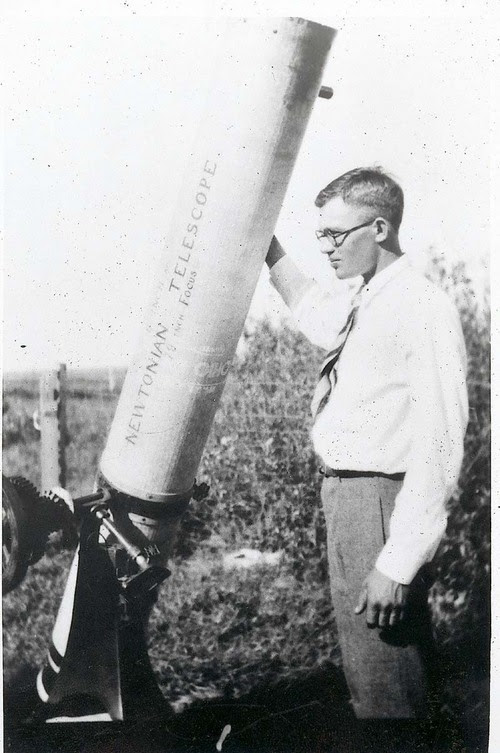
Lest we discount Janzen as an eccentric, it bears mentioning that even Clyde Tombaugh, Kansas’s astronomical sweetheart, reported several UFO sightings during his scientific career. Tombaugh built his first telescope on his family’s farm near Burdett, Kansas, and was a self-taught astronomer with a high school diploma when, in 1930, he discovered the long sought-after “Planet X”—soon dubbed Pluto, after the Greek and Roman god of the underworld. (Pluto was reclassified as a dwarf planet and hailed as the first known object in the Kuiper Belt in 2006.) Tombaugh earned his bachelor’s and master’s degrees from the University of Kansas while continuing to work summers at Lowell Observatory in Arizona, where he first caught sight of the smudge of light that was Pluto.
In addition to discovering Pluto, 15 asteroids, and hundreds of stars, Tombaugh also observed several UFOs. Although he tended toward a scientific explanation rather than an extraterrestrial one, he was nevertheless open to the idea of intelligent life on other worlds. And perhaps it was this openness that drew him back to the sky night after night, straining to see just a little bit further into the unknown.
Sometimes we look to the sky in search of faraway worlds, but we find ourselves instead. What if those stories about aliens and UFOs are really stories about us? Stories to make the darkness a little less lonely, the strange a little more familiar. They speak of our thirst to make meaning, to seek connection, to ask questions and discover answers.
But sometimes when we look up at the night sky, we aren’t looking for answers. We look to the stars to set our imaginations alight.
Christopher Auner is a writer from Lawrence, Kansas, who has a background in teaching, publishing, freelance writing, and higher education. He earned an MFA in fiction from the University of Kansas and an MA in literature from Missouri State University.

More Gruesome Aggie Humor

0
Thayne Cozart
Milo Yield

The long marriage of a middle-aged farm couple was growing more and more contentious. Their constant sniping at each other was more and more agitating. One area of disagreement wuz housekeeping by the wife.

Finally, the arguing reaches a head. The wife bluntly tells her husband that if he walks across the kitchen floor after she mops again, she’s going to kill him.

So, the next time she mops the kitchen floor, hubby comes into the house from choring and blatantly and defiantly stomps across the kitchen floor again. He gets the floor dirty, tracks water into the living room, and plops himself down into his recliner in front of the TV.

His wife decides to do as she had promised. Without saying a word, she goes to their bedroom, gets his pistol out of the closet, and shoots him dead in his recliner.

Then, she calls 911 and reports, “I told my husband that if he walks through the kitchen after I mopped and the floor isn’t dry yet, I would kill him. He didn’t listen, and I shot him.”

The sheriff’s emergency dispatcher immediately sends an ambulance for the husband, and a squad car to arrest the wife.

The sheriff overhears about the call shortly afterward, thinks it’s a rather strange crime, so he drives to the farm house.

When he gets there, his deputies are still waiting outside. He asks the officers, “Why haven’t you gone inside and arrested the woman?”

They sheepishly reply, “Sir, we can’t go in now. The kitchen floor is still wet.”

***

The gab at the Old Geezers’ morning gabfest frequently turns to local history. One morning this week, the conversation turned to recalling the last blacksmith doing bizness in downtown Riley. He apparently wuz a real eccentric character and sort of an odd ball, too.

He’d been in bizness for a long time and his blacksmith shop wuz best described as “random clutter” from floor to ceiling, from wall to wall, and from back door to sidewalk. He never threw anything away because, as he self-explained, “I never know when I’ll need something again.”

However, in spite of his oddities, Smitty wuz a skillful craftsman and given enuf time could solve about any blacksmithing problem customers could bring to his door.

The morning kibitzers recalled one time an old customer came to the blacksmith shop, took a casual glance at the cluttered-up appearance, turned to the owner and asked with a tinge of sarcasm, “Smitty, how long you been working in this place?”

“Oh, I’d reckon about 20 years now,” Smitty replied.
“No way,” the customer corrected. “I know you’ve been here a lot longer than that.”

“But, you asked how many years I’ve been working here,” Smitty countered. “And, I reckon I’ve been working about 20 years, and the rest of the time I’ve spent looking for the right tools to get the work done.”

***

The local funeral home is in the process of building a new structure, which, when completed, will house an up-to-snuff cremation facility. Learning that fact, prompted my old mind to recall this story that I used to tell to audiences back in my public entertaining days. Here’s the story:

A woman, in her eighties, made the evening news because she was getting married for the fourth time.

The day following her marriage, she was being interviewed by a local TV station. The young reporter asked her what it felt like to be married again at her advanced age —
and would she share information about her three previous marriages?”
It seemed quite unique, to the reporter, that the newlywed’s new husband was a funeral director. She asked the newlywed, “Tell me about your new husband, and about your first three marriages, too.”

After a short time to contemplate the question, the new bride broke into a big smile. She proudly explained that she had first married a banker when she was in her twenties. In her forties she married a circus ring master, In her sixties she married a pastor, and now in her eighties, a funeral director.

The amazed reporter asked her how she happened to have married men with such diverse careers.
With a smile on her face, the new bride explained, “I married one for the money, two for the show, three to get ready, and four to go!”

***

Words of wisdom for the week: “Be sure to ask your doctor if a drug with 32 pages of possible side-effects is really what you need to cure you.”

“How did we oldsters survive our childhoods when our mothers cleaned our faces with spit on a handkerchief and not an anti-bacterial wipe.”

“I wanna be 14 years old again and ruin my life differently. I have new ideas on how to do it.”

Have a good ‘un.