
Thursday, January 29, 2026
Home Blog Page 225

Long before lab-made colors, cactus bugs put the red in ‘redcoats’

0

Centuries before the now-banned red dye No. 3 was synthesized in a lab, humans turned to insects to bring a little scarlet, vermillion or burgundy into their foods, fabrics and artwork.

On Jan. 15, the federal Food and Drug Administration banned the use of Red Dye No. 3 for use in food, decades after banning it in cosmetics. A generation earlier, Red No. 2 was banned as a potential carcinogen.

“Crimson lake, also called carmine lake, is a red pigment derived from carminic acid, which is produced from the cochineal bug, Dactylopius coccus,” said Jon Zawislak, assistant professor of apiculture and urban entomology for the University of Arkansas System Division of Agriculture.

These are scale insects in the order Hemiptera — the “true bugs,” not beetles — that feed primarily on many species of Opuntia cacti, or prickly pears.

“It was traditionally produced by the pre-Columbian natives of Mexico,” Zawislak said. “After the Spanish conquest, it became an important export commodity from the New World to Europe, especially as a textile dye.”

Prickly pear cacti are breeding grounds for cochineal bugs. Adult female and immature cochineal bugs are flightless. But adult males have wings and can fly. After mating on the cactus, the females lay eggs and the nymphs remain on the plant to feed on its juices.

“They produce red carminic acid as a defense against predators,” Zawislak said.

“Once mature, the insects were laboriously collected by hand picking or brushing off the cactus pads, killed by boiling in water, sun-dried and ground into a fine powder,” he said. “It takes more than 30,000 insects to make one pound of this pigment powder.”

Carmine, the primary ingredient in the red dye, is extracted by boiling the powder. The color could be altered by adding other chemicals.

“The brilliant pigment was used to dye the robes of Catholic Cardinals and the British Redcoats,” Zawislak said. “It’s also been used as a natural colorant in many foods and cosmetics, sometimes listed on package ingredients as ‘carmine,’ ‘E120,’ ‘cochineal extract’ or ‘Natural Red 4’ — making whatever it’s in non-vegetarian or vegan, and as a protein it could potentially cause allergic reactions in some people.”

In 2012, Starbucks announced it was phasing out insect-based color from its food, instead using a tomato-based color.

Cochineals are still farmed in parts of Mexico, but the practice is on the decline.

Not the only bugs

However, cochineals are not the only insect in the dye business.

here are a few species that produce similar products, and at least one more is commercially grown — Kerria lacca —  from which ‘lac’ dye and shellac, a natural resin, originate,” said Austin Jones,  extension instructor and director of undergraduate education and outreach coordinator, with the Division of Agriculture and the Dale Bumpers College of Agricultural, Food and Life Sciences. “India seems to be the main area of production, but other countries on the Asian continent dabble as well.”

Use of dyes in food

“Food dyes are used to add or correct the color or shade of a product, often to increase the product’s appeal to consumers,” said Sun Ferreira, assistant professor-food process engineering for the Division of Agriculture and Bumpers College.

“In the case of jams using berries, a processor may not need to add dyes since the fruits will provide enough color,” he said. “However, in products such as breakfast cereals, beverages, syrups, and baked goods, the color provided by the fruits may not be bright or intense enough, and processors may choose to use food colorants.

This happens because the natural red color may fade during cooking/baking and storage. Additionally, the use of colorants or dyes ensures product consistency in appearance, as horticultural products may vary over seasons or varieties,” Ferreira said.

Ferreira noted that food producers have several natural dye options:

  • Beet juice for deep reds and is used in beverages, plant-based meat analogs and baked goods
  • Paprika, turmeric and annatto, when mixed can produce red hues.
  • Raspberries and strawberries can be used to create pinks and reds
  • Red cabbage, which can achieve shades of red to blue depending on the product acidity.

“The issue with some of these natural alternatives is their stability to light, heat, and oxygen, which may alter their color,” he said. “To overcome this, techniques such as microencapsulation can be used to extend and facilitate their application, although this may increase their cost.”

“One of the main and greatly used ‘natural’ alternatives is the use of lycopene extracted from tomatoes,” Ferreira said. “Lycopene-based food colorants are heat, light, and pH stable, which greatly facilitates their usage.”

Ferreira said that are still some synthetic dyes that are FDA approved and widely used, but “also have data showing potential associations with behavioral issues. The FDA and European Union may require label claims for these dyes.”



Substitutes for recently banned cherry dye are limited, says food scientist

0

K-State’s Blakeslee says food bans are based on best available science

The U.S. Food and Drug Administration’s recent ban on the use of a popular food dye will create a new challenge for home bakers aiming for a signature cherry red color in candy, cakes, icings and other food products.

Kansas State University food scientist Karen Blakeslee said there are foods that can substitute for FD&C Red No. 3 – such as beets, cranberries, raspberries and more – “but these may also add flavors to food that may not be wanted.”

She added that food manufacturers and researchers will look at how these new colors react with other ingredients or temperature changes.

The FDA announced on Jan. 15 that it is banning the use of FD&C Red No. 3 in any food product or drugs that are ingested. The government agency cited two studies indicating cancer in laboratory male rats that were exposed to high levels of the dye, due to a rat-specific hormonal mechanism.

To date, there are no scientific studies that have shown a connection between consuming FD&C Red No. 3 and cancer in humans, but a provision within the U.S. Food, Drug and Cosmetic Act (called the Delaney Clause) prohibits the use of food or color additives if they are proven to cause cancer in humans or animals.

The FDA will require manufacturers using FD&C Red No. 3 to reformulate their products by Jan. 15, 2027 or Jan. 18, 2028, depending on the size of the business. Imported foods may not contain this ingredient.

If shopping for food colors, consumers can avoid products containing FD&C Red No. 3 by reading the ingredient statement on the packaging, according to Blakeslee.

“Look for FD&C Red No. 3, Red 3, or if the product is imported, it may be called erythrosine,” she said. “FD&C Red No. 3 is a certified color additive and it must be specified in the ingredient statement if it is included in the product.”

Other examples of color substitutes for FD&C Red No. 3 include red beet extract or paprika extract. Blakeslee said future decisions on food additives by the FDA will be based on the best science available. The agency shares information regarding recalls, outbreaks and more on its website.

More food safety tips are available online from K-State’s Rapid Response Center for Food Science. Blakeslee publishes a monthly newsletter, called You Asked It!, with timely tips for safe food in and out of the home.

More information is also available at local extension offices in Kansas.

Bird watchers are traveling to Kansas for a look at this ‘mega-rarity’

0

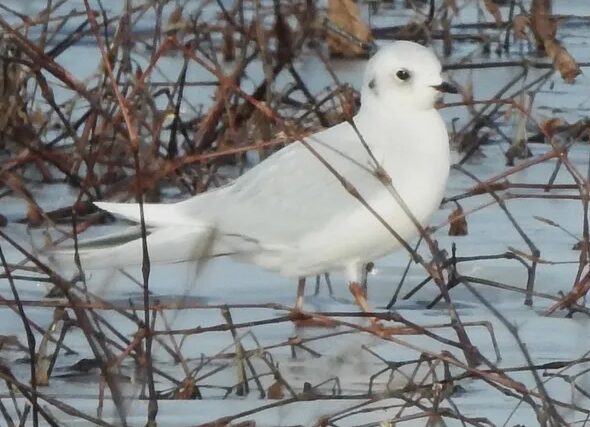
Bird watchers are flocking to southwest Kansas after the appearance there of a Ross’s gull, a rare species generally found only in Siberia, Greenland, Canada and northern Alaska.

“This is a really big deal to birders, not only to Kansans but to birders across the United States,” said Carol Morgan, president of the Topeka Audubon Society.

At least 100 people had journeyed to Ford County to enjoy a “once-in-a-lifetime opportunity” to see the lone Ross’s gull, which was first spotted Friday in a rural area about 20 miles south of Dodge City, Morgan said.

The bird remained in that area Tuesday morning, she said.

“Confirmed by experts, this small, pale gray gull has caused a stampede of birders to the location for the chance to see a mega-rarity,” Morgan said.

Bird expert says this is one of 11 reported sightings ever in lower 48 states

Morgan said she learned online Friday from fellow bird watchers that the Ross’s gull had been spotted in Ford County. The bird’s gender is unknown, she said.

“There have been only 10 other reported sightings of Ross’s gull on eBird in the lower 48 states ever,” Morgan said. “Most of those sightings were on the northern east or west coasts.”

Morgan said she and two friends drove nearly 300 miles Saturday to the area involved, where they spent about 30 minutes watching the Ross’s gull fly around and scavenge in the area of a playa, which is a “seasonal wet spot” that provides a good habitat for migrating birds.

Morgan said of the experience, “It was fantastic.”

Gull’s appearance in Kansas as rare as a ‘three-peat Super Bowl victory’

Chuck Otte, a past president of the Kansas Ornithological Society who lives near Milford in Geary County, said he drove out to see the Ross’s gull Sunday.

Otte has been watching birds since he was 4 and is about to turn 69, he said.

A Kansas City Chiefs fan, he said he found it difficult to explain to people “what a rarity” the bird’s appearance here is.

“It’s the bird watcher’s equivalent of a three-peat Super Bowl victory,” he said.

What is the Ross’s gull?

The global population of the Ross’s gull has been estimated at less than 10,000, according to the website of the National Audubon Society.

The bird is named after the British explorer James Clark Ross. Its breeding grounds were first discovered in 1905 in northeast Siberia.

Ross’s gulls are generally 11.4 to 12.2 inches long, weigh 4.9 to 8.8 ounces and have a wingspan of 35.4 to 39.4 inches, according to www.allaboutbirds.org.

During its breeding season, the Ross’s gull has a remarkable appearance, with a dark collar circling its head, Morgan said.

“It is pale gray and brilliant white, sometimes with a pink wash on the breast and belly, a small black beak, bright orange legs and a wedge-shaped tail,” she said. “In non-breeding season (now), the circle around the head is almost invisible, with only a dark ear spot remaining, and the legs are dull orange.”

The species is protected in the U.S. by the Migratory Bird Treaty Act.

Ross’s gulls feed mostly on insects during the breeding season and mostly on small fish and marine invertebrates during migration and in the winter, Morgan said.

“It may also feed on dead animals, which is what it is doing at the playa in Ford County,” she said. “I observed it consuming parts of a dead snow goose that was lying on ice.”

Topeka Audubon Society president: ‘This is a birder’s dream’

Morgan said she and her friends began their journey to southwest Kansas about 5 a.m. Saturday, arriving about 9:30 a.m.

“It was a long drive, but it was worth it,” she said.

Morgan said she and her friends watched the rare bird accompanied by about a dozen other people, including one from Texas.

The Ross’s gull was often within about 40 feet of the dirt road from which the birders watched using binoculars and telescopes on tripods, though it sometimes flew out to areas that were more distant, Morgan said.

Ross’s gull is ‘a delicate little gull’

Otte said he is accustomed, when showing up at a place where a bird from a rare species has been sighted, to having to scan through hundreds of other birds before finding the one rare bird.

That was not the case Sunday, he said.

“It was the only gull there,” Otte said, adding that none of the other types of gulls he expected to see in the area were present.

The Ross’s gull is “a delicate little gull, one of our small gulls, and because of its rarity that makes it even more striking,” Otte said.

Gull’s presence brought tourism dollars to southwest Kansas

Bird watchers from Oklahoma, New Mexico, Colorado, Nebraska, Missouri, Wisconsin and South Carolina have also traveled to Ford County to see the Ross’s gull, Morgan said.

“This is a birder’s dream, to be able to see an incredibly rare species somewhere within driving distance, or within flying distance if you’re coming from someplace like South Carolina,” she said.

She said she was pleased the presence of the rare bird was generating tourism dollars for the state of Kansas, with visitors paying “considerable” amounts to cover costs that include food, gasoline and lodging.

As reported in the Topeka Capital Journal


Register of Deeds Office Closed Temporarily for Software Training

0

From February 10–14, 2025, the Reno County Register of Deeds Office will be temporarily closed to the public as staff receive training on the county’s new land records management system, Tyler Enterprise Records Management. The Register of Deeds Office is located in the Courthouse Annex building, 125 West First Avenue in Hutchinson.

To ensure a smooth transition to this updated system, the following adjustments will be made:
• eRecording Submissions: The eRecording system will be temporarily closed to submitters
starting Thursday, February 6, 2025, at 4:30 PM.
• Phone Calls & Messages: Calls during the temporary closure will be forwarded to voicemail but will be checked twice daily between 8:00 AM – 8:30 AM and 4:30 PM – 5:00 PM. Please leave a message at (620) 694-2942 if assistance is needed.
• Front Counter Services: The front counter will be closed to walk-in customers and document drop-offs during the closure period.
• Urgent Inquiries: If immediate assistance is required, please contact Michelle Updegrove at [email protected].

The office will resume normal operations on Monday, February 17, 2025, coinciding with the official launch of the Tyler Enterprise Records Management system. This transition will enhance efficiency and provide improved services to the public.

“We appreciate the community’s patience and understanding as we implement these upgrades to better serve Reno County residents,” said Michelle Updegrove, Reno County Register of Deeds.

Time to rethink deworming the beef herd

0

The use of commercial livestock dewormers has paid off in terms of animal health and productivity, but it has also resulted in resistance among parasite populations.

“As dewormers lose effectiveness, producers need to develop a broader strategy for managing internal parasites in their livestock,” said Eric Meusch, University of Missouri Extension livestock specialist.

Resistance to deworming products

A recent study funded by Merck Animal Health and led by Eric Bailey of the University of Missouri conducted fecal egg count reduction tests in beef herds across the state, finding resistance to macrocyclic lactone dewormers (avermectin-type dewormers). The benzimidazole class of dewormer (“white” dewormer) still showed efficacy above the threshold for effective deworming, which is 90%. The results of the Missouri study are consistent with a larger data set compiled by Merck Animal Health.

The dewormers losing efficacy are products commonly used in pour-on and injectable forms and have become popular due to cost and ease of administration.

“The popularity and frequency of use of these products has likely led to resistance,” said Meusch.

Understanding the enemy

To manage parasites, it is important to understand their life cycle, said Meusch. Stomach worms must complete several life-cycle stages both inside the gastrointestinal tract of cattle and on the pasture. The cows can only be infected by consuming grass from infected pastures, and pastures can only be infected by cows carrying adult stomach worms.

Worms that are resistant to a dewormer (less than 90% are killed by the treatment) survive and lay eggs that are deposited in the pasture. Over time, the percentage of resistant larvae increases in the pasture until the animals are infected with worms that can no longer be controlled with the product.

Manage the problem strategically

Better grazing and pasture management can limit the exposure of cows to parasites on pasture, Meusch said. Rotational grazing can allow cows to avoid times when the most larvae are emerging on the grass. Because the larvae remain lower in the grass surface layer to keep from drying out, leaving a higher residual when grazing can help avoid exposure to the larvae as well.

Strategic deworming is another concept that can help avoid exposure to parasite larvae on pasture. This is basically timing deworming treatments to take advantage of when the worms on the pasture are dormant and not reinfecting animals. When temperatures drop to 28 degrees Fahrenheit a few times, typically in the late fall, it can be a good time to deworm because it isn’t likely that cattle will be reinfected from the pasture after that point. This allows them to go through the winter without stomach worms, ensuring they benefit the most from supplemental feeding. It also ensures cattle aren’t depositing more eggs on the pasture over the winter.

The parasites infecting pastures will become active again in the spring when temperatures regularly exceed 50 degrees. As the eggs emerge into larvae and advance to the third stage, the cows will be infected again. The next strategic time to deworm is about six weeks after the springtime temperatures exceed 50 degrees. At this time, the cows will have been reinfected but are not yet depositing eggs in the pasture. This extends the time that eggs aren’t being deposited and helps reduce the parasite burden on the pasture.

It isn’t always possible to visually identify which cows are carrying the heaviest worm loads, but culling cows that chronically show symptoms of a heavy parasite infection can also benefit overall herd health.

“By managing grazing and strategically deworming cattle to avoid further pasture contamination, producers can keep their animals healthy and productive, as well as help ensure the long-term efficacy of deworming products,” said Meusch.

For more information about deworming strategies or assessing the worm load in your cow herd, contact your local MU Extension center, or email Eric Meusch at [email protected].