

Lettuce Eat Local: All That Jas-mine
Amanda Miller
Columnist
Lettuce Eat Local
“Rice is great if you’re hungry and want 2000 of something.”
This quip from a comedian is printed in one of the cookbooks on my shelf, and it has printed itself in my brain as well. It’s not like screamingly hilarious, but I guess it’s just the right amount of funny.
This caused me to wonder if 2000 was also just the right amount of “rices.” Apparently I am not the first one to be curious about how many grains of rice are in a cup, and thanks to the internet I don’t even have to do my own computations. If I wanted to watch a youtube video of someone else counting individual grains of rice, I could do that — or at least that’s what it looks like, but I didn’t watch, because I have over 2000 better things to do with my time.
Fortunately some people were really smart and went with basic math instead. They took the weight of either a grain of rice in milligrams, or how many grains of rice were in a gram, and calculated it out from there. Thus, an approximate value of a cup of dry rice is around 8500 grains, and so 2000 would be slightly under one-fourth cup; rice increases in volume by about 2 ½ times when cooked, so that equals a strong half-cup of cooked rice.
So okay, you can’t be starving, but if you’re moderately hungry and have plenty of other food to put on it, then 2000 grains is great.
This comes with a few disclaimers. As with many foods and like I discussed with lettuce a few weeks ago, we often oversimplify culinary categories. Rice is rice, yes, but also: short grain, long grain, jasmine, basmati, brown in any of those types, arborio, carolina gold, etc. Types all share similarities, of course, but also have their own inherent distinctions in texture and flavor — plus also are often more common in different regions, so are frequently more associated with particular usages and cooking styles. Since rice is eaten all over the globe, there is literally a worldful of possibilities.
That also means there is a planet of things I could talk about in regards to rice. Considering it’s J week, though, my choice for jasmine rice is obvious.
My other disclaimer is that even if I were hungry for 2000 of something, it wouldn’t be rice. I could probably handle that many popcorns? I tend to get bored with actually eating rice itself, although I love making it, since it is so globally versatile and I tend to love the foods that are paired with it, from South American to African to Asian.
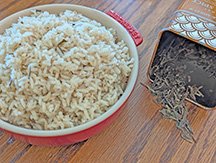
Jasmine rice, with its long grain and fragrant aroma, was developed in Thailand in the 1950s and remains the rice of choice in much of Southeast Asia. Its name is because the white rice grains reminded people of the white petals of jasmine flowers; even just cooked plain, it tends to have more “rice-y” flavor, and the texture is very appealing — a little sticky and chewy, with a distinct aroma. I was struck by how much it smelled like popcorn when I was cooking it, before knowing that that is what everyone else also says it smells like.
Rice that smells like popcorn…that means jasmine rice might be the right thing after for when I’m hungry for a couple thousand of something.
KU News: Podcast from KU’s FLITE Center helps teachers navigate classroom AI tools

From the Office of Public Affairs | https://www.news.ku.edu
Headlines
Contact: Chance Dibben, Achievement & Assessment Institute, [email protected]
Podcast from KU’s FLITE Center helps teachers navigate classroom AI tools
LAWRENCE — With the number of artificial intelligence tools growing and changing by the day, Lisa Dieker, director of the Center for Flexible Learning through Innovations in Technology & Education (FLITE), and Maggie Mosher, assistant research professor and global keynote speaker in AI, wanted to provide an up-to-date, accessible and reliable resource for teachers who may feel overwhelmed by the amount of information and tools offered. To this end, Dieker and Mosher created a free podcast series called “AI Advocates” to inform teachers about artificial intelligence tools for the classroom.
“We’ve been in schools working with teachers in different districts to transform education using AI, and the thing we hear the most frequently is, ‘I don’t know what’s out there to help my students,’” Mosher said. “We wanted to provide something to help educators start a little at a time without feeling overwhelmed. AI changes so quickly. Often, by the time an episode comes out, the tool has already gone through multiple reiterations. That’s how quickly AI progresses.”
FLITE, a center within KU’s Achievement & Assessment Institute, introduces and creates new technologies in education to improve learning and performance outcomes. As AI tools become more available and accessible to the public, FLITE researchers are looking at how AI can help teachers and students in the classroom.
In each podcast episode, Dieker and Mosher explore a different AI tool and its benefits, drawbacks, safety, privacy considerations and classroom uses. The episodes include only the necessary information so that teachers can get the information quickly, keeping in mind their busy schedules.
“We’ve really tried to make it digestible. In five minutes or less, we tell you about a tool we’ve used and what we like about it,” Dieker said. “We’ve also really tried to focus on tools that are free or at least tools that you can try out for free and then make your decision from there.”
Dieker said that AI is not meant to replace teaching and human connections between educators and students; rather, the tools are meant to make their jobs easier by facilitating some of the behind-the-scenes administrative work teachers must do, such as creating visuals, condensing information and creating presentations.
“A lot of people worry that transforming and integrating technology is going to take more time, but what we’ve found is it gives teachers back the time that they would have spent on administrative tasks,” Dieker said. “AI gives teachers back that time so that they can then spend their time building relationships with students, which is where we know powerful education happens.”
Dieker and Mosher also hope to see some of the highlighted AI tools benefit students with disabilities and make learning more accessible by helping teachers better serve all students.
“Students with disabilities shouldn’t be singled out because they have a disability. Using a team-teaching approach with AI in the general education classroom can ensure every student’s needs are met without causing teacher burnout. AI provides the possibility for students to individualize their own education,” Mosher said. “When teachers need additional support to quickly individualize content, they can consult AI tools to ensure timely access to content on ideas to effectively teach specific skills to individual students all within the same classroom.”
An “AI Advocates” journal to accompany each podcast episode is also in the works. It will feature a step-by-step process for using the tool covered in that episode. The journal and the video version of each podcast episode, currently available on YouTube, will give listeners various ways to receive the information.
“AI Advocates” is available on KU ScholarWorks and numerous podcast platforms, including Spotify, Apple Podcasts and Amazon Music.
Dieker will be exploring more about AI’s use in special education in her Fall 2025 SPED 598 course, Artificial Intelligence for ALL: Educational Applications, and Mosher will continue training teachers in K-12 schools throughout Kansas in partnership with the Center for Reimagining Education (CRE), which assists Kansas educators in exploring AI tools to begin thinking about how to reimagine teaching and learning.
-30-
————————————————————————
KU News Service
1450 Jayhawk Blvd.
Lawrence KS 66045
https://www.news.ku.edu
Erinn Barcomb-Peterson, director of news and media relations, [email protected]
Today’s News is a free service from the Office of Public Affairs
KU News: New digital tool provides satellite monitoring of crop health across US

From the Office of Public Affairs | https://www.news.ku.edu
Headlines
New digital tool provides satellite monitoring of crop health across US
LAWRENCE — Researchers from the University of Kansas, with support from the KansasView and AmericaView programs, have created a web-based app for the public that provides free satellite monitoring and analysis of vegetation and crop health across Kansas and the nation, called the Sentinel GreenReport Plus. The app’s tools should lead to better-informed agricultural producers, policymakers, insurers and research ecologists in Kansas and across the nation, according to the researchers.
Study simulates pulling on athlete’s jersey to predict noncontact ACL injuries
LAWRENCE — Contact sports frequently see athletes go down with ACL injuries, but they most commonly do not result from direct contact to the knee. To better understand indirect contact knee injuries, a University of Kansas study has simulated pulling on an athlete’s jersey while jumping to determine which types of contact are most risky for such injuries, finding pulling from behind is the most dangerous and that upper body strength is more important in preventing injuries than perhaps thought.
KU composer creates choral music to match ‘mystical’ texts
LAWRENCE – The COVID-19 pandemic lockdown was a challenging time for Forrest Pierce, professor of composition at the University of Kansas School of Music. He now says his lifeline was writing “The Bell and the Blackbird,” which has its North American premiere in a pair of concerts May 31 and June 1 by the Kansas City, Missouri-based choral group Te Deum.
KPR announces new ‘Morning Edition’ host
LAWRENCE — Kansas Public Radio has welcomed a new program host with deep roots in public radio. Matthew Algeo began as KPR’s new “Morning Edition” host May 26. Algeo has hosted public radio programs on stations in Seattle, Minnesota, St. Louis, Maine and Rhode Island. He has also worked on NPR’s Newscast desk, writing and editing anchor copy.
Full stories below.
————————————————————————
Contact: Brendan Lynch, KU News Service, 785-864-8855, [email protected]
New digital tool provides satellite monitoring of crop health across US
LAWRENCE — Researchers from the University of Kansas, with support from the KansasView and AmericaView programs, have created a web-based app for the public that provides free satellite monitoring and analysis of vegetation and crop health across Kansas and the nation, called the Sentinel GreenReport Plus.
The free digital tool integrates Google Earth Engine with high-resolution imagery from the European Space Agency’s Copernicus Sentinel-2 satellite mission, consisting of two identical satellites that share the same orbit. The Sentinel GreenReport Plus combines this satellite imagery with climate datasets from the PRISM group. As a public-service resource, the tool provides users with up-to-the-day insights into vegetation greenness, changes in land cover over time and climate abnormalities.
According to its KU creators, the Sentinel GreenReport Plus already has seen use in monitoring crops, assessing damage from drought, detecting changes in land use and tracking vegetation recovery following a disaster.
“Remote sensing and satellite imagery technology has been improving in terms of the spatial footprint that it can represent in a pixel,” said Dana Peterson, director of KansasView and senior research associate with Kansas Applied Remote Sensing, a program of the Kansas Biological Survey & Center for Ecological Research at KU. “This allows us to do more detailed monitoring of vegetation condition — it could be vegetation in a forest community, a cropland community or on rangeland. We could create a tool that would allow access to these data easily and create an interface where people — whether educators, researchers, ranchers or cropland producers — could access the imagery easily and look at vegetation health.”
The KU team said the public-facing digital tool could be used further to assess vegetation destruction from natural hazards or even more routine damage like hail.
“We’ve also looked at some of the burn events and wildfires,” Peterson said. “You can look at how the vegetation has been damaged and to what extent and severity.”
The Sentinel GreenReport Plus improves detail and insight over the classic GreenReport, introduced in 1996 with support from NASA by the Kansas Applied Remote Sensing Program. The new Sentinel GreenReport Plus is underpinned by Copernicus Sentinel-2 satellite data, a much finer 10-meter resolution than the classic version relying on 1,000-meter resolution MODIS imagery.
Abinash Silwal, KU graduate student and tech lead in the project, said any agricultural producer could use the tools to assess the success of different crops, monitor crop health or compare crop conditions over time, which may indicate yield performance. The tool integrates USDA NASS Cropland Data Layers, which allows crop-specific stress analysis.
“We can look at vegetation health at the crop-type level,” Silwal said. “For example, if I want to monitor my field of corn, I can select ‘corn’ in the app and draw a rectangle or polygon around the area. The tool instantly displays multiple charts, including a time series and comparison charts showing current vegetation health relative to historical averages. This helps determine whether the crop’s current condition falls within the normal range or is showing signs of stress.”
The heart of the Sentinel Green Report PLUS is underpinned by the Normalized Difference Vegetation Index. The Sentinel GreenReport PLUS has several key features:
Greenness Map: Uses the NDVI as a proxy for photosynthetically active plant biomass over a selected composite period.
Difference Map 1: Compares NDVI to the previous composite period within the same year, illustrating recent vegetation changes.
Difference Map 2: Compares NDVI to the same period from the previous year, highlighting year-over-year vegetation changes.
Difference Map 3: Compares current NDVI to the average NDVI from previous years, showing changes relative to historical trends.
Aside from Peterson and Silwal, the team that produced the Sentinel GreenReport Plus is composed of Chen Liang, former doctoral student; Jude Kastens, research associate professor and director of KARS; and Xingong Li, professor of geography & atmospheric science.
The KU researchers know stakeholders have found many features to be valuable. For instance, Silwal said the ability to compare vegetation health with precipitation adds a powerful dimension to understanding vegetation stress.
“The addition of the precipitation curve is the coolest thing,” he said. “If I see that vegetation health is below normal and the precipitation curve is flat or shows significantly lower rainfall compared to the 30-year historical statistics, we can infer that drought may be contributing to the stress. When the vegetation line is declining and the accumulated precipitation trend remains flat or below average, it points to possible drought conditions affecting crop health.”
These breakthroughs should lead to better-informed agricultural producers, policymakers, insurers and research ecologists in Kansas and across the nation, Peterson said.
She added the Sentinel GreenReport Plus might represent “a better way to understand the interplay of climate and vegetation. Users can visualize trends, generate crop-specific charts and download outputs to support reports, presentations and further analysis.”
For more information, visit the program’s website.
-30-
————————————————————————
Research at KU powers 54 active startups with more than half based in Kansas.
https://ku.edu/distinction
————————————————————————
Editors: See video.
Contact: Mike Krings, KU News Service, 785-864-8860, [email protected]
Study simulates pulling on athlete’s jersey to predict noncontact ACL injuries
LAWRENCE — Contact sports frequently see athletes go down with ACL injuries, but they most commonly do not result from direct contact to the knee. To better understand indirect contact knee injuries, a University of Kansas study has simulated pulling on an athlete’s jersey while jumping to determine which types of contact are most risky for such injuries, finding pulling from behind is the most dangerous and that upper body strength is more important in preventing injuries than perhaps thought.
In sports like football, basketball, volleyball and soccer, competitors frequently suffer knee injuries. To better understand how the injuries happen and how to prevent them, the KU study had participants jump while a strap connected to their torso dropped a weighted “slam ball” to pull on them from either the right or left side or from the posterior. The pull simulated injuries where contact to the body but not the knee results in ACL injuries.
“Studies have shown that sports with contact have a more than five times higher chance of ACL injuries than noncontact sports,” said the study’s lead author Yu Song, assistant professor of health, sport & exercise sciences and director of the Biomechanics Laboratory at KU. “We are looking at where most of that contact happens. Most of the time it’s in the trunk region when a player is jumping, cutting, planting their foot or changing direction that contributes to injury. So, we’re working to quantify in a lab setting how that trunk contact affects the knee.”
For the study, the research team recruited 31 participants who are active in sports and had no prior history of knee injuries. After warming up, the subjects performed a series of jumps where they jumped from both feet and landed on one. For all jumps, the slam ball was connected to their torso via a strap that did not impede movement. While attempting to touch a basketball fixed above them, researchers dropped the slam ball either front or rear of the subject to simulate someone pulling on their jersey forward or backward. Whole body kinematics and ground reaction forces were measured using optoreflective cameras that measured movements of joints and trunk angles and force plates that measured force applied during takeoff and landing.
Posterior pulling proved to be the most significant in the effect it had on subjects. Jumpers landed with impact of more than two times their body weight during the condition. It also resulted in the smallest peak trunk and knee flexion angles, resulting in subjects landing in such a way that applied more stress to their joints, increasing risk for injury. Anterior pulling saw the highest peak trunk flexion and smallest peak knee extension.
The results help illustrate the importance of the torso in knee injuries. Research has shown that most ACL injuries do not result from direct contact to the knee or leg.
“If we show that being pulled back is more dangerous, which this study indicates, what can we do? We don’t say you can’t play sports, but it suggests that developing your trunk is very important and effective,” Song said. “We can suggest it’s important for athletes not only to do strength training, but to focus on the core and do things like neuromuscular training where you have resistance or pulling.”
The study, co-written with Zhichen Feng, Kareem Mersal and Lauren Salsgiver of the University of Wyoming, Kaden Van Valkenburg of the University of Utah and Boyi Dai of the University of Vermont, was published in the Scandinavian Journal of Medicine & Science in Sports.
In addition to the published work, ongoing research projects continue to strengthen these efforts within the Biomechanics Laboratory at KU. Song praised several undergraduate students who contributed to ongoing studies. The students, not only exercise sciences majors (Anne Jordan, Thanh Nguyen, Nawfal Malik, Lexi Dillon, Lexi Rasmussen), but also from majors ranging from biology to mechanical engineering (Kristina Lincoln, Phoebe Lane, Hammad Javed) at KU, as well as Haskell Indian Nations University in Lawrence (Elijah Savala) conducted data gathering and research for the Biomechanics Laboratory in KU’s Department of Health, Sport and Exercise Sciences, and they recently presented the preliminary findings at KU’s Undergraduate Research Symposium.
The study builds on Song and colleagues’ work to better understand both risk factors for knee injuries and previous research on how single-leg hopping can predict recovery from ACL surgery. Future research will expand on the study by pulling on subjects when they start a jump or when planting a foot to see if one is more dangerous. They also plan to see if a subject knowing which direction a pull is coming from changes their kinematic reactions.
While the studies can help better understand causes of knee injuries, Song emphasized that no subjects were injured while performing the jumps. Taken in total, the research can help coaches, trainers, athletes and medical personnel better understand ways to anticipate and prevent what can often be devastating injuries.
“We know being pulled during competition is dangerous. This helps us understand from a biomechanical standpoint what happens to the body when it occurs and what we can do to help prevent it,” Song said. “It also helps show that you don’t only want to look at the knee, but up at the trunk and what’s happening throughout the body.”
-30-
————————————————————————
KU provides fire, rescue and law enforcement training across Kansas.
https://ku.edu/distinction
————————————————————————
Contact: Rick Hellman, KU News Service, 785-864-8852, [email protected]
KU composer creates choral music to match ‘mystical’ texts
LAWRENCE – The COVID-19 pandemic lockdown was a challenging time for Forrest Pierce, professor of composition at the University of Kansas School of Music. He now says his lifeline was writing “The Bell and the Blackbird,” which has its North American premiere in a pair of concerts May 31 and June 1 by the Kansas City, Missouri-based choral group Te Deum.
“All of the choirs all around the world stopped singing for the year because of the pandemic, with the exception of the Australian choirs, so I had a large number of premieres and performances that year that were just canceled,” Pierce said. “Some of those choirs never came back into existence afterward, but the Australian Voices, who commissioned ‘The Bell and the Blackbird,’ kept singing. And it was really a great thing, because it kind of saved me as a composer to have something to work on; where I knew that there were people somewhere in the world who were going to be learning this piece and performing and presenting it.”
It’s a setting of a poem by the same title by contemporary Anglo-American David Whyte.
“‘The Bell and the Blackbird’ hasn’t been done in North America, so I’m very excited about it,” Pierce said. “That piece is concerned with the liminal spaces, the boundaries between the order and structure of our human existence and our simultaneous attraction to the wildness of utter freedom, and how we go back and forth. The poet compares the sound of a blackbird singing and the sound of a bell, both of which have these very unusual, what we would call nonharmonic spectra.”
Pierce said he tried to convey that musically with a recurring, dissonant motif that never truly gets resolved.
“We find that we actually can live with the tension in the music,” Pierce said. “We can find the right context to make the tension of apparent dissonance part of the harmony. It doesn’t need to go anywhere. It doesn’t need to do anything. That’s just a beautiful sound. And that’s part of who we are as humans … complex and sometimes sweet and sometimes tangy. And, you know, we can live with that.”
Te Deum will perform two other, older works by Pierce.
“The Old Ground” is from 2003 and is a setting of a text by American activist and poet Wendell Berry.
“It’s essentially an anthem for Advent — that period that leads up to Christmas in the Christian tradition — that has much broader implications,” Pierce said. “You could say it has more animistic overtones. It’s about … how the earth continually brings forward good things over and over with each season. It’s a very mystical text that has to do with spirit and what it means to be human.”
Pierce explained how he wrote the music to underscore Berry’s words: “The text itself references the shepherds in the story of Christmas being visited by the heavenly host — the angels — and being told ‘fear not.’ So there’s a kind of gesture that’s present in the tenors and basses that is a wordless, susurrating, hollow and mysterious melody that’s going on while the text is being sung by the sopranos and altos. So that’s trying to convey the spirit of life; that it’s moving to be reborn again.”
The third Pierce composition Te Deum will perform is “The Darkness Around Us.”
It’s a setting of a work by Kansas-born poet William Stafford.
“It’s about our discourse and the way that … although we could fool each other, we should remember … to let our yes mean yes and our no mean no,” Pierce said. “He compares us to a circus parade, where the elephants are all holding the tail of the one in front. And he says that if one elephant should lose its way, then the parade will be lost in the dark. It closes with the phrase, ‘The darkness around us is deep.’ So it’s a very somber invitation to the audience to consider the ways we converse with each other and to make wise choices.”
Te Deum takes its name from a hymn and is Latin for “To God.” It specializes in sacred, though not necessarily Christian, music.
Matthew Christopher Shepard, artistic and executive director, said he had “long admired Dr. Pierce’s compositions for their beauty, emotional clarity and expressive depth. What truly sets his work apart, though, is his extraordinary sensitivity to text. His compositions are not only musically compelling — they are anchored by his impeccable selection of texts that speak to something spiritual, enduring and deeply human.”
Shepard said the pieces fit perfectly in a program titled “Harmony of Connections.”
“The texts he sets speak of hope, kindness and personal responsibility — qualities that resonate powerfully in today’s world,” Shepard said. “In each piece, his music doesn’t simply support the text; it expands and deepens it, bringing clarity and emotional resonance that allows the listener to experience the words in new and profound ways.”
-30-
————————————————————————
Each of Kansas’ 105 counties receives KU Medical Center outreach.
https://ku.edu/distinction
————————————————————————
Contact: Emily DeMarchi, Kansas Public Radio, 785-864-0190, [email protected]
KPR announces new ‘Morning Edition’ host
LAWRENCE — Kansas Public Radio has welcomed a new program host with deep roots in public radio.
Matthew Algeo began as KPR’s new “Morning Edition” host May 26.
Algeo has hosted public radio programs on stations in Seattle, Minnesota, St. Louis, Maine and Rhode Island. He has also worked on NPR’s Newscast desk, writing and editing anchor copy.
In addition to his radio experience, Algeo is also the author of eight books, including “Harry Truman’s Excellent Adventure,” which tells the story of a road trip Harry and Bess Truman took shortly after leaving the White House. Algeo has also written for many major publications including The Atlantic, The New York Times and The Washington Post.
For the past 20 years, Algeo has been traveling the world with his wife, Allyson, who will soon retire from the U.S. Foreign Service. They have lived in Mali, Italy, Mongolia, Mozambique, Bosnia and, most recently, Botswana. They have a daughter, Zaya.
Algeo is originally from Philadelphia and holds a degree in folklore from the University of Pennsylvania. He’s also worked as a convenience store clerk, a Halloween costume salesman and a hot dog vendor in a traveling circus.
“I am thrilled to join Kansas Public Radio,” Algeo said. “I believe deeply in the mission of public radio and in the importance of local news. My family will put down deep roots here, and we look forward to engaging with the many vibrant communities that KPR serves.”
Algeo added, “I am painfully aware and slightly ashamed to say I am not a native Kansan, and I hope KPR’s listeners will be forgiving if I mispronounce a name or two as I find my footing. And I’m sure they won’t hesitate to correct me if I do.”
KPR, a 22-time winner of the KAB’s Station of the Year, licensed to the University of Kansas, broadcasts on 91.5 FM and 96.1 FM (KPR2) in Lawrence, 89.7 FM in Emporia, 91.3 FM in Olsburg-Junction City, 89.9 FM in Atchison, 90.3 FM in Chanute, and 99.5 FM and 97.9 FM (KPR2) in Manhattan. KPR can be heard online on the KPR website, and KPR2, a news-talk programming stream, which can be heard on an HD receiver or on KPR’s website.
-30-
————————————————————————
KU News Service
1450 Jayhawk Blvd.
Lawrence KS 66045
https://www.news.ku.edu
Erinn Barcomb-Peterson, director of news and media relations, [email protected]
Today’s News is a free service from the Office of Public Affairs
KU News: New 2025-2026 Self Memorial Scholars, School of Education & Human Sciences Distinguished Alumni Award recipient

From the Office of Public Affairs | https://www.news.ku.edu
Headlines
KU announces new 2025-2026 Self Memorial Scholars
LAWRENCE – Twenty students have been selected to receive the University of Kansas Madison and Lila Self Memorial Scholarship for the 2025-2026 academic year, a merit-based, $10,000 award to outstanding seniors transitioning into their first year of a master’s or doctoral program at KU in fall 2025. Recipients include students from De Soto, Hiawatha, Kansas City, Lawrence, Louisburg, McLouth, Olathe, Overland Park, Pratt and Topeka.
School of Education & Human Sciences to honor 2025 Distinguished Alumni Award recipient
LAWRENCE — The University of Kansas School of Education & Human Sciences will honor alumnus Jason Booker with one of its top awards this spring. The deputy athletics director for external affairs at Kansas Athletics will be recognized with the 2025 Distinguished Alumni Award on May 17 at the school’s spring convocation ceremony. Booker previously worked for the Kansas City Royals and recently served as chair of the board for the Kansas City Sports Commission and Foundation.
Spencer Museum announces KU Common Work of Art for 2025-2026
LAWRENCE — The Spencer Museum of Art at the University of Kansas has announced “Haunted by the Ghosts of Our Own Making” by Hollis Sigler as the KU Common Work of Art for the 2025-2026 academic year. The painting, on display in the museum’s Michaelis Gallery, complements the KU Reads book, “The Anthropocene Reviewed: Essays on a Human-Centered Planet” by John Green. Together the KU Reads selection and KU Common Work of Art serve as entry points to inspire curiosity and generate enthusiasm for scholarly inquiry across disciplines, providing opportunities for the KU community to come together for engaged discussion and discovery in the classroom and beyond.
Study finds giving pre-service social studies educators practice in teaching difficult topics boosts confidence
LAWRENCE — Four pre-service teachers designed and delivered a lesson on “Night,” Elie Wiesel’s seminal Holocaust survival memoir, in a new University of Kansas study. The lesson, performed in a mixed-reality simulator, found the teachers did not have instruction on teaching difficult topics, but their confidence in teaching difficult material improved. “We need to better prepare our teachers for when they feel afraid of addressing certain topics,” said Anna Yonas, assistant professor of curriculum & teaching. “We’ve found that when that happens, they rely more heavily on teacher narrative and don’t leave time for student discussion.”
KU faculty honored as 2025 Kemper Fellows for Teaching Excellence
LAWRENCE — Teaching is integral to the University of Kansas’ mission to educate leaders, build healthy communities and make discoveries that change the world. This spring, five KU faculty members were honored with the William T. Kemper Fellowship for Teaching Excellence award, recognizing their commitment and contributions to teaching excellence on KU Lawrence’s campus.
Full stories below.
————————————————————————
Contact: Daniel Rivera, Self Graduate Fellowship, 785-864-7249, [email protected]
KU announces new 2025-2026 Self Memorial Scholars
LAWRENCE – Twenty students have been selected to receive the University of Kansas Madison and Lila Self Memorial Scholarship for the 2025-2026 academic year.
The Self Memorial Scholarship is a merit-based scholarship that is awarded to outstanding seniors from KU who will be transitioning into their first year of a master’s or doctoral program at KU in the fall 2025 semester. Students who were selected demonstrated achievement in leadership and scholarship, capable of envisioning and attaining goals that require energy and tenacity.
The Self Memorial Scholarship provides each recipient with a $10,000 scholarship award, $1,000 professional development award, leadership and career development training, and an opportunity to be a part of an interdisciplinary cohort of graduate students. The leadership and career development training, the Scholar Development Program, complements the specialized education and training provided by the graduate programs.
Madison and Lila Self were deeply motivated by the idea that developing and investing in young leaders was vital for a successful future. The Selfs began their legacy of supporting graduate students in 1989 with the establishment of the Madison and Lila Self Graduate Fellowship. Since 1991, the Self Graduate Fellowship has supported over 220 doctoral students.
The Self Memorial Scholarship was launched and permanently endowed in 2014. The first Scholars were awarded in 2018. Since 2018, the Self Memorial Scholarship has supported nearly 100 graduate students. The overall mission of Self Graduate Programs is to provide funding and development opportunities for exceptional graduate students who demonstrate the promise to make significant contributions to their field of study and society as a whole.
The new Self Memorial Scholars for 2025-2026:
Adam Baruth of De Soto: bachelor’s degree in aerospace engineering from KU; incoming master’s student in aerospace engineering.
Jenna Ghannam of Louisburg: bachelor’s degree in speech-language-hearing from KU; incoming master’s student in speech-language pathology.
Archisa Ghimire of Olathe: bachelor’s in speech-language-hearing from KU; incoming master’s student in speech-language pathology.
Bhavik Goplani of Dubai, United Arab Emirates: bachelor’s degree in computer science, minor in math from KU; incoming master’s student in computer science.
Trent Gould of Overland Park: bachelor’s degree in computer science from KU; incoming master’s student in business administration and business analytics.
Rachael Hampton of Lawrence: bachelor’s degree in sociology and applied behavioral science from KU; incoming master’s student in sociology.
Sian Helfrich of Pratt: bachelor’s degree in architectural engineering from KU; incoming master’s student in structural engineering.
Jolie Hilgedieck of Columbia, Illinois: bachelor’s degree in accounting from KU; incoming master’s student in accounting.
Edona “Donna” Kraja of Bar, Montenegro: bachelor’s degree in accounting and international business from KU; incoming master’s student in accounting.
Lakyn Leupold of Hiawatha: bachelor’s degree in atmospheric science pollution from KU; incoming master’s student in atmospheric science.
Max Linares of Fayetteville, Arkansas: bachelor’s degree in organ performance and church music from KU; incoming master’s student in music (organ and church music).
Jake Makela of Lindenhurst, Illinois: bachelor’s degrees in English and women, gender & sexuality studies from KU; incoming doctoral student in women, gender & sexuality studies.
Maddie Peterson of Edmond, Oklahoma: bachelor’s degree in speech-language-hearing from KU; incoming master’s student in speech-language pathology.
Chase Perkins of Topeka: bachelor’s degree in ecology & evolutionary biology from KU; incoming master’s student in ecology & evolutionary biology.
Casey Queen of Omaha, Nebraska: bachelor’s degree in aerospace engineering from KU; incoming master’s student in aerospace engineering.
Christopher Raithel of McLouth: bachelor’s degree in accounting, minor in business analytics from KU; incoming master’s student in accounting.
Maria Luisa Segares of San Jose, Costa Rica: bachelor’s degree in electrical engineering from KU; incoming master’s student in electrical engineering.
Daisy Torres of Kansas City, Kansas: bachelor’s degree in speech-language-hearing from KU; incoming master’s student in speech-language pathology.
Megan Tucker of Plano, Texas: bachelor’s degree in speech-language pathology from KU; incoming master’s student in speech-language pathology.
Holly Wilson of Kansas City, Missouri: bachelor’s degree in social work from KU; incoming master’s student in social work.
-30-
————————————————————————
Why do university graduates wear caps and gowns? Learn more about the history
behind hoods, tassels, stoles and more on this latest KU News Service podcast episode.
https://whenexpertsattack.libsyn.com/regalia-is-for-scholars-not-just-kings
————————————————————————
Contact: Aspen Grender, School of Education & Human Sciences, [email protected]
School of Education & Human Sciences to honor 2025 Distinguished Alumni Award recipient
LAWRENCE — The University of Kansas School of Education & Human Sciences will honor alumnus Jason Booker with one of its top awards this spring.
Booker will be recognized with the 2025 Distinguished Alumni Award on May 17 at the school’s spring convocation ceremony at Allen Fieldhouse.
“Jason’s career reflects the kind of leadership and impact we hope to inspire in all our graduates,” said Rick Ginsberg, dean of the school. “We’re proud to honor his outstanding accomplishments.”
Booker earned his bachelor’s degree in sport management from the school at KU in 1999. He currently serves as deputy athletics director for external affairs at Kansas Athletics, where he has led transformative growth across multiple areas since his return to the university in 2021. With nearly 30 years of experience in the sports business industry, Booker’s work spans marketing, licensing, premium seating and corporate partnerships, including seven years as senior director of corporate partnerships and broadcast sales for the Kansas City Royals. Prior to joining the Royals, Booker spent time at TCU, the University of Oklahoma and the University of South Carolina.
Since rejoining KU, Booker has played a pivotal role in marketing and sales strategies for major facility projects, including the $445 million reimagining of David Booth Kansas Memorial Stadium and the $55 million renovation of Allen Fieldhouse. Under his leadership, Kansas Athletics has seen a 47% increase in ticket revenue and 40% overall revenue growth in just four years.
He also oversaw the creation of Jayhawk Creative Services, an in-house agency supporting creative, design and social media for all athletic programs. Additionally, Booker serves as sport administrator for Kansas women’s soccer and led the hiring committee of head coach Nate Lie, who won the Big 12 Championship in his first season.
In addition to his professional accomplishments, Booker has dedicated significant time to community leadership. He recently served as chair of the board for the Kansas City Sports Commission and Foundation, where he helped bring the 2023 NFL Draft, the 2026 FIFA World Cup and multiple NCAA championships to the Kansas City region. He also serves on the Lawrence Chamber of Commerce board, strengthening connections between Kansas Athletics and the local business community.
The Distinguished Alumni Awards are the highest honor the School of Education & Human Sciences bestows upon its alumni. Award recipients demonstrate ongoing, exceptional professional, academic or research achievement and contribution to the community at the local, state, national or international levels.
-30-
————————————————————————
KU News Service is now on BlueSky.
Follow for KU News Service stories, discoveries and experts.
https://bsky.app/profile/kunewsservice.bsky.social
————————————————————————
Contact: Elizabeth Kanost, Spencer Museum of Art, 785-864-0142, [email protected]
Spencer Museum announces KU Common Work of Art for 2025-2026
LAWRENCE — The Spencer Museum of Art at the University of Kansas has announced “Haunted by the Ghosts of Our Own Making” by Hollis Sigler as the KU Common Work of Art for the 2025-2026 academic year. The painting complements the KU Reads book, “The Anthropocene Reviewed: Essays on a Human-Centered Planet” by John Green.
Both Green’s text and Sigler’s painting incorporate autobiographical references while pondering the larger question of what it means to be human in the modern era. Together the KU Reads selection and KU Common Work of Art serve as entry points to inspire curiosity and generate enthusiasm for scholarly inquiry across disciplines, providing opportunities for the KU community to come together for engaged discussion and discovery in the classroom and beyond.
Celka Straughn, Spencer Museum director of academic programs, said shared themes from both selections include memory, hope, illness, survival, wonder and distinguishing facts from misinformation.
“Sigler’s painting and Green’s essays cast light on a subject to make it visible from multiple perspectives,” Straughn said. “Their work encourages us to look behind the curtain of what might seem invisible, such as the consequences of human actions in the age of the Anthropocene.”
Sigler was diagnosed with breast cancer in 1985. From the 1990s until her death in 2001, her art focused on her personal struggle with cancer as well as the disease’s effects on society. “Haunted by the Ghosts of Our Own Making” focuses on dichlorodiphenyltrichloroethane, the insecticide more commonly known as DDT. The painting presents a theatrical stage with curtains parted to reveal a sunset backdrop and a performance of ghostly skeletal servers attending a diner-less table prepared for a feast. Scratched faintly above are the letters “DDT” and a crop-duster spraying the scene. Sigler inscribes her message around the handmade frame: “Although the use of DDT has been banned by the Government for years, its long-term effects are now being recognized. The cancer-causing potential of pesticides in use today may be hidden for years to come.”
“Haunted by the Ghosts of our Own Making” is on view in the Spencer Museum’s Michaelis Gallery as part of the “Empowerment” exhibition. The Spencer Museum is free to visit and open to the public six days a week.
Resources for expanding conversation about the KU Common Work of Art are available online.
-30-
————————————————————————
KU provides fire, rescue and law enforcement training across Kansas.
https://ku.edu/distinction
————————————————————————
Contact: Mike Krings, KU News Service, 785-864-8860, [email protected]
Study finds giving pre-service social studies educators practice in teaching difficult topics boosts confidence
LAWRENCE — If practice makes perfect, teachers should not be expected to teach difficult topics to students without a chance to rehearse in a low-stakes setting. Yet that commonly happens, and a new study from the University of Kansas found that when pre-service teachers designed and taught a lesson on a seminal text about surviving the Holocaust, they inconsistently used historical source analysis, relied on lessons they received years ago and said they were afraid of what might happen teaching the subject matter.
Social studies teachers routinely guide lessons on difficult topics like the Holocaust. But most research on how they teach focuses on veteran teachers who have received professional development to provide them new skills or supports. Anna Yonas, assistant professor of curriculum & teaching in KU’s School of Education & Human Sciences, led a study examining how four pre-service social studies teachers designed and led a lesson about “Night” by Elie Wiesel, an influential narrative about surviving the Holocaust, in a simulated practice environment.
The research was published in the journal The Social Studies.
Without instruction on traumatic history instruction, the pre-service teachers tended to rely on what they remembered about the Holocaust from their own education, Yonas found.
“There is a representative body of research that suggests novice teachers are still developing subject matter expertise, but not much has looked at how they teach in practice,” Yonas said. “I want to know more about how we can allow pre-service teachers to learn in practice before they are teaching difficult topics to real students in real classrooms.”
Yonas chose “Night” because research has shown it is the most commonly read book by American high school sophomores. The pre-service teachers gave the book lesson in a mixed-reality simulated classroom, a technology designed by the Flexible Learning through Innovations in Technology & Education Center at KU. The study examined how they delivered the lesson and how they described the supports they believe would help them teach the subject matter, then measured their confidence in covering the curriculum before and after.
The subjects took varying approaches to the lesson. Two reported they ran out of time to complete what they hoped to cover, one taught about the history of antisemitism, and one did not mention Jewish people at all.
Following the lesson, all said they were not sure how to address the Holocaust and had not had training in traumatic history instruction — teaching subject matter that was not only traumatic at the time but has the potential to be traumatic for students and teachers in the present.
All four attempted to manage students’ expectations, noting that the subject matter would be difficult and that some might find it upsetting.
“They said across the board they didn’t know how to address this subject matter, and surprisingly, two were even afraid of doing so because they didn’t know what to do if a student made antisemitic comments while discussing the material,” Yonas said.
However, all four pre-service educators indicated that their confidence level in teaching difficult subject matter increased after practicing in a simulated setting. Taken together, the results showing inconsistency in historical source analysis, teaching a lesson from the perspective of the oppressors, improved confidence following the simulation and other factors indicate training in traumatic history instruction and opportunity for practice should be a part of teacher preparation programs, Yonas said.
She has also published research that found an increasing number of states have mandates requiring teachers to cover genocide but lack guidelines in how they should do so.
Yonas, who is continuing research into how novice social studies teachers conduct lessons on similar subject matter before and after practice sessions, said the current findings can help teacher programs better prepare future educators by giving them instruction in how to address difficult subject matter and by providing opportunities to practice before leading their own classrooms.
“We need to better prepare our teachers for when they feel afraid of addressing certain topics. We’ve found that when that happens, they rely more heavily on teacher narrative and don’t leave time for student discussion,” Yonas said. “I would argue for preparation that involves practice. It doesn’t have to be a simulation but something in a low-stakes setting where they can learn with support about the basics of teaching traumatic history.”
-30-
————————————————————————
Each of Kansas’ 105 counties receives KU Medical Center outreach.
https://ku.edu/distinction
————————————————————————
Contact: Elizabeth Barton, Office of Faculty Affairs, [email protected]
KU faculty honored as 2025 Kemper Fellows for Teaching Excellence
LAWRENCE — Teaching is integral to the University of Kansas’ mission to educate leaders, build healthy communities and make discoveries that change the world. This spring, five KU faculty members were honored with the William T. Kemper Fellowship for Teaching Excellence award, recognizing their commitment and contributions to teaching excellence on KU Lawrence’s campus.
The 2025 William T. Kemper Fellowship for Teaching Excellence recipients:
Giselle Anatol, director of the Hall Center for the Humanities and professor of English.
Jennifer Delgado, associate teaching professor of physics & astronomy.
Sean Gullickson, associate teaching professor of Spanish & Portuguese.
Eileen Hotze, associate teaching professor of molecular biosciences.
Pamela Keller, clinical professor of law.
Each honoree received a surprise visit in class or during a departmental meeting from either Chancellor Douglas A. Girod; Amy Mendenhall, vice provost for faculty affairs; or Meagan Patterson, associate vice provost for faculty affairs. These unannounced visits allowed the instructors to be celebrated in front of their students and colleagues.
The Kemper fellowships recognize outstanding KU faculty whose teaching guides students in gaining crucial skills, embracing academic and professional challenges, developing learning strategies and improving long-term success. Each of the five awardees will receive $7,500 from the William T. Kemper Foundation (Commerce Bank, trustee) for demonstrating teaching excellence, innovation and student-centeredness, which is essential to the success of KU.
“Excellence in teaching is central to KU’s mission and integral to our students’ experience,” Girod said. “This year’s Kemper Fellowship for Teaching Excellence recipients include some of our finest educators and mentors, each of whom are worthy of our recognition and thanks. I look forward to celebrating these outstanding teachers at our annual awards ceremony, and I invite our entire academic community to join us.”
The five Kemper Fellows will be honored alongside the winners of KU’s other annual teaching awards at the annual University Teaching Awards event in September.
About the 2025 Kemper Fellows
Summaries below include portions of each fellow’s nomination packet, highlighting their strengths in teaching and mentorship.
Giselle Anatol
Anatol shapes not only the classes she teaches, but also the teaching culture of her department and other units through her leadership of the Hall Center for the Humanities.
Her teaching and student mentorship balances high expectations and rigor with passion, fun and support as she encourages students to extend their learning beyond the classroom through sharing publishing and award opportunities. Students describe her as “one of the most consistently inspiring instructors I’ve had here at KU.” Anatol’s teaching and mentorship have been recognized with multiple awards at the department and university levels, including the Byrd Graduate Educator award and the Mabel S. Fry teaching award.
Jennifer Delgado
Delgado’s students describe her as an exceptional teacher who supports students within and beyond the classroom and makes complex material understandable and enjoyable. Her pedagogy emphasizes student agency and creative projects where students are able to demonstrate mastery of course content in multiple ways. Delgado has significantly influenced her department’s curriculum design, aligning content and skill development across courses. She also supports graduate student instructor training and organizes community events such as “telescope nights,” extending her impact beyond KU.
Sean Gullickson
Gullickson oversees undergraduate degree program assessment of student learning for the Department of Spanish & Portuguese, contributing to the department’s recognition with a campuswide degree assessment award. His expertise has also been shared at the university level through participation in the task force on degree-level learning outcomes, alternative assessment working groups and Mellon Scholars program. Gullickson consistently receives positive student feedback on his innovative approaches to teaching and grading in language learning. Beyond teaching, his positive influence on the culture can be felt within his department through collaborations with faculty and training of graduate student instructors.
Eileen Hotze
According to student feedback, Hotze makes large classes engaging and provides a wealth of resources to aid students in learning. Although she teaches students across a range of majors, they often remark that Hotze believes in them more than they believe in themselves. Her dedication to student success is evident in and out of the classroom through her dedication to student mentorship. Hotze’s curriculum design emphasizes scaffolding and instructional alignment to ensure student success in future courses. She also integrates hands-on research experiences, demonstrating creativity and innovation in her teaching.
Pamela Keller
As the director of the lawyering skills and moot court programs, Keller has been a key contributor to the School of Law’s skills-based curriculum. The programs merge theoretical rigor with real-world application of principles of legal reasoning, legal writing, oral advocacy and professionalism. Both programs prioritize individualized feedback and mentoring to students. Students noted that Keller “gives incredible, detailed feedback on our writing” and “always works to make students think more deeply about their writing.” In both her classroom teaching and her work as a moot court coach, Keller demonstrates attention to student improvement over time, continuously refining her courses based on student feedback and developments in the legal field.
-30-
————————————————————————
KU News Service
1450 Jayhawk Blvd.
Lawrence KS 66045
https://www.news.ku.edu
Erinn Barcomb-Peterson, director of news and media relations, [email protected]
Today’s News is a free service from the Office of Public Affairs
