Saturday, January 24, 2026
Home Blog Page 175

Red, white and blue for the green thumb

0

Make a splash in the garden with the 60-30-10 rule.

Plan now to use basic design principals to create a patriotic garden this summer, says University of Missouri Extension field horticulturist Gwen Funk.

“Designing your outdoor living space comes with many opportunities for creativity,” says Funk. “One might be thinking about themed garden beds, pots and hanging baskets,” she adds. “Using a red, white and blue color scheme around your patio or deck could add a festive, energizing ambiance.”

For harmony and interest, follow the 60-30-10 rule when choosing flowers for your beds and containers: Buy 60% of your flowers in a dominant color, 30% in a secondary color and 10% in an accent shade.

The dominant flower will be the anchor of your garden or container. It should be bold and draw the eye of the viewer immediately. The secondary color supports the main attraction, and the accent enhances the other two.

Red and blue sit on the opposite side of the color wheel. In general landscape design, this makes each color seem more saturated and creates visual appeal, says Funk. Pair with a neutral white to create balance.

Red as the primary color creates a feeling of energy and festivity while blue creates a feeling of spaciousness and relaxation, she says. Choosing white as the main color creates a fascinating twilight moon garden, she says.

Design beds with native plants with Missouri’s varied climate conditions, local pollinators and songbirds in mind, she adds.

Funk suggests considering these plants:

Red flowers. Cardinal flower (Lobelia cardinalis) if planting in the shade. This July-October-blooming flower prefers shade and moist areas. Royal catchfly (Silene regia) produces bright red star-shaped flowers and may bloom from May to September. Royal catchfly prefers dry, well-drained, sunny locations. The native red bee balm (Monarda didyma) will support many pollinators and may attract hummingbirds.

Blue flowers. Blue wild indigo (Baptisia australis) is drought-tolerant and blooms in late spring. Blue star (Amsonia illustris) can withstand shadier conditions. Both flowers have a full, shrublike appearance and bloom late spring to early summer.

White flowers. New Jersey tea (Ceanothus americanus) is a low-growing, branching shrub that can grow in partial shade to full sun in well-drained soil. Expect blooms late spring to early summer. Another species of Baptisia, Baptisia alba, or white wild indigo, sports pure white blooms on tall spikes from May to July.

Other choices such as red zinnias are heat-tolerant and long-blooming. Red geraniums are suitable for containers or borders. White Shasta daisies are a classic perennial choice, while alyssum offers low-growing fragrant flowers. Blue salvia and bachelor’s buttons round out the trio with blue flowers.

Remember the classic design principle of “a thriller, a filler and a spiller” for hanging baskets and other containers, says Funk:

• A full sun option might include red salvia or tall blue delphinium (thriller), white petunias or white verbena (filler) and blue lobelia or trailing blue torenia (spiller).

• A drought-tolerant combination is red geranium (thriller), white angelonia or white lantana (filler) or blue scaevola (spiller).

• A hummingbird and pollinator container might include red bee balm (thriller), white alyssum (filler) and blue bacopa (spiller).

Learn more about “Container gardening: thrillers, fillers and spillers” at https://extension.missouri.edu/news/container-gardening-thrillers-fillers-and-spillers.

Managing spring flowers and weeds

0

Most years, Spring signals the start of a colorful garden and a host of blooming flowers.

Yet, at this point in the season minimal care is needed for spring-flowering bulbs, Kansas State University horticulture expert Cynthia Domenghini said. To enjoy blooms in April, Domenghini suggests following simple care tips to ensure roots are taking in the nutrition to support future growth.

Roses

Before new leaf buds open (bud break), roses should be fertilized and pruned.

“April is a great time to plant new roses in the landscape as well,” Domenghini said. “Specific maintenance practices vary based on the classification, or type, of rose.”

Domenghini recommends tips from the Growing Roses publication, available from the K-State Research and Extension bookstore.

Easter Lilies

Containerized lilies are common in the spring as they are used to celebrate the Easter holiday.

“This perennial bulb can be grown in the landscape to enjoy for years to come,” Domenghini said.

The Easter Lily Fact Sheet provides care instructions.

Henbit and Chickweed

Henbit weed is in bloom, creating waves of purple through the landscape.

“Weeds drive most gardeners crazy, but many weeds provide food for pollinators,” Domenghini said. “Henbit is one of the first sources of pollen and nectar for honey bees and bumble bees after the long winter.”

Henbit and chickweed are winter annuals that germinate in the fall but become more noticeable in the spring, Domenghini added. Treating these weeds is best done by applying a pre-emergent in the fall.

“Controlling for these weeds this time of year is much less effective,” Domenghini said.

Manual removal is recommended if the plants can’t be tolerated in the landscape.

The henbit and chickweed fact sheet provides tips for prevention and management in the spring.

Grassy Sandbur

Another annual — grassy sandbur — is a grassy weed commonly found in lawns, and spreads profusely as the stickers produced attach to clothing and pets.

“Maintaining a dense lawn is the best defense against this weed,” Domenghini said.

Alternative solutions can be found in the Grassy Sandbur fact sheet.

Domenghini and her colleagues in K-State’s Department of Horticulture and Natural Resources produce a weekly Horticulture Newsletter with tips for maintaining home landscapes and gardens. The newsletter is available to view online or can be delivered by email each week.

Interested persons can also send their garden and yard-related questions to Domenghini at cdom@ksu.edu, or contact your local K-State Research and Extension office.

Hitting Bottom

0
lee pitts

Child rearin’ these days sure is a lot different than when I grew up. And when I say ‘rearin’ that’s where the biggest difference occurred… in the rear end.

A person these days would rightly be put in jail and have their children taken away if they were caught administering punishment the same way our parents did. For heaven’s sake, our ag teacher had a long paddle an inch thick that he used for swatting the bottoms of unruly students. I only felt the sting of the paddle once and that’s when he had everyone in the class grab their ankles so we’d feel the full force of his paddle.

There were degrees of punishment at our house. For a minor crime my mom would bend us over her knee and say, “This is going to hurt me more than it is you but it’s for your own good.” Then she’d spank our bottom several times with her bare hand. If the offense was a major misdemeanor, like stealing some change from her purse to buy a 50/50 bar from the ice cream man, she’d break one of her yardsticks walloping us a good one. And then she’d wonder where all her yardsticks went when she needed one for her dressmaking.

If we committed a felonious assault on a sibling she’d say, “You just wait until your father gets home.” My dad was a long haul trucker so he could be gone for several days and that meant we’d have to anticipate the spanking for a long time which made it that much worse. His favorite tool for committing child abuse was the belt and he was a very strong man. A kid might not be able to sit down for days after the rear attack.

The second worst whoopin’ I ever got was the time I was kicked out of school for three days for throwing an egg, which was a tradition at our school. The seniors lobbed eggs and water balloons at the freshmen almost daily and to the best of my knowledge, no one had ever been kicked out of school before, or since, for the offense. I missed high with the egg I threw so it hit a tree branch and the yolk dripped all over the vice principal’s daughter. I was ratted out, called to the office of the vice principal, who was also the football coach, given a tongue lashing and sent home for three days with a note.

Now here’s where it gets real interesting. The captain of the football team just happened to be the boyfriend of the dripped-on girl and he was the one who brought the egg to school and dared me to throw it! Of course nothing happened to him. Interestingly, when I ran on the school’s cross country team as a freshman I was crammed and locked inside a locker by two burly guys on the football team and stayed crumpled up for two hours! Of course they were never kicked out of school because the coach needed them on Friday night.

I’ve endured a lot of physical pain in my life but the most agonizing I’ve ever experienced was when I was ten years old and had to sit through an entire dance recital of my younger sister’s dance class. A person can only endure so much of watching 15 six-year-olds in tight tutus shuffling off to Buffalo.

After one such experience my sister’s picture appeared on the front page of our local paper and my mother was quite proud. My older perfect brother, the exalted one, took that newspaper my mom wanted to preserve for posterity and drew horns on my sister and a goatee with an ink pen so she looked like a fat devil. I thought it was quite a good likeness but my mom hit the roof and naturally thought I did it. And my perfect brother was more than happy to let me suffer the pain that only got worse when my father got home. I insisted between swats that I was not the culprit but that only made the blows harder. When I was 40 my brother finally admitted to my mom that he was the guilty party and everyone got a good laugh out of it. Ha, ha.

I’ve suffered from PTSD (post traumatic swatting disorder) ever since.

Lettuce Eat Local: Just in Queso Cheesiness

0

Amanda Miller
Columnist
Lettuce Eat Local


It’s no secret that I’m a fan of puns and the “dad joke” style of humor, especially food-related. When I first started writing this column, I had a great arsenal of good pithy phrases and witty wordings (or at least what I considered good at the time). But that was around 400 headlines ago, and I am fully ready to admit that my quips get stretched pretty thin at times, making even me cringe at the cheesiness.
I have nothing against cheesy — we are dairy farmers, after all. In general, moderation is key to proper enjoyment, but sometimes going overboard is called for.
And yes, I am talking about both metaphorical humor cheese and physical edible cheese. Just by typing a number and “cheese” in the internet search bar, taking the first suggested result leads me to three-cheese manicotti, four-cheese pasta, five-cheese ziti al forno, six-cheese bagel, seven-cheese mac and cheese, eight-cheese pizza: does it ever stop? (You be might be stopped up long before you get through that much cheese, but that’s another topic.) The options do start to slow down after the octave of cheesiness, although it seems Pizza Hut once ran a limited time offer for nine-cheese pizza in Thailand.
Apparently it’s hard to have too much cheese.
This does beg the question, since none of those foods seem inherently humourous to me, why do we call jokes cheesy? A little research shows a disappointing denigration of both meanings of cheese. Using the word “cheesy” to describe non-food items or situations appeared in vocabulary in the mid 1800s, with a negative connotation of shoddiness or inferiority.
I’m a little offended — perhaps I think the definition itself is cheesy — but I suppose I understand its potential origin. Milk that sits out and spoils curdles or turns “cheesy,” clearly not of the highest quality anymore, just like some jokes. Google dictionary’s two definitions of the term are “like cheese in taste, smell, or consistency” (which could be very positive) and “cheap, unpleasant, or blatantly inauthentic” (which is obviously less desirable).
I say we bring back a little more of the long-obsolete meaning of ostentatious or showy, because that’s clearly what those eight-cheese pizzas were about. The Big Cheese. Whether showy or not, I maintain that cheesy humor does not necessarily mean shabby and shoddy; maybe it has a bit of the funk of a well-aged cheese but turns out to be just the thing when you learn to appreciate it.
Something like that.
I do greatly enjoy when both cheese and cheesiness show up together, such as in cheesy puns. My parents-in-law just got Kiah a t-shirt that proclaims “Up to no Gouda” — and there could barely be a cheddar way to describe her mischievous self. Most of us in the Miller family have at least one dairy good cheesy shirt, thanks to manning the cheese booth at the Kansas Mennonite Relief Sale every year. That weekend just happened again, so we pulled out our t-shirts; this year my sister-in-law also brought way too many cheese-pun stickers. You can’t disa-brie that we were all in gouda shape.
You might, understandably, think that I could have done a cheddar job than writing about cheese for my Q-themed article, but I still had to try it just in queso.

Queso-chiladas

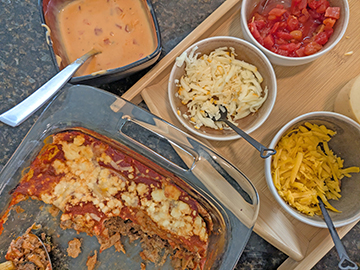
These were going to be tres-o queso, but as mentioned, it can be terribly hard to stop once the cheese wheel gets rolling. But I can’t think of a good reason to not have cinco quesos! The enchilada sauce is crucial in the flavoring here, so make sure you get good quality — I used a homecanned tomato-based one, but I’m thinking the green style would also be really tasty. The more authentic way to assemble is to dip each tortilla in the sauce before filling it, but it’s so much messier that I skipped it this time. 

Prep tips: as per usual, another hearty green can sub (like kale or spinach). Try with corn tortillas for a twist; just adjust assembly as necessary to accommodate their smaller size. 

1 small onion

½ pound ground beef

a couple handfuls of chopped swiss chard

2 cups ricotta 

1 cup shredded muenster

salt, pepper, cumin, and smoked paprika to taste

8 whole-wheat tortillas

2 cups red enchilada sauce

1 cup shredded sharp white cheddar

1 cup crumbled queso blanco

Cook onion and hamburger in a large skillet until meat is browned. Stir in chard, and cook until it’s wilted, just a minute or two. Remove from heat, and stir in ricotta, muenster, and seasonings to taste. Scoop around a half-cup of meat mixture into the center of each tortilla, roll up, and place seam-side-down in a 9×13” baking dish. Pour sauce on, trying to leave no portion unsauced. Sprinkle with remaining cheeses, and bake at 350° until the sauce is all bubbly and the cheese is all melty. Serve with rotel queso sauce and more shredded cheeses (of course), along with green onions, olives, beans, salsa ranch, etc.