

Lettuce Eat Local: Pope’s Nose Possibilities
Amanda Miller
Columnist
Lettuce Eat Local
Whether it was appropriate or not, I waited until the others were all chewing before I told them what was in their mouth. I’m not exactly sure what my five teammates thought that afternoon in a Kenyan desert, which speaks well to how effectively they handled their reaction to eating roast goat. To be fair, they knew it was nyama choma ya mbuzi; they just hadn’t known it was a special part of the billy goat.
I think my Turkana hosts were being genuinely generous when they told me that particular portion was reserved for special guests…although looking back now I realize they may have just been playing a trick on their naive little white friend.
Often when there’s only one of something available, it becomes more of a delicacy. Sometimes it’s primarily the rarity that catapults it into that category, sometimes it is due to heightened quality, and sometimes it’s an indistinguishable interplay of the two. For example, when we butcher, I see the ratio of tenderloin to ground beef — I do prefer filet, dare I say obviously, but also there’s only so much to be had so it kind of feels like you have to enjoy it. This isn’t quite as common, but I’m certain the very bottom slice of pineapple is the sweetest, and conversely the very top portion of mango.
There are only two fish cheeks per fish, and they are purported to be particularly tender and delicately flavored. In many cultures, calf, lamb, or pig brain are also considered delicacies, and of course there’s only one available per animal. I’m not personally into that, but I will always volunteer to eat the turkey heart when it comes in that little package with gizzards and liver.
Speaking of turkey, that’s what started this whole thought process for me. Obviously it was Thanksgiving last week, so I’m guessing a lot of you also saw those “bonus” turkey parts. By chance I learned a new term for the turkey tail: “the pope’s nose.” It intrigued me so much that I had to do some research, especially since learning that this fowl tail structure is more academically labelled the pygostyle: clinching the idea that it is perfect for my P-focused article.
I discovered that that funny, fatty triangular section could be called any number of people’s noses, from the parson’s to the bishop’s to the sultan’s. The perspective of this proboscis-based etymology is ambiguous, with different theories heading in opposite directions. Either the turkey tail began to be called the pope’s/parson’s nose since it would be saved as a fleshy, fatty delicacy for the guest of honor — or it reminded people of a pompous dignitary’s fleshy, fatty nose stuck up in the air.
As with all of life, a lot depends on perspective. It would be easy to toss that floppy protuberance or to think it’s gross, thinking it’s both fowl and foul, although someone might consider that same tail a prize portion. We get to choose the things we are thankful for!
I may never consider that (very chewy, very charred) piece of goat a culinary delicacy as far as taste is concerned, but I do remember it as a prized bite. And I’ll remember to selflessly save the pope’s nose for any guests.
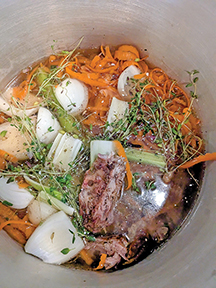
The Pope’s Poultry Broth
Most of the commenters on the forum where I saw turkey tail called pope’s nose said it’s a great addition in bone broth. I’m almost as thankful for the turkey bones for making stock as I am for the actual roast turkey, so that works perfectly for me. Soup can be transformed from good to fabulous with a quality broth, and other “delicacy” bits like the neck or roasty skin give good depth. People often say not to salt the broth so you can control it when you use it, but I figure I’m never going to want unsalted broth, so I go ahead and give it some.
Prep tips: If I get enough, I like to pressure-can my broth, but having a bunch is also a good excuse to make lots of soup, which I am also a fan of any time of year but especially now.
1 set of turkey bones, tail included of course
a splash of apple cider vinegar
2 onions, peeled and halved
a couple celery ribs
a couple carrots (or peelings from scrubbed carrots…)
optional: a jalapeño
optional: dash of liquid smoke
peppercorns, salt
handfuls of fresh parsley, sage, rosemary, and thyme
Add all ingredients to a large pot or pressure cooker, and cover just so with cold water. Bring to a boil and simmer for 4-5 hours until everything is very tender, or pressure-cook according to manufacturer’s directions. Use in cooking, or if you’re one of those people, sip it as a hot beverage.
Word For Word (Best Of)

Because they may be offensive, the L.A. Times banned the use of the words “deaf”, “alien”, and “handicapped”. This is the same newspaper that refers to looters as “non traditional shoppers.” UPS scores its worst drivers as the “least worse” and when Chrysler announced a big layoff they called it “a career change opportunity.” Workers called it being “fired.”
We are living in a society where the Army refers to “friendly fire” as “the accidental delivery of ordnance equipment.” You can’t “take a stab at something” or “kill two birds with one stone” any more. You can’t even “hit” a computer key or use the expression “there is more than one way to skin a cat.”
We use several words in agriculture that may be offensive to the politically correct. With some help from The Politically Correct Dictionary and Handbook I came up with some alternatives.
Artificial Inseminator- Animal companion sex care provider.
Bummer Lambs- Disowned future providers of non-human animal fibers.
Castrated- Cosmetically altered and sexually challenged male.
Dead-Non-living corpse; terminally inconvenienced; no longer a factor.
Dwarf- A vertically-challenged non-conforming bovine of color.
Dog- A canine American.
Dog Catcher- Animal welfare officer who picks up temporarily displaced animal companions and canine Americans.
Eggs- Stolen non-human animal products that come fried, poached or scramble.
Fat- Adipose tissue from horizontally challenged processed animal carcasses.
Futures Trader- A potential client of our corrective ecosystem who creates negative cash flow.
Grubby- Parasitically oppressed.
Horseback Riding- The thievery of uncompensated non-human animal transport.
Housebreaking- Environmental orientation.
Husband- Sub optimal utensil sanitizer.
Kill- Degrow.
Locoweed- Unwanted botanical companion.
Manure- Previously utilized organic matter.
Pig- A hair disadvantaged animal companion that because of its good taste will fail to fulfill its wellness potential.
Rancher- Economically exploited cattle murderer. Also, “a non performing asset.”
Screwworm- Temporarily hostless non- human animal.
Sheep- Intellectually challenged non-human being.
Slaughter- The engagement in reduction activities.
Veal- Pre-cow scorched animal carcass.
Vegetarian- A differently logical fruitarian who consumes non-violent food.
Wife- Non-waged employee, unpaid sex survivor; environmental hygienist.
In the future in order not to offend any of our readers this “processed tree carcass” will continue to be on the lookout for words that a socially misaligned, incompletely successful person may find cerebrally challenging.
A Lesser Man
As I look back on my nearly 73 years I have two big regrets, one is that I never served my country in the military, and number two is that I never learned how to barbecue. For a person who has made his living off the beef business, I realize there are no good excuses for not being a grill master, but I’m going to offer up some anyway. First, this Pitts never had a proper pit. And because I went to bull sales nearly every weekend, when most barbecues are held, I never had the opportunity. Even if I was home on a rare weekend my wife was working most Saturday and Sunday nights at the grocery store and I hardly think it would have been proper to have a barbecue by myself while she was slaving away.
The best reason I have for not becoming a man tested by fire is because I am terrified by it. As a youngster I was asleep in my bed at 2:00 AM when my brand new electric blanket caught fire and my bed became a raging inferno with me in it. It was bad enough that my mother had purchased it from her father’s furniture store but even more embarrassing when the fire chief of the volunteer fire department arrived and he just so happened to be the very same furniture store owner. Yes, my Grandpa.
You might say fire doesn’t light my fire. When I die I’ve left specific instructions that there will be no cremation.
Barbecuing is quintessential maleness, an element of danger plus the use of tools. It is living life on the wild side without pilot lights, timers, knobs or thermostats. It’s a macho thing that allows men to revert back to their cave man origins. I know I’m a lesser man because I’ve never mastered the art but I never had a barbecue role model. My dad was a long haul trucker and hardly ever home. And if he was home a typical barbecue at my house went like this. My father would awake some weekend morning and say to my mom, “Why don’t you take tonight off and I’ll barbecue?” She would groan and trudge off to the butcher shop to buy two steaks we couldn’t afford. They were great steaks but I had to take the grownup’s word for it because kids got hamburgers at our house because we couldn’t squander hard-earned cash on kids. I was 21 years old and out of college before I ever tasted that most delectable of all food stuffs, filet mignon.
When my mom got home from the store my father would announce that he’d invited a couple over who my mom hated. So it was back to the market to buy two more steaks which at this point we REALLY couldn’t afford. My mom would make my brother and I mow the lawn, pick up after the dog and spritz the place up for company. My dad would announce that since he’d be cooking and doing all the heavy lifting that evening, he was going to take a nap, while my mom baked pies, prepared all the fixings, set the table, cleaned the grill and laid the kindling and wadded up newspaper for the fire. Then my dad would give it a big squirt of starter fluid and ceremoniously light the inferno. Usually it was such a huge fire I expected my grandfather to show up any minute with his siren blaring.
While my father was attempting to bring the fire under control by squirting water on it, my mom was seasoning the steaks before taking them to my dad to ceremoniously put on the grill. “And fetch us another beer while you’re not doing anything,” he’d say to my mom.
Then at just the right moment, the make or break moment of any barbecue, my father would take the steaks off the grill. Then he’d burn the bread, and our hamburger buns. With his big job finally concluded he could let his hair down, accept accolades for a wonderful dinner and enjoy a few more beers for a job medium well done.
My folks invariably concluded every barbecue with a big fight because my mom didn’t appreciate all the work my dad had done so she could enjoy a night off.
Giving thanks for God’s blessings—including fresh ponhoss and sausage

Lovina’s Amish Kitchen
Lovina Eitcher,
Old Order Amish
Cook, Wife &
Mother of Eight
It is already mid-forenoon and I feel like I’m running behind. I have so much to do before Joe and I leave tomorrow.
Joe’s workplace is taking their employees and their spouses and children under age 16 to Gatlinburg, Tennessee, over Thanksgiving Day. Two Crossroad buses will take all of us. There will be 56 people on our bus. It is an eight-and-a-half-hour drive from the start-out point to Gatlinburg. Joe and I have never been to the Smoky Mountains, so it will be nice to see them.
It was our turn to host Thanksgiving dinner this year for our Michigan family, but we will be gone over that time. It wouldn’t have worked out for sister Emma’s family either, with Steven still pretty weak from his surgery.
Nephew Steven, 17, spent last week in the hospital after having spinal fusion surgery for scoliosis. This is a major surgery, and with Steven also having muscular dystrophy, it takes the muscles longer to recuperate. He will have some long days, and so does sister Emma with being his caregiver. He needs to be turned over every hour or so.
Sunday afternoon, Joe and I went to visit him. Emma’s family were all there as well, and so was sister Verena. Then Dustin and daughter Loretta and sons and daughter Verena and her special friend Daniel Ray also came to visit Steven.
Saturday evening, son Joseph and Grace, daughter Lovina and Daniel, and son Benjamin spent the evening there as well. Nephew Benjamin was excited to shoot his first deer—an 8-point buck. So of course the men all stood around telling “deer” stories!
Our Friday night and Saturday were busy butchering two pigs. One was for Daniel and Lovina and the other one for us. Son-in-laws Dustin and Daniel dressed the two pigs on Thursday evening since they had to work on Friday. Then on Friday night, all the meat was cut from the bones. The bacon, pork loins, hams, and so on were cut out.
Saturday morning they started a fire under the big kettle to cook meat from the bones so we could make ponhoss. Ponhoss, also known as scrapple, is a mush made from pork, flour or cornmeal, and spices. We pick the cooked meat off the bones and put it through the grinder. The water the bones were cooked in is then measured and poured back into the kettle along with the ground meat. The mixture is then thickened with flour and seasoned with black pepper and salt.
Daniel and Lovina used flour and cornmeal and different seasonings for their ponhoss. It turned out a little too spicy for my taste. Everyone has their different tastes and opinions on how to make ponhoss, but I prefer seasoning with good old salt and pepper.
The sausage was also ground, seasoned, and bagged. My husband Joe sliced the meat, and it was all bagged and put in the freezer. Daniel has their bacon and ours soaking in a brine he mixed up for a few days before we slice it up. The lard was also rendered and turned out really nice and white.
I am so thankful to have sausage in the freezer again. We were out of it, though I still had canned sausage. We are enjoying ponhoss and fresh sausage again.
Dustin and Loretta, Joseph and Grace, and Daniel Ray also helped with the butchering of the pigs. We were glad once the last piece was washed up and we could call it a day.
As Thanksgiving Day draws near, let us thank God for the many blessings we have. Thank God every day, not only on Thanksgiving Day. Wishing all of you God’s blessings as well!
Ponhoss
For more information on ponhoss, see the story “Busy Butchering Days” in my most recent cookbook, The Cherished Table.
Pork bones
Water
Flour
Salt
Black pepper
Place pork bones in a large kettle and add enough water to cover. Cook until the meat comes off the bones. Remove bones and skim fat from broth. Measure the quantity of broth remaining. Return meat to broth. (We grind the meat before returning it to the broth.)
Then add 4 cups of flour for every gallon of broth, sifting in the flour, as well as 2 tablespoons salt and 1 tablespoon black pepper per gallon of broth. Cook, stirring constantly, until thickened, then pour into pans. Let cool, then slice loaves as desired. Fry slices on each side until golden brown.
Lovina’s Amish Kitchen is written by Lovina Eicher, Old Order Amish writer, cook, wife, and mother of eight. Her three cookbooks, The Cherished Table, The Essential Amish Cookbook, and Amish Family Recipes, are available wherever books are sold. Readers can write to Eicher at Lovina’s Amish Kitchen, PO Box 234, Sturgis, MI 49091 (please include a self-addressed stamped envelope for a reply); or email [email protected] and your message will be passed on to her to read. She does not personally respond to emails.
