Thursday, January 29, 2026
Home Blog Page 263

Brooke Rollins nominated for Secretary of Agriculture

0

President-elect Donald J. Trump has nominated Brooke Rollins to serve as U.S. Secretary of Agriculture. Rollins is a former director of the Domestic Policy Council and the Office of American Innovation. She currently serves as president and CEO of the America First Policy Institute.

Rollins is a graduate of Texas A&M University, where she earned a bachelor’s degree in agriculture development. Rollins also received a law degree from the University of Texas.

“From her upbringing in the small and agriculture-centered town of Glen Rose, Texas, to her years of leadership involvement with FFA and 4-H, to her generational family farming background, to guiding her four kids in their show cattle careers, Brooke has a practitioner’s experience, along with deep policy credentials in both non-profit and government leadership at the state and national levels,” Trump said.

If Rollins ultimately steps into the role of secretary of agriculture, passing a new farm bill will be the first item on the agenda. Although the current Democratic-led Senate proposed a farm bill draft on Nov. 18, it is unlikely that bill will be passed before the calendar year runs out. If a farm bill is still in limbo when Rollins takes office, she will need to work with Congress to find common ground and pass a bill that benefits agriculture.

“As our next Secretary of Agriculture, Brooke will spearhead the effort to protect American farmers, who are truly the backbone of our country,” Trump said. “Brooke’s commitment to support the American farmer, defense of American food self-sufficiency, and the restoration of agriculture-dependent American small towns is second to none.”

If Rollins is confirmed by the Senate, she will be the second woman to serve as secretary of agriculture. The first woman to lead the U.S. Department of Agriculture was Ann Veneman, who served under President George W. Bush.

Lacey Vilhauer can be reached at 620-227-1871 or [email protected].

FREE DENTAL CLINIC IN HUTCHINSON

0

The Kansas Dental Charitable Foundation is planning to host its twenty-fourth
Kansas Mission of Mercy free dental clinic at the Kansas State Fairgrounds Meadowlark
Building in Hutchinson, KS on January 17-18, 2025, with clinic doors opening at 5:30 a.m. both days.  Local dentists Drs. Todd Esau and Jared Dye have volunteered to chair the 2025 event.

Support for this project comes entirely from donations and grants and uses no state or federal funding. Local coordinators are making contacts within the community to gain monetary and in-kind support for the project, as well as recruiting the hundreds of community volunteers necessary to make the Kansas Mission of Mercy possible. This project will cost nearly $170,000 but will leave behind nearly $1M of donated dental care in return.

There are no appointments or reservations, and patients will be seen on a first come, first served basis. Treatment options include cleanings, fillings, extractions, and dental hygiene education.

The clinic will include an estimated 100 dental chairs and it is expected that nearly 1,000
volunteers, consisting of dentists, hygienists, dental assistants, medical personnel, and
community volunteers will donate their talents to treat patients. Volunteer registration will open on December 2 and can be done online at www.ksdentalfoundation.org
Since its inception in 2003, the Kansas Mission of Mercy has provided free care to 32,942
patients with a value of $23,173,915.

Let’s talk turkey! Six poultry preparation pointers

0
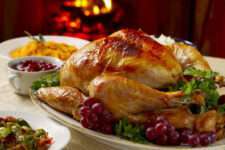
Photo courtesy: plainville farms

it’s time to talk turkey! Because of the increased number of turkeys prepared during the holidays, food-borne illnesses often increase. If not handled, thawed, and cooked properly, turkey and all poultry can carry Salmonella, a common type of bacteria that can cause food-borne illness. Consider these tips for preparing a safe and succulent turkey this year.

  1. Properly thaw the turkey. This is the first and most important food safety step. The best way to do this is in the refrigerator. Make sure the turkey is still in its original wrapper, and place a tray underneath it to catch juices and prevent cross-contamination. For every 4 to 5 pounds of turkey, you will need 24 hours of thawing time, so be sure to give yourself enough time to thaw it properly. Once thawed, refrigerate and cook it within 1 to 2 days.
  2. If you need to thaw the turkey more quickly, use the cold-water method. Place the turkey in an airtight package or leak-proof bag. Submerge the turkey in cold water for 30 minutes per pound, changing the water every half-hour so it stays cold. Cook immediately.
  3. If you purchased a smaller turkey, it may be possible to thaw it in the microwave if it will fit. Check the manufacturer’s instructions for the size of the turkey, minutes per pound, and the power level for thawing. Roast it immediately after thawing.
  4. It is never safe to thaw turkey and other meat on the counter. Doing so puts the meat in what food safety experts call the danger zone, 40 to 140 F, where bacteria multiply rapidly. Under ideal conditions, bacteria can double every 10 to 20 minutes. That means one cell can increase to more than 16 million cells in 8 hours. For this reason, all perishable foods such as poultry should never be held at room temperature for more than 2 hours.
  5. To roast a turkey, set the oven temperature no lower than 325 F. Despite what you may hear, cooking a turkey for a lengthy time, such as overnight, at a very low temperature is not safe. This encourages bacterial growth. To check for doneness, use a meat thermometer inserted into the thigh. Do not rely on the pop-up thermometer alone. Meat thermometers are available at reasonable prices in most supermarkets and variety stores. For safety, the thigh meat should reach 165 F. If the bird is stuffed, stuffing should reach 165 F as well.
  6. After the meal, promptly refrigerate leftovers in shallow containers. Some people leave turkey and other perishable items out for guests to enjoy all day, but this practice is unsafe. Place perishable items in the refrigerator. If people want to snack, they can take the food out of the refrigerator.

For more information on turkey preparation and storage, contact USDA’s Meat and Poultry Hotline at 888-674-6854.

Lettuce Eat Local: Oh Grandma

0

Amanda Miller
Columnist
Lettuce Eat Local

O my. The letter “O” doesn’t weigh more than any of the other letters of the alphabet, but writing about it this week is definitely heavier than normal. 

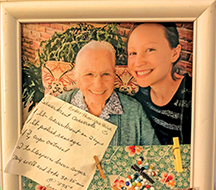
That’s because it corresponds with the death and burial of my precious one-hundred-year-old grandma. Often the transpirings of my life take precedence over culinary topics even though this is technically a food column, but Grandma Weber lived out much of her remarkable generosity from the space of her kitchen, so she fits right in here. 

Remembering Grandma on “O” week seemed quite timely as I was full of ideas right away. She played such an indelible role in my life that I might feel that about every letter, but oh well. Even just talking about letters is such a Grandma thing, since she was an avid Scrabble player for decades — so much so that she played a game of it every day for years. It’s my favorite game, too, perhaps not by coincidence. 

O tiles are only worth one point each in Scrabble, but lots of points in this context. I was chatting with cousins about my article trajectory after the visitation, and they were immediately coming up with ideas too. 

Oatmeal was one of the first suggestions. Now, my family loves oatmeal; Benson has been a fan of it all his life, and I do use it in some less-common ways, but Grandma might have us beat both in longevity and creativity. Apparently she enjoyed a breakfast concoction consisting of sauteed onions and celery, an egg, and toasted bread cubes atop a bowl of cooked oats, garnished with a dollop of her signature mustard dip — I’m sure that could be on a fancy tasting menu somewhere, but not in my kitchen. 

I also have a handwritten copy of one of her recipes which comprises oats, brown sugar…and sausage and sauerkraut. My mom’s note on it, “Better than you think :),” echoes my sentiments, which I admit may not be saying much.

Onions were also pulled up instantly from my treasure trove of memories, this time an example of her avidity in trying home remedies. I’ll never forget how we kids were staying at our grandparents’ house one time, and my older brother had a little cough. Grandma made him eat a raw onion and sit on the couch all day, while my younger brother and I had a high time running around outside and cackling at his misfortune. I’m guessing my son would stop faking a cough around his grandma if she had a pocketful of onions instead of cough drops. 

Okra has to be mentioned since she lived in the deep South for 65 years. My dad, the youngest of their seven children, said he couldn’t remember much of what she actually cooked as it was more for quantity than quality, but her cornmeal-fried okra was crisp and good (“Put ketchup on and anything is good.”). I heard recently that “okra water” is getting popular for people who like extra healthy (and slimy) beverages, and I have to wonder if Grandma didn’t try that at some point — she used to take a spoonful of minced garlic plus strawberry yogurt at bedtime because she read somewhere it was healthy. 

It’d be easier to question her judgment on some of these things if she hadn’t lived to be 100.

The really amazing part isn’t her living that long, it’s the way she lived those many years full of integrity: strength and gentleness, faithfulness and generosity. Her guestbooks show proof of how she was always hosting, how she fed thousands of people throughout her century. Grandma’s food nourished souls as well as bodies, because she gave it so generously. 

This will be published the week of Thanksgiving, which again feels extremely timely. If I can be even a little bit like her, I’ll be doing well…although I might skip the raw onion bit. See you later, Grandma. 


Grandma’s Sauerkraut Casserole

Grandma’s food was not gourmet, but she was a good cook, and she excelled at hospitality. As stories were shared about her, it only became more and more evident how generously open-handed she was in the home she made for her family and everyone they (often unexpectedly) brought to the table — even though she did all this in an era of huge gardens and slow food instead of UberEats and fast food. This unusual dish is incredibly simple to prepare, with easy to use ingredients, and can be economically stretched to feed surprise guests. It’s different…but honestly, as mentioned, it is better than your think! I’m very curious if anyone else has seen a recipe like this, so please email and let me know if you have!

Prep tips: I’m sure Grandma used home-canned sauerkraut, but any will do as long as there is plenty of juice — I’m going to be honest, I haven’t made this for a while, and don’t feel the need to at this moment, so I don’t remember if I added water or not; use your own judgment. If I made it again, I would add black and red pepper, and some fresh herbs, maybe some melty cheese. 

1 pound [2 cups] sauerkraut

1 pound polish sausage

1 ¾ cups oatmeal (rolled oats)

2 tablespoons brown sugar

Mix well and bake 30-35 minutes at 375 degrees°.