Wednesday, February 4, 2026
Home Blog Page 351

Peonies

0

It’s the time of year when two fungal diseases may appear on peony plants. Preventative care each year is the best control against them.

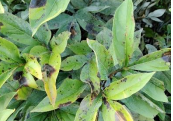
Peony measles, also referenced as red spot and leaf blotch, appears initially as purplish-brown circular spots on the top of the leaves. The spots on the undersides of the
leaves are brown. Over time, more spots develop and eventually merge creating large, irregularly shaped blotches. Spots can appear on the stems, flower buds,
petals and seed pods as the disease progresses.

Powdery mildew can infect a variety of plants. It presents as a white-grey powder on plant
material. Powdery mildew is quite common in Kansas due to the warm, humid conditions.

Fortunately, both diseases are primarily aesthetic problems unless they become severe. Promote good air flow by spacing peonies several feet apart when planting. Individual
plants can be pruned selectively during the growing season to improve circulation. Powdery mildew and measles overwinter in the soil on diseased plant material. At the end of the growing season cut peonies to the ground and throw out the plant material. Do not compost, especially if the plants are diseased. Use drip irrigation, if possible, to keep water from splashing on the leaves. When leaves are wet, avoid handling them.
Dividing Iris

0

Irises have a rhizome root system. Every year, each rhizome yields additional rhizomes creating a larger network of roots. After several years of this development, bloom production may slow down or halt altogether if the rhizomes become too crowded. This indicates it’s time to divide the rhizomes.

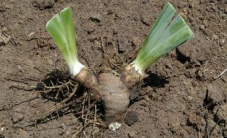
When the bloom season has ended dig the entire plant including all the rhizomes. Break the rhizomes apart by hand at the joints where they are connected. Healthy rhizomes should have roots extending below and a fan of leaf blades above.

The rhizome should be firm and at least the width of your thumb. Discard any rhizomes that are soft, have an odor or do not have leaves protruding.

Trim the fan blades to about eight-inches cutting each blade at an angle to keep water
from collecting in the thick, open leaves. Trimming the leaves prevents the plant from
falling over while the roots become established. Dig a hole just deep enough that the
top of the rhizome is slightly exposed when placed inside. Irises will tolerate poor soil
conditions but well-drained soil is best. Space plants 12 to 18 inches apart and do not mulch. Irises do not respond well to over-watering; however newly planted rhizomes need to be watered in thoroughly.

Fertilize according to soil test recommendations or by applying a complete fertilizer, such as a 10-10-10, at the rate of 1 pound per 100 square feet. Mix the fertilizer into the soil to a depth of 6 inches. If your soil test shows high phosphorus levels, use a fertilizer that has a much higher first number (nitrogen) than second (phosphorus). It is important to get
irises planted early enough in the season to allow roots to establish before the first hard frost.

Cut the cost of watering trees

0

Modifying soaker hoses can help reduce the cost of water, says K-State horticulture expert

As the temperatures climb into the 90s and above, most trees require more water, but more water means more costs. Kansas State horticulture expert Cynthia Domenghini says modifying soaker hoses can help homeowners save a few dollars.

“Soaker hoses are notorious for non-uniform watering,” Domenghini said. “In other words, you often receive too much water from one part of the hose and not enough from the other part.”

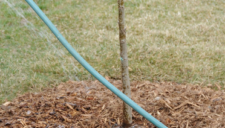
Patchy water application may not affect smaller trees, as the soaker will circle the tree several times, but can affect larger trees. For more uniform watering, Domenghini suggests hooking the beginning and end of the soaker hose to a y-adapter to equalize pressure and provide more uniform watering. The parts needed are just a y-adapter and a female-to-female connector.

“It is also helpful if the y-adapter has shut-off valves so the volume of flow can be controlled,” Domenghini said. “Too high a flow rate can allow water to run off rather than soak.”

The position of the hose can also make a difference. On larger trees, Domenghini said the soaker hose can circle the trunk at least half the distance to the drip line. On smaller trees, she said the hose can circle the tree several times so only the soil that contains tree roots will be watered.

To check if the watering is effective, Domenghini said the soil should be wet at least 12 inches deep. A metal rod or something similar can be used to check.

“Dry soil is much harder to push through than wet and your probe will stop when it hits dry soil,” she said. “How long it takes water to reach a 12 inch depth varies depending on the rate of water flow and soil.”

As a test when first watering the tree, record the amount of time it takes to reach a 12-inch depth of dampness. The tree can then be watered for that amount of time in subsequent watering.

Domenghini and her colleagues in K-State’s Department of Horticulture and Natural Resources produce a weekly Horticulture Newsletter with tips for maintaining home landscapes and gardens. The newsletter is available to view online or can be delivered by email each week.

Interested persons can subscribe to the weekly newsletter, or submit their garden and yard-related questions, by sending email to Domenghini at [email protected], More information also is available at your local K-State Research and Extension office.

Kansas artist completes 108-foot wheat mural on grain elevator

0

Talented Kansas-based mural artist Mindy Allen has recently finished her largest project to date — a 108-foot-tall mural on a grain elevator in rural Inman.

The mural project began nearly five weeks ago, timed to celebrate the 150th anniversary of turkey red winter wheat’s introduction to Kansas. Allen, whose business is called Mindy’s Murals, was determined to honor this milestone accurately. She even engaged the community by setting up a donation poll on Facebook, allowing locals to vote on the color of the combine featured in the mural.

Throughout the process, Mindy’s Murals actively shared updates and behind-the-scenes glimpses on its Facebook page. Followers were treated to a visual journey of the mural’s development, from initial sketches to final touches, giving the community an inside look at Allen’s meticulous work.

“I wanted to make sure every detail was perfect — the equipment, the colors — so that the people of Inman would be pleased and feel a connection to the mural,” Allen explained to local news outlet ksn.com.

Allen said that she finds joy not only in the painting process but also in seeing the finished project.

“It’s wonderful to feel a part of the community for a while, and while painting is fun, finishing and leaving knowing the project is done is always exciting,” she said.

Allen told reporters that feedback from the Inman community has been overwhelmingly positive.

“WOW!!! Soooo beautiful!!! Your work is ALWAYS amazing, but I think you’ve outdone yourself on this one. Incredible!!!” one comment on Facebook said.

“God has gifted you with such talent… I love seeing your work!” another said.

“It has been so fun to watch this project progress. You are truly talented. Thank you for the beautiful art,” yet another added.

Originally from a farming family near Scott City, Allen is based in Junction City but told the local media that she plans to return to her hometown for her next project.

“I loved this project!! Inman….you were great!” Allen said in one of her Facebook posts.

K-State food scientist outlines steps to canning frozen food safely

0

Frozen foods are best used in sauces, jams and jellies, Blakeslee says

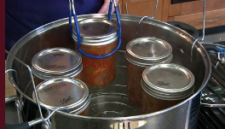
Freezing is often the quickest way to preserve fresh food from a garden or farmers market, but Kansas State University food scientist Karen Blakeslee said consumers should be cautious if thinking about canning that same food later on.

“Using frozen food in canning is not very cost-effective because of labor, time and energy to can the products,” said Blakeslee, who also is coordinator of K-State’s Rapid Response Center for food science. “Because of the time and labor spent freezing the food, it may be best for safety and quality to leave the food frozen, then thaw and use it later when cooking a meal.”

If canning the food is still preferred, Blakeslee suggests doing so in sauces, jams, jellies or fruit butters.

“The reason is that frozen food is much softer in texture when thawed,” she said. “Canning frozen foods in their original form – such as whole or cut pieces – can cause safety problems because the food will compact more and become more dense inside the jar. This can slow down how heat moves through the jar during canning, which affects food safety. The quality of these foods will be poor.”

Some examples of foods that could be frozen, then used later in a canned product, include:

  • Peaches – make into jam, peach butter or jelly.
  • Tomatoes – make into tomato juice, tomato sauce or spaghetti sauce.
  • Apples – make into applesauce, apple butter or jelly.
  • Berries – make into jam or jelly, or blend them to dehydrate fruit leather.

“Juice can be extracted from fruit to make jelly,” Blakeslee said. “There are stovetop juice extractors that steam the fruit to allow the juice to release from the fruit. Another option is to heat and crush the fruit, then pour into a jelly bag and suspend over a bowl to catch the juice.”

Additional guidance on preserving jams and jellies is available online.

Still, Blakeslee said, “for many foods, it is best to leave them frozen for best quality in the end.”

More information on food preservation is available online from K-State’s Rapid Response Center for food science.

Blakeslee publishes a monthly newsletter called You Asked It! that provides numerous tips on being safe and healthy. More information is also available from local extension offices in Kansas.