Scientists are trying to figure out which insect species are struggling, what it means for ecosystems and, ultimately, how it will impact people.
BURLINGAME, Kansas — Without dung beetles, rancher Jamin Horton would be up, um, an unpleasant creek.
These efficient manure wranglers break down the huge patties produced by the hulking livestock that wander Horton’s Soldier Creek Bison Ranch. Otherwise, the sheer volume of dung would smother the prairie plants that feed Horton’s bison.
“I’m in the grass business,” he said. “The more grass I can feed them, the better off I am.”
The beetles also drill countless holes into the earth, letting rain soak in deep, so that the grasses hold up better during dry spells. They haul dung down those hatches for their larvae, fertilizing the soil.
Insects by the millions work these and countless other tiny miracles across the Great Plains and Midwest every day. They undergird agricultural industries and entire food chains as decomposers, pollinators, predators and prey.
But a growing body of alarming research suggests insect populations are shrinking. Suburban sprawl, climate change, pesticides and other threats take their toll on a class of animal that remains poorly understood — considering its lynchpin role for keeping so much other flora and fauna going.
Scientists have studied just a small fraction of the unfathomably diverse world of insects. That complicates their efforts to pin down answers about which species are ailing — and the repercussions for ecosystems, industries and humanity.
Even basics remain murky, such as how many dung beetles crawl on a swath of Kansas prairie and how this has changed over time.
“I suspect that the dung beetle abundance has gone down,” said Mary Liz Jameson, a Wichita State University biology professor and entomologist. “The same as the native bird abundance.”
The North American bird population plummeted by nearly 3 billion over the past half-century.
Scientists believe diminishing insect numbers likely help explain that. But the humble bugs are notably less understood than their eye-catching, feathered counterparts.
“The things that we keep track of are the larger things,” Jameson said. “The little dung beetles are below our feet, where we’re not really looking that often.”
The insect challenge
Ranching families like the Hortons want to make sure that robust numbers of beneficial insects thrive on their properties.
That’s why Horton has tried his hand at raising and releasing the insects. It’s why he pays attention to which agricultural chemicals and medications can seep into the soil and inadvertently harm the precious decomposers.
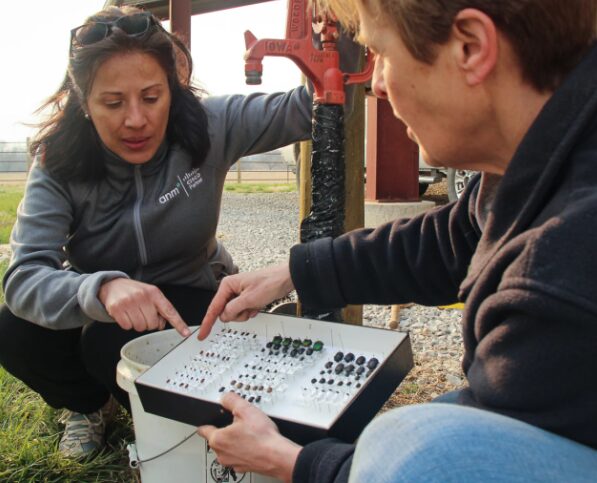
It’s also why he invited Jameson, a dung beetle expert, to his ranch to help him learn about the species living there as he considered how to bolster their count.
“Why not try to work with Mother Nature?” he said while wandering the pastures with Jameson in 2022, searching piles of bison dung for beetles. “I don’t know that she’s gonna be too fond if I just keep spraying chemicals on stuff. It’s gonna come back to bite me and it costs me money.”
His wife, Luz Horton, shares his concern that leaving too heavy a mark on the land can backfire, pummeling the plants and creatures that support them.
“We need to work with nature,” she said. “We need to respect nature.”
Many ranchers and farmers want to do right by beneficial insects, but operating with less pesticide (or none at all) can involve steep learning curves and financial risks.
Their efforts range from cutting back on chemicals that fight parasites to funneling livestock through chutes that brush off and trap flies. Some farmers restore hedgerows to lure back pollinators and helpful predators, such as wasps. Others plant a wider variety of crops to rein in certain pests.
The stakes for getting this right are high. Pests wreak billions of dollars of damage annually on crops and livestock, hitting producers and food and commodity markets.
Yet an arms race of chemicals and medications carries consequences.
Ivermectin, for example, protects livestock from parasites — but not without impacting dung beetles and other important decomposers.
“It’s affecting everything,” Jameson said, “And therein is the problem.”
Oliver Milman, author of The Insect Crisis, points to studies that have found significant accumulation of insect-killing substances such as neonicotinoids.
“Farmland is far more toxic than it once was,” said Milman, environment correspondent for The Guardian US. “It’s kind of this horrible irony that modern farming is killing off its allies. Bees and other creatures are actually essential for pollination and for actually preying upon the pests.”
In some places, predatory insect species may be declining faster than crop pests. That’s what Chinese researchers found over the course of a nearly two-decade study.
What’s happening to insects?
Scientists are racing to put together big-picture answers about the fate of creatures that we’ve long taken for granted.
“Previously, it seemed pointless,” Milman said. “Why would you count insects? Because they seemed to be everywhere.”
A few particularly hair-raising studies found cratering insect populations in specific places, fueling conversations about whether an “Insect Armaggedon” is nigh.
Entomologists haven’t reached a consensus about how extreme the overall global situation is, Milman said. Yet most agree that many kinds of insects face serious declines — a cause for alarm.
One 2020 review of hundreds of studies worldwide suggests the global population of land insects (as opposed to water insects) could be shrinking by nearly 10% each decade.
The reasons are likely many.
University of Oklahoma scientists found, for example, that greenhouse gases help explain why grasshopper numbers are dropping nearly 2% annually on a protected Kansas prairie where their habitat is shielded from human development and pesticides.
The extra carbon dioxide in the atmosphere changes prairie grasses, making them less nutritious to insects.
“It’s like compound interest,” biology professor Michael Kaspari told the Kansas News Service. “You add that up over 25 years and we’re talking about a significant decline in one of the most important insects on the prairie.”
Such dramatic changes raise concerns that some insect losses are occurring faster than scientists can figure out the implications — for the rest of the food web and for humans.
Conservation biologist Peter Soroye at the Wildlife Conservation Society Canada, compares it to popping bolts off an airplane in flight.
“Do you want to be doing the research on the plane of which bolts exactly you can pop off as it’s flying?” he said. “We might be able to lose a lot of species and we’ll get by. But do we want to take the risk of losing the wrong species?”
A Danish scientist wondering why birds were vanishing decided to build an annual snapshot of the bugs that feed them. He drove the same route each summer for a few decades to count the bug splats on his windshield. The insect goo decreased sharply over the years.
Milman says stories like that generate unease in those old enough to have seen very different scenes in their childhoods — when the numbers of moths banging against neighborhood porch lights seemed inexhaustible.
“People remember fireflies lighting up rural areas around themselves — or suburban areas even,” Milman said. “We’ve got this kind of loss happening. Loss in experience, loss in memory.”
Milman sees hope. Insects breed fast, and if humans can resolve some of the obstacles they face, by shifting to pollinator-friendly farming, for example, many populations could bounce back.
“They can leap back up,” he said. “They are the great survivors of our planet, after all. There’s been five mass extinctions in the Earth’s history and insects have traversed their way through all of them.”
As reported from the Kansas News Service. ksnewsservice.org.