

Most of our warm-season vegetables can be planted in early May, however, winter squash and pumpkins should be delayed until mid to late June. The first generation of squash bugs is active in July. Delaying the planting date for squash will result in younger plants that can escape this round of squash bug damage. Plants will need protection from the second generation of squash bugs which is present in August.
A Mid-Scale Anaerobic Biodigester Creates On-Farm Renewable Energy
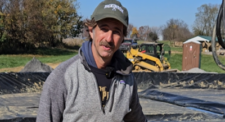
I’ve always found ways to turn “waste materials” into useful resources on the farm fascinating. On my farm, I tried to reuse and recycle resources as much as possible to close the off-farm input loop. I think farms can become more resilient as they rely on fewer off farm inputs. So, when I heard of the mid-scale anaerobic digester being installed at Dickenson College Organic Farm as a demonstration of how small dairy farms can utilize manure and other waste streams to produce on farm energy, I was eager for the opportunity to visit the farm and help spread the word to other farms.
In November 2023, NCAT Agriculture Specialist Eric Fuchs-Stengel and I had that opportunity. We traveled to Dickenson College Organic Farm in Carlisle, PA to visit Matt Steiman, Farm Energy and Livestock Manager at the farm. The farm is a beautiful certified organic working farm situated on 90 acres in the south-central part of the state where they grow vegetables and raise beef, lamb, and layers. Eric and I were there to shoot a video tour of the newly installed, mid-scale anaerobic biodigester that transforms manure from a neighboring dairy, as well as food waste from the college dining hall and local restaurants, into natural gas that can be used to generate heat and electricity.
This biodigester project comes after years of biofuel research and experimentation by Steiman at the college. The idea of using waste products from the farm and local area to produce fuel and power greatly intrigued Steiman, so he started making biodiesel that converted waste cooking oil into fuel to run equipment on the farm. Since the glycerin byproduct from biodiesel production can be useful in anaerobic digestion of organic matter that produces natural gas, he started experimenting in 2010 with small anaerobic digester systems to utilize glycerin, leading to a series of larger systems and culminating with the latest farm-scale biodigester.
The process of anaerobic digestion for production of natural gas is straightforward. A sealed tank creates an anaerobic, or oxygen-free, environment where a slurry of organic matter can be “eaten” or digested by microbes that thrive at certain temperatures in low-oxygen conditions. The methane gas given off from the microbes in this process rises to the top of the tank to an outlet tube where it can be collected and used as a fuel source for heat or electric production. The leftover digestate, which contains all the nutrients from the original waste material, is collected and spread on farm fields.
The size and cost of this new biodigester project required very specific design considerations to ensure that it was sized properly to match the expected waste flow and operate as intended. The digester tank is a 10-foot tall, 115,000-gallon, 50-foot-diameter cement tank buried 8 feet in the ground and sealed with a heavy-duty rubber covering. In the tank are heater pipes and an agitator to mix the slurry. A free-style barn was built next to the tank to house the dairy cows and heifers. At one end of the barn are three in-ground cement tanks that make up the waste-collection system for the digester. One tank is for daily manure collection, the second is for food waste collection (up to 3 tons per day), and the third is for collecting the digestate material remaining after the digestion process. The digestate goes through a liquid removal process and can then be used for bedding in the barn. The liquid portion of the digestate is staged to be used as a nutrient source for the farm’s crop fields and compost piles.
This digester is sized to produce enough gas to match a 50-kilowatt (kW) combined heat and power (CHP) engine. An engine from the European company TEDOM adapted to biogas was chosen for the job. The power produced will first be used to supply the power needs of the farm and the biodigester itself with excess electric production being sold back to the local utility company. This unique 150-cow-scale digester is small compared to other on farm digesters in the United States.
Funding for this project was secured from multiple sources, including NRCS’s Environmental Quality Incentives Program (EQIP). For farmers looking for biodigester funding, Steinman had several suggestions. First, he said, talk to your Natural Resources Conservation Service (NRCS) county office. In addition, the Rural Energy for America Program (REAP) is a grant program administered through USDA’s Rural Development office. Through REAP, farmers and rural businesses who meet grant criteria can apply for grant funding up to 50% of the cost of an on-farm alternative energy project, including anaerobic biodigesters. Steiman also suggested talking to your state Department of Agriculture and Department of Environmental Management or Protection as funding sources. It is also worth investigating local conservation districts and utility companies that may offer funding for on-farm alternative energy projects.
Funding for this project was secured from multiple sources, including NRCS’s Environmental Quality Incentives Program (EQIP). For farmers looking for biodigester funding, Steinman had several suggestions. First, he said, talk to your Natural Resources Conservation Service (NRCS) county office. In addition, the Rural Energy for America Program (REAP) is a grant program administered through USDA’s Rural Development office. Through REAP, farmers and rural businesses who meet grant criteria can apply for grant funding up to 50% of the cost of an on-farm alternative energy project, including anaerobic biodigesters. Steiman also suggested talking to your state Department of Agriculture and Department of Environmental Management or Protection as funding sources. It is also worth investigating local conservation districts and utility companies that may offer funding for on-farm alternative energy projects.
With this new biodigester, Steiman and Dickenson College are using farm and food-waste streams to generate renewable energy right on the farm and reduce greenhouse gas emissions. With nearly 5,000 dairy farms in Pennsylvania alone with an average herd size of 100 cows, this project is intended to showcase how biogas production can work for mid-sized farms across the state and the country. The college is partnering with Penn State University and agriculture producer groups like PASA Sustainable Agriculture to use this project as an on-the-ground demonstration of properly sized biodigester design and implementation and to educate farmers on the benefits of biogas production at this scale.
By Chris Lent, NCAT Agriculture Specialist
Related ATTRA Resources:
Episode 350. Mid-Scale Biodigester with Matt Steiman of Dickinson College
Biodiesel Use, Handling, and Fuel Quality
Micro-Scale Biogas Production: A Beginners Guide
Anaerobic Digestion of Animal Wastes: Factors to Consider
Other Resources:
Biogas – Dickinson College Organic Farm
Organic Farm Dickinson College – YouTube
On-Farm Energy Initiative, NRCS
Produced by the National Center for Appropriate Technology through the ATTRA Sustainable Agriculture program, under a cooperative agreement with USDA Rural Development. ATTRA.NCAT.ORG.
Can Kansas lure the Kansas City Chiefs to leave Missouri? Lawmakers didn’t vote on it.

ansas lawmakers ended the legislative session without passing a plan intended to help make a pitch for the Kansas City Chiefs to leave Missouri and relocate across state lines.
Legislators met Monday afternoon on the penultimate day of the legislative session to discuss proposed changes to an economic development program. Despite agreement on the proposal, the bill never got a vote before the Legislature adjourned early Wednesday morning.
The “temporary and targeted changes” would be to sales tax and revenue bonds, said Rep. Sean Tarwater, R-Stilwell, as he wore a Chiefs lapel pin.
“We called this meeting because of recent events in the Kansas City region where there was a vote to extend sales tax for the Kansas City Chiefs and the Kansas City Royals, which failed pretty miserably,” Tarwater said. “We kind of had an idea that was going to happen, so we’ve been working on some sort of a solution for them for some time now without their involvement.
“We just want to make sure that we have the right plan for when the time is right for us to start those negotiations.”
The government subsidy bill won support from a conference committee.
“We see an incredible opportunity, an exciting opportunity, to put Kansas on the map along with states that have professional sports,” said Sen. Renee Erickson, R-Wichita.
Is there still a chance Kansas lawmakers make a play for the Chiefs?
But the STAR bond bill was never brought up for a vote Monday or Tuesday before the Legislature adjourned. Internal political differences among Republican leadership appear to be to blame in addition to fear of a narrative that lawmakers were giving tax breaks to a large company while failing to secure meaningful tax relief for Kansans.
Gov. Laura Kelly has already vowed to call a special session because she will veto the tax cut plan passed by legislators on the last day.
Tarwater said lawmakers could try again at making a play for the Chiefs during the special session. But the process would be more laborious since they would have to start over, hold actual commerce committee hearings and have floor debates and possible amendment. The attempt during veto session did not follow that normal legislative process.
“That’s going to be something that we’re not going to have a whole lot of time to do,” he said early Wednesday morning after the House adjourned. “Who know? Maybe? Because we did have the votes on both sides, and I’m very disappointed that they didn’t even take it up.”
STAR bond districts would try to lure NFL, MLB, NBA or NHL teams
The plan would have been done through a gut-and-go of House Bill 2663. It would authorize STAR bond districts to build a new stadium and practice facilities with a minimum investment of $1 billion. Up to two professional sports teams from the NFL, MLB, NBA or NHL could use the program.
Local cities and counties wouldn’t have to offer their own incentives, but they could in what Tarwater likened to a bidding process among local governments in Kansas.
“We want to make sure that since Jackson County dropped the ball here that we’re in a position to do a scoop and score,” Tarwater said before the plan failed.
Voters in Jackson County, Missouri, rejected a sales tax for the Chiefs and Royals. The Kansas plan wouldn’t necessarily require any public votes.
“It’s important to note that no Kansans will be asked to pay any more taxes than they currently are,” Tarwater said. “There won’t be a vote for sales tax because of this bill. This bill can happen in either way. We are using tomorrow’s money to pay, and it’s tomorrow’s money that we otherwise wouldn’t receive because these structures will bring it in the business and they will cause development around them.”
As reported in the Topeka Capital Journal
Think of pets when needing to change lifestyle

If you or your family member is getting older and looking to downsize, think ahead about what that might mean for your pet.
“A lot of it is knowing your pets,” said Erica Miller, DVM with Apple Lane Animal Hospital. “You went from your pets being able to run around and have all this land and kind of free roam and now, you’re in an apartment. Your lifestyle changed. Are you getting up early and going on walks to release some of that energy for your pet. Are you doing walks after work? Can you go home at lunch and do a quick walk? Walks are good for us, too.”
It’s also sometimes best for the animal to be offered to a different owner who may have a similar living situation to what is being left behind.
“We’ll have elderly clients that are like, hey, we’ve got to move,” Miller said. “We can’t take our pets with us. Rehoming is always an option. Sometimes that can be hard for the owner, but sometimes the owner knows. They’re like, hey, I need to rehome my pet, because it’s not fair to them to not have these things that they have always had. I want them to have those things. There’s always that.
Miller says there are times where she’s able to match up current clients with prospective ones.
“A lot of times, it’s like, I don’t want a puppy,” Miller said. “I don’t want to do the potty training. I don’t want to do this. I want a dog that’s already older and just kind of ready to enter the family. If you’re talking with your veterinarian and you’re in regularly, we know your pet. A lot of times we know if they’d be a good fit for someone who is looking for someone just like them.”
If you have other questions, you can call Miller’s office at (620) 662-0515.
Don’t worry, be happy: It could lead to a longer life

Is there a science to happiness?
Michelle Lane thinks so. And she can prove it.
“I have found more than 30 studies that found that happiness actually adds several years to your life,” said Lane, the senior director of community wellness and corporate health at North Kansas City Hospital.
Lane was a featured speaker to participants in Kansas State University’s Walk Kansas program, an eight-week challenge that encourages teams of six to exercise and live more healthfully while working toward a common goal.
One research study, Lane says, monitored 1700 people in Canada for 10 years to determine whether their attitude affected their health.
“After accounting for known risk factors within this population, the researchers found that people who were happier were 22% less likely to get heart disease,” Lane said. “Then, study after study demonstrates that people with the most negative emotions had the highest risk for heart disease, and people that scored highest for happiness had the lowest risk.”
Johns Hopkins University reported similar results following a 25 years study: People with a positive outlook were one-third less likely to have a heart attack.
“Pessimism is really a big risk factor for poor health,” Lane said. “When pessimistic people develop age-related illnesses like cancer or heart disease, that illness tends to progress faster.
“Happy people are less likely to get sick because the brain is directly wired to our immune system. Portions of our nervous system connect with our thymus and our bone marrow, which affect the immune response systems in the body.”
Lane noted a trial in which 950 volunteers were asked to be exposed to a cold virus. Prior to the study, the participants were interviewed over a two-week period in which they reported such things as feeling energetic or whether they were pleased with their life.
“During the trial, those that reported more positive emotions were less likely to get the cold, even though they were swabbed with the virus,” Lane said.
Lane reviewed more than 400 studies and came up with four “set points” to increase happiness in one’s life:
- Satisfaction with relationships. Lane learned that the people most satisfied with their relationships at age 50 are the healthiest. A satisfactory relationship was more important than such health indicators as blood pressure and cholesterol level. Make an effort to talk to and know people you meet daily.
- Be intentional about finding your flow and seek out new experiences. Exercise is one way to ‘find your flow,’ Lane said. Make it a priority to do healthy things every day that bring you joy. A mystery dinner date, scavenger hunt or other outing helps individual find a flow away from less happy things, such as doing taxes or home repairs.
- Do nice things for others. “It’s simply part of our nature to be altruistic and compassionate,” Lane said. “Being intentional about it makes you feel good about yourself and make you feel pride, but it also gives you those ‘feel-good’ hormones.”
- Show gratitude. Lane calls it “foundational science” that doing even a couple things to express gratitude helps to increase one’s happiness. Consider starting a journal to write something you are grateful for every day.
“I like to think of emotions as being contagious…like a virus, right?” Lane said. “Happy people tend to life the mood for everybody around us; unhappy people can bring us down. So, hopefully we can all lift the moods of those around us.”
More information about Walk Kansas also is available at local extension offices in Kansas.
