Wednesday, February 11, 2026
Home Blog Page 443

Wheat Scoop: National Wheat Yield Contest: Entries Open Until May 15 For audio version, visit kswheat.com.

0
Kansas Wheat

Catch a break from Mother Nature with moisture this winter? Have a sweet spot with an excellent stand thanks to perfect planting and growth conditions? Kansas Wheat encourages growers with renewed enthusiasm for this year’s harvest to enter the ninth annual National Wheat Yield Contest, which is accepting entries now until May 15 for winter wheat categories.


“We are so thrilled to launch this new website where contestants will find it easier to enter, even using their cell phones,” said Anne Osborne, NWF yield contest director, in a press release. “The data analysis is improved on this new website, so we can continue to share production practices that lead to winning yields and top quality.”


The National Wheat Yield Contest is organized by the National Wheat Foundation. The 2024 categories include irrigated winter wheat, dryland winter wheat, irrigated spring wheat and dryland spring wheat. The contest will name 26 national winners, including state winners. All national winners will receive a trip to the 2025 Commodity Classic to be held March 2-4, 2025, in Denver.


Contest fields must be at least five continuous acres planted with professionally produced, certified, branded and newly purchased wheat seed. The field must be verified by a third-party supervisor during harvest of the contest field. Entries cost $100, with vouchers available from contest sponsors.


Contest rules also require growers to retain a 10-pound sample of grain from their entry, which will be milled, baked and evaluated for quality if the entry places nationally. For each class, the three highest ranking samples for quality will be recognized and awarded an additional $250.


In last year’s contest, William Noll of Winchester had the top yields for both dryland and irrigated winter wheat categories. His dryland entry of AgriMaxx 516 soft red winter wheat yielded 103.99 bushels per acre, while his irrigated entry of AgriMaxx 505 soft red winter wheat yielded 121.1 bushels per acre. Second prize in the state’s dryland winter wheat category was awarded to Matt Grabbe of Hays with a sample of WestBred WB4792 that yielded 79.18 bushels per acre, the same variety with which he won third place in the previous year’s contest.


Partnering sponsors for the 2024 National Wheat Yield Contest include WestBred, John Deere, BASF, U.S. Wheat Associates, The McGregor Company, Croplan, Limagrain, Ardent Mills, AgriMaxx, Bushel, DynaGro, Eastman, Kentucky Small Grain Growers Association, Mennel, North Carolina Small Grains, Ohio Corn & Wheat, Siemer Milling Company, USG, Grain Craft, Kansas Wheat, Miller Milling, Montana Grain Growers Association, ND Mill & Elevator and PlainsGold. DTN/Progressive Farmer is the competition’s official media outlet.


Growers have until May 15 to submit their entries. Enter the National Wheat Yield Contest or learn more about the contest at: wheatcontest.org Kansas entrants must be members in good standing of the Kansas Association of Wheat Growers, so renew your membership today at kswheat.com/KAWG.

Lettuce Eat Local: A Partial Boba Eclipse

0

The sky darkened, the temperature dropped, the birds and breeze stilled. Dusk in the countryside is beautiful, isn’t it? 

It was beautiful, and it was out in the country, but this time it wasn’t dusk — you can probably guess by now that I’m referencing the afternoon of the solar eclipse. I would have mentioned the shadows deepening or lengthening, but I’m not sure what they were actually doing; they were just changing. The cast of the light changed too, but again I’m not sure what descriptors to use. It’s like the sun “going down” in the middle of the day isn’t something we talk about often. 

It wasn’t eerie, per se, but for an hour or so things felt different. Although we here in the partial zone didn’t have full darkness and couldn’t see the moon’s shadow over the sun without intervention, even if I would have had neither eclipse glasses nor known what was going on, I would have definitely known something was going on. 

I had just started walking home with the kids when the sun was most shadowed here. We had been invited to a neighbors’ house for chili and eclipsing, an apposite pairing since I got distinctly chillier as the eclipse progressed. We sat outside around noon to chat and wait, taking peeks through our hostess’s telescope and quick glimpses through our funny special glasses, and for a while I could feel the sun burning the back of my winterized neck as the day warmed up. Gradually I realized that not only was I not too hot but that I was pining for a sweatshirt — it’s amazing what a little moonshade can do to an environment. How incredible that our solar system was designed so precisely that we can predict and witness something like this, and also that we’re not always having these “weird” events.

My parents were actually in the zone of totality in central Ohio, and while what we saw here was cool, what they experienced there sounded epic. A once in a lifetime event for them! Here in the States we’ve been talking about it so much, but did you know that total solar eclipses happen fairly regularly? As in, approximately every year and a half — but the path of totality just isn’t often over such a widely populated swath. 

Since everyone was talking about it, everyone had to be making special food for it, too. My SiL let me sample her black-ish Sonic eclipse slushie-float thing, my mom told me about her chocolate-disc-topped eclipse latte, and my email showed me a purple Vitamix eclipse smoothie bowl ringed with coconut shavings. Of course I was dreaming up various eclipse-esque dishes, but when I listened to a completely unrelated podcast about bubble tea, I knew I found it. A sunny partial-zone smoothie cup full of black tapioca-pearl moon shadows! My inspiration on bubble tea was clinched as I then made boba drinks with a friend who’d never had it, and out-of-the-blue was brought milk tea boba by another friend. Three days in a row of bubble tea showing up might happen to me even less than solar eclipses. 

Boba tea might be a new thing to you, but I encourage you to give it a try. The chewy “bubbles” might catch you off guard, so if they’re not your thing, try wearing your eclipse glasses. They won’t help, but might help you remember it’s An Experience. 


Eclipsed by the Bubble Smoothie

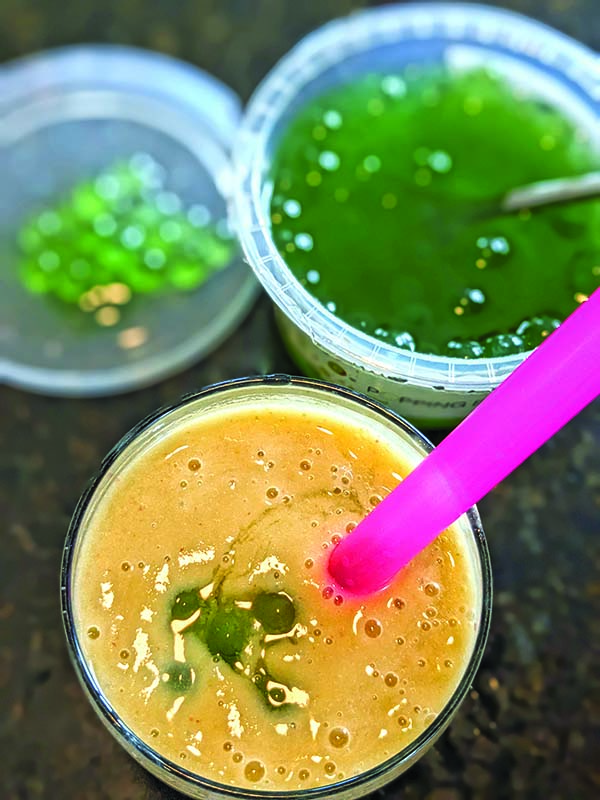
The April 8 Great North American Eclipse also covered parts of Mexico, so the fruit in this sunny-colored smoothie are also a nod to the tropical produce available south of our border. You’ll notice I’m throwing around combinations of words, bubble and boba with smoothie and tea; they’re all different aspects of related ideas, but I’d need a whole other article to elucidate them better (perhaps you’ll see one in the future). Awkwardly upon already beginning to make our drinks, I realized the bubbles I had were kiwi-flavored popping boba and not the black-tea-cooked tapioca pearls I intended, but it was still tasty and perhaps a more appropriate color anyway for our partial zone of totality. A fat straw is definitely the best way to drink this — yes it is a smoothie with surprise chewy bits — but if you don’t have any, you can use a spoon to catch the bubbles. Benson just wanted to eat them all straight out of the container..

Prep tips: you can buy regular or popping boba, or you can also skip this whole recipe and buy a readymade bubble tea! In Hutchinson, Sugartime Confections has a large flavor selection, and BHappy Pho & Boba is set to open the end of this month. 

1-2 mangos, cubed (peeled if desired)

2 cups cubed papaya

½ a pineapple, cubed

squeeze of lemon or lime juice

1 cup plain or vanilla yogurt

ice cubes

1 cup boba pearls or popping bobas

Add all ingredients but boba to a blender and process until smooth; add sweetener if necessary. Divide boba among cups, and top with smoothie. 

Insight: Farm Finances

0
Image courtesy: Kansas Farm Bureau

Jackie Mundt,
Pratt County farmer and rancher

There was a line in one of those corny comedy/action-adventure movies that made me roll my eyes recently. A character asked, “What’s in Kansas?” in reference to them being unable to understand why a mutual friend moved to Kansas. That’s not the line that made me roll my eyes. I am a transplant myself and know from experience that Kansas doesn’t seem to be very exciting until you get to know what makes it such a wonderful place to live.
The line I am still thinking about was the response, “she married a rich rancher.” The insinuation that the only thing making Kansas attractive to a highly affluent, college educated woman is lots of money, makes me little concerned about how many people think all ranchers and farmers are rich.
Since Tax Day is this week, I thought it would be appropriate to dive into how much money farmers make and why people have so many misconceptions about the topic.
In my opinion, there are several culprits creating mystery around farm income levels. The first is non-farm people. I find it humorous to watch an outsider ask a farmer how many acres or cows they have. Some farmers see that as asking point-blank, “What’s your salary?” The poor outsider is probably just trying to show interest and wouldn’t have a clue if 500 or 5,000 acres was normal, let alone have any insight on the value of a cow.
Farmers also contribute to the problem. Growing up, my parents had off-farm jobs, so I never really thought about if our dairy made money. In college, I meet farm kids who somewhat proudly talked about getting Pell grants because their parents had a low income or at least had a low taxable income. I never liked that attitude and was glad to meet other farmers who were content to pay taxes because that meant their business was successful and they were being productive members of society.
Legislators and estate taxes are also part of the misunderstanding. Farming is incredibly capital intensive; high land and equipment prices make it really difficult to get started if you don’t inherit family assets. Politicians regularly point to a lower threshold for estate taxes as a way to tax the rich. The reality for farmers and many family businesses is that property and equipment quickly add up to large figures.
Those dollar signs aren’t the same as cash. They represent the tractor and field used to plant a crop. Most family farms would have to sell land and equipment to pay estate taxes if the threshold were lowered. Unless a farmer sells out, they will never see the kind of money in cash that makes people think they are rich.
Farmers deal with bigger numbers than other people. They may bring in $1 million in a great year and $100,000 the next – before expenses. After paying for seed, fertilizer, machinery, fuel, rent and other business costs, a farmer may make six figures or lose money for the year.
Farmers have tremendous amounts of money invested in equipment, inputs and land. Their risk level is high; they make many decisions without knowing if the weather or market at harvest will cover the costs they’ve already incurred. All farmers experience bad years. Sometimes they event put a farmer out of business. The stress and uncertainty of trying to keep the farm alive for the next generation is often cause of mental health issues.
Judging a farmers’ income is complicated and difficult because there are too many factors; rich or poor, materialistic or humble, heavily leveraged or paid in cash. My experience is that farmers’ finances may look different than the average American, but we really aren’t that different at all.

Dairy Cows With Avian Influenza, What?

0

Trent Loos
Columnist

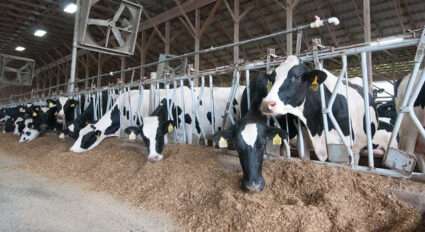
All hands on deck. I smell a serious rat in the situation that is unfolding in the dairy cattle world. Earlier today, I had a tremendous conversation with Texas Commissioner of Agriculture Sid Miller about the dairy females that are testing positive for H5N1, otherwise known as Highly Pathogenic Avian Influenza. Sid told me that, for the longest time, they were testing these sick cows for bovine diseases when someone suggested there were a large number of dead birds in the area. They tested the cows for H5N1 and got positive test results. Clearly, it was originally called a “mystery disease” and I would say that name still fits.
So right off, let’s describe what the “sick cow” means. As Sid Miller indicated, the cows affected are all in lactation. They are the older cows within in each herd. The young cows seem to be resistant to any symptoms that the older infected cows are experiencing. Now I have had dairy folks tell me that 5-10% of the positive cows will actually dry up and quit milking. For the most part, the cows experience very typical flu-like symptoms. They lose their appetite and have a fever for a few days and then come back into milk and move forward with no issues. In the realm of animal diseases. the situation could be significantly worse.
At the time of this writing, Sid Miller also reported that, for only the second time in recorded US history, a human has contracted H5N1 from interacting with animals. The symptom experienced by the worker on one of the dairies was simple pink eye. As always, there is zero reason to be careless around animals but certainly not a reason to have an elevated fear about contamination.
Honestly, I find the whole think strange. I mean migratory birds cover more than just this path in Texas where the outbreak originated. Yet the animals infected in all states, with the exception of Kansas thus far, have a direct tie to animals from Texas. Capturing many headlines in the past couple of days is the fact that the state of Nebraska announced that it will now require a permit for breeding dairy females with a Health Certificate from the state of origin in order to come into the state. To me, the news in that is the fact that a permit was not already required. As a person who routinely delivers animals to dozens of states, it is rare that permits are not already commonplace.
It needs to be said that this is an animal disease and no way should be confused as a human health issue. The milk from sick cows is discarded and not sent into the normal fluid milk channels. If that were to happen, the pasteurization process would remove any health risk for human consumption. I am concerned that I see quite a few negative sentiments about the consumption of raw milk surfacing through this situation, at a time when raw milk consumption was making a comeback.
Already the fear mongering fools out there are trying to work the consuming public into a frenzy about mass injections of mRNA H5N1 vaccines being given to these cows. That is a blatant lie.
It has not and will not happen. In fact, I attended a USDA meeting last week in Omaha where the poultry producers in the room asked Secretary of Ag Tom Vilsack why the USDA could not champion an Avian Influenza vaccine for birds. His answer was horrible but nothing short of “it will not happen anytime soon.”
At the end of the day, I am going to quote Sid Miller from our broadcast when he said, “This is not a good thing, but certainly it isn’t a real bad thing either.” I am going to predict that if we do not get armed with the truth and become louder than we have been in the past, the collateral damage to dairy and beef production will be severe.
There are plenty of folks in the world today looking to bring the cow business crashing down. Let’s not let them even start crowing about all the problems these cows are suffering. Hey, but then again, we are a week ahead of a solar eclipse that will last less than 4 minutes in any one spot and we have state governors already declaring a state of emergency. That is proof that it doesn’t take much darkness to spook some folks.


https://trentloos.substack.com/p/dairy-cows-with-avian-influenza-what?publication_id=974571&post_id=143416431&triggerShare=true&isFreemail=true&r=o4hmr&triedRedirect=true

Tomato Tips

0

Scott Eckert
Harvey County Extension Agent, Horticulture

There are thousands of varieties of tomatoes out there to try. I am asked the question of what is the best tomato for our area. The answer is what ever grows best and tastes best for you! Standard slicers have some disease resistance. Determinate tomatoes produce most of their fruit early in the season and less later. They also have shorter, more manageable vines. Indeterminate tomatoes produce large vines and bear fruit through the season except when hot, summer temperatures prevent pollination and fruit formation. Here is a list of possibilities for you to find and try! (Just wait until May after the chance frost has passed!)
Roma: Little Napoli (H; determinate, compact)
Plum Crimson (H; determinate)
Plum Dandy (H; indeterminate)
Pony Express (H; nematode resistant)
Margherita VF (H; determinate)
Roma VF (heirloom, semi-determinate)
Super Marzano VF (H; indeterminate)
Grape/Cherry Type
Esterina (H; yellow, indeterminate)
Juliet (H; indeterminate)
Mountain Belle (H; determinate)
Sun Gold (H; yellow, indeterminate)
Suncherry (H; indeterminate)
SunSugar (H: yellow, indeterminate, excellent flavor, prone to cracking)
Supersweet 100 (H; indeterminate)
Tumbling Tom (H; determinate)
Sweet Olive (H; determinate)
Standard Slicers
Amelia (H; some disease resistance)
Beefy Boy (H; short internode indeterminate)
Big Beef (H; large fruit, productive, indeterminate)
Carolina Gold (H; yellow, determinate)
Celebrity (H; highly disease resistant, vigorous determinate plant, large fruit)
Chef ’s Choice (H; large fruit, indeterminate)
Florida 47 (H; determinate)
Florida 91 (H; heat tolerance, determinate)
Jetsetter (H; indeterminate)
Jet Star (H; an older indeterminate variety, very good yield, very good crack resistance. This was the top recommended variety for years. Some disease resistance.)
Mountain Fresh Plus (H; determinate)
Mountain Gold (yellow, determinate)
Mountain Spring (H; crack resistant, determinate)
Primo Red (H; early, productive, strongly determinate)
Scarlet Red (H, determinate)
Sun Leaper (H) and Sunmaster (H; heat set types that continue setting fruit at higher temperatures than standard varieties.)
Heirloom Slicers (indeterminate)
Amanda Orange (orange, very large fruit, highly fluted)
Black Krim (dark, red-purple, fruit, higher yield than most heirlooms)
Cherokee Purple (pink-purple fruit)
Mortgage Lifter (red fruit, fluted)
This is by no means the entire list of actual tomato varieties there are in the world! So as you can see there are many varieties to choose from.