
4 Kansas Pharmacists Are Taking On The Prescription Drug Industry, And Their Company Is Growing
By Bek Shackelford-Nwanganga
Kansas News Service
The four pharmacy owners formed their own pharmacy benefit manager to take on the huge companies that influence how much people pay for medications.
After years of frustration with mega companies, a group of four Kansas pharmacists is working to change the pharmacy benefit manager trade from the inside out – by creating their own, different kind of pharmacy benefit manager called Oread Rx.
Nate Rockers, owner of Rockers Pharmacy in Paola, Kansas, said the current pharmacy benefit manager situation is dire.
“The industry has morphed away from what we think is the right practice, in an industry that is rife with opportunities for abuse,” Rockers said.
The Kansas company formed in late 2018 is aimed at disrupting a multi-billion dollar industry where major companies decide how much people pay for drugs in their insurance plans, and critics say the pharmacy benefit managers are making big profits in the process while lacking transparency.
To understand what is different about Oread, it helps to understand the complex business of pharmacy benefit managers, also known as PBMs.
PBMs: the ‘middlemen’ of the pharmaceutical world
Health policy expert Karen Van Nuys is the executive director of the University of California Shaeffer Center’s Value of Life Sciences Innovation, a research program aimed at transforming health care.
Pharmacy benefit managers were created in the 1960s when insurance companies started offering prescription medication as a benefit. According to some research, the first PBMs were created by pharmacists. Van Nuys said PBMs were originally designed to help insurance companies process claims.
“It was a sort of high volume, low margin, back-office kind of business,” she said. “Figuring out who needed to be paid what and then processing those transactions.”
Now, PBMs create what are called formulary lists, which include the medication brands that insurance plans will cover. Also, the companies negotiate prices with drug manufacturers and process claims. Over the years, as the health care landscape evolved, the influence of PBMs has, too. The top three pharmacy benefit managers are commonly referred to as the Big Three. CVS Caremark, Express Scripts and Optum Rx are owned by mega insurance companies. And two of them also own major pharmacies, including CVS Pharmacy and Express Scripts Pharmacy, a mail-order pharmacy.
Van Nuys said when companies integrate like this, it puts them in a position where they can see pharmacy transactions from all angles and gives them a massive amount of power.
“The fact that they have that visibility means that they can capture profits or design contracts in such a way to bring more money to them,” she said.
According to Van Nuys, the three large PBMs control 70%-80% of retail prescriptions. She said they rake in billions of dollars using controversial methods like spread pricing — which is when the PBM charges the payer (a health plan or Medicaid program) more than what they pay the pharmacy and pocket the difference.
Van Nuys said pharmacy benefit managers are not transparent with insurance companies or patients. She said the PBM industry is largely unregulated, so they are allowed to operate this way.
These are all things the pharmacists who formed Oread want to change. They said PBMs and their policies are choking out independently owned pharmacies.
The trade group representing pharmacy benefit managers disagrees.
The Pharmaceutical Care Management Association, also known as PCMA, did not return requests for comment on this story. But in a previous statement, the group said pharmacy benefit managers understand that independent pharmacies play a vital role in prescription accessibility for rural Kansans.
“In support of that critical role, PBMs support rural pharmacies in Kansas, and nationwide, through innovative programs that increase reimbursements and allow rural pharmacists to spend more time with patients,” Katie Payne, senior vice president and spokeswoman for PCMA said in an emailed statement.
“A strong relationship between PBMs and rural pharmacies means a better experience and more affordability for patients, which is our shared priority,” the statement continued.
The pharmacists
behind Oread
In addition to Paola pharmacist Nate Rockers, the group of founders includes Dared Price, Tyson Mullen and Matt Morrison. The guys have a lot in common. Not only are they pharmacists, but they all own rural Kansas pharmacies and three of them graduated from the University of Kansas.
Their mutual qualms about the PBM industry put them on an unexpected path. Rockers said when they decided on their career paths, their initial goal was to take care of patients.
“We felt that pharmacy was that pathway,” Rockers said. “Becoming business owners was a byproduct of how we thought we could best serve patients.”
Matt Morrison owns Gibson’s Pharmacy in Dodge City, Kansas. He said he hit a breaking point and realized there had to be a better way after a large local employer approached him with concerns about ever-rising prescription expenses.
“I was like, ‘Well, that’s funny, because reimbursement keeps declining,’” Morrison said.
So in late 2018, the group founded Oread, their vision of an equitable PBM. They named the company after Mount Oread, a hill in Lawrence, Kansas, where parts of the University of Kansas campus sit.
How Oread works
Rockers, the Paola pharmacist, said Oread has three main distinctions from a traditional PBM. The company is transparent, it does not engage in spread pricing and passes 100% of manufacturer rebates back to clients.
“Our mission with Oread is to put the patient and the plan in the driver’s seat of their health care to ultimately achieve the best outcome at the best price,” Rockers said.
Oread customers
One of Oread’s early, large clients was the Winfield school district. The district started working with Oread in 2021 when Nate Reed was the superintendent. Reed said when he heard about the new company, he did not know employers could change PBMs.
“It was kind of like an onion where you just peel back layers, you’re like, ‘Oh my gosh,’” Reed said. “Why don’t more people know about this?”
Reed said before switching to Oread, the district’s insurance rates varied and were on the rise, mostly due to prescription costs.
Reed said he requested an explanation and wanted to see the data on the district’s prescription drug spending. But his requests didn’t get him anywhere.
“You don’t get to see your data. It’s not transparent, even at request,” he said.
But switching the district of about 600 employees was no small feat. The district had to change over to a partially self-funded insurance plan, which Reed said was a bit of a headache.
Ultimately, Reed said Oread saved the Winfield school district more than $270,000 on prescription drugs the first year. The savings allowed them to stabilize insurance costs and give employees ‘premium holidays,’ which are months when workers did not have to pay for health insurance.
Last summer, Reed changed careers. He now works at a heating and cooling company in Wichita called Building Controls and Services, Inc., or BCS. Reed said BCS uses Oread, too, and he’s getting to enjoy Oread from the consumer side now.
“You just feel like you’re being well taken care of and you’re being heard,” he said.
Oread serves several other school districts in Kansas, as well as various counties and municipalities, including the city of Derby, Kansas. Human Resources Director Jenny Turner said they started using Oread in 2023.
So far, the city has seen significant savings on specialty prescription drugs, and their rebate returns have doubled. Turner said before moving to Oread, they were told the PBM they used was fully transparent.
“So we believed them. And then when we moved to Oread, and now we’re seeing savings that are twice the amount,” Turner said.
Like in Winfield, Turner said it was somewhat difficult to change PBMs. But she said Oread was clear and easy to communicate with.
“I think it’s great that someone who’s dealing with the same kind of issues that we are, who shops local,” Turner said. “They don’t feel so far removed the way the big PBMs do.”
Oread is not a nonprofit. It makes money from a fixed admin fee. Rockers said for the company to stay successful, it will have to process a high volume of claims and grow its client base. But he said, unlike other PBMs, they do not steer patients to the pharmacies they own. Rockers said at Oread, they want patients to choose the pharmacy that works best for them.
Morrison, the Dodge City pharmacist, said ultimately, there are parts of the PBM system he sees as problematic that they can’t avoid, like building formulary lists, for example.
“We’re playing in a sandbox that we didn’t build,” Morrison said. “There are things about this system that, frankly, are not advantageous to anybody but the processor in some cases.”
The founders said they are also actively pushing for legislative reform of the industry. They want stronger regulations on pharmacy benefit managers that force them to be more transparent and operate more like Oread.
https://www.kcur.org/health/2024-03-19/4-kansas-pharmacies-banded-together-to-fight-the-big-players-in-the-drug-industry-and-theyre-growi
Solar eclipse viewing party at Kansas Wetlands Education Center
FHSU University
Communications
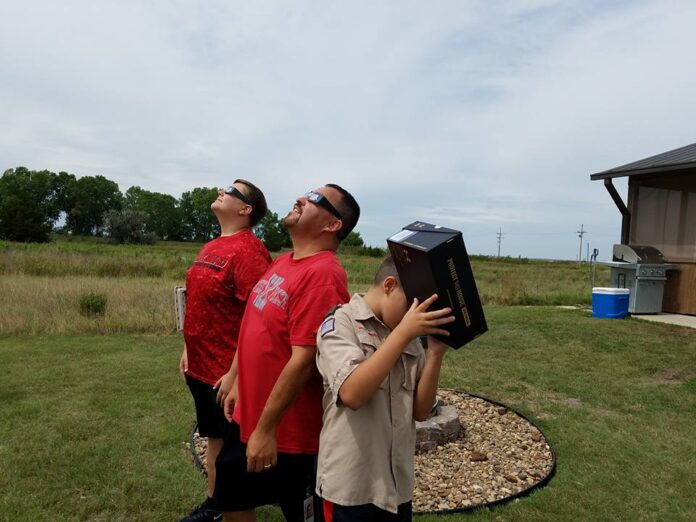
On April 8, from 12 to 3 p.m., the Kansas Wetlands Education Center is offering a unique opportunity for the community to witness a Solar Eclipse Viewing Party. While our location may not experience totality, viewers will still be treated to a rare and spectacular sight as the moon obscures 82.5 percent of the sun.
The event is not just about the eclipse; it’s a fun-filled and educational afternoon for all ages. Attendees can look forward to engaging in games, science experiments, snacks, crafts, and safe viewing opportunities. We encourage guests to bring lawn chairs and lunches to make the most of this exciting day.
Safety is paramount, and attendees will be reminded not to stare directly at the sun to avoid damage to their retinas. Thanks to the generosity of the Great Bend Noon Lions Club, 300 eclipse glasses will be available for distribution to participants on the day of the event.
Activities will include various safe viewing methods, learning sessions about moon phases, accompanied by sweet treats, discussion about animal behavior during an eclipse, and crafting sessions to make UV bead bookmarks and eclipse necklaces as keepsakes. Sponsors and students from the Barton Community College STEM Club will assist in leading activities. Additionally, lawn games will be set up around the picnic shelter, and eclipse-related videos will be screened in the auditorium.
For more information, please contact the Kansas Wetlands Education Center at 877-243-9268.
Event details:
Date: April 8
Time: 12-3 p.m.
Location: Kansas Wetlands Education Center, 10 miles northeast of Great Bend.
Newly Introduced Bill could launch Kansas’ first Pilot Medical Cannabis Program

Kansas one of 10 states with no medical cannabis program, could provide relief to hundreds of thousands of Kansas patients.
Senate Bill 135 was introduced in the Kansas Legislature that, if approved, would launch a pilot medical cannabis program allowing patients diagnosed with at least one of 16 covered medical conditions to seek relief through their primary care physician.
Hundreds of thousands of Kansans suffer from these medical conditions, with often no treatment option other than prescription narcotics. Kansas is one of 10 states that does not currently have a medical cannabis program.
“This bill is the culmination of a thoughtful and collaborative process by legislators and industry experts to ensure that Kansas legalizes medical cannabis the right way to enact the nation’s most conservative and safe program,” said Sam Jones, Chief Operating Officer of Kansas Natural Remedies.
Kansas Natural Remedies is the state’s largest indoor hemp producer whose expertise in the industry was sought to create this bottom-up bill.
“This bill was written to comprehensively address the concerns legislators had with previous bills,” said Jones, “and to ensure that Kansas has the most conservative and controlled medical cannabis program in the nation.”
For instance, restricting the product types such as gummies & edibles, and restricting how it is distributed are big differences from other states. One key to eliminating the issues that plagued Oklahoma was to ensure that licensees are sophisticated operators capable of complying with regulations, and implementing a program that requires a close relationship between regulators and operators. This professional and clinical approach ensures that Kansas implements a safe medical cannabis program that avoids the issues plaguing other states’ medical cannabis programs.
Many Kansans are crossing into adjacent states like Colorado and Missouri to obtain relief through medical cannabis. However, it is not legal to cross back into Kansas with cannabis products. Furthermore, Oklahoma has become the primary supplier of unregulated black market cannabis products in Kansas.
The bill does not allow many forms of consumption, such as gummies, smoking or vaping. Medicine is not administered in these forms, and this medical program avoids the safety issues to health, children and pets often linked to these forms of ingestion. Prescribed products under this program are limited to tinctures, pills/tablets, flower, ointments, and patches. A tincture is a concentrated liquid that you consume by placing the measured dosage drops in your mouth. All forms of delivery will be in tamper-proof, child-resistant packaging.
Medical cannabis is of special concern to military veterans, as reported by the American Legion1, an advocate of medical cannabis nationally. In an independent survey of its members, 82% support legalizing medical cannabis. According to the report, 60 percent of veterans returning from combat deployments and 50 percent of older veterans suffer from chronic pain.
Medical cannabis has been shown to be effective for pain relief, helpful in stopping vomiting2 during chemotherapy, relieving stiffness associated with multiple sclerosis, alleviating clinically diagnosed anxiety, and alleviating symptoms of PTSD including insomnia. The drugs currently prescribed in Kansas to treat some of these illnesses include prescription opioids and sleeping pills, which carry significant side effects including overdose and death. Medical cannabis is, in many ways, a safer alternative to these prescription drugs, and Kansans should be given the medical freedom to choose these products instead of opioids and other narcotics.
Medical cannabis plugs an existing gap in pain relief options that reduces opioid prescriptions. According to a 2019 report from the Kansas Health Institute3, some studies suggest that medical cannabis augments the analgesic effects of opioids, thereby allowing for a lower dose of opioids. Other studies found that states with operational networks of medical cannabis may experience a greater decrease in opioid prescribing than states without these networks.
Medical cannabis is a relatively benign alternative treatment compared to many commonly prescribed drugs for which the side-effects are often worse than the symptoms they are treating.
Another key feature of the bill is that pharmacies will be the sole distributor of medical cannabis to patients. Other states’ medical cannabis programs typically distribute cannabis to patients through dispensaries, which lends these supposedly medical programs the appearance of recreational use.
“It is very important that physician-ordered medication goes through a pharmacist,” said Jared Holroyd, executive director of the Kansas Pharmacists Association. “Receiving medication through a pharmacist, versus a dispensary such as in other states, gives patients a needed level of confidence in the prescription with expert answers to their questions.”
He continued, “If Kansas is to pass a true medical cannabis bill, it only makes sense that licensed pharmacists dispense to the public based on a physician’s order, as is the case with nearly all other medications. This bill does that while also not opening the door to the recreational industry, and we are therefore supportive of our inclusion in the legislation.
Jones said the bill would also provide benefits to Kansas from taxation and newly created economic activity.
“Kansas will retain taxes that are now being levied by other states from Kansans who cross the border for their purchases,” Jones said. “New jobs will be broadly created as a new industry is created in the state, including for businesses that service this new industry. Businesses such as accountants, contractors, attorneys, laboratories and even universities will all experience the economic benefit of a medical cannabis program in Kansas.”
1. https://www.legion.org/veteranshealthcare/239814/survey-shows-veteran-households-support-r esearch-medical-cannabis
2 https://www.ncbi.nlm.nih.gov/books/NBK425767/
3 Kansas Health Institute, Medical Marijuana Health Impact Assessment Update, April 2019
Lettuce Eat Local: Tasty Pastry
Amanda Miller
Columnist
Lettuce Eat Local
The first time I asked the question, most of the kids raised their hands excitedly. “Ooh, me, me!” Wait a minute…I could see our kindergarten and first-grade class needed me to rephrase the question. While I didn’t know all their personal histories, I was pretty sure none of them had died and come alive again.
After explaining being born and alive now wasn’t what I meant, with the second try I could see the understanding sweeping across their intent little faces. None of them had “gotten not dead” before — no one can do that!
No one, of course, except Jesus, which is what I was getting at. Life itself is a miracle, but life again after dying is crazy. It’s tricky to know how to talk about death with such young kids, especially kids that are not mine, yet it’s also impossible to talk about Easter’s new life without death in the picture. We had a very quick, surface discussion in our kids’ class that night — I think they could sense that there were plastic eggs with candy yet to find — just a sentence or two about how seeds have to die to grow and eggs have to break for chicks to hatch, but what I hope they understood and remember for now is that Easter means Jesus loves them.
My consideration of the intertwining of death and life within Easter is a bit more nuanced of course, and I’m thinking about it in some special ways this year. We made a quick trip to Ohio this week, needing the rest of the family to meet new baby Kiah and for us to meet an even newer baby niece. These sweet tiny babies stand (or rather, are held) in contrast to the other person for whom we needed to visit Ohio: my 97-year-old grandpa. He’s on the other spectrum of this thing we call life, the babies with only a short span of days under their belts (/diapers) and Grandpa with only a short span of his long life left.
I also can’t be around Grandpa without thinking of Grandma, whose birthday is this week and who’s been gone for almost eight years. She died on April 12, the day before my birthday, and so forever her death and my birth are on the calendar close to Easter. Now I bring my baby girl, and forever I have that pang of sweet sorrow knowing Kiah and Grandma would have adored each other if they’d gotten the chance. Life and death, intertwined.
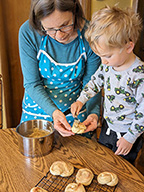
Mom had the beautiful idea of making Grandma’s famous Danish pastries while we were together, a tangible and literally sweet way of remembering her. While four-month-old Kiah was much more interested in sleeping than helping, it did feel like we had four generations of mothers and daughters working together. It was a much longer process than we had anticipated, realizing after we actually read the recipe that these signature knots are essentially frosted croissants; it was another sweet glimpse into the life of my grandma who didn’t love to cook but invested so much time and effort into making these precious pastries for the people around her. She was a quiet woman, yet she loved so well.
I swung by her grave real quick as we left church on Sunday. I know she won’t “get not dead” and that I won’t see her here again, no matter how many Danish pastries I make in her honor. But I’m not so sad, because like we tell Benson, she just didn’t need her body anymore. She gets to be with Jesus now, the One who did rise again, the One we really remember every Easter with death and life intertwined.
Grandma Mayer’s Danish Pastries (greatly abbreviated version)
These are a bit of a legend around here, and for good reason. I remember seeing these caramel-frosted knots filling up Grandma’s table as she finished them, and arranged in Tupperwares and on paper plates to keep eating and to give away. I had no idea they were so much work — I’ve made laminated dough before, but I think only once, because it was A Thing. Fortunately, that experience already in my repertoire greatly assisted my experience following Grandma’s recipe, which was definitely not what I would call overly complete (it reminds me of the technical round in the Great British Baking Show, if that tells you anything). It’d be much too long for this column if I rewrote it in a more helpful fashion, so look up homemade puff pastry if you want to start from scratch for yours. It felt like a shame to frost such incredibly layered, flaky pastries, but they did go from amazing to phenomenal, at least with our attached memories.
Prep tips: Grandma’s recipe said “shape as desired,” but this is how Mom and I remember them looking. Honestly, we think she might have used margarine in her pastry dough (it was the era for it) because ours baked up so much flakier and possibly even tastier than we remembered.
a batch or package of puff pastry dough, cold
1 cup light brown sugar
5 tablespoons salted butter
½ teaspoon salt
¼ cup whole milk
1 ½ cups powdered sugar
a splash of vanilla or maple flavoring
Cut pastry into strips approximately 6”x1”x ½”. Roll like a rope and shape into a pretzel-ish knot. Bake as directed; let cool fully (eat some hot). Mix and melt the brown sugar, butter, and salt together, then add milk and bring to a boil. Cook and stir for a couple minutes, then let cool slightly. Whisk in powdered sugar and vanilla to spreading consistency, and frost the pastries.
