Friday, January 16, 2026
Home Blog Page 77

Texas pecans near harvest in challenging season

0

Texas pecan growers are preparing for the 2025 harvest season with a crop outlook that reflects the state’s diversity in weather and geography, according to a Texas A&M AgriLife Extension Service expert.
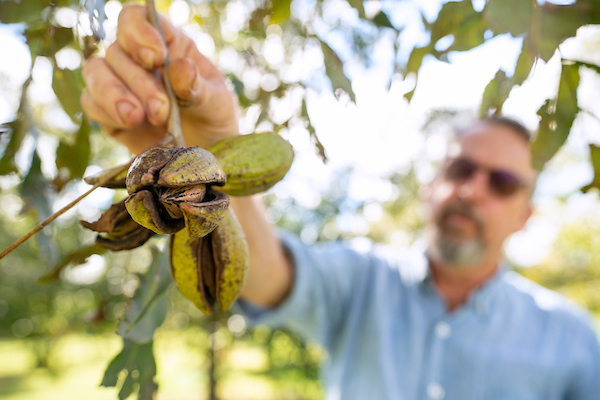
Pecan harvest is about to begin in parts of the state and will continue into winter. (Laura McKenzie/Texas A&M AgriLife)

Monte Nesbitt, Ph.D., AgriLife Extension pecan specialist and assistant professor in the Texas A&M Department of Horticultural Sciences, Bryan-College Station, forecast the state’s crop at 32 million pounds, a number that falls near the middle of Texas’ recent production history.

Texas’ all-time high pecan production was 91 million pounds in 1979, while the record low – 5 million pounds – occurred in 1951.

“This year would be considered average — maybe mediocre,” Nesbitt said. “Some regions are looking at decent yields, but weather conditions created challenges for others, and crop losses are expected.”

Weather drives regional differences

Harvest is about to get underway, but Nesbitt said conditions throughout the growing season created clear contrasts around Texas. He said nut quality remains in question. Cooler, wetter weather around the state helped trees recover from years of drought and triple-digit temperatures, but it also created higher pressure from pecan scab, a fungal disease that can cause fruit loss and reduce nut quality.

In East Texas, abundant rainfall and more moderate summer temperatures helped tree health but fueled pecan scab. He said pecan yield and quality losses to the disease could be significant in the region, especially for backyard and smaller commercial producers.

“Even with best management practices, including fungicide applications, we’ve seen crop injury that would suggest the possibility of quality losses for East Texas,” he said. “Scab is the No. 1 biological threat to pecans, and it was back in full force this year.”

Central Texas pecan trees in some areas encountered spring frost, but the region overall saw better rainfall and a departure from prolonged drought of the previous three years. Many orchards were in an “off year” of their natural alternate bearing cycle and scab was similarly more of a problem in Central Texas than usual. July flooding in some areas also caused tree damage and crop losses.

In West Texas, the pecan crop potential was lowered in some orchards by an early spring frost and then hail in late spring, but otherwise the growing conditions have been normal and conducive to good production.

Market challenges persist

Even as growers look toward the upcoming harvest, market prices remain a pressing concern for producers, Nesbitt said. Wholesale pecan prices have lingered below $2 per pound in recent years, creating financial strain for many producers.

“There’s frustration across the industry,” Nesbitt said. “Growers don’t understand why prices are so low. It shouldn’t be from oversupply since domestic production has not been really high. It’s generally thought to be a mix of global trade factors and a reduction in the number of shellers.”

Retail and direct-to-consumer sales remain strong, with increased consumer awareness of expanded ways to cook with pecans beyond traditional holiday baking. Promotion at state, national and local levels are helping boost that awareness, Nesbitt said, but the wholesale outlook remains uncertain.

“There’s optimism that new markets, like India, could help,” he said. “But right now, the perception among many growers is that current wholesale prices are not sustainable.”

Long-term perspective for Texas pecans

Despite market and weather-related pressures, Nesbitt said Texas pecan producers are hoping better days are ahead. The state’s size and regional diversity mean productivity often shifts year by year, creating statewide consistency overall despite localized highs and lows.

As growers and pecan industry organizations mobilize to raise the nut’s profile with consumers, researchers like Nesbitt continue to work on solutions for pecan scab and other pest and disease issues that increase costs and hamper production.

“The good news is that scab-resistant varieties exist,” Nesbitt said. “We’re working to identify and develop trees that can hold up and produce good pecans with fewer inputs. That’s the future for growers and homeowners alike.”

Son Kevin Writes the Column

0

Lovina’s Amish Kitchen
Lovina Eitcher,
Old Order Amish
Cook, Wife &
Mother of Eight


Hi, this is Kevin, I’m Lovinas’ youngest son. She calls me the baby, but I don’t like being called that. I decided to write the column while she is downstairs washing laundry. I’ve always wanted to get back into writing. It seems that every time I write I quit after 20 pages in, and that makes 20 pages of unfinished stories. I’m currently writing a comedy book. I got the idea from reading The Diary Of The Wimpy Kid. I still have yet to finish it. My goal is to write at least 15,000 words. I never thought I’d be a bookworm until I got into The Diary Of The Wimpy Kid books, which is probably the only book I have ever finished. 

Thank you all for the donations for my handicap buggy. I’m still saving up for it, but we are getting closer to being able to get it. Usually my brother helps me in the buggy, but with me being 6’4″ and 230 pounds, that’s not that easy. The buggy doors aren’t that wide to try and wind my long legs in there and try to keep my head from getting bumped. A handicapped buggy will have a platform lift in the back and will pick up my whole scooter with me on it, and I can drive in it. So, a handicap buggy will help me and those that help me out. That sounds like a golden deal. Every time my brother picks me up I’m saying don’t drop me over and over and luckily he hasn’t yet. If I wasn’t handicapped, I’d be picking my brother up instead or taking him down. Either one works. 

My birthday was September 2nd, and I had some of my friends over for a bonfire and hotdogs. A friend that I stay in contact with from Ohio came, and that made the night even better. My dog Hatchi kept trying to steal the hot dogs, but with me being a food lover I didn’t let him. I’m not ready for this cold weather and already can’t wait until warmer weather again. That way, I can go on more scooter rides. I’m already 20 and not a teenager who thinks he knows everything anymore (just trying to quote mom’s words). heehee! Though I’m still single as a Pringle and that, my friends, is not a golden deal. haha Well, maybe it’s for the better. The way I see it, I got family and friends and a nice home and that’s all I need.

When I was younger, I always wanted a lot of things. Now I realize maybe I should just appreciate what I have. Getting older isn’t all that bad. Older or not, Christmas is still my favorite holiday. Makes winter something to look forward to, plus Christmas isn’t normal without snow outside. Still no reindeer and Santa Claus, I wonder who came up with that anyways. haha Every time I fall off my scooter, I try to cover it up by saying I am catching that mouse, or I was just dancing, haha. Mice are something I never was scared of, but some people climb on chairs, tables, and what not to get away from them. Never understood how you can be scared of something like 100 times smaller than you. 

I had grilled cheese for breakfast with homemade bread, bacon, and eggs. I didn’t make it because oh my, what a mess that would be. Mom made it because she is better at cooking than me. I should maybe take lessons from her. haha One task I haven’t done yet is washing dishes. Mom always tries to get me to do it but I always find excuses to get out of it. Truthfully, it would be hard for me to wash the dishes. 

I will sign off now. Have a nice day and God bless you!

Where to see ‘Gunsmoke’ episodes to celebrate show’s 70th anniversary

0

Seventy years ago this week, on Sept. 10, 1955, CBS-TV premiered the western drama series “Gunsmoke,” set in Kansas and starring James Arness as Matt Dillon, a tough-as-nails U.S. marshal.

A TV station available locally is celebrating the anniversary by airing some memorable episodes of that program, the longest-running scripted TV drama of its time.

MeTV, which airs “Gunsmoke” at noon Topeka time on weekdays, since Aug. 30 has hosted a “month-long hootenanny full of specially selected episodes, themed weeks, and made-for-TV movies,” it said on its website.

More information on where to find MeTV in Topeka can be found online at Where do I watch MeTV in Topeka?

Western drama series was on the air 20 years

Set in the 1870s, “Gunsmoke” focuses on Dillon as he works to preserve law and order in the Old West community of Dodge City.

The series aired for 20 seasons, from 1955 to 1975. It became the longest-running prime-time live-action series on American TV until its record was broken in 2019 by “Law & Order SVU.”

Cast members Arness and Milburn Stone, who played Galen “Doc” Adams, remained with the show throughout its 20 seasons. Amanda Blake, who played “Miss Kitty,” was with the show for all seasons except its last.

Other well-known cast members included Dennis Weaver, who appeared as Chester B. Goode from 1955 to 1964, and Ken Curtis, who played Festus Haggen from 1964 to 1975.

Gunsmoke” can be streamed on Paramount+.

MeTV airing memorable episodes of western drama

MeTV’s website said that at noon Topeka time through Sept. 12, “Best of Matt Dillon” week, it is airing memorable episodes in which Dillon’s character is highlighted.

From Sept. 15 to 19, “Best Characters of Dodge City” week, MeTV’s site said it will air notable episodes highlighting favorite characters and co-stars.

From Sept. 22 to 26, “Guest Stars” week, MeTV said it will air episodes featuring well-known guest stars who included Adam West, Leonard Nimoy, Ron Howard, Bette Davis, Margaret Hamilton and Willie Aames.

“What Questions Do You Have?”

0

We have all heard it before. Before the end of the visit, the doctor will usually ask, “Do you have any questions?” That is usually the precise moment that my mind goes completely blank. Every question I can think of seems silly or embarrassing. I know the doctor is busy so I don’t want to “bother” him/her by taking up too much of their time. I really do not want to look stupid or ignorant. So, I say nothing, smile and the doctor leaves the room shortly afterwards. As soon as that door closes, the flood gates open and all the questions I should have asked bubble to the surface. Now it feels too late to ask them. Sound familiar?

As we begin our next season of On Call with the Prairie Doc, I encourage all our viewers to come to us with those questions. This show is unique because we ask our audience to engage with the show. We do not want you to just be passive consumers of the knowledge. We want you to be co-creators of the show with us. While we will never replace your primary care physician, we want to answer the questions that you did ask during your last clinic visit. Since you can submit questions anonymously, ask that question you were too embarrassed to ask. Use this show to fact check that health information you saw on social media or heard someone talk about at the local café.

We work hard to find the local experts for each show who can share with us their expertise. At the end of each season, we review our shows and look at what questions were asked. We see how many questions were answered for each show and what topics resonated the most with our viewers. We try to determine what topics you want to hear more about. We also look for emerging topics so you have up to date health information that is based in science and built on trust.

The hardest part of planning this show is narrowing down all the topics we want to discuss with you to fit within our season. This is why we will have several “Ask Anything” shows each season. These shows ensure that you, our viewers, will always have a show where any question not only welcomed, but encouraged. The beautiful part of our show is that each show is fluid and we can pivot our focus based on the information you want most. The more you interact with this show, the better it will become. After twenty-four seasons we have yet to run out of questions to answer. This week and every week to follow, please ask anything. We will be here to answer.

Dr. Jill Kruse is a hospitalist at the Brookings Health System in Brookings, SD. She serves as one of the Prairie Doc Volunteer Hosts during its 24th Season providing Health Education Based on Science, Built on Trust. Follow The Prairie Doc® at www.prairiedoc.org Facebook, Instagram YouTube, and Tik Tok. Prairie Doc Programming includes On Call with the Prairie Doc®, a medical Q&A show (most Thursdays at 7pm on YouTube and streaming on Facebook), 2 podcasts, and a Radio program (on SDPB, Sundays at 6am and 1pm).

Big farmer”oops”

0
Thayne Cozart
Milo Yield

As crop producers keep farming more and more acres, sometimes their management gets stretched a bit too thin.

That’s what happened to ol’ L. Austin deBinn, several decades ago. Austin wuz farming several thousand acres spread over most of the county.

He had several hired men. He had farm machinery scattered from hill to yonder. He had grain storage facilities in several strategic places.

It wuz getting close to the fall harvest and Austin instructed one hired man to make sure all the grain storage facilities were cleaned out and ready to receive grain when harvest started.

He instructed another hired man to make sure there were tractors at every storage bin and metal Quonset building to operate the grain augers.

That’s how it happened that the first hired man cleaned out a Quonset building and, after he wuz done, the second hired man parked a John Deere 4020 in the same building so it would be handy to get when needed.

Well, Austin’s crew wuz well into harvest when it came time to store corn in the Quonset. The day corn harvest started in the nearby fields the first hired man drove a different tractor to the Quonset and hooked it up to the grain auger.

With nary a glance inside by anyone, the corn started pouring into the Quonset through the roof opening. Within hours, the poor JD 4020 wuz buried deep in corn — and no one knew about it.

Eventually, when harvest wuz over, Austin discovered he wuz missing a John Deere tractor. Some of the hired men had been sent home after harvest and the remaining hired guys had seen hide nor hair of the 4020.

So, Austin figgered that the tractor had been stolen while parked in a field somewhere. Naturally, he reported the theft to the sheriff and to his insurance agent.

The tractor didn’t turn up in the subsequent legal and insurance investigation and Austin received insurance compensation for his loss.

Well, imagine Austin’s chagrin when he began to sell corn from the Quonset and, lo and behold, there sat the grain-encrusted John Deere on the floor of the Quonset.

There wuz nuthin’ left to do but go to his insurance agent and confess about the “oops” that had happened with the tractor.

Eventually, things were made right. But, this story proves the point that stretched-thin management can cause costly and embarrassing situations.

***

The Kansas State Fair is rapidly approaching at the state fairgrounds in Hutchinson. The promotions for the State Fair brought back to my mind a supposedly true story I heard long ago.

The story goes that an “enterprising” gentleman who lived in a small rural community developed quite a state fair reputation as a prize-winning grain exhibitor.

Year after year the gentleman, ol’ Copp Sears, had many winning entries at the Kansas State Fair in the open class ears of corn and heads of grain sorghum contests. It happened enuf that ol’ Copp gained quite a reputation as a top-notch corn and sorghum producer among state fair officials.

However, the folks back in Copp’s home county knew better. They knew that every year just prior to the state fair ol’ Copp would spend hours roaming the countryside scanning corn and sorghum fields. Every once in a while his old rickety pickup truck would stop and he would disappear into the maze of stalks and emerge later with a burlap bag bulging with corn ears or sorghum heads.

When he got home, Copp meticulously sorted his “haul” for the best ears and heads and entered them in the fair.

The locals never tipped off Copp’s state fair scam, but merely chuckled about him as an amusing eccentric character. Some local farmers even claimed, “Well, my corn won at the state fair, but I didn’t get the ribbon or the premium.”

However, eventually, Copp’s scamming reached the ears of the open exhibit officials at the state fair and they put an end to his antics.

But, it still makes for an amusing state fair story.

***

One of the geezers at the morning geezer gab session recently claimed he had a checkered life as a child growing up on a farm with lots of brothers and sisters.

When someone asked him if “checkered” meant he’s got in trouble with the law, he laughed and said, “Nope. It means I got in trouble with my mother. She had a piece of paper pinned to the wall right next to the pencil markings on the wall she made to check my growth occasionally. Every time I got in trouble with her, mom would put a check mark on the piece of paper and when I got three check marks, then I got disciplined in some way.
That’s what I mean by a ‘checkered’ childhood.”

***

I absolutely abhor pesky, irritating, time-wasting, robo calls about health insurance, car warranties, or any other subject. I wish all phone scammers could spend a few years in prison for disrupting the lives of decent folks.

Which leads to my weekly words of wisdom: “Phone scammers are scum of the Earth.” Have a good ‘un.