Monday, January 19, 2026
Home Blog Page 122

Lettuce Eat Local: Let Them Eat Frosting

0

Amanda Miller
Columnist
Lettuce Eat Local


 We’ve all watched it happen a hundred times — a child is given a cupcake, and instead of taking a well-balanced bite, they dive straight into the frosting. They might proceed to lick it off, use a finger or utensil (unlikely) to shovel it off, or simply stick their teeth right in to bite it off, but they’re going for the frosting first and foremost. 

The rush to the sugar, resulting in a sugar rush. 

The cupcake, cake, cinnamon roll, or whatever it is becomes less an entire entity to be enjoyed and more a vehicle for the frosting. The kid cares only about devouring the frosting, no matter how carefully the baker planned the ratio of cake to frosting or thought about how they want the components to work together.

I witnessed this travesty at a party just yesterday with — dare I admit it — my own son. It was a beautiful slice of homemade white birthday cake, two layers of moist cake with a tender crumb surrounded by ample but not overwhelming buttercream: a very appropriate cake experience. That little fork went like a magnet directly to the edges, poking and pecking away until all traces of white and pink frosting were gone. He was noncommittal about the remainder of the cake, in his opinion having harvested the portion of greatest value. 

I want to be offended, but it seems Benson is not impervious to the temptations of his age. My nephew did the exact same thing right beside him; around the room were the tell-tale signs of similar misdemeanors, like bald cupcakes now topped only with teeth marks and streaks of frosting on small noses and cheeks. 

To be fair, the opposite transgression is often sighted in the generations above. When I think of those who reject frosting to enjoy cake on its lonesome, my mom comes first to mind. She has some notoriety in our family for not liking things to be very sweet (although she herself is quite sweet), and it’s hard to think of anything much sweeter than frosting. It would be a shock to the system to see her at a cake-eating event without a pile of frosting scraped on the side of her plate.

The proper ratio is also disrupted here by favoring cake without any frosting…but since I clearly inherited some of Mom’s tendencies, I tend to see this side of the situation as less of an indecency (with the exception of caramel frosting on cinnamon rolls, in which at least a small amount is crucial).

In fact, I ruin the whole equation by not even liking cake very much and therefore typically preferring to eat neither component. (Give me ice cream or fruit instead of cake any day!)

Add dark chocolate to the mix, however, and it changes everything. The kids and I are out in Ohio visiting my parents this week while Brian is doing the farming thing and living in tractor/combine cabs, so of course I made my mom a chocolate birthday cake like I always do, just a couple weeks late. I should make the cake without any frosting (and I do sometimes), but it’s hard to make it look quite as special without any, so I usually just explore different options. 

This year a super chocolatey double-decker recipe caught my eye with sweet corn blended in the batter and popcorn adorning the top — along with a double chocolate ganache. It may be sweet, but not like regular frosting; herein we find the answer to our frosting dilemma (as well as many of life’s other quandaries), in simply, dark chocolate. 

Just don’t sit too close to my kids if you want any. 


Frosting for Everyone, aka Whipped & Drizzled Chocolate Ganache

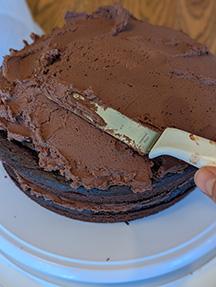
I decorated the cake with the littles in close proximity, and it was a losing battle to keep those fingers out of the ganache — handing over the beaters and spatula only temporarily distracted their ravenous desire for more frosting. But who am I to argue, it’s just chocolate after all! Fortunately it was just as easy to make and spread as it was to eat. 

Prep tips: the melted chocolate shouldn’t be too warm or too chilled when you whip it, but you should be good to go as long as it’s cool to the touch and not hardening up. 

8 ounces dark chocolate, chopped

6 ounces heavy cream, whole milk, or combination of

½ teaspoon salt, plus coarse salt for sprinkling

small splash of vanilla

Melt chocolate with cream gently on the stovetop or in intervals in the microwave; stir in the salt and vanilla. Reserve about a fourth of the chocolate, setting it aside, and refrigerate the remainder for about 15 minutes or until cooled but not cold. Using an electric mixer, whip the cooled chocolate until fluffy and lightened in both color and texture, 2-3 minutes. Spread this on your cake (it’s enough for a two-tier 8” cake if you don’t do the sides, which you shouldn’t or it will be too much frosting), and then drizzle with reserved unwhipped chocolate and top with a sprinkle of coarse salt. 

“Motion is Lotion; the Importance of Movement”

0

Orthopedic medicine is truly a team sport; we have the opportunity to collaborate with nonsurgical professionals, including physical therapists, occupational therapists, athletic trainers, among others, to deliver comprehensive musculoskeletal care. While there are proven surgical options to help our patients where indicated, in many cases, patients are able to achieve pain relief and improved function with nonsurgical treatment options. Much of orthopedic surgical training is appropriately dedicated to the planning and execution of surgery, but it is also important to understand and recognize patients who present with conditions readily addressed without surgery and the accompanying risks of invasive procedures. It is also important to advocate the idea of prevention.

A phrase that is often loosely spoken within our clinic is, “Motion is Lotion.” What does this mean? This is a simple phrase to express the importance of movement and activity, whether that be independent exercise, supervised or specialized therapy, or simply taking a walk outside. With inactivity, we naturally are at risk for muscle loss, obesity, and the many adverse health conditions associated with obesity. It is important to consider exercise and its many health benefits. More specifically, resistance training and cardiovascular exercise have been shown to have robust benefits to our overall physical and mental health and function.

The National Institute of Health has been studying the effect of strength training for more than 40 years, demonstrating beneficial results in adults including maintained muscle mass, maintenance and improvement of mobility, and increasing healthy years lived. Not all resistance training is the same, however, the effects on improved function largely are the same. Resistance training promotes muscle strength and growth, simultaneously improving our overall cardiovascular health. Studies have demonstrated that our muscle mass peaks around the age of 35. Naturally, muscle volume and performance decline slowly until we reach the age of approximately 65 where muscle volume loss proceeds faster. However, this decline in muscle volume and strength is substantially slowed by resistance training. Dr. Fielding with Tufts University, an NIH-supported scientist, has studied resistance training at a molecular level. His research has suggested that the best recipe for improving physical function and avoiding disability is a combination of walking and resistance training, whether resistance be against gravity or moving weight. The list of research-proven benefits of resistance training is quite impressive. In addition to improved muscle mass and cardiovascular health, resistance training offers improved metabolism and promotes weight loss of adipose tissue, increased bone density potentially preventing fractures associated with aging and fragility, improved balance and coordination, and natural release of anti-inflammatory mediators. Outside of bone and muscle anatomy, being active and exercising has been proven to reduce stress, improve our mood and cognitive performance, boost our energy and libido, as well as provide a mean of self-confidence.

Now understanding the many benefits of physical activity, where do we start? If you are looking for some help, reach out to your physician, a personal trainer, or other trained professionals such as a physical therapist or athletic trainer for guidance. The health benefits will not be immediately realized, but you will eventually notice an improvement in your mood, and perhaps many years from now, also an improvement in your overall physical health. “Motion is lotion.” Let’s get out and move!

Anthony P. Fiegen, MD is a fellowship-trained orthopedic sports medicine physician specialized in treating conditions of the shoulder, hip, and knee at the Orthopedic Institute. In addition to a comprehensive sports medicine practice and joint preservation, he also performs joint replacement of the shoulder, hip, and knee. Dr. Fiegen grew up in Madison, SD. He attended South Dakota State University competing for the Jackrabbits ’men’s basketball team from 2009-2013. Prior to joining Orthopedic Institute in 2024, Dr. Fiegen completed orthopedic surgery residency at Mayo Clinic in Rochester, MN. He then went on to complete a sports medicine fellowship at Wake Forest University in Winston-Salem, NC, where he served as a team physician for the ACC Wake Forest football, men’s basketball, and baseball teams. Follow The Prairie Doc® at www.prairiedoc.org, Facebook, Instagram, YouTube, and Threads. Prairie Doc Programming includes On Call with the Prairie Doc®, a medical Q&A show (most Thursdays at 7pm streaming on Facebook), 2 podcasts, and a Radio program (on SDPB), providing health information based on science, built on trust.

“Big Brotherism” — Aggie style

0
Thayne Cozart
Milo Yield

“Big Brotherism” is on the tip of many tongues these days. Folks using the phrase have in mind the many ways all levels of government have to watch and monitor the everyday activities of its residents.

They’re talking about such things as cameras that record everything that happens on a street, in a store, at your front door, from above with a drone, etc.

Also, “cookies” and computer memories that keep track of your every keystroke and website visited. You get the picture.

Well, folks, I’m pleased to tell you there is another form of “Big Brotherism” that has been practiced in rural families for generations. Here’s a true story that proves my point.

***

My Geezer Gab & Gossip Group friend and fishing buddy, ol’ Castin Crankitt, grew up as one of the youngest of 17 kids in the small rural community of Minneota, Minnesota. Needless to say, as one of the youngest in such a huge family, he suffered sibling trials, tribulations, and abuse. This is a story about one of those trying times.

Riding herd on such a big brood, Castin’s dad wuz a no nonsense kind of guy. His directives were non-negotiable. Obey or there’d be unenviable consequences.

This happened on a hot, muggy summer day when Castin’s dad left the family home to run an errand.

As he got to his pickup, the last thing he said to Castin and two of his older brothers wuz, “You three jokers get to work on this yard. Get the grass cut. Get the trees trimmed. Get the dead limbs picked up. And, get the sidewalks edged.” Then he left.

He’d no sooner got out of sight when Castin’s “bully bro” siblings told him, “Get to work on that stuff Dad said, pronto, or we’ll give you a head-thumping you’ll never forget.”

They left Castin no other choice but to obey. So, he started pushing the lawn mower. Meanwhile, his two older brothers sat in the shade in the porch swing swigging from cold drinks all the while egging Castin to “pick up the pace.”

This sibling abuse went on for some time until a few minutes before his older brothers knew the “old man” would be home. That’s when they ran to the well pump, wet down their hair and soaked their T-shirts and told Castin to “sit down and take a break and cool down. We’ll take over from here.” So, Castin did as told.

When his dad drove into the driveway, he saw the two older brothers slaving away — all hot and sweaty — and young Castin sitting in the shade relaxing.

When he exited his truck, he started yelling at Castin, “What’s your lazy butt doing in the shade? I told all three of you guys to get the yard work done. I ought to tan your hide.

Of course, neither of his older brothers fessed up and told their dad the truth and they even made fun of Castin when the “old man” wuz out of earshot.

That’s the story of “Big Brotherism” — Aggie Style.

***

Now some rural humor of the heavenly kind. Thanks to my friend Willie Jay at Mt. Vernon, Mo. for this one.

An farmer dies and goes to hell. Dissatisfied with the foodstuffs he finds in hell, he starts a gardening project. Before long, folks in hell are eating fresh veggies of all kinds. The farmer becomes the more popular guy.

One day, God asks Satan, “So, how are things going down there?”

Satan says, “Why, things are going great.” Thanks to the farmer you sent down we’re now eating nutritious fresh vegetables from a highly productive garden. We’re really appreciative of him. He’s been a literal godsend!”

God is horrified. “What, you’ve got a farmer? That’s clearly a mistake! He should never have gone down there! You know all farmers go to Heaven. Send him back up here immediately!”

Satan replies, “No way, I really like having a farmer in charge of our foodstuffs. So, I’m keeping him.”
God says, “Send him back up here or I’ll sue you.”
“Yeah, right,” Satan laugh. “And just where are you going to get a lawyer?”

***

Two wheat farmers friends meet at the local co-op selling their wheat. As one turns to leave, he says to his friend, “I’d tell you to stay out of trouble, but I don’t like to waste my breath.”

***

The Short Stop where we old geezers gather has an entire wall with an assortment of bottled cold drinks beyond imagination.

The tables where we sit and gossip has a clear view of these bottled cold drinks. I noticed recently that one popular selection is a product named “Smart Water.”

I have no idea what makes a bottle of Smart Water any better than a bottle of plain water or a drink out of the kitchen faucet, but I do know that it costs a pretty penny per swig.

Which I think proves the point that folks who pay to drink Smart Water may not be so smart after all.

***

Words of wisdom for the week: “All my passwords are protected — by amnesia.”

Have a good ‘un.

Day 8, Kansas Wheat Harvest Report

0
Kansas Wheat

Contact: Marsha Boswell, [email protected]

For audio version, visit kswheat.com.


This is day 8 of the Kansas Wheat Harvest Reports, brought to you by the Kansas Wheat Commission, Kansas Association of Wheat Growers, Kansas Grain and Feed Association and the Kansas Cooperative Council.


While yields and protein levels remain generally average, Kansas wheat farmers are facing significant challenges this year, including the widespread impact of wheat streak mosaic virus and related diseases, drought during the growing season and scattered rainfall during harvest.


Mike McClellan, who farms in Rooks County with his nephew Cade Beesley, started harvest about five days ago. Their crew includes hired hand Dave and Cade’s son, Coy. With about two-thirds left to cut, they’re making steady progress.


Yields have been above average compared to the past three years and are landing around average overall. Protein levels are ranging from 11.5 to 15.5 percent, and test weights on their better fields, those not hit by wheat streak mosaic virus, have been coming in at 58 to 60 pounds per bushel.


McClellan said their biggest challenges this year have been drought and wheat streak mosaic virus. The virus hit hard in the spring, with large pockets showing up across fields, more widespread than usual. The impact has been noticeable, with lower yields, reduced plant height, and lighter test weights in affected areas. Scattered rain showers during harvest have added to the test weight struggles.


Jackson Hoelker with Skyland Grain in Kingman County says harvest is nearly a month in, with cutting beginning the first week of June. Yields are coming in between 50 and 55 bushels per acre. Protein levels range from 10.5 to 11.5 percent, and test weights, which began around 60 to 63 pounds, have dropped slightly and are now closer to 58.


Hoelker estimates harvest is 85 to 90 percent complete. For the most part, everything that can be cut has been, but growers will need fields to finish drying out before they can finish the rest. While they haven’t seen much sprouting in the area, the biggest challenge this year has simply been how long the harvest is taking to complete.


Jason Ochs, who farms in Hamilton County, reported that harvest began on June 20, but some of the wheat has had several rain showers since it has been ripe. Other areas have received very little rain the past three years. Wheat in the area is short and hard to get it all in the header. The moisture came a little too late, but they did have perfect grain fill weather, cool and rainy. Yields are ranging based on conditions, but test weights have been decent, ranging from 59 to 61 pounds per bushel. He mentioned some wheat streak mosaic virus in the area. Ochs has seen some wind shatter from 40 mile per hour winds. While the wheat is short, the residue out there “makes a huge difference for the next crop,” he said. “It retains moisture and protects from sun and wind.”


The 2025 Harvest Report is brought to you by the Kansas Wheat Commission, Kansas Association of Wheat Growers, Kansas Grain and Feed Association and the Kansas Cooperative Council. To follow along with harvest updates on social media, use #wheatharvest25. Tag us at @kansaswheat to share your harvest story and photos.


Race to the Finish – Custom Harvesters Help Kansas Farmers Wrap Up Wheat Harvest

0
Kansas Wheat

Contact: Marsha Boswell, [email protected]


For the audio version, visit kswheat.com.

This year’s Kansas wheat harvest has been far from typical. Rainfall happening throughout the state during the entire harvest process has slowed efforts and even caused some localized quality issues for farmers. The delays have created an opportunity for Kansas wheat farmers who need help getting their harvest done quickly, as well as for custom harvesting crews whose own schedules have been pushed back by the rain. Experienced wheat harvesting crews are still available and ready to help wrap up wheat harvest.


In the latest episode of Wheat’s On Your Mind, Aaron Harries, vice president of research and operations at Kansas Wheat, sits down with Lyle Friesen of Friesen Harvesting to talk about the realities of custom harvesting and how his family-run business adapts to a harvest season full of surprises.


“Wheat harvest isn’t just a job, it’s a way of life,” said Lyle Friesen, owner and third-generation custom harvester from Meade, Kansas. “We’re not just running machines, we’re helping families bring in their livelihoods.”


Friesen Harvesting, based in Meade, Kansas, is a third-generation, family-owned custom harvesting business built on values of honesty, hard work and Christian faith. Founded in the early 1950s with a single Massey combine and a Chevy truck, the operation has grown into a modern fleet of John Deere S770 combines and Kenworth trucks. Friesen Harvesting provides professional custom harvesting services for winter wheat, spring wheat, durum, peas and lentils along a northbound route from Oklahoma to Montana. In the fall, they harvest corn, milo and soybeans within a 100-mile radius of Meade. Their crew culture emphasizes professionalism, safety and a family-friendly environment, making them a dependable and trusted partner for farmers across the plains.


Much like many other custom harvesters, their northbound harvest route usually stretches from Oklahoma to Montana, but this year’s weather has complicated that traditional migration. New wheat varieties, tighter labor markets and high input costs have added pressure to custom harvest operations. At the same time, growers struggling with rain delays may find themselves with ripe fields but no available crew.


That’s where U.S. Custom Harvesters, Inc. (USCHI) can help. USCHI’s online harvester database connects growers with professional harvest crews across the country, many of whom are still seeking work due to this year’s interrupted harvest flow. With some areas still too wet to cut and others drying out quickly, Kansas producers can turn to the directory to find skilled, ready crews who may be available nearby.


Kansas-based custom harvester Jacob Hermesch, who is listed on USCHI.com, has been working through tough, muddy conditions and taking on new acres where he can.


“There’s demand for harvesters right now — farmers have the crop ready, they just need someone who can actually get through the fields,” Hermesch said.


Hermesch is currently running near Kinsley but said he’s open to picking up more acres, especially along U.S. Highway 36. With scattered rain in the forecast, Hermesch and others like him represent a timely opportunity for Kansas farmers looking to finish strong.


With harvest windows narrowing and timing critical, Kansas growers are encouraged to visit USCHI.com to find a custom harvester who can help finish the job.