We can see it coming from a mile away: Kiah purses her lips and puffs up her chest, then demands, “No, ME.” She reserves an oddly deep tone of voice for this proclamation, along with a certain accent and emphasis that makes it sound more like “maaaaaay.” The sass dripping from those pooty lips suggests years of practice, belying her mere 24 months.
I don’t want to say we hear this dozens of times a day, yet I also don’t want to say we don’t. Her independence — or illusions thereof — has been asserting itself with the tenacity and willful ignorance characteristic to the toddler age for some time now. “No, maaaaaay” is apparently applicable in any and all situations, regardless of Kiah’s actual ability to follow through; she is as comfortable boasting it when she is inextricably tangled in and blindfolded by a sweatshirt gone wrong as she is in enthusiastically whisking/exploding anything I’m trying to mix up.
Sometimes she really can do it on her own, of course, although clearly more practice is necessary. Eggs in general seem to be a dangerous arena; she’s pretty good at carefully collecting and carrying the eggs (after many times of that not being true), but Kiah peeling hardboiled eggs is painful to watch, not to mention to eat.
Or perhaps more practice is neither necessary nor helpful, something I feel keenly when she starts to take her diaper off herself or tries to pick up the glass gallon jar of milk. Often her desperate insistence in her personal ability makes matters worse, and a simple question or attempt to help her turns into juice slung across the floor and hair tangled every which way.
All this perceived independence is clearly an expected and important part of childhood development, and we wouldn’t want to put her coat on her forever. However, this stage does parallel a critical one in parental continuing education: patience. And some days, its synonym, longsufferingness.
As far as I can tell, though it looks different in different contexts, this resolution to spreading wings of independence doesn’t stop anytime soon. We’ve all met teenagers.
Benson, as an almost-adult four-year-old, has his own share of independence assertions. He can manage most of the actions I mentioned that Kiah is wrestling through, so he’s moved on to bigger and better things. One process he’s essentially mastered, though, is making breakfast for everyone — and no, not just pouring bowls of cereal (although of course both kids also must do that by themselves).
He makes a pot of oatmeal just about every other morning, enough for today and leftovers for tomorrow. These silly kids of mine are obsessed with oatmeal, and always have been. I think we served it for at least two of Benson’s birthdays so far, and all signs point to having it at Kiah’s birthday lunch this week.
I know they like the flavor and familiarity of it, but I’m sure their preference is at least slightly biased by the victorious power of self-efficacy involved. I let them add their own toppings to their bowls, with moderation intervention as called for, and the last couple months I’ve let Benson take more responsibility with making the oatmeal itself. I run the stovetop, and he does the rest. We try to get it going while Kiah is distracted, or she invariably comes barreling over with a cry of “No, ME!”
I make it up to her by letting her adorn hers. Let’s just say it’s a good thing she likes a lot of cinnamon, because you can guess how that usually goes.
Lettuce Eat Local is a weekly local foods column by Amanda Miller, who lives in rural Reno County on the family dairy farm with her husband and two small children. She seeks to help build connections through food with her community, the earth, and the God who created it all. Send feedback and recipe ideas to [email protected].
What began as a quiet promise made during a snowstorm far from Hutchinson has grown into one of the most elaborate Christmas displays in the Salt City, and this year, for the first time, the public is invited inside to experience it.
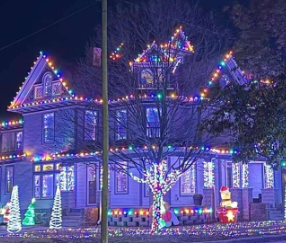
Nick Fisher, who moved to Hutchinson with his family from New Jersey during the pandemic, is opening his Victorian home at 201 W. 12th Ave. for a one-night holiday open house on Friday, Nov. 21, from 7 to 9 p.m.
“This is something I’ve been doing for eight years now, but we’re going to do it really big and really bright,” Fisher said. “Last year people saw the house and were interested in it. This year, we’re going bigger than ever.”
The tradition traces back to a winter when Fisher was serving in the military and stationed in Alaska. He and his wife couldn’t afford to fly home for Christmas. “It snowed really, really bad, and we were snowed into our apartment for two weeks,” he said. “We watched Hallmark Christmas movies for the first time together, and we made a promise that we would go bigger and better every year.”
That promise now fills every floor of their Hutchinson home with holiday scenes. Inside, 30 Christmas trees will be decorated with nearly 10,000 ornaments. Fisher estimates between 40,000 and 50,000 lights will illuminate the inside and outside of the house. He installed eight outdoor 20-amp electrical outlets to power it all.
“Originally there was just one in the front and one in the back,” he said. “I knew if this continued to grow, we’d need more.”
Every design is personal. This holiday marks 10 years since Fisher’s mother passed away, and he said she is the inspiration behind everything he does.
“My mother really, really loved Christmas,” he said. “She always wanted to go all out, but we grew up in a two-bedroom apartment, and she never could. Every year my designs are dedicated to her, but this year, because it’s the 10-year anniversary, I decided to go bigger than I ever have before.”
The third floor will be his favorite place in the house this season. “That room is dedicated to my mom in its entirety,” he said. “It’s going to be like a holiday memorial room to honor our past loved ones.”
Fisher doesn’t just hang lights, he designs themes.
“I don’t like just throwing everything out there,” he said. “If I go candy cane style, it’s going to be red and white. If it’s multicolor, everything matches. I like it to have a look, a design, a theme.”
This year’s interior theme is titled “Once Upon a Christmas.” Each room is designed to look like a page in a storybook.
“My house is a canvas,” he said. “When we moved in, we didn’t have much furniture, and it was so open. One tree lit up one room, and the rest of the house was dark. So I just started filling it in, room by room.”
The event will offer free cookies, coffee and hot chocolate to the first 100 visitors. A Santa Claus will be on the front porch for pictures with kids, framed by Christmas trees and lights.
“If you want the photographer to take it, she’ll take the picture and send it to you,” Fisher said. “If you’d rather take it yourself, totally up to you.”
Admission is free, though Fisher said donations are welcome. “I could never ask,” he said. “If people give, I’m more than grateful.”
Fisher said opening the house to the public this year was inspired by a letter he received last Christmas from a woman who had recently lost her husband.
“She wrote that seeing my house all lit up brought her warmth and closure,” he said. “That hit me. I’m doing this for my mom, and I figured if it brings that kind of feeling to someone else, let’s share it.”
For Fisher, the meaning behind the display is simple. “We’re very old-fashioned when it comes to Christmas,” he said. “It’s a magical time of year. It’s love, family, warmth. And we just want to share that with the community.”
The open house will take place from 7 to 9 p.m. on Friday, Nov. 21, at 201 W. 12th Ave., at the corner of 12th and Adams in Hutchinson.
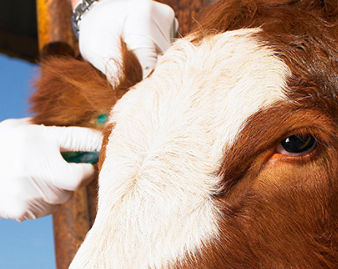
K-State beef cattle experts discuss parasite control measures and how they are evolving.
Cattle producers are rethinking traditional parasite control methods, shifting toward more strategic treatments to prevent drug resistance, Kansas State University beef cattle experts say.
“In the past, we would treat everybody, but now we understand that approach creates pressure to select for resistant populations of parasites,” K-State veterinarian Todd Gunderson said.
Experts recommend producers work closely with veterinarians to develop targeted parasite management plans. Factors such as animal age, geographic location and environmental conditions should play crucial roles in treatment decisions.
“Young animals are much more likely to benefit from deworming than older animals,” K-State veterinarian Bob Larson said. “Mature cattle have natural protections against parasites that younger animals do not.”
The new approach emphasizes selective treatment, avoiding blanket deworming strategies that can accelerate parasite resistance problems. Producers are encouraged to consider individual herd characteristics and consult professional veterinary guidance.
Parasite control remains critical for maintaining cattle health and productivity, with strategic interventions proving more successful than broad-spectrum approaches of the past, K-State experts said.
To learn more about this topic and others, listen to the most recent episode of the K-State BCI Cattle Chat Podcast.
Animals that disappeared from some rivers because of pollution, dams and overharvesting are getting a new lease on life that could have ripple effects for other wildlife and for humans.
COFFEY COUNTY, Kansas – On a warm day last spring, wildlife biologist Trevor Starks squatted in a few feet of water and felt the riverbed with his hands in search of one specific mussel species.
Starks wanted to find native, endangered Neosho muckets. More than 600 of them had been released eight months earlier at this spot on the Neosho River, about 60 miles south of Topeka.
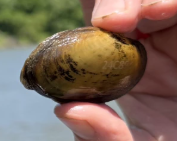
After about an hour and a half of searching, Starks held one of the young mussels in his hands.
“This is the most exciting, rewarding part of the job,” said Starks, who works for the Kansas Department of Wildlife and Parks.
He measured the small creature, about the size of a ping pong ball. And he wrote down the number that had been engraved onto it at the federal hatchery where it was born.
Then Starks released it back into the river. He hopes it could start reproducing in the next few years.
Hear Starks tell the story on the November episode of Up From Dust, the Kansas News Service’s environment podcast.
These animals are reeling from the impacts of overhunting, pollution, dam construction and other human activities. Yet some of the dangers these animals once faced have eased up, meaning scientists see hope that specific species could increase again with a little help from humans.
For example, the mussel-harvesting industry that once ravaged the Neosho River and other waterways is now illegal. In Kansas, commercial harvest hasn’t been allowed for more than 20 years.
Also, the 1972 Clean Water Act regulated many pollutants that were killing off river wildlife. Although Kansas rivers continue to face pollution problems, water quality has in many cases greatly improved.
“What we’re trying to do here is restore a cog, a piece of this machine, of the ecosystem back to its place,” Starks said, using rare Neosho muckets as an example.
The last time someone recorded them living in the Neosho River was in the mid-1990s.
The species has disappeared from most of its range. In 2013, the federal government concluded the mussels were endangered.
Kansas wants to help restore healthy populations and someday make it possible to remove the animal from the Endangered Species List.
Losing puzzle pieces
Mussels filter water. Each one filters gallons of it daily. When sections of a river are lined with healthy mussel beds — beds that can have thousands or tens of thousands of mussels each — all this filtering adds up.
“They’re taking bacteria, excess nutrients,” Starks said. “If you took every mussel out of this river — and went and visited water treatment facilities along the Neosho River — I’d imagine that water treatment would get a lot more expensive if you didn’t have mussels in the water.”
Like many Midwest rivers, the Neosho River doesn’t have as many mussels as it once did, nor as many kinds.
In Kansas, 8 mussel species have disappeared. Forty remain, but more than half of those species are suffering to the point that they’re now under various levels of state or federal protections.
When a species disappears from an area, scientists call it a local extirpation. Across Kansas and the country, different areas have lost different species.
Wildlife biologists and ecologists worry about the potential cumulative effects of these missing puzzle pieces.
A native river mussel that disappears was not only filtering the water but also feeding river otters, raccoons and other predators. A turtle that vanishes was dispersing plant seeds and eating carcasses.
“At some point, we lose enough species and the ecosystem goods and services — water filtration, clean air, clean water, pollination, all of those things that intact environments do for us — we could lose that,” Starks said.
Where did the mussels go?
Old descriptions of mussel beds in Kansas paint quite the picture.
“They talk about some of these beds where you couldn’t take a step without stepping on mussels,” he said. “Like there was more mussel than there was gravel almost.”
Such spots still exist, but aren’t nearly as common as they once were. Some contributing factors, such as climate change and invasive species, pose ongoing problems. Other contributors were historic.
In the late 1800s, for example, mother-of-pearl became the focus of a major industry.
For several decades, factories positioned along Midwest rivers turned mussel shells into clothing buttons and other items at a stunning pace.
For example, a single factory on the Neosho went through 18 tons of shell in one week in 1922, according to A Pocket Guide to Kansas Freshwater Mussels, co-written by Edwin Miller, the former endangered species program coordinator for the Kansas Department of Wildlife and Parks.
After that industry waned, the second half of the 1900s brought another reason to pull freshwater mussels from the water: the cultured pearl industry.
This commercial use involved placing pieces of mussel shells into oysters, which would then coat the pieces with mother-of-pearl and form cultured pearls.
Kansas hasn’t allowed commercial mussel harvest since 2003.
Industrial pollution posed a similar problem, particularly before the 1972 Clean Water Act. Discharges of chemicals and sewage could wipe out many animals at once.
The effects were compounded by widespread construction of dams in the 1900s. Although useful to humans, these posed new problems for many aquatic animals.
Before then, if something caused a fish or mussel to disappear locally from one stretch of river, other members of the species would eventually show up there again.
“Well, now they can’t,” Starks said. “If you’ve seen the size of John Redmond Dam (on the Neosho River), you know that a fish and a mussel isn’t moving over that anymore.”
Many rivers are in this situation. Animals have disappeared from some segments and can’t return.
“It’s just kind of a long, drawn out micro-extinction going on in different stretches of the river,” Starks said.
This is why wildlife biologists — with help from a federal hatchery — started releasing young Neosho muckets.
“These mussels will never be back here without human intervention,” he said.
The plan for action
State biologists hope it’s possible to put back some of the puzzle pieces that went missing from certain rivers or from stretches of those rivers.
“ We think there are conditions that have gotten better in certain stretches,” Starks said, “that can sustain some of these animals that were taken out.”
But to restock rare fish, mussels and turtles, Kansas needs permission from private landowners who may be skeptical of regulations related to rare species and fearful of potential legal liabilities related to having them around.
This is why Kansas and the U.S. Fish and Wildlife Service are trying a new approach.
In 2021, Kansas became the first state with a statewide program meant to help win over assistance from landowners for rebuilding populations of a raft of imperiled species. North Carolina became the second in 2022.
Kansas is focusing on 21 aquatic species, including 10 fish, 10 mussels and the alligator snapping turtle.
Staff from the Kansas Department of Wildlife and Parks find good places to release specific animals into their historic ranges.
Landowners who say yes get liability protections in case a rare animal were to get hurt by accident on their property while landowners are doing legal activities such as farming and ranching.
At first, Starks wondered if any landowners would sign up.
“Going up to a farmer and slapping an agreement on their desk and saying, ‘Hey, do you want to sign an agreement with the federal government and let us put endangered species on here?’” he said. “I was really skeptical that that was going to work.”
Yet each landowner he has approached has ended up saying yes. The key, he thinks, is having thorough, transparent conversations about what Kansas is trying to achieve.
So far Kansas has nearly 20 agreements in place with landowners to release imperiled mussels, fish or turtles on their properties.
The Neosho muckets are two years old when biologists release them, which is almost old enough to reproduce.
“The folks at the hatchery tell me that these get sexually mature at age three,” Starks said.
That means Starks and his colleagues hope that in some years, they could start finding young ones in this spot that aren’t engraved with hatchery numbers. Those would be born in the wild, in an area where no one had recorded one alive for 30 years.
“That’s the big, long end game, is to find a self-sustaining population here again,” he said. “That’s the dream.”
Celia Llopis-Jepsen is the environment reporter for the Kansas News Service and host of the environmental podcast Up From Dust. You can follow her on Bluesky or email her at celia (at) kcur (dot) org.
The Kansas News Service is a collaboration of KCUR, Kansas Public Radio, KMUW and High Plains Public Radio focused on health, the social determinants of health and their connection to public policy.
Lovina’s Amish Kitchen
Lovina Eitcher,
Old Order Amish
Cook, Wife &
Mother of Eight
Dear readers,
This is Loretta, I’m Lovina’s daughter. I haven’t written Mom’s column for a while. I thought that since I have some free time to write, this would be the time. Right now my husband is out with the children choring. They love being outdoors. Denzel is 3, Byron is 2, and Kylie is 10 months old. Denzel and Byron are my helpers throughout the day when Dustin goes to work. Denzel is potty trained; I’m still working on potty training Byron. He’s a different cookie. Every time he needs to go, he says, “it’s coming” hahaha. Byron will tell me when he needs to go but it’s too late. Dustin has his own business doing excavating work and lots of different construction work, so he’s staying busy doing that. Throughout the winter, it slows down a bit.
Seeing sister Verena practice with her bow with a screen brought back memories of when I used to go deer hunting. That was before I was married and before our children were born. My husband Dustin had taught me how to use a bow, which didn’t have a screen like Verena’s, which would have been a lot nicer. My first shot was a small buck (button buck). Next, I shot a nice size spike, and you could see his antlers. Dustin told me if I shot my first bigger buck, he would mount it for me, so he did. It wasn’t a big buck but to me it felt nice to have meat in the freezer. It was also something in the future I could show my kids that I did. Nothing is impossible, which is what I love to tell myself. I also shot two does after that. I missed once, but that’s because I got pretty excited. I never really had a chance at getting a bigger buck, but maybe I can go again after the children grow older. Right now, Dustin and I do not really have a good hunting spot. If you don’t have your own hunting land, it’s hard to find someone else’s to hunt on.
Recently we spent two weeks in Alabama. A cousin of ours had asked if Dustin would want to come out and help with the construction of a big office building that he needed help with. It was nice to also be able to go see where my Uncle Pete and Aunt Carol live and their children. It was very beautiful scenery. After the 2 weeks were up, we left that Friday afternoon and headed towards the Smoky Mountains. We drove up some mountains and saw a black bear! Very awesome!! Son Byron said, “Oh, there is a moo moo cow!!!” Hahaha, we had a good laugh at that. We also went to Gatlinburg, Tennessee and looked around. There is so much to see so we didn’t get to see everything but just that one day we got was worth it. If you go to Gatlinburg, Tennessee, you’ll have to go more than one day to see everything.
We headed home Sunday morning, home sweet home. How you miss home when you leave that long. While at the motel Dustin would leave for work at 6:30 in the morning and I stayed with the children. We stayed in a handicap accessible motel for two weeks. It was a challenge to keep the children happy in a motel room. It wasn’t as bad as I thought it would be. I felt worse for the children than I did for myself. But they did very well. It was at least a trip we could do that we could afford. Other than that, we wouldn’t have been able to go down there if it wasn’t for that job. I had never been to Gatlinburg, Tennessee in my life, so it was a nice experience.
I’m going to share the recipe for this coffee cake my sister Susan and Ervin brought to our house recently when they came for supper. We really liked it and it’s easy to make. Susan’s mother-in-law gave her the recipe.
I’m going to sign off now. You all have a Happy Thanksgiving and Merry Christmas.
God’s blessings from our family to yours.
COFFEE CAKE
4 eggs
1 cup water
1 cup vegetable oil
1 yellow cake mix
1 box instant butterscotch pudding mix
1 box instant vanilla pudding mix
TOPPING
1 cup sugar
1 tablespoon cinnamon
Mix eggs, oil, and water together. Add both dry pudding mixes and cake mix and beat well. Pour into a greased 10×15 cookie sheet and then sprinkle on the topping and bake at 325 degrees for about thirty minutes. Optional- Two vanilla puddings can be used instead of butterscotch.
Lovina’s Amish Kitchen is written by Lovina Eicher, Old Order Amish writer, cook, wife, and mother of eight. Her three cookbooks,The Cherished Table, The Essential Amish Cookbook, and Amish Family Recipes, are available wherever books are sold. Readers can write to Eicher at Lovina’s Amish Kitchen, PO Box 234, Sturgis, MI 49091 (please include a self-addressed stamped envelope for a reply); or email [email protected] and your message will be passed on to her to read. She does not personally respond to emails.