

Stickers

I belong to that fraternity of people known as “stickers” so named because we tend to stay put and do the same old thing in the same old way. Whereas the average American homeowner stays in their house 11.8 years my wife and I have lived in a house we had built 40 years ago.
Ranchers and farmers know what I’m talking about. Practically every rancher I know is the third, fourth or fifth generation to live on the same ranch. I’ve known two ranchers who were born and died in the same bed. While my wife and I can’t make that claim I am a fifth generation Californian and the last of my family to live here. I know it’s the trend and we should leave California like the smart people are doing but we’re just not built that way. I’m a little angry at the Californians who are giving up and leaving so they can go mess up some other state instead of staying here and putting up a good fight against the communists and socialists who have ruined my once golden state. That was before we were overrun by illegal aliens, lefty professors, government bureaucrats, the homeless, whack-job Hollywood types and rich nerds who sit at computers all day drinking Five Hour Energy drinks and Mountain Dew who’ve made their pile of dough, bought their yacht and pulled up the ladder behind them.
I can’t help it, I get attached to things, like my wife. Last year we celebrated 50 years of marriage and we commemorated the occasion by going to the same Mexican restaurant we always do. Our last truck we owned for 25 years and our current car, a Buick Lucerne, is the best car we’ve ever owned. It’s 18 years old now, has never had a major mechanical problem, has 70,000 miles on its speedometer and when washed and waxed looks brand new. Since my stroke five years ago I can’t drive so we tend to stay home and we’re satisfied. That’s a word you don’t hear much any more… satisfied.
It used to be that the only person who liked change was a wet baby but now it seems our society can’t change fast enough. Look around and you’ll see dying downtowns replaced by big box stores and Amazon. In my younger years a family could have a nice house, a nice car and a nice life with only one wage earner but now it takes two people working multiple jobs just to stay afloat. They’re only one injury or sickness away from bankruptcy. And this we call progress?
While the parents are working their sons are home playing war games on their computers and getting indoctrinated by dangerous people. When I went to school we never had to worry about some sicko bringing an AR-15 to school to slaughter his fellow classmates. My wife and I couldn’t have kids and when I look around today I think maybe it was a blessing.
When my wife and I got married we were broke but hard work quickly corrected that. Stickers tend to be savers. We still bank at a real bank, I don’t know how Bitcoin or an ATM works, we have one credit card, pay it off every month and we have zero debt. We started out with nothing and were able to buy our first home at 24 years of age and paid it off within five years with both of us working. Today we find kids still living at home at twenty-six, unemployed with a huge student loan to pay off. They are sad and mad and they rebel by assassinating good people who are just trying to help.
Stickers are loyal. We buy the same brands of food we ate when we were kids, use the same old tools, and buy the same gas. Some might look at my wife and I in our old, comfortable and familiar clothes and call us misers or dinosaurs but we’re not opposed to change, but only if it’s a change for the better. You can get hurt out there on the cutting edge.
And you know what? We’ love our happy home and the way we live. It may not be perfect but it’s home and we have no intention of ever leaving except in a hearse or a body bag.
November is National Diabetes Month

MANHATTAN, Kan. — November marks National Diabetes Month, a time to spotlight one of the most pressing chronic health conditions in the United States.
Alongside well-known topics like blood sugar and insulin, A Kansas State University expert also is drawing attention to a lesser-known but powerful player in diabetes management: the gut microbiome.
“We have trillions of microbes living on and inside our bodies, most of them in the gut, and usually they live in harmony,” said Priscilla Brenes, a nutrition and health specialist with K-State Extension. “They often provide beneficial support, but when there’s an imbalance – called dysbiosis – it can actually be harmful.”
That imbalance, researchers are finding, may be closely linked to the development of Type 2 diabetes and obesity. When the gut microbiome is out of balance, it can lead to inflammation, weakened immunity, and even disruption in how the body processes sugar.
The gut microbiome begins forming at birth and continues to evolve throughout life. Brenes notes that factors such as how we were born – via natural birth or C-section – the foods we eat, our stress levels, medication use, and even our environment influence the microbes in our gut.
One way to support a healthy gut is through probiotics – beneficial bacteria found in fermented foods like yogurt, sauerkraut, kimchi, kefir, kombucha, and miso.
“These probiotics help maintain a healthy community in our gut and support immune response,” Brenes said. “They help with our immune response, or how our bodies respond when we get sick, or to other pathogens in the environment.”
Brenes said yogurt is a common choice for adding probiotics to one’s diet: “When shopping for yogurt, look for labels that say ‘live cultures.’ That means the probiotics are still active when you consume them.”
Just as important are prebiotics – fibers from fruits, vegetables, legumes, nuts, and whole grains that feed the good bacteria.
“Think of it like this: just as we eat every day, our (beneficial) gut microbiota also need to eat,” Brenes said. “Prebiotics are their food source.”
Brenes said the connection to diabetes comes down to what those good bacteria produce when they digest fiber: short-chain fatty acids, or SCFAs.
“These SCFAs help strengthen the gut lining, acting as a protective screen,” Brenes said. “They help prevent harmful substances from entering the bloodstream and support better blood sugar control by reducing inflammation and helping insulin work more effectively.”
According to the American Diabetes Association, nearly 258,000 Kansans have been diagnosed with diabetes, or approximately 10.3% of the state’s population. The ADA estimates 17,000 new cases are diagnosed in Kansas each year.
Brenes recommends a pair of publications available for free from the K-State Extension bookstore: Good Gut Health, and Taking a Look at Fermented Foods.
Local extension offices also will have information two community-based diabetes programs, Dining with Diabetes and the new Live in Control Diabetes program.
Live in Control pairs individuals with diabetes and a support partner to work together on managing blood sugar, medications, and diet, Brenes said.
“It’s about not doing it alone,” she said. “And November is a great time to start taking those steps.”
Lettuce Eat Local: Custard’s Not-Last Stand
Amanda Miller
Columnist
Lettuce Eat Local
“Ooh, we love custard, and my recipe is perfect.” “Wait no, I have the perfect custard!” “And here we are pretty sure our custard is the best….”
I was chatting about this and that with a few friends, when we stumbled onto the seemingly-at-odds fact that we each had The Best Custard. As moms do, fueled both by culinary interest and family-feeding necessity, we had been swapping recipe ideas back and forth; up until this point, while we exhibited enthusiasm for particular dishes we enjoyed making, I don’t think anyone had claimed possession of the best version.
As soon as we hit on custard, however, something changed. All four of us chimed in matter-of-factly that the recipe we use is supreme. There was no antagonism or boasting, rather more humor and curiosity that we all felt so secure in our family’s version of this particular concept.
In fact, I think custard can be held so tightly (not literally, that gets messy) for the same reason that it can be held so loosely: its simplicity. It’s milk, eggs, and sugar. How could we get too precious about that?
Now obviously there are variations, and I will never be one to turn my nose up at pumpkin custard, rhubarb custard, sweet corn custard, et cetera ad infinitum. You may have noticed I love to play with flavors and challenge some traditions, always tinkering and adding, and the concept of custard is no safer than any other. I love bold, punchy, exotic flavors, but at the end of the day, custard custard should be none of those things.
In its essence, custard is and must always be basic. Ratios change, sugar sources might fluctuate, baking methods vary — but custard is custard, and that’s how we want it. Creamy, mildly sweet, unassuming, perpetually enticing. Its appeal lies not in pretension or difficulty, but in delicious humility.
Custard, I suggest, should be recognized as a superfood. Differing from salmon and blueberries, custard’s superpowers come less from nutrition (although its contents are pretty solid) and more from its broad appeal. Show me someone who doesn’t like custard, and I’ll show you…someone who should.
But really, its down-to-earth ingredients and soft, melt-in-your-mouth texture make it ideal for both ends of the age spectrum: those either very young or very old benefit from the smooth nutrition and enjoy the gentle flavor, no teeth required. Yet there is no particular age requirement or even inclination with custard, as it crosses all demographics with the same ease it has sliding down your throat at any age.
Speaking of demographics, in a similarly magical fashion, custard glides through all economic and societal sectors as well. The ingredients could not be more homey or pantry-essential, with no special equipment or pastry skills required; a child could make it, for pennies. At the same time, custard, often going under the name of creme brulee, is at home in the fanciest echelons of restaurants with mere modifications. And oh look, it’s even graciously global: from Philippine leche flan to Spanish crema catalana to Peruvian crema volteada, everyone likes custard.
I get the feeling that we friends were all right — we do each make The Best Custard, and so does everyone else. To borrow the classic mom line: everybody is a winner! I’m not arguing with custard.
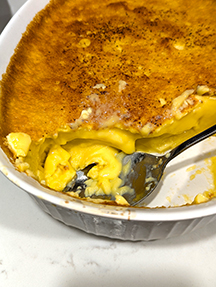
Custard
Here is ours, one of the thousands of variations of the same masterpiece. I should have specified that this whole time I’ve been referencing baked custard, not the various sauces, fillings, or frozen desserts that the term custard could also mean. We four moms all shared our recipes, so I’ll be happily working my way through our same-but-not versions. One batch in, and I’ve upped my egg ratio slightly to keep the cooled custard from becoming watery, and will whip half the egg whites when I’m feeling fancy for the top effect — it pays to learn from the other bests.
Prep tips: with such incredibly simple ingredients, it also pays to use quality. If possible for you, I strongly recommend local milk and farm eggs.
7 eggs
½-1 cup sugar (we do the lower range, but most like it a little sweeter)
a good ol’ splash vanilla
dash salt
5 cups hot milk
optional: freshly grated nutmeg
Set a 2-quart baking dish in a pan; pour 1” hot water into the pan.
Blend or beat eggs, sugar, vanilla, and salt. Gradually add milk, blending until smooth. Pour through a fine-mesh strainer into the baking dish, topping with nutmeg if desired. Bake at 425° for 5 minutes, then reduce heat to 325° for about 30 minutes until custard reaches 170° and is just set. I prefer to eat it chilled, although there’s usually a spoonful or two gone before it reaches the fridge.
Lettuce Eat Local is a weekly local foods column by Amanda Miller, who lives in rural Reno County on the family dairy farm with her husband and two small children. She seeks to help build connections through food with her community, the earth, and the God who created it all. Send feedback and recipe ideas to [email protected].
Wheat Scoop: Wheat Scoop: Kansas Agriculture Works Better Together
Contact: Marsha Boswell, [email protected]
For the audio version, visit kswheat.com.
At a round table in the Wheat’s On Your Mind studio at the Kansas Wheat Innovation Center, four Kansas commodity CEOs traded notes that sounded a lot like the conversations happening at kitchen tables across the state. They pulled back the curtain on how checkoffs work, why grower associations matter and how collaboration keeps Kansas agriculture relevant in a tough market.
Justin Gilpin of Kansas Wheat, Josh Roe of Kansas Corn, Caleb Little of Kansas Soybeans and Adam York of Kansas Grain Sorghum outlined the roles of Kansas commodity commissions and the separate, dues-funded associations that handle advocacy. The group walked through how farmer dollars support research, market development and education while associations carry out policy work in Washington, D.C. and Topeka.
They also compared Kansas’ realities with the I-states, pointing to different climate, infrastructure and biofuel dynamics. The conversation kept circling back to a Kansas advantage: farmers who raise multiple crops and organizations that plan together on markets, research and water.
That statewide perspective comes from working shoulder to shoulder.
“Whether it’s research at K-State or joint market development abroad, we’re all working toward the same mission: helping farmers succeed,” Gilpin said. “We face different challenges, but we share the same fields and communities.”
The CEOs highlighted the strength of Kansas research leadership, especially through Kansas State University’s College of Agriculture. From developing wheat varieties resistant to disease and drought to improving sorghum genetics through the Center for Sorghum Improvement, farmer-funded checkoff dollars are driving real results. Investments in research partnerships across K-State departments help create practical, farmer-focused innovation.
“Research is the long game, but it’s also the clearest return farmers can see from their checkoff,” Gilpin said. “Every new variety, pest study or efficiency breakthrough helps keep Kansas agriculture competitive.”
Still, short-term challenges remain. Commodity prices are down across the board while input costs stay high, tightening farm margins heading into 2026. The CEOs agreed that while farmers prefer markets over aid, short-term relief may be necessary until the new farm bill provisions take effect. Roe added that Kansas producers are facing gluts in corn and soybeans, while international trade slowdowns have hit sorghum and wheat exports.
“Farmers are survivors,” York said. “Getting through this next year means focusing on efficiency, maintaining markets and making sure policy decisions reflect Kansas reality.”
Each Kansas commodity group operates a farmer-elected checkoff commission that invests producer dollars back into research, education and market development. The Kansas Wheat Commission, established in 1957 through the Kansas Wheat Act, collects a state assessment of two cents per bushel of wheat sold. Those funds support programs like the Kansas Wheat Innovation Center, international trade through U.S. Wheat Associates and research collaborations at Kansas State University.
Similarly, all four Kansas commodity commissions are funded through checkoff collection at the first point of sale. These funds are used for promotion, research and market development; however, checkoff funds aren’t used for lobbying or political advocacy; the separate dues-funded grower associations handle those efforts.
Together, Kansas’ commodity groups are proving that collaboration is one of agriculture’s greatest strengths. Farmers don’t typically just grow just one commodity but include several of the four in their crop rotations. By aligning priorities such as research, market development and policy advocacy, these groups are ensuring that farmer investments generate real returns — not just in stronger crops, but in stronger communities. Even in a challenging market, Kansas agriculture continues to move forward with resilience, innovation and a shared commitment to the future.
Listen to the full episode and watch the studio video at WheatsOnYourMind.com or wherever you get your podcasts.
###
