Monday, February 2, 2026
Home Blog Page 4470

Horticulture Events

0

MANHATTAN, Kan. – K-State Research and Extension is offering these events, available to all interested persons. For more information about these, as well as more localized events, check with your local K-State Research and Extension office.

* March 16 – Plant Propagation and Production Planning – Kansas City, Kan. – www.growinggrowers.org

* March 20 – Regional Farmers’ Market Vendor Workshop – Olathe Registration site

* April 11 – Tree Festival – Wichita – 316-660-0138

* April 11 – Building and Managing Healthy Soils – Olathe – www.growinggrowers.org

* May 3 – Herb Day – Wichita – 316-660-0138

* May 11 – Small Farm Equipment and Drip Irrigation – Lawrence – www.growinggrowers.org

* May 28 Conservation Agriculture & Sustaining Soils – Lawrence – www.growinggrowers.org

* May 29-31 – Garden Tour – Wichita – 316-660-0138

* June 8 – Postharvest Handling – Lawrence – www.growinggrowers.org

* June 20 – Introduction to Tree Fruit Production – Kansas City, Mo. – www.growinggrowers.org

* July 13 – Equipment Maintenance – Kansas City, Mo. – www.growinggrowers.org

* July 25 – Tomato Day – Wichita – 316-660-0138

* July 25 – Insect, Disease, and Weed Management – Kansas City, Mo. www.growinggrowers.org

* August 3– Introduction to Cut Flowers – Kansas City, Mo. – www.growinggrowers.org

* August 10 – Field Day/Horticulture Research Update – Olathe – www.growinggrowers.org

* August 17 – Storage Crops – Baldwin City – www.growinggrowers.org

* September 5 – Farm Business Management – Kansas City, Mo. – www.growinggrowers.org

Specialty Crop Block grant applications period now open

0
CHRIS NEAL / THE CAPTIAL-JOURNAL

MANHATTAN, Kan.– The Kansas Department of Agriculture is now accepting applications for the 2015

Specialty Crop Block Grant program. Funds are awarded to the agency by the U.S. Department of Agriculture’s

Agricultural Marketing Service. The funds are in turn granted to projects and organizations that promote

specialty crops in Kansas.

The purpose of the specialty crop program is to enhance the competitiveness of specialty crops. Specialty crops

are defined by the USDA as “fruits, vegetables, tree nuts, dried fruits, horticulture, and nursery crops, including

floriculture.”  The advancement of these crops aligns with KDA’s mission of providing an environment that

promotes economic and agricultural growth in all aspects of the Kansas agricultural industry.

In 2014 Kansas received – $314,370.38 for the grant program. Kansas is expected to receive approximately the

same amount for 2015.

Applications will be evaluated by a team of external reviewers. The team will rate proposals on their ability to

successfully promote specialty crops in Kansas and make a positive impact on the Kansas economy, and submit

those recommendations to the Secretary of Agriculture, who will make the final awards.

Applications are due to KDA no later than May 15, 2015. For more information, and to download the 2015

application please visit www.agriculture.ks.gov/specialtycropblockgrant.

Kansas farmers, guests support families at ‘Meet the Makers’ event

0
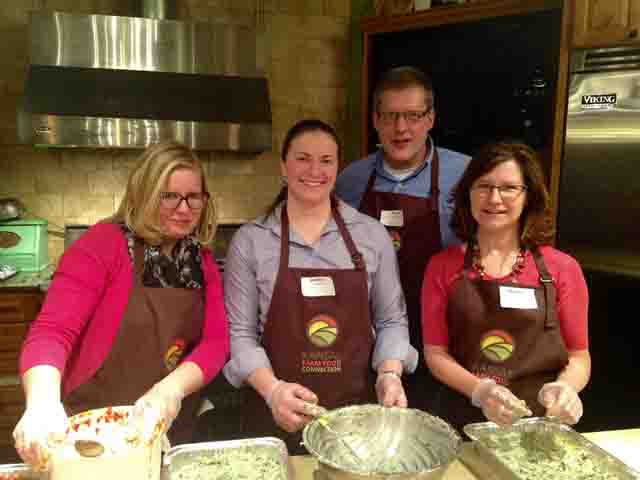
Annie Shultz, blogger at www.mamadweeb.com; Jennifer Heim, Kansas dairy farmer; Mary Jo Mason, registered dietitian for the Lawrence Hy-Vee; and Ron Grusenmeyer, Midwest Dairy Association; build a meal together during the Kansas Farm Food Connection “Meet the Makers” event. The event provided an opportunity for farmers and consumers to connect. “There’s a widening gap between farm and non-farm families today,” said Grusenmeyer. “We need to listen to consumers and share our stories with them.”
 Lance Rezac, Onaga farmer, talks with La’Shonda Woodard, blogger at www.fashionplatekc.com, while they prepare a meal together. The topic of genetically modified organisms (GMOs) was one topic of discussion.
Lance Rezac, Onaga farmer, talks with La’Shonda Woodard, blogger at www.fashionplatekc.com, while they prepare a meal together. The topic of genetically modified organisms (GMOs) was one topic of discussion.

Members of the Kansas Farm Food Connection (KFFC) gathered with dietitians and food bloggers at the Culinary Center of Overland Park, Kan., March 5 for an evening of good food and conversation.


KFFC hosted this “Meet the Makers” event to encourage an exchange of ideas between farmers and consumers.  Farmers at the event grow soybeans, sorghum and corn, and raise beef or dairy cattle on family farms.


“There’s a widening gap between farm and non-farm families today,” said Ron Grusenmeyer, regional director of industry relations at the Midwest Dairy Association. “We need to listen to consumers and share our stories with them.”


At the event, farmers and their guests worked together to prepare home-cooked meals for Ronald McDonald Charities of Kansas City, which serves 87 families a night.


The mission of Kansas Farm Food Connection is to share the exciting story of Kansas agriculture by connecting farms to families and families to farms to learn, eat and grow together. To learn more, visit http://www.raisingkansas.com or Facebook.

Bloggers, dieticians, and farmers prepared and enjoyed a meal together while sharing about their lives and discussing today’s current farming practices. The group prepared and provided 300 meals to the Ronald McDonald Charities of Kansas City.

Halstead to combine festivals

0

This summer the Halstead Brick Street Arts & Crafts Festival will be joining the Halstead Old Settlers Festival, which is Saturday, Aug. 8. To get involved, or for more information, please call (316) 641-3142.

Adding Organic Matter in the Spring

0

Organic matter is a good way to improve garden soil as it improves a heavy soil by bettering tilth, aeration and how quickly the soil absorbs water.  However, organic matter added in the spring should be well decomposed and finely shredded/ground.   Manures and compost should
have a good earthy smell without a hint of ammonia. Add a 2-inch layer of organic matter to the surface of the soil and work the materials into
the soil thoroughly.   Be sure soils are dry enough to work before
tilling as wet soils will produce clods.
To determine if a soil is too wet to work, grab a handful and squeeze. If water comes out, it is much too wet. Even if no water drips out, it still may not be dry enough to work. Push a finger into the soil you squeezed. If it crumbles, it is dry enough, but if your finger just leaves an indentation, more time is needed. Be sure to take your handfuls of soil from the depth you plan to work the soil because deeper soils may contain more moisture than the surface.  (Ward Upham)