
The city of Halstead now has a drop box to be used for discarding unwanted, unused or expired prescription or over-the-counter drugs.
Halstead police will be in charge of disposing of the medicine. The bright orange drop box is located in the alley between the fire station and City Hall.
Halstead now has drop box for unwanted medicine

Unbeaten Hesston girls basketball team recognized
The defending 3A state champion Hesston High girls were just featured on “Sports In Kansas” as one of the handful of undefeated teams remaining in the state. The Swathers are 20-0 and on a 35 game winning streak.
Visit these trout fishing hot spots
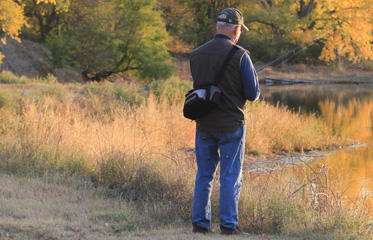
Kansas offers trout fishing at more than 30 public fishing lakes
PRATT – Winter weather may not be synonymous with fishing for most people, but the Kansas Department of Wildlife, Parks and Tourism offers anglers winter trout fishing opportunities that make putting up with the cold worth it.
Trout are stocked in select waters during the trout season, which is open through April 15. Anglers can try their luck at trout fishing in Type 1 waters, which require all anglers to possess a $12.50 trout permit, and in Type 2 waters, which require only those fishing for or possessing trout to purchase the permit. The $12.50 permit is valid for the calendar year and can be purchased wherever licenses are sold and online at ksoutdoors.com.
Trout fishing opportunities are available at the following lakes:
TYPE 1 LAKES: TROUT PERMITS REQUIRED OF ALL ANGLERS
- Cedar Bluff Stilling Basin
- Dodge City Lake Charles
- Ft. Scott Gun Park Lake
- Glen Elder State Park (SP) Pond
- Kanopolis Seep Stream
- KDOT East Lake in Wichita
- Lake Henry in Clinton SP
- Mined Land WA Unit #30
- Pratt Centennial Pond
- Walnut River Area in El Dorado SP
- Willow Lake at Tuttle Creek SP
- Webster Stilling Basin
- Sandsage Bison Range and WA Sandpits (Periodically Dry)
- Vic’s Lake and Slough Creek in Sedgwick County Park
- Topeka Auburndale Park
- Garnett Crystal Lake
TYPE 2 LAKES: TROUT PERMITS REQUIRED ONLY FOR TROUT ANGLERS
- Sherman County Smoky Gardens Lake
- Solomon River between Webster Reservoir and Rooks County #2 Road
- Ft. Riley Cameron Springs
- Lake Shawnee – Topeka
- Salina Lakewood Lake
- Moon Lake on Fort Riley
- Scott State Fishing Lake
- Scott State Park Pond
- Hutchinson Dillon Nature Center Pond
- Atchison City Lake # 1
- Belleville City Lake (Rocky Pond)
- Holton-Elkhorn Lake
- Syracuse Sam’s Pond
- Cimarron Grasslands Pits
- Colby Villa High Lake
- Great Bend Stone Lake
- Herington – Father Padilla Pond
TROUT Permit required year-round
- Cherokee County – Mined Land Wildlife Area No. 30
*Because trout survive through the summer here, a trout permit is required year-round for anglers utilizing the lake.
Residents 16-74 years old, and all non-residents 16 and older must also have a valid fishing license. The daily creel limit is five trout unless otherwise posted. Anglers 15 and younger may fish without a trout permit, but are limited to two trout per day, or they may purchase a permit and take five trout per day. Possession limit for trout is 15.
For information on trout stocking schedules, visit ksoutdoors.com and click “Fishing / Special Fishing Programs for You / Trout Fishing Program.”
Source: Kansas Department of Wildlife, Parks and Tourism
Hesston: 5 candidates going for 3 City Council spots

One member of the Hesston City Council is running for re-election, but two of them have decided to let their terms expire. There are a total of five candidates running for the three positions on the council.
UNL study characterizes genetic resistance to wheat disease

Lincoln, Neb., Feb. 26, 2015 — A new study co-authored by University of Nebraska-Lincoln researchers has unearthed the genetic roots of resistance to a wheat disease that has recently devastated crop yields from southern Africa through the Middle East.
Though reports of stem rust date back to biblical plagues and ancient Greece, plant breeders successfully combated the disease by introducing rust-resistant cultivars in the mid-20th century. Stem rust epidemics largely faded until 1999, when a mutated strain — Ug99 — emerged in the east African country of Uganda.
Ug99 and its recent variants have toppled nearly all previously resistant genes. The rare holdouts include Sr2, found in an especially hardy wheat variety named Gage that was co-released by the University of Nebraska and the U.S. Department of Agriculture in 1963.
The recently published study isolated and examined DNA sequences of Gage to ascertain why it enjoys greater resistance to stem rust, including Ug99, than other cultivars featuring the Sr2 gene. The authors concluded that Gage’s rust-resistance during adulthood likely owes to a combination of Sr2 and an additional gene, which the team believes also contributes to the wheat’s resistance in the seedling stage of its development.
The researchers have narrowed down the location and potential identity of this additional gene, which they said they hope to soon verify through further study.
:It so happens that the source of Sr2 that was used to create Gage — the variety Hope — actually had a number of other stem rust resistance genes in it,” said P. Stephen Baenziger, a co-author and the Nebraska Wheat Growers Presidential Chair at UNL. “Our results would say that it looks like Gage got the lucky straw, so to speak, from Hope.
“If it’s a two-gene resistance, then it should be more durable. Let’s say you have a mutation that allows something to become virulent to your gene one in a million times. When you have two genes, the idea would be that a mutation that overcomes both genes happens only once in a million multiplied by a million.”
Drawing a genetic map to that level of resistance could prove extremely valuable against Ug99, which has raced down the Nile River valley to threaten some of the most fertile areas of the Middle East and west Asia.
The wealthiest African farmers fight Ug99 with fungicides, which introduce foreign chemicals into the environment. Yet most farmers in the affected regions cannot afford these fungicides, leaving them little defense against the ravages of the mutated strain, according to Baenziger.
“It’s already crossed over into the Arabian Peninsula. It’s spreading now toward Pakistan, Afghanistan and India, which are the real breadbaskets for that part of Asia,” Baenziger said.
“It’s important to understand the resistance to stem rust, because with the mutations that are coming out of Africa, we’re losing genes all the time. But Sr2 is still resistant to it, and now that we can associate parts of the genome with the resistance, we’re making good progress.”
The team’s study appeared in the January-February edition of the journal Crop Science. Baenziger’s UNL co-authors included Tadele Kumssa, postdoctoral researcher at the Center for Plant Science Innovation, along with postdoctoral researcher Mary Guttieri, professor Ismail Dweikat and assistant professor Aaron Lorenz, all with the Department of Agronomy and Horticulture. Researchers from the USDA Agricultural Research Service, University of Minnesota, North Carolina State University and Kansas State University also contributed to the study.
WRITER: Scott Schrage, University Communications
