Tuesday, January 27, 2026
Home Blog Page 4550

Improve Farm Value Through Forestry Management

0
Photo credit: Nicholas A. Tonelli

Landowners should consider the benefits of windbreaks and properly managing woodlands for economic gains.

MANHATTAN, Kan. – A farmer knows where to find his cow herd at various times of the day, which is helpful as he goes out to feed, count and check on them this time of year in the early spring calving season. Typically the cows tend to huddle near a stretch of trees to block the wind and keep warm.

Flash forward a few months, and the same farmer evaluates his corn with gratitude, as another row of trees along this field prevented strong spring winds from damaging his crop.

Healthy trees—including those in windbreaks and woodland areas—can add more economic value to land than most farmers might realize, said Bob Atchison, rural forestry leader for the Kansas Forest Service.

Assessing windbreaks

Kansas windbreaks, also known as shelterbelts, offer a variety of benefits to Kansas farmers, Atchison said. Windbreaks can help farmers increase crop yields up to 23 percent, improve calving survival, save 13 percent on feed bills and reduce energy costs around the farmstead by 25 percent. Additionally, windbreaks provide wildlife habitat, sources of fuel and forage, and recreational opportunities.

Following the Dust Bowl, windbreak planting occurred mostly in central Kansas, he said, and a majority of windbreaks in the state are believed to be in the central and western areas. It remains undocumented scientifically where windbreaks are located, however, which brought on the need for a windbreak assessment (http://link.springer.com/article/10.1007/s10457-014-9731-4) for the state, in which Atchison took part.

“The assessment in the Kansas Smoky Hill region found 69 percent of (windbreaks) in good condition, with 31 percent in fair to poor condition and in need of renovation,” Atchison said. “The study took place in Wallace, Logan, Gove, Trego, Ellis, Russell and Ellsworth counties using a process called remote sensing.”

Remote sensing uses computer software and aerial photographs from the National Agricultural Imagery Program to identify the location of the windbreaks in a particular region, he said. Following the remote sensing process, Kansas Forest Service foresters assessed a percentage of the windbreaks on the ground to collect a variety of information on condition, size and species.

“This important information helps our foresters focus their resources and efforts where they can be most effective to sustain this valuable natural resource,” Atchison said.

The windbreak assessment found that in the Smoky Hill region, Ellis County had the largest number of windbreaks at 769, followed by Gove with 645. Average length of the windbreaks was about 900 feet, and the most common trees found were eastern red cedar, pines (Austrian, Ponderosa, Scotch), Siberian elm, honey locust and Osage orange.

Forty-five percent of the windbreaks protected crop fields, according to the assessment, with 37 percent protecting farmsteads and 18 percent protecting livestock. More than half the windbreaks contained a single species, most commonly eastern red cedar, and Ellsworth and Gove counties had the healthiest windbreaks in the study area.

In general, windbreaks in the Smoky Hill region were younger than those assessed in seven additional counties in southwest Kansas that included Ford, Clark, Gray, Haskell, Hodgeman, Meade and Seward.

Atchison said Kansas Forest Service foresters plan to work with local conservation districts to ask landowners to consider renovating their old windbreaks and also think about possible locations for new ones.

Managing woodlands

Most Kansas farmers don’t consider themselves “woodland owners,” and woodland areas on farms often get little attention, Atchison said. One reason might be that managing woodlands in Kansas can be confusing.

“Farmers might ask themselves, ‘Where do trees belong?’ or ‘How can these trees increase the economic value of a farming operation?’” Atchison said. “Well-managed woodlands can contribute to the overall economic value of a farming operation and provide a place for our children and grandchildren to experience wildlife, the beauty of the natural world and many other benefits.”

He said preliminary data from the 2011-2013 U.S. Forest Service National Woodland Owner Survey estimates 62,000 Kansas farmers own at total of 2.1 million woodland acres. The majority of these woodlands occur in small patches of 40 acres or less.

Atchison recommends farmers and other landowners who own patches of woodland areas to contact the Kansas Forest Service and visit with a professional forester about ways to improve land value. Some possible ways include harvesting timber, removing invasive trees and plants, planting trees beside streams to stabilize stream banks, and renovating old windbreaks and planting new ones to improve crop yields and reduce windblown soil.

Also, establishing pecan, black walnut and Christmas tree plantations can add even more value for landowners, he said.

In addition to the Kansas Forest Service, the Kansas Tree Farm Program, Kansas Forestry Association, Walnut Council, Kansas Christmas Tree Growers and Kansas Nut Growers are all important groups that can help landowners diversify income and increase overall value, Atchison said.

Visit www.kansasforests.org for information on how to contact these groups, or call 785-532-3300.

Barton women bounce back to thump Dodge City 74-55

0

Bouncing back from a disappointing loss on Saturday, the Barton Community College women pulled away for a sixteen point halftime lead Wednesday night at the Barton Gym cruising to a 74-55 win over Dodge City Community College.  Outrebounding the Lady Conquistadors by twenty-eight in the team’s earlier meeting in Dodge City, Barton again dominated the boards this time by twenty while also holding Dodge City to thirty-four percent from the field.  The victory gets Barton back to .500 in conference play at 5-5 and 15-7 on the season while Dodge City drops its seventh straight in falling to 1-9 and 10-14 on the season.  Barton will next play at 5:30 p.m. Saturday at Garden City Community College before a quick turnaround to face Butler Community College at the Barton Gym on Monday.

Setting a career high in the first meeting at Dodge City, Indiah Cauley surpassed her career high scoring nineteen points on 8-of-12 shooting from the field and led Barton in steals with four.  Joining Cauley in double figures were the nineteen points off the bench from Phikala Anthony and McKinna Kraus tying a career high with eleven points.  Kraus and Ciera Lampe both set career highs in rebounding as the duo tied Anthony for team high honors grabbing eight boards each.  Point guard Dominique Baker also set a new career high dishing out seven dimes as the Lady Cougars had fourteen assists on twenty-eight field goals.

Fourteen points off the bench for Antania Newton was the lone Lady Conquistadors to reach double-figures.  Alejandra Esparza led Dodge City in rebounding with eight while Newton’s two assists was a team high.  The Lady Conquistadors’ leading scorer and ranked fourth in the Jayhawk West, Azaria Nave was held to 3-of-10 from the field for only seven points well below her 16.2 average.

Kansas Profile – Now That’s Rural – Deanna Munson – Munson’s Prime

0
kksu
K-State Research and Extension, Candice Shoemaker

By Ron Wilson, director of the Huck Boyd National Institute for Rural Development at Kansas State University.

It’s time to name the Grand Champion at the American Royal. And here it is! But this isn’t the grand champion steer, it is the grand champion steak. The American Royal has wisely started to honor a top quality end product, in the form of a steak, as well as the traditional grand champion steer. The Grand Champion steak for 2013 is from the Munson Angus farm near Junction City, Kansas. The Munson family are high quality beef producers and innovators in marketing their product all the way to the consumer.

Deanna and Chuck Munson are owners of the Munson Angus farm and a new restaurant, Munson’s Prime, in Junction City. Counting their grandchildren, there have been six generations of the Munson family in Geary County going back to the 1870s. In 1924, they started breeding Angus cattle for their superior meat production and quality.

Charles and Deanna and son David now operate some 200 Angus cows and 2,000 acres of pasture plus 3,000 acres of crop ground. Friends and neighbors started buying Munson beef directly from the farm and then the Munsons opened a retail outlet for fresh beef in Junction City. One constant through all the years had been the hearty meals prepared for family and farmworkers each day, and those could be marketed to others too. The Munsons discussed trying to get all their enterprises under one roof.

Meanwhile, a Munson steak was entered in the competition at the American Royal. The purpose of this competition is to identify the best tasting steak in America. The winner, based on a sensory lab and trained judges, was the steak from Munsons.

In January 2014, the Munsons bought a closed restaurant building located near I-70 in Junction City, gutted the entire building and started over. The result is a beautiful building with native stone, attractive wood, comfortable leather chairs up front, digital photo displays, and lots of seating.

The restaurant is called Munson’s Prime. It includes a retail store plus a restaurant with hearty farm and ranch meals offered for lunch, plus a bar and grill and a steakhouse which is open Thursday through Sunday nights plus midday on weekends. It even has a drive thru.

Years before, Deanna Munson served on the Geary County Fair Board and volunteered to make homemade ice cream to sell at the fair as a fundraiser. “I made 65 gallons using borrowed freezers from all the neighbors and every sink in my house,” Deanna said. It was a huge success, but it was so much work that Deanna vowed never to do it again.

At the state fair, Deanna saw a wagon carrying two ice cream freezers selling ice cream. The Munsons ended up buying an ice cream wagon like that which they then used at the county fair.

Then the Munsons saw a larger, stationary ice cream machine while visiting Silver Dollar City. It inspired them to put a similar machine in their new restaurant, Munson’s Prime. Every piece of this new, ten-foot tall ice cream machine was built by the Munson farm crew in their farm shop.  It includes four five-gallon ice cream freezers set in attractive metalwork complete with pulleys turning belts. It’s a whole lot easier than making it by hand, but they still use the original recipe of Deanna’s grandmother with locally-grown Jersey milk.

In addition to Munson beef and homemade ice cream, the menu features as many other locally-grown products as the Munsons can find. This supports local and rural growers. One man is raising an entire garden to supply Munson’s Prime next year. Sweet corn, for example, comes from a farmer near the rural community of Tampa, population 112 people. Now, that’s rural.

For more information, go to Munson’s Prime.

It’s time to leave the American Royal, where a steak from Munsons was named Grand Champion. Now that beef is available through a retail store and restaurant in Junction City. We commend Deanna and Charles Munson and family for making a difference in their marketing of beef. I think the way they champion the beef industry is grand.

Easy, Delicious Meals that Make Hearts Happy

0

(Family Features) Did you know that small, positive additions to your diet and lifestyle can help promote a healthier heart? Instead of denying yourself the delicious flavors you crave, try weaving a few subtle changes into your menu and you can healthfully and conveniently meet your wellness goals.


Show your heart some love

Besides giving meals a satisfying boost, soy-based foods are a heart-healthy addition to your diet. According to the U.S. Food and Drug Administration (FDA), a diet containing 25 grams of soy protein per day, accompanying other foods that are low in saturated fats and cholesterol, may decrease the chance of heart disease.


“Soy protein is a very high quality protein, equivalent to egg or milk protein,” said Mindy Kurzer, Ph.D. and professor with the Department of Food Science and Nutrition at the University of Minnesota. “Soyfoods, such as soymilk, have been shown to lower dietary cholesterol and saturated fat, decreasing blood cholesterol concentrations and improving heart health.”


Sprinkle soy into your diet, easily

Available in many delicious forms, soy-based foods and beverages make the swap towards healthier options a snap. Try some of these meal ideas to help you cut calories, saturated fat and cholesterol from your diet:


  • Breakfast: Take on the day by enjoying a fruit and soymilk blended smoothie for breakfast. Soymilk is the only plant-based dairy alternative with an average of 7 grams of protein per serving plus calcium, potassium, and vitamins A and D.


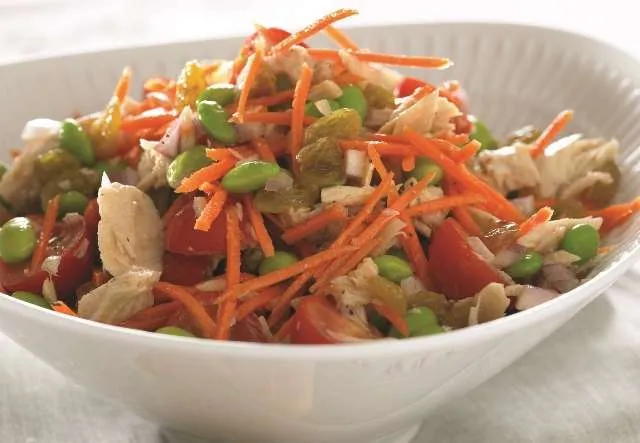
  • Lunch: Opt for a juicy veggie burger – easy to cook in just a few minutes. Or try this flavorful recipe for Tuna Edamame Salad, which allows you to take in all the healthy benefits of these young green soybeans with a quick and easy lunch. Did you know one cup of edamame contains 17 grams of protein?


  • Snack: Throw a protein-packed nutrition bar in your car, bag or purse so you can have a healthy snack while running errands. (But read the label to make sure it contains soy protein and isn’t loaded with sugar.)


  • Dinner: Load up on vegetables and protein with a tasty and easy stir fry using marinated tofu strips. Or cholesterol-free soy “crumbles” can quickly and easily be added to favorites including pasta sauce, soup, chili and tacos.


To find more recipes featuring soy protein, visit www.soyfoods.org or www.soyconnection.com.


Tuna Edamame Salad

Prep time: 5 minutes

Servings: 4


1          cup frozen shelled edamame, cooked according to package directions

1          cup cherry tomatoes, cut in half

1          cup carrots, shredded

1          can (6 ounces) tuna, water packed, drained

1/2       cup golden raisins

1/4       cup red onion, diced

1/4       cup bottled, reduced-fat Italian salad dressing

Pita bread or whole grain crackers (optional)


Mix edamame, tomatoes, carrots, tuna, raisins and onion in medium bowl. Pour dressing over salad and toss until combined. Serve with pita bread halves or whole grain crackers.


Nutrition per 1 cup serving: 210 calories; 3 g fat (0 g saturated fat); 16 g protein; 27 g carbohydrate; 4 g fiber; 25 mg cholesterol; 350 mg sodium.

Source: Soyfoods Association of North America


A Mediterranean Menu for Outdoor Entertaining – Opa!

0

(Family Features) When al fresco entertaining calls for some flavorful inspiration, look to the fresh and abundant offerings of Mediterranean cuisine.


Inspired by its coastal origins, traditional Greek dishes feature a colorful collection of fruits, vegetables, grains, legumes and grilled fare. Whether you’re serving friends with a themed event or simply enjoying a homemade meal with the family, delicious Greek cuisine is perfect for sharing with those you love.


From raw to roasted, pickled to caramelized, the onion is one of the most versatile vegetables, and is commonly found among the many fresh flavors of this fare. Plus, when you cook with the mighty onion, you’re serving up a good source of vitamin C.


The growers and shippers of the Idaho-Eastern Oregon Onion Committee and the National Onion Association offer the following tips about onions:

  • One large onion, diced equals about 1 cup fresh and 1/4 cup cooked.
  • Grill and saute onions over low to medium heat. This will bring out a savory, sweet, mellow flavor. High heat can cause the onion to taste bitter.
  • Store onions in a cool, dry, well-ventilated place with minimal exposure to light.
  • Keep peeled and cut onions in a sealed container in the refrigerator for seven to 10 days.


For more tips and ideas to add flavor to your outdoor celebrations, visit www.onions-usa.org and www.usaonions.com.


Turkey and Onion Meatball Kebabs with Yogurt Dipping SauceTurkey and Onion Meatball Kebabs with Yogurt Dipping Sauce

Servings: 6 large or 9 small kebabs

1          tablespoon cumin seed

1          cup plain yogurt

1          tablespoon chopped cilantro

1          tablespoon chopped chives

3/4       teaspoon honey

1/4       teaspoon salt

1          pound ground turkey

3          cloves garlic, chopped

2          teaspoons lemon zest

1/4       teaspoon kosher salt

1/4       teaspoon cayenne pepper

1          large yellow onion, peeled and cut in thin wedges

1          green pepper, cut into 1-inch dices

12        cherry tomatoes


Heat small pan over medium heat. Add cumin seeds to toast. Stir frequently, for about 3 minutes or until seeds are fragrant and slightly browned. Remove seeds to spice grinder or mortar and pestle; grind to moderately fine powder.


In medium bowl, combine yogurt, cilantro, chives, honey, salt and 1 teaspoon ground toasted cumin. Cover and refrigerate at least 1 hour.


In second medium bowl, combine turkey, garlic, lemon zest, salt, cayenne and 1 teaspoon ground toasted cumin; mix gently but thoroughly. Shape into eighteen 1 1/2-inch meatballs.


Preheat grill. On metal skewers (or bamboo skewers soaked in water 30 minutes), thread meatball, onion wedge, pepper square and cherry tomato. Repeat. Finish skewer with another meatball and onion wedge.


Grill until meatballs reach internal temperature of 160°F, turning as needed. Serve immediately with dipping sauce.


For mini-skewers, use 2 meatballs, 2 onion wedges, 1 cherry tomato and 1 pepper square on each skewer.


Lentil Salad with Marinated Onions, Roasted Tomatoes and OlivesLentil Salad with Marinated Onions, Roasted Tomatoes and Olives

Servings: 6–8

2–3      medium tomatoes cut into eight wedges

1          (9.5-ounce) jar whole, pitted Greek olives, drained

4          tablespoons extra-virgin olive oil

1          tablespoon balsamic vinegar

8          thyme sprigs, leaves removed

Sea salt

1 1/3    cups lentils

1/2       medium red onion, thinly sliced

1 1/2    tablespoons red wine vinegar

2          garlic cloves, pressed

1          medium cucumber, chopped

1          (12-ounce) jar artichoke hearts, sliced

1/4       cup parsley, chopped

3          tablespoons chives, chopped

2/3       cup crumbled feta

1          tablespoon lemon juice

Fresh ground black pepper


Preheat oven to 400°F. On medium-sized baking sheet lined with parchment paper, arrange tomatoes skin side down. Add drained olives to pan; drizzle with 1 tablespoon olive oil and balsamic vinegar. Sprinkle with thyme leaves and sea salt. Roast for 20 minutes. Remove from oven and cool completely.


Cook lentils according to package directions, approximately 20 minutes.


While lentils are cooking, place red onion in small bowl. Pour red wine vinegar over onions and sprinkle with sea salt. Stir and let stand at room temperature while lentils are cooking.


When lentils finish cooking, drain if needed. In large bowl combine lentils, marinated red onion, garlic and remaining olive oil. Mix well and cool completely. When cool, combine rest of ingredients with lentils. Serve cold.


Orange, Mint and Onion SaladOrange, Mint and Onion Salad

Servings: 6

3          navel oranges

1/2       sweet yellow onion, peeled and thinly sliced

1/4       cup fresh mint leaves, torn

1/4       cup black olives, oil cured, pitted

Vinaigrette:

1/3       cup cider vinegar

2          tablespoons honey

2          teaspoons Dijon mustard

1/2       teaspoon ground cinnamon

1/2       teaspoon salt

1/4       cup canola oil


For salad, cut top and bottom off each orange so it sits flat on cutting surface. Remove peel and pith (white part) by taking sharp knife and running it down sides of orange from top to bottom, following shape of each orange. Slice oranges into rounds.


Arrange slices, overlapping each other slightly, on large platter. Scatter onion, mint and olives over oranges.


For vinaigrette, whisk vinegar with honey, mustard, cinnamon and salt. Slowly add oil while whisking constantly, until well combined.


Drizzle vinaigrette over salad and serve immediately.


Note: Any leftover dressing can be stored, tightly covered, in refrigerator for up to 5 days.

Source: Idaho-Eastern Oregon Onion Committee and the National Onion Association