

Monday, January 26, 2026
Home Blog Page 4561

Program Provides Free Access To Tax Prep Software

0

(NAPS)—There’s good news for taxpayers looking for a safe way to save money at tax time.

Thanks to a public-private partnership between the IRS and a coalition of industry-leading tax software companies, there’s a program that provides qualified taxpayers with free, online, name-brand tax preparation software products.

Called the IRS Free File program, it’s designed to make tax time easier by walking taxpayers who qualify through the filing process online and ensuring that they capture all the credits and deductions they deserve. To take advantage of the program, taxpayers must have an adjusted gross income of $60,000 or less.

By using the program, eligible taxpayers can easily and accurately complete their federal tax return with trusted name-brand tax preparation software products.

Since its creation in 2003, the Free File program has donated 40 million federal tax returns. That translates to a total savings for taxpayers of more than $1.3 billion in tax preparation costs donated. Approximately 70 percent of U.S. taxpayers are eligible for the Free File program.

The Power Of Technology

Ed Black, president and CEO of the Computer & Communications Industry Association (CCIA), said that the Free File program is a great example of the power of technology to improve the lives of all Americans. Black added that CCIA is proud to support Free File and will be working this year to help ensure all eligible taxpayers are aware of this “important program.”

Additionally, 20 states plus the District of Columbia sponsor a state-level Free File program, allowing eligible residents to easily and accurately complete both their federal and state taxes for free.

For more information, visit the websites at www.irs.gov/freefile and www.taxprephelp.org.


Thanks to a public-private partnership, eligible taxpayers can have free access to name-brand tax preparation software products when filing their federal taxes.
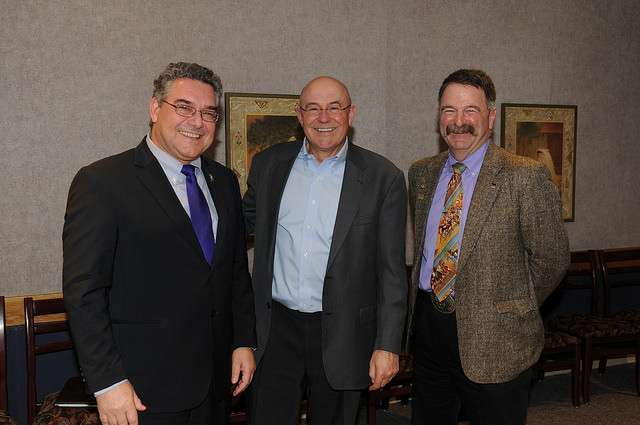
Mitigating Global Challenges Focus of Inaugural Henry C. Gardiner Lecture

0
Pictured (l to r): John Floros, dean of the College of Agriculture, Robert Fraley, Monsanto Company, and Mark Gardiner, son of Henry C. Gardiner.

Monsanto Executive and 2013 World Food Prize Recipient Addresses Food Security

MANHATTAN, Kan. — In the next 35 years, farmers will have to produce more food than the world has produced in its history, a challenge some are calling the greatest challenge we’ve ever faced. However daunting it may seem, Robert Fraley is optimistic.

Fraley, the executive vice president and chief technology officer for Monsanto Company who was part of a team of scientists to first genetically modify plants, spoke at the inaugural Henry C. Gardiner Lecture at Kansas State University on Monday. Fraley addressed the challenges facing agriculture in the coming decades and the resources needed to achieve food security.

“What excites me is a world in which we are smart about our innovation and take a bold step forward and use science,” Fraley told the packed audience at McCain Auditorium.

Farmers, which account for less than 1 percent of the population, are expected to feed more than 9 billion people by 2050, while facing limited resources and changing climate conditions. Despite the challenges that lie ahead, Fraley points out that the agricultural industry has already made advances in increasing production because of two major breakthrough areas: biology and information technology.
Technology Changes Crop Production

“I know I’m expected to say genetically modified organisms are the answer to everything, but I think the most remarkable story is how our technology has changed the way we produce crops,” Fraley said.

That technology now enables easier and more extensive management of fields and advances in biology change how scientists breed crops. Fraley says accessibility to technology also is changing the game for smallholder farmers, which account for more than 90 percent of agricultural production. In India, seven out of 10 farmers now have a cellphone, which Fraley says is a tool that gives them access to markets, credit and agronomic information.

However, he doesn’t leave GMOs out of the equation for feeding a larger population. Fraley points out that these organisms, designed to withstand factors like climate and pests, have been consumed for 20 years and every major scientific body and regulatory agency in the world has concluded GMO products are safe. He says the misunderstanding about their safety comes from lack of scientific education for the general public.

“The biggest mistake Monsanto made was they were excited about the product and spent all their time talking to farmers and didn’t talk to the public,” Fraley said. “The combination of complexity and misinformation was never addressed, and now Monsanto is trying to do a better job of directly informing the consumer about these products because people want to know where their food comes from.”

However, education about farming practices is not only a job for Monsanto, Fraley said. He encouraged the audience— filled with students, farmers and the general public— to educate the other 99 percent of the population not involved in farming.

About 1,000 people attended the first Henry C. Gardiner lecture, established in honor of the Kansas State University graduate who was a visionary leader in the U.S. cattle industry. The purpose of the lecture series is to bring leaders in the global food systems from throughout the world to present their views and provide a forum for open discussion.

“As the first lecture in the series, it was a spectacular success,” said John Floros, dean of the College of Agriculture. “The presentation was in depth where it needed to be but broad enough that anyone can understand these agricultural issues. The questions from the audience were tough but thoughtful and Fraley did a good job answering those questions respectfully. I hope to follow up next year with another speaker as compelling.”

Use a Planting Calendar

0

If you start vegetable plants indoors, it is often helpful to list seeding dates on a calendar so that plants are ready for transplanting at the proper time.
To do this, choose your transplant date and count back the number of weeks necessary to grow your own transplants. For example, cabbage, broccoli, and cauliflower are usually transplanted in late March to early April. It takes 8 weeks from seeding to transplant size. Plants should be seeded in early February. Information on how many weeks it takes to grow transplants is available in our January 6 newsletter at http://www.hfrr.ksu.edu/doc4036.ashx .

Below are examples of some common vegetables grown for transplants and a recommended date for seeding.  Dates are Saturdays as this is when many homeowners have the most free time. The dates are not set in stone, and a week earlier or later will not ruin the plants. Also, you may want to seed a week or two earlier if you are in southern Kansas and possibly a week later if you are in northern Kansas. Keep notes on how well the transplants did so you can tweak the planting schedule. Your conditions may result in plants that need a bit more or a bit less time. (Ward Upham)

Seeding         Transplant
Crop                     Date          Date
Cabbage, Broccoli
& Cauliflower       February 7        April 4

Lettuce  (if you
grow transplants)  February 7         April 4

Peppers                 March 21         May 16
Tomatoes              March 28         May 9

Local Seed Sources
A couple of weeks ago, we asked for anyone selling seeds in Kansas to contact us with their information.  Following are the companies who provided that information.

Clinton Parkway Nursery
4900 Clinton Parkway (corner of Clinton Parkway & Wakarusa) Phone Number: (785)842-3081
E-mail: [email protected]
In store sales only.
Prepackaged seed only: pre-packaged Renee’s Garden.
Transplants: …a wide variety and assorted sizes!

Jackson’s Greenhouse & Garden Center, Inc.
1933 NW Lower Silver Lake Road
Topeka, KS 66608
785-232-3416  fax 785-233-6348
www.jacksonsgreenhouse.com
[email protected]
We have 60+varieties of tomatoes, 60+varieties peppers, much more.

Seeds from Italy
PO box 3908
Lawrence, KS 66046
Phone: 785-748-0959
Fax:   785-748-0609
Web site: www.growitalian.com

Skinner Garden Store, Inc.
4237 NW Lower Silver Lake Road
Topeka, KS 66618
785-233-9657
[email protected]
www.skinnergardenstore.com
In store sales only.
Everything we sell is prepackaged, but we can special order many thing in larger quantities.
We sell all kinds of transplants.

(Ward Upham)

Plants Recommended for Kansas

0
Photo credit: Rachel Kramer

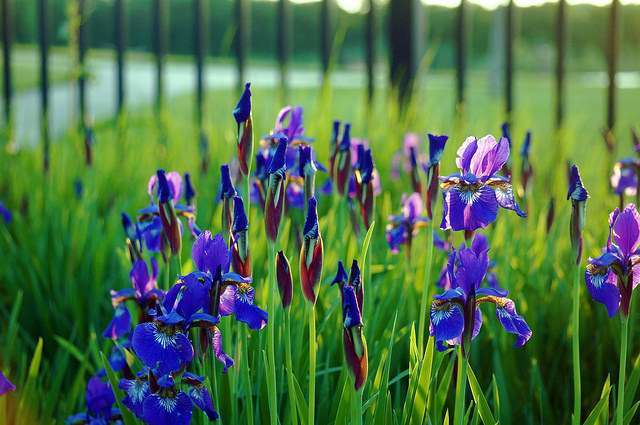
If you have had trouble finding a listing of plants recommended for Kansas, visit our web page devoted to this topic. We have links to a wide variety of plants including annual flowers, perennial flowers (including breakouts for iris and daylilies), fruit, vegetables, turfgrass, low-maintenance roses and tree recommendations that are broken out by areas of the state. We also list recommended low water use plants. You can find this page at:
http://www.hfrr.ksu.edu/p.aspx?tabid=731
We also have images of hundreds of the following:
Varieties of iris and daylilies found in the University Gardens Collection Gardens at http://www.ksre.ksu.edu/ksugardens/p.aspx?tabid=38
Annual flowers recommended for Kansas at http://www.prairiestarflowers.com/Prairie_Star_nav.html
Perennial flowers at
http://www.prairiestarflowers.com/Prairie_Bloom_nav.html
(Ward Upham)

No. 4 Butler handles Seward 82-58 to move to 21-0 on the season

0

credit – Butler CC

EL DORADO, Kan. – The Butler men now own the program’s longest winning streak in more than 70 years as No. 4 Butler defeated Seward County 82-58 on Saturday at the Power Plant.

It is the 21st straight win for Butler to start the season, surpassing the 20-game winning streak put together by the 1993-94 Butler men. It is second only behind the 40-game winning streak put together by Butler teams over three seasons from 1941 to 1945.

In addition to being 21-0 overall, the Grizzlies are also 7-0 in Jayhawk West Conference action continuing to hold on to first place by a game over second-place Barton.

There was little drama in game against Seward, who matched its season low of 58 points. Both teams started slowly, as the score was just 5-5 nearly seven minutes into the contest. Eventually, the Grizzlies heated up as Robert Joiner hit a 3-pointer to give Butler the lead for good at 10-7 with 10:03 to play in the half.

A Caelan Neal steal and layup capped an 8-0 run as the Grizzlies doubled up Seward 20-10 with 7:41 to go in the period. Travis House would later hit a 3-pointer as Butler led 32-16 with 3:08 to play and the Grizzlies went into halftime leading 36-20.

The Grizzlies cruised through the second half. Butler’s biggest lead was 28 points after a Jacolby Harris free throw with eight minutes to go. The Saints would get back within 16 points with before Butler finished off the victory, winning by 24.

Kyle Steward led Butler with 18 points while Chris Howell had 17, making 7-of-10 free throws. Jacolby Harris and Lamar Wofford had 10 points apiece. Wofford also had 11 rebounds to mark a double-double, giving him five on the season. All but one of Butler’s 11 players scored in the win.

The Grizzlies shot 52 percent from the floor (28-of-54) and made six 3-pointers. Butler also outrebounded Seward 43-23.

The Grizzlies now go on the road for a pair of conference games, as they will play at Dodge City on Wednesday and at Garden City on Saturday. Wednesday’s tipoff against the Conquistadors from the Dodge City Civic Center is at 7:30 p.m.