Saturday, January 24, 2026
Home Blog Page 4596

Finding Best Ways to Safeguard Beef Production in Changing Climate

0

MANHATTAN, Kan. — Under a bright blue, fall Oklahoma sky in a serene setting, cattle are doing what cattle do – quietly moving through a pasture looking for the next best thing to eat. As they graze, instruments are recording how much methane they are producing.

Sporting collars equipped with GPS tracking devices, these beef cattle are part of a sweeping five-year study led by Kansas State University to better understand beef production vulnerability across the southern Great Plains in the face of climate change.

The goal, said K-State agronomy professor Dan Devlin, is to increase the resiliency of beef cattle operations on grazing lands and wheat pasture so producers can better sustain future productivity through potential climate changes. As part of the work, researchers are also looking for the best ways to reduce beef production’s environmental footprint. That includes finding the most efficient ways to use water, best grazing practices, best forages and improving soil and water quality. Communicating the study’s findings to beef producers is another component of the project.

Forty-six scientists from K-State, the University of Oklahoma, Oklahoma State University, Tarleton State University, the Samuel Roberts Noble Foundation and the U.S. Department of Agriculture’s Agricultural Research Service are working on the five-year project. They represent several disciplines, including computer specialists, animal scientists, social scientists and agronomists. Funding for the project came from the USDA National Institute for Food and Agriculture’s Agriculture and Food Research Initiative.

The team is into its second year of work on the $9.6 million, five-year project, formally titled Resilience and Vulnerability of Beef Cattle Production in the Southern Great Plains Under Changing Climate, Land Use and Markets.

The study is wide ranging, with social scientists working to determine producers’ and cooperative extension educators’ perceptions and attitudes about climate change and economists assessing its economic impact on the region. Extension specialists on the research team are focusing on a dialogue on resilience as the climate changes, communication to producers about the research and collecting data from producers.

The grazing research is being conducted on cattle and pastures near El Reno, Oklahoma.

“A couple of years ago we (K-State) did focus groups that included town leaders and farmers in a number of communities,” said Devlin who is the director of the Kansas Center for Agriculture and the Environment at K-State. “Almost all thought the climate has changed and are concerned.”

But people are also concerned that they will be forced into taking certain actions, which can influence attitudes about climate change in general, he said.

Why the southern Plains?

“Beef cattle raised on pasture, rangeland forages, and winter wheat in the southern Great Plains provide a significant portion of the nation’s red meat and makes up the largest land use and agricultural enterprise in the region,” Devlin said.

The number of cattle in Kansas, Oklahoma and Texas combined totaled 21.0 million of the total U.S. cattle herd of 87.7 million head as of Jan. 1, 2014, according to the USDA (http://www.usda.gov/nass/PUBS/TODAYRPT/catl0114.pdf).

The area is subject, however, to a variable climate. Drought, high winds and blizzards are part of living on the southern Plains.

The results of the research, Devlin said, should not only help beef producers manage their operations more effectively even as climate change is occurring, but also help ranchers prepare for and mitigate the effects of the periodic droughts that happen in the region. To that end, studies are underway on wheat grazing as well as cover crops, which can help manage soil moisture, soil fertility and erosion.

Technology’s role

Some cattle in the study have access to automated feeders called Greenfeeders. When an animal approaches, a computer chip in its collar signals the Greenfeeder which identifies the animal and also measures methane and carbon dioxide through its breath.

“One of the things we’re looking for is if there are genetic differences to determine if one breed produces more methane than another,” said Devlin, noting that the Greenfeeder technology was developed prior to the beginning of the study, but enhanced for this research.

Also, using atmospheric measurement devices called eddy correlation flux towers, researchers were able to establish baseline greenhouse gas production from the pastures being studied. In addition to studying pastures where cattle are grazing, pastures where no cattle are grazing are also being assessed to determine if methane is present unrelated to the animals. Those pastures include native tallgrass prairie in some and old world bluestem in others.

COSMOS (Cosmic-ray Soil Moisture Observing System) is a fairly new tool being used to measure soil moisture as part of the research. Rather than buried underground, it can be placed in the back of a vehicle and driven down county roads to map soil moisture along the way. By doing this, information can be gathered about soil moisture under cropland, as well as grassland.

Another part of the study has researchers in Texas studying animals that are indoors to determine how much methane they are emitting.

“We’ll feed the data being collected to a group that’s doing computer modeling,” Devlin said.

In the end, this new research will yield science-based information that producers and others can use to guide their own decisions, he added

credit: KSU

photo credit: Vicky Frank

Realizing the risks of radon

0

Credit: Kandace Fisher-McLean, MS, HHS, Housing and Environmental Design Specialist, St. Louis County, University of Missouri Extension

Radon is a radioactive gas that you cannot smell, see or taste. According to the National Cancer Institute, minimal levels of radon typically exist in all air. However, when radon is concentrated at high levels within the air of your home it can increase your chance of developing lung cancer when you breathe it in. The National Cancer Institute, the Environmental Protection Agency (EPA) and the Surgeon General caution that radon exposure is the second leading source of lung cancer in the United States behind cigarette smoking…

According to the EPA, radon gas is found everywhere in the United States and it is produced from the natural breakdown of uranium in soil, rock and water. Radon gas moves through the ground into the air and travels into your home through gaps, cracks and holes in the foundation. It can also enter through the water supply of your home. Once radon gas is in your home it can build up to dangerous levels. Approximately 1 out of every 15 homes in the United States has increased levels of radon.

January is National Radon Action Month and it’s a good time to have your home tested. Radon is problematic any time of the year but the EPA explains that radon levels can escalate during colder months because people spend more time inside with their windows closed.

For the steps you can take to test your home for radon, including how Missouri residents can obtain a free radon test kit, check out the full version of this article at http://missourifamilies.org/features/housingarticles/radon.htm 

Endive/Escarole

0
kksu
K-State Research and Extension, Candice Shoemaker

by: Scott Eckert, KSU County Extension Agent, Horticulture

Endive is a hardy, leafy vegetable similar to lettuce in growth habit and use. Endive has a crinkled leaf, while escarole has a broad, flat leaf. The flavor is stronger than lettuce, but both make an excellent addition to a mixed green salad.

Varieties – Endive varieties include Green Curled and Salad King. Escarole varieties include Broad Leaved Batavian, Florida Deep Heart, and Full Heart Batavian.

When to plant – These leafy green vegetables do not like hot weather and must be planted early in the spring for best results. Starting seedlings indoors and setting out transplants in early April is advisable. Direct seeding in mid-July or setting out transplants in early August is suitable for growing fall crops.

These leafy crops are hardy and can withstand freezes in the fall. Like most leafy greens, they require consistent watering and are fairly shallow rooted. They also require fairly rich or well-fertilized soil.

Harvest – Cut the entire plant at ground level and discard the dark- green outer leaves. The most desirable part of the plant is the bleached light green/yellow leaves near the center. Store leaves in plastic bags in a refrigerator for several weeks.


MC Loses 75-63 Despite Abra’s Career Night

0

credit: McPherson College

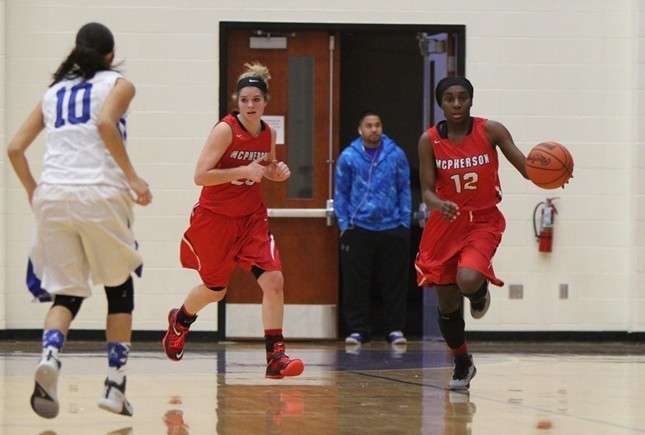
Salina, Kan. – Even with a career-high 18 points from freshman point guard Zatorian Abra, the McPherson College women’s basketball team fell to York College 75-63 in their non-conference finale.  The Bulldogs sit at 2-14 for the year and are on a five-game losing streak.

MC controlled the opening minutes on Saturday and led by as many as six within the first five.  York stormed back and tied it up before the midway point of the half.  The Lady Panthers stole the momentum heading into the break and led 35-30.  McPherson went 12-of-33 in the first half but made a mere 2-of-14 from deep.  YC connected on 12 attempts as well but only put up 27; they were 5-of-12 from three-point land.

In the second, York maintained their slim lead and held off multiple comeback attempts by McPherson.  Each time Mac needed a bucket to change the tide, it rimmed out.  And conversely, the Panthers connected on multiple clutch shots to keep MC on the ropes.  The final buzzer sounded with YC claiming a 75-63 victory.  In the second half, the Bulldogs knocked in 11-of-34 field goals with 3-of-15 coming from range; they went 8-of-14 from the stripe.  York converted on 14-of-27 from the floor and was 4-of-11 from beyond the arc; the team cashed in on 8-of-10 from the foul line.

Mac ended the contest making 23-of 67 from the field and drained 5-of 29 threes (17.7%); they converted on 12-of-19 free throws.  The team netted 46 rebounds with an impressive 21 coming on the offensive side of the floor.  The Lady ‘Dogs tabbed 16 turnovers, nine steals, nine assists, and three blocks.

Abra’s 18 points came on 7-of 9 shooting including 2-of-3 from deep; she also made 2-of-3 free throws.  Bailey Brown tallied 10 points on just 2-of-13; she had nine rebounds and a team-high four steals.  Sunny Smart continued to struggle shooting the ball from behind the arc as she went 0-of-9; the junior did score nine points and racked up 10 rebounds to lead the team.  Callie Atkins and Alicia Demaret each added eight points.

KCAC play kicks off with a 6:00 (CT) matchup with the Sterling College Warriors in Sterling, Kansas on January 8th; the junior varsity is scheduled to play at 2:00.

Make sure to follow Bulldog Nation on Facebook (MCathletics) and Twitter (@MAC_Bulldogs)

McPherson College is a Kansas Collegiate Athletic Conference member school and a part of the National Association of Intercollegiate Athletics.


Quartet of Bulldogs Hit Double-Digits in Mac Win

0

credit: McPherson College

Baldwin City, Kan. – McPherson College men’s basketball started 2015 off with a win as they took down Baker University 75-64 on the road Saturday.  The victory snapped a five-game losing streak and bumps the ‘Dogs to 5-11 on the year.

“Certainly I’m happy for our players,” said Coach Swartzendruber.  “Going through a losing streak is tough.  But this group has continued to work hard.  They have positive attitudes and believe they can be a good team.”

Baker started the game holding a slim lead which they maintained for the first half of the period.  After trailing by five, McPherson closed out the final nine minutes on a 19-8 which included nine straight points; the Bulldogs took a 30-23 advantage into the break.  MC made 11-of-28 in the first half and went 3-of-8 from deep while the Wildcats scored on 9-of-22 with 2-of-7 dropping from behind the arc.

Mac led throughout the second half, but not by much; the ‘Dogs stayed ahead of BU by a just handful and never let the Wildcats get ahead.  It wasn’t until there were less than seven minutes left that the score margin reached double figures; McPherson hit on 12-of-12 from the free throw line in the final seven minutes to hold on for the 75-64 triumph.  The Bulldogs knocked down 12-of-22 from the floor with 5-of-7 threes going in; they also converted on 16-of-20 foul shots.  Baker scored on 14-of-29 field goals but made a mere 1-of-10 from distance; the team went 12-of-14 from the stripe.

McPherson ended the game making 23-of-50 from the field, 46%, and bucketed 8-of-15 from range, 53.3 percent; 21-of-28 free throws were netted by the Bulldogs.  The team grabbed 32 rebounds and also recorded 14 turnovers, 12 assists, and seven steals.  25 points came from bench players for MC.

DeAndre Henson didn’t start the game but ended the night with a team-high 18 points; he was 5-of-8 including four three balls.  The guard/forward combo was 4-of-4 from the charity stripe and also led the team rebounds with eight.  Both TJ Grant and Darius Hill tabbed 15 points for Mac.  Grant went 3-of-6 from the floor and made all eight of his free throws; Hill connected on 5-of-16 field goals and 5-of-5 foul shots.  Chris Crook, who also had a team-high four steals, was the final Bulldog to hit double-digits with his 12; he hit on 4-of-7 from the field and also 3-of-4 from the stripe.

Mac travels to Sterling College for their first game of the 2015 KCAC season; the Bulldogs will face the Warriors on January 8th at 8:00 p.m. (CT) with junior varsity set to compete at 4:00.

Make sure to follow Bulldog Nation on Facebook (MCathletics) and Twitter (@MAC_Bulldogs)

McPherson College is a Kansas Collegiate Athletic Conference member school and a part of the National Association of Intercollegiate Athletics