Friday, January 23, 2026
Home Blog Page 129

3 tips to pick out a sweet watermelon By Mary Leigh Meyer │ Texas A&M AgriLife June 30, 2025

0

A ripe, juicy watermelon can be a mouthwatering snack on a hot summer day.

Looking for the perfect summer snack? A ripe, sweet watermelon is hard to beat — if you know how to pick a good one.

This season, Texas watermelons are high quality and prices are lower for shoppers. So now is a great time to enjoy this refreshing, healthy fruit. An expert shares how watermelon sweetness is measured and how to spot the best one at the store or farmers market.

Sweetness that is off the charts

Watermelon sweetness is measured using the Brix scale, which indicates the sugar content. On this scale, 10 is considered standard, while 11-12 means a melon is extra sweet.

This year, Juan Anciso, Ph.D., a Texas A&M AgriLife Extension Service vegetable specialist, Weslaco, and associate head of the Department of Horticultural Sciences in the Texas A&M College of Agriculture and Life Sciences, said Texas watermelon producers are reporting exceptional quality and consistently finding fruit with 11 Brix.

Here are three tips from Anciso to choose the best fresh watermelon.

Tip 1: Find the yellow belly, or the field spot

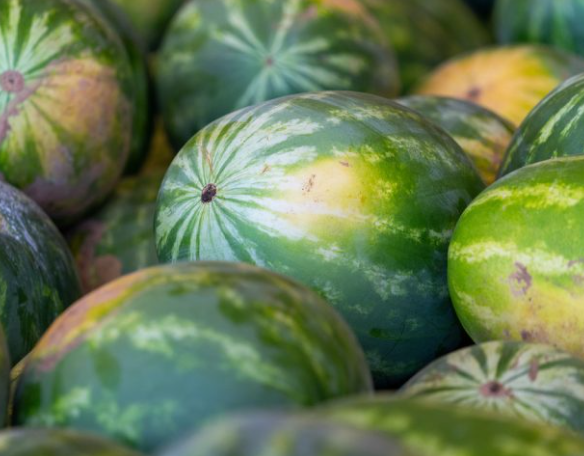
Other than cutting open a watermelon to see the inside, the field spot may be the best sign of ripeness. This spot shows where a melon was lying on the ground while attached to the vine.

If the watermelon is ripe, the field spot should be a large yellow patch on one side. The color should be a creamy, almost butter-like yellow. The bigger the yellow belly and the creamier the color, the more time the melon ripened on the vine. However, if the spot is small or looks more white than yellow, the melon may not be ripe.

Tip 2: Tap the underbelly and listen for a deep sound

Another way to find a ripe watermelon is to knock on the outside with your knuckles gently. A ripe melon will have a deeper sound, as opposed to an overripe one. A hollow thud, paired with an oversized yellow spot, indicates a melon may be mealy and overripe.

Tip 3: Look for a dull color and heavy watermelon

Although they may not be the prettiest or the easiest to carry to your car, the best watermelons are dull in color and heavy.

A shiny melon means the insides are underripe. Also, the best melon of the bunch will most likely be the heaviest one. A heavier melon likely holds more water. On average, a watermelon is 92% water, which is what makes it so juicy.

A Frank Discussion (Best Of) Hot diggity dog July is National Hot Dog Month!

0
lee pitts

Lest you think National Hot Dog Month was just a scheme dreamed up by mustard makers to sell more condiments, I’ll have you know that Congress declared July to be National Hot Dog month way back in 1957. I think you’ll agree that whether you call them wieners, franks, or hot dogs they are dog-gone good and they deserve a month of their own.

A Babylonian named Frank Furter was the first person to stuff a bunch of meat and sawdust into animal intestines. Just kidding. Actually, the frankfurter is thought to have originated in Frankfurt, Germany over 500 years ago. (This was the same time that wieners were invented in Vienna.

The sausages made their way to this country with early immigrants but it wasn’t until 1904 that the frankfurter was Americanized. A vendor at the St. Louis Exposition was selling sausages but they were “too hot to handle.” So with each sausage he handed out a glove. When the vendor ran out of gloves he asked his brother in law, a baker, to make some buns to fit around his sausages. Thus the hot dog was born and now there are 3,000 licensed hot dog vendors in New York City alone!

Before the wieners were referred to as “hot dogs” they were known in this country as Dachshund sausages, named after the wiener dog of the same general conformation. The term “hot dog” crept into our vocabulary when a cartoonist, Tod Dorgan, drew a picture of a Dachshund sausage but, like me, didn’t know how to spell Dachshund. So he just called them “hot dogs” and the name became part of our jargon just as hot dogs became part of our diet..According to the National Hot Dog and Sausage Council Americans purchase 9 billion hot dogs per year from grocery stores! Adding in what would be consumed at restaurants or ball parks, the NHDSC estimates that the total number consumed in a year is approximately 20 billion hot dogs!

Babe Ruth is said to have once downed 12 hot dogs between games of a doubleheader but that doesn’t even come close to the record set In 2021 when Joey Chestnut set the world record for hot dogs and buns eaten with 76. Chestnut set the world record twice in the prior three contests: He makes almost half a million dollars per year competing in eating contests and selling his own line of condiments.

Between Memorial Day and Labor Day five billion hot dogs will be consumed, most of them at sporting events. During one World Series game there were enough hot dogs ingested that if laid end to end they would have stretched for five miles. (Who calculates these things I wonder?)

It’s estimated that 95% of American households purchase hot dogs and that over 50 million are consumed daily. They come in all shapes and sizes. The longest hot dog on record was a 1,983 foot hot dog made in 1983 in Michigan and the heaviest was a 681 pounder made in 1987 in Chicago. That’s a lot of mustard!

Surprisingly, adults eat more hot dogs than children and women eat more than men.

All this information still does not answer the most often asked question about hot dogs. “Why are hot dogs sold ten to a package but the buns come eight to a pack?”

Day 5, Kansas Wheat Harvest Report

0
Kansas Wheat

This is day 5 of the Kansas Wheat Harvest Reports, brought to you by the Kansas Wheat Commission, Kansas Association of Wheat Growers, Kansas Grain and Feed Association and the Kansas Cooperative Council.


Harvest is progressing steadily across parts of Kansas, with yields generally around average despite challenges like strong winds, scattered rain and wheat streak mosaic virus. Weather and market conditions remain obstacles. Growers are staying optimistic and focused on finishing the season successfully.


Jess Schwieterman, who farms with his wife Laryce in Hamilton County near Syracuse, reports that this year’s harvest has been going well, despite strong winds and a few rain showers. They received a good November rain, but no winter moisture and a dry March and April until it started raining the week after Easter. The grain fill conditions were excellent, and yields have been right around average, similar to last year. Test weights have held up around 60 to 61 pounds per bushel.


High winds brought in a spring infection of Wheat Streak Mosaic Virus, turning the fields yellow. Schwieterman mentioned several varieties that have proven to have good resistance – KS Territory, KS Bill Snyder and KS Dallas. Their harvest began on June 20 and is nearly halfway finished. However, others in the area are just getting started. They have been pleased with yields, noting that the longer the fields are in no-till, the better they yield. They also manage for higher yields and have a strong fertility program. The biggest challenge this year has been the depressed wheat prices.


Kris Allen, general manager of Randall Farmers Coop in Jewell County, reports that harvest has been moving steadily across their two locations. Since taking in their first load on June 16, they’ve brought in around 700,000 bushels. Yields are ranging from 45 to 60 bushels per acre, and protein levels are holding solid at 12.6. Depending on the area, fields are about halfway to two-thirds cut, with combines rolling steadily. While this year isn’t quite as massive as last year’s crop, fueled by failed acres the season before, it’s still shaping up to be a strong and successful year.


Over halfway done with harvest, Brian Sieker, a farmer in Rice county, is facing the challenges of a wet season head-on, and staying optimistic.


“Mud is a challenge, but we’re grateful for it,” Sieker said. “Moisture is a welcome sight for our crop.”


On average, fields have produced 40-70 bushels per acre. Wheat Streak Mosaic Virus (WSMV) has taken a toll on both yield and test weight this year, prompting a change in how he’ll select varieties going forward.


“In the future, I will be taking varieties for WSMV; I haven’t in the past,” Sieker said. “We have to protect our neighbors because the investment is huge and margins are thin.”


With winter in mind, Sieker said he’s glad to have residue left in the fields. “It’s nice to have the stubble. It will hold us through the winter.”


Above all, he encourages others to check in with each other and find joy in the season.


“Check on your neighbors,” he said. “Enjoy the process. Harvest is a fun but stressful time.”


The 2025 Harvest Report is brought to you by the Kansas Wheat Commission, Kansas Association of Wheat Growers, Kansas Grain and Feed Association and the Kansas Cooperative Council. To follow along with harvest updates on social media, use #wheatharvest25. Tag us at @kansaswheat to share your harvest story and photos.


###


Written by Hannah Blodgett for Kansas Wheat

On the roads (gravel) again

0
Thayne Cozart
Milo Yield

On the gravel roads again. On the gravel roads again. We just can’t wait to get on the gravel roads again. Taking in the Flint Hills sights again with my friend. We just can’t wait to get on the gravel roads again.” (apologies to Willie Nelson)

Column readers will recall that a favorite pastime of mine is simply driving through the beautiful Kansas Flint Hills admiring the unique tallgrass prairies, the ever-changing landscape, and relishing the region’s current status and trying to absorb its history.

That pastime becomes doubly fun when I’m accompanied by my ol’ high school buddy, Canby Handy, from Platte City, Mo.

As a column reader refresher, our first such “gravel road” tour was a 3-day excursion of the southern Flint Hills that took in parts of Chase, Coffey, Greenwood, Elk, Montgomery, Chautauqua, Cowley, and Marion counties. Our second wuz a one-day tour of the southern part of Morris County. Our third tour wuz a 2-day tour of Wabaunsee County.

Well last Monday, Canby and I redoubled our fun by taking our wives, Neva Yield and MayBea Handy, along with us on a one day “Geezers & Geezerettes Tour of the Flint Hills on Gravel Roads.” It wuz his and my fourth such “gravel road” tour in recent years. This time the tour was the gravel roads of “southernish” Geary County. He did the driving in his comfortable F-150 pickup.

Here’s how the Geary County tour went down. For years I’ve traveled north/south highway 177 from Strong City to Manhattan and north-south highway 57 from the burg of Dwight to Junction City.  But, not once have I traveled the east/west gravel roads between those highways and I “knew” there had to be a lot to see in that relatively small area. Canby hadn’t seen that area either.

So, on Monday morning Canby and MayBea drove to our home in Riley. We loaded four chairs, iced up a big cooler, and headed south for our trip. We stopped in Manhattan and bought some sub sandwiches — figgering that we’d “find some nice shade somewhere along the line” to eat our lunch.

We took McDowell Creek Road south out of Manhattan, stopping to see the Ashland Bottoms Research Farm of Kansas State University. Once we got south of Interstate 70, we happened upon the beautiful old St. Joseph’s Church and Cemetery. The native limestone church has been restored and modernized.

Then we took the first gravel road west which wuz Tully Hill Road. Shortly after noon, we happened upon a couple of guys preparing to round bale a little meadow of hay. The meadow wuz right next to a farm house yard containing four huge, clearly ancient oak trees. Canby, who never met a stranger he didn’t want to talk to, introduced himself to the farmers, and soon had their gracious permission for us to eat our picnic lunch in the driveway of the home in the shade of one of the ancient oaks. The trunk of the tree wuz so large that Canby and I couldn’t spread-eagle our arms around it. The farmer said the trees had to be at least 200 years olds.

For the next three hours we moseyed along both east/west and north/south gravel roads. The roads included Burley Road, Ridge Road, Zumbrum Road, Schermann Road, Florence Road, Moyer Road, Rosey-Loop, Welcome Road, Old Highway 13 and Old Highway 18. Welcome Road is as far south in Geary County as we got.

The tallgrass prairie looked excellent everywhere, but Canby and I wondered where all the cattle were. We drove for miles without seeing a bovine on the rangeland. We could tell most of the pastures hadn’t been grazed at all. I know national cattle numbers are way down, but I figgered there would still be some cattle grazing. We did see a goodly number of cow/calf pairs in the pastures and some feeders, but not many. Why? That’s a mystery.

We drove by any number of fine, old, stately remodeled limestone homes and barns. Of course, there were a number of crumbling old farmsteads, just like there are across rural America. We drove past the headquarters of the Moyer Ranch and I wondered if the current owners are related to a long-ago-deceased friend of mine, Wendell Moyer, who wuz the KSU Extension swine specialist decades ago.

We saw plenty of tallgrass prairie birds, including the Golden Plover, killdeers, buzzards, hawks, and unidentified small sparrow-like birds. We knew they were nesting and we wondered how in the world such birds find a specific place in the ocean of grass to build their nests and how they instinctively know where the nest is?

On our way home we stopped briefly trailhead for the Konza Prairie Preserve, an 8,000-acre-plus research rangeland. It wuz too hot to walk the trail.

We got home just before it started raining and cooled off, sending the high humidity hiking. We filled the evening with supper, cards, visiting, and adult beverages.

Canby and I said we’d get together for another such “gravel road” tour whenever it works out.

***

Hoorah! We ate our first homegrown tomatoes for this summer. A couple of yellow tomatoes ripened first. It’s rare for us to get our first ripe tomato in June. And, it will be quite a while before we get the next ripe one. I’ve finished the hoop-trellises for my pole beans.

I’m happy to say that my gardening has reached the “Four W” stage. All I can do now is water, weed, worry, and wait. I can only control the first two.

***

Words of wisdom for this week: “I get most of my exercise these days from shaking my head in disbelief.”

Have a happy and safe Fourth of July — a good ‘un.