Wednesday, January 28, 2026
Home Blog Page 198

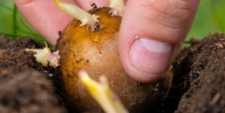
Time to plant potatoes in Kansas

0

K-State horticulture expert shares tips for successful crop.

For Kansas gardeners, St. Patrick’s Day means something much more than donning a favorite green outfit and heading to local celebrations.

Traditionally, the Irish holiday signals the date for planting potatoes.

“Actually, anytime from mid- to late-March is fine for potato planting,” said Kansas State University horticulture expert Cynthia Domenghini.

“Be sure to buy seed potatoes rather than using those intended for cooking. Seed potatoes are certified disease free and have plenty of starch to sprout as quickly as soil temperatures allow.”

Domenghini notes that most seed potatoes can be cut into four pieces – “though large potatoes may yield more,” she said. Each seed should weigh between 1 ½ to 2 ounces, and likely have more than one eye.

Each pound of seed potatoes should yield 8 to 10 pieces, according to Domenghini.

“Cut the seed 2 to 3 days before planting so that freshly cut surfaces have a chance to suberize, or toughen, which provides a protective coating,” Domenghini said. “Storing seed in a warm location during suberization will speed the process.”

Domenghini recommends planting each seed piece 1 to 2 inches deep and 8 to 12 inches apart in rows.

“Though it is important to plant potatoes in March, they emerge slowly,” she said. “It is often mid- to late-April before new plants poke their way through the soil. As the potatoes grow, pull soil up to the base of the plants. New potatoes are borne above the planted seed piece and it is important to keep sunlight from hitting the new potatoes.”

Domenghini said exposed potatoes will turn green and produce a poisonous substance called solanine. Keeping the potatoes covered will prevent this.

Domenghini and her colleagues in K-State’s Department of Horticulture and Natural Resources produce a weekly Horticulture Newsletter with tips for maintaining home landscapes and gardens.

Interested persons can subscribe to the newsletter, as well as send their garden and yard-related questions to [email protected], or contact your local K-State Research and Extension office.

Just a Little Light: Oreo Memories

0

By Dawn Phelps 


Most grandmas probably have a cookie jar, but I have a special “Oreo Jar” that I had for many years before I was a grandma.  During the years while I lived at Thornberry Acres near Miltonvale before my first husband died, many little hands reached into that jar and pulled out those delicious dark chocolate cookies with the yummy white icing in the middle!  


And during some of the years at Thornberry Acres, “The Oreo Jar” became a part of a hide-and-seek game between me and my youngest daughter Misty.  I had started the Oreo Jar because I enjoyed having an occasional cookie, but my youngest daughter Misty really liked Oreos.  


Then a foreign exchange student named Victoria from Spain came to live with us for a school year.  And Victoria really liked Oreos too, so she and Misty could empty the Oreos Jar in an evening!  


That’s when the “hiding-the-Oreos” game began.  At first, I moved the Oreos around in the kitchen—different shelves, the bread box, high in shelves, or low in shelves.  But Misty always found them. 


Then I moved them to the filing cabinet, the closet, or sometimes on the steps that went upstairs!  And those “moving” Oreos gave us lots of laughs and memories.


The years moved swiftly along, and our girls grew up and were married.  Then the grandchildren came along.  And they really like Oreos too.  So, when they came to our house, little hands and not-so-little hands reached into the Oreo Jar—even the older grandchildren really like Oreos too.  


A couple of my favorite “Oreo Memories” involved Will Thomas, our youngest grandson when he was about three years old.  For about a year, after my present husband Tom and I were married, we took care of Will every Tuesday while his mother Misty was in school.  


Toward evening on those days, either Tom or I would drive Will half-way toward his home in Manhattan to meet his mother.  Will liked to take a snack bag of cookies home with him.   


One day I fixed Will a bag of 8 Oreos—2 for him and 2 for each of his 3 siblings.  Will wanted to hold onto the bag that evening while Tom drove him to meet his mother.  Due to difficulties with keys getting locked into Tom’s car when Misty and Tom met, for a while, Will and the Oreos were forgotten.


Then when Will and his mother were finally on their way home toward Manhattan, Will proudly presented a total of 3 Oreos to his mother for his 3 siblings.


Later that day I talked to Misty by phone.  I asked her if the other kids got their Oreos and she said yes, there were three.  Then we realized that Will had “done the math”—he had eaten 5 Oreos, but he had left one each for his sisters and brother.


Another day I sent a bag of Oreos home with Will.  That day I drove him to meet his mom.  He announced that he planned to give some of the cookies to his mother.


As we rode along, I watched Will in the rearview mirror as he ate the icing out of middles of all the cookies.  He carefully put some of the chocolate cookies back together in the baggie “for his mom,” but only after all the icing was licked clean!


When I saw what he had done, I encouraged him to go ahead and eat the chocolate parts too, telling him his mother would not be disappointed since she did not know he was bringing Oreos home to her anyway.  Will had such good intentions, but he just could not resist that yummy icing—a fun Oreo memory! 


Oreos are difficult for many of us to resist.  They have been around since 1912 when they were first baked on Oreo Way, a street in New York City in the first Nabisco factory.  Originally, dark chocolate and lemon meringue-flavored Oreos were baked, but the lemon ones were eventually discontinued, and the chocolate ones have persisted.  Here are a few more Oreo facts.  


*It takes 120 minutes to make and bake an Oreo cookie.


*In addition to the original dark chocolate flavor, there are now Double Stuf Oreos, mint, thin ones, Mega Stuf, golden, peanut butter, and more.  


*Oreos are used in many ways—to eat with milk, crushed to make a crust, in ice cream, and other ways.  


*Factories in 18 countries bake about 40 billion Oreos cookies each year!  


*50% of people pull or twist them apart before eating them, and more women twist them off than men.


And there you have a little information about Oreo cookies and a few of my special Oreo memories!

[email protected]

Turf

0
Crabgrass
Crabgrass is a summer annual. It germinates in spring and dies in the fall. It has a different texture and color than turfgrass creating a non-uniform lawn. It also sets seeds and can spread throughout the landscape. Lawns that are not well maintained are prime targets for crabgrass invasion.
It is easiest to control crabgrass before it germinates using preemergence. May 1 is typically when crabgrass is expected to germinate throughout much of Kansas, but this does vary depending on location and weather patterns. Many homeowners use signals from nature to determine preemergence timing.
A common guideline is to apply crabgrass preemergent when redbuds are in full bloom. While this is an indicator, it’s not going to provide 100% accuracy since microclimates exist within each landscape. In warmer areas of the landscape, crabgrass is likely to germinate earlier.
Soil temperature is a useful indicator to predict crabgrass germination. Using the K-State Mesonet you can access the average soil temperature at a two-inch depth over the past seven days. When the daily average is 55 degrees F for about five days, research suggests this is the time to apply crabgrass preemergence.
Why Weeds Invade Lawns
Instead of combatting weeds all season, take a proactive approach to prevent weeds. Here are some common reasons why weeds invade lawns.
  • Improper Mowing: Mowing too low and too infrequently thins the turf, allowing weeds to get started.
  • Improper Watering: Frequent watering encourages weed seed germination, disease, thatch, and a shallow-rooted turf that is less competitive with weeds for soil moisture and nutrients.
  • Improper Fertilizing: Fertilizing too much, too little or at the wrong time may benefit weeds more than grass.
  • Insect and Disease Injury: Weeds rapidly invade lawns that are thinned by insects and diseases.
  • Compacted Soil: Soil compaction is a hidden stress on the turfgrass root system. The grass is unable to compete effectively with weeds.
  • Excessive Wear: Turf areas used for recreation and sports are subjected to wear and compaction.
  • Wrong Kind of Grass: The wrong kind of grass for the location will gradually decline and be invaded by weeds.
  • Environmental Stress: Weeds often take over a lawn after it has been weakened and thinned from weather-related stress.
  • Thatch: Excessive thatch causes shallow-rooted grass and contributes to insect and disease problems.
Turf Substitutes
Though a thick, healthy lawn can be a beautiful part of the landscape, if you’re ready for change there are several alternatives to traditional turf. Japanese spurge, English ivy and periwinkle are three ground covers that are good options for an alternative lawn.
Certain ground covers perform well in compacted soils that are unsuitable for a traditional lawn. Areas with little sunlight may not be conducive to growing turf but can be a great environment for perennials. Keep in mind that it may take more time to establish a thick groundcover lawn, and it won’t tolerate heavy foot traffic but once established it will be less maintenance and can stand up to weeds. Here are a few ground cover options to consider:
  • Bugleweed (Ajuga spp.)
  • Periwinkle (Vinca minor)
  • English ivy (Hedera helix)
  • Creeping lily-turf (Liriope spicata)
  • Lamb’s ear (Stachys byzantina)
  • Japanese spurge (Pachysandra terminalis)
Pollinator lawns are designed to provide sustenance for bees and other pollinators by combining turfgrass with flowering ornamentals. Though aesthetically this option lacks the uniformity of a manicured lawn, pollinator lawns require less irrigation, fertilization, mowing and weeding once established. It is important to select turfgrass species that are compatible with the flowering plants and to choose ornamentals that fit the growing conditions.
Here are some plants to consider for a pollinator lawn:
  • Dutch white clover (Trifolium repens)
  • Self-heal (Prunella vulagris spp. lanceolata)
  • Creeping thyme (Thymus praecox spp. arcticus)
  • Common violets (Viola sororia)
  • Dandelions
When selecting a turf substitute beware of invasive growth habits. Lily of the valley and goutweed are two groundcovers that can be problematic if not managed.

Harvey County Home and Garden Show “Birds and Blooms”

0
Photo credit: daryl_mitchell
March 22 (8:00AM-5:00 PM) – March 23 (Noon-5:00 PM)
Hosted at the 13-acre Dyck Arboretum, the 2025 Harvey County Home and Garden Show has great food, vendors and an amazing speaker line-up addressing this year’s theme “Birds and Blooms”. For just $1 admission you can spend the weekend enjoying the scenery while getting a great education as you prepare for the growing season.

K-State, Kansas Forest Service building facility to support state’s rural fire and agricultural education initiatives

0
Effort includes training for state firefighters and agricultural educators.
Kansas State University and the Kansas Forest Service have announced plans to build a $5 million shared facility to boost current efforts to provide critical training and equipment for firefighters and state-of-the-art instructional space for academic and regional workforce development programs.
The construction process will begin soon on the Kansas Rural Fire and Workforce Development Center, which will be shared by the state’s forest service and K-State’s department of communications and agricultural education.
The 13,268-square-foot facility will include:
• A modernized shop for fire equipment.
• A teaching lab for classes about emergency response, modern agricultural technology and mechanics.
• A multipurpose classroom and lab for teaching and workforce training and development.
State Forester Jason Hartman said the new building will address “critical space limitations” faced by the Federal Excess Property Program, which acquires excess property from the Department of Defense and other federal sources, retrofits the equipment and then provides it on loan to local fire departments.
Jason Ellis, head of K-State’s department of communications and agricultural education, said the facility also creates an applied learning space for faculty to train future teachers and provide continuing education for the state’s 300-plus agricultural educators.
“This new facility will allow us to support our key stakeholders in the state by providing high-demand education, professional development and resources,” Ellis said.
Ellis hailed the joint effort between the Kansas Forest Service and K-State’s College of Agriculture, saying the building’s dual program focus is built on the university’s vision of becoming the nation’s premier land-grant university, as it will be Kansas-centered and learner-focused.
Kansas State University received a $3.2 million grant from the U.S. Economic Development Administration for this project. Hartman added that the forest service’s collaboration with the Flint Hills Regional Council was essential to helping secure funding for this project.
As the nation’s first operational land-grant institution, Kansas State University has served the people of Kansas, the nation and the world since its founding in 1863 — and it continues to set the standard as a next-generation land-grant university. K-State offers an exceptional student experience across three physical campuses and online offerings, meeting students where they are and preparing them to achieve their personal and professional goals. The university is committed to its mission of teaching, research and service through industry-connected programs, impactful research-driven solutions, and a sharp focus on community engagement and economic prosperity.

K-State News and Communications Services
Division of Communications and Marketing
128 Dole Hall
1525 Mid-Campus Drive
Kansas State University
Manhattan, KS 66506
785-532-2535
[email protected]
k-state.edu/media